
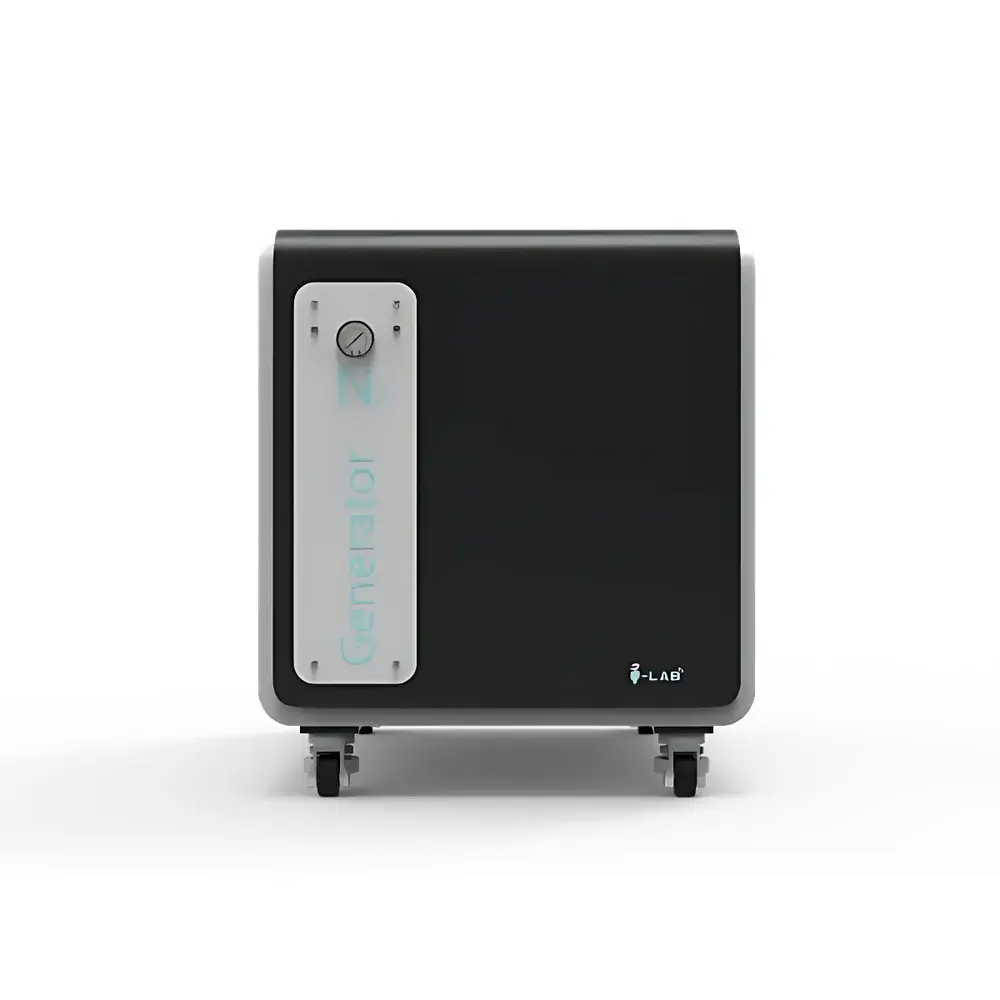
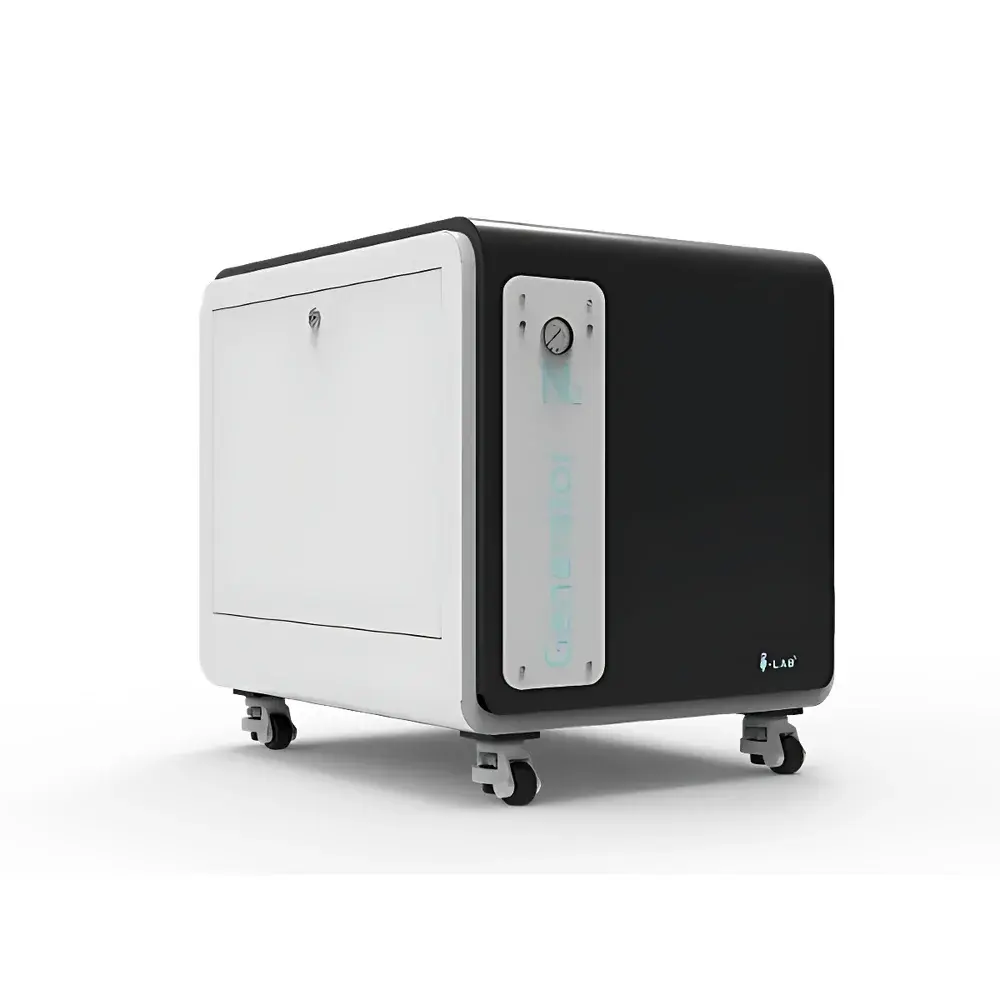
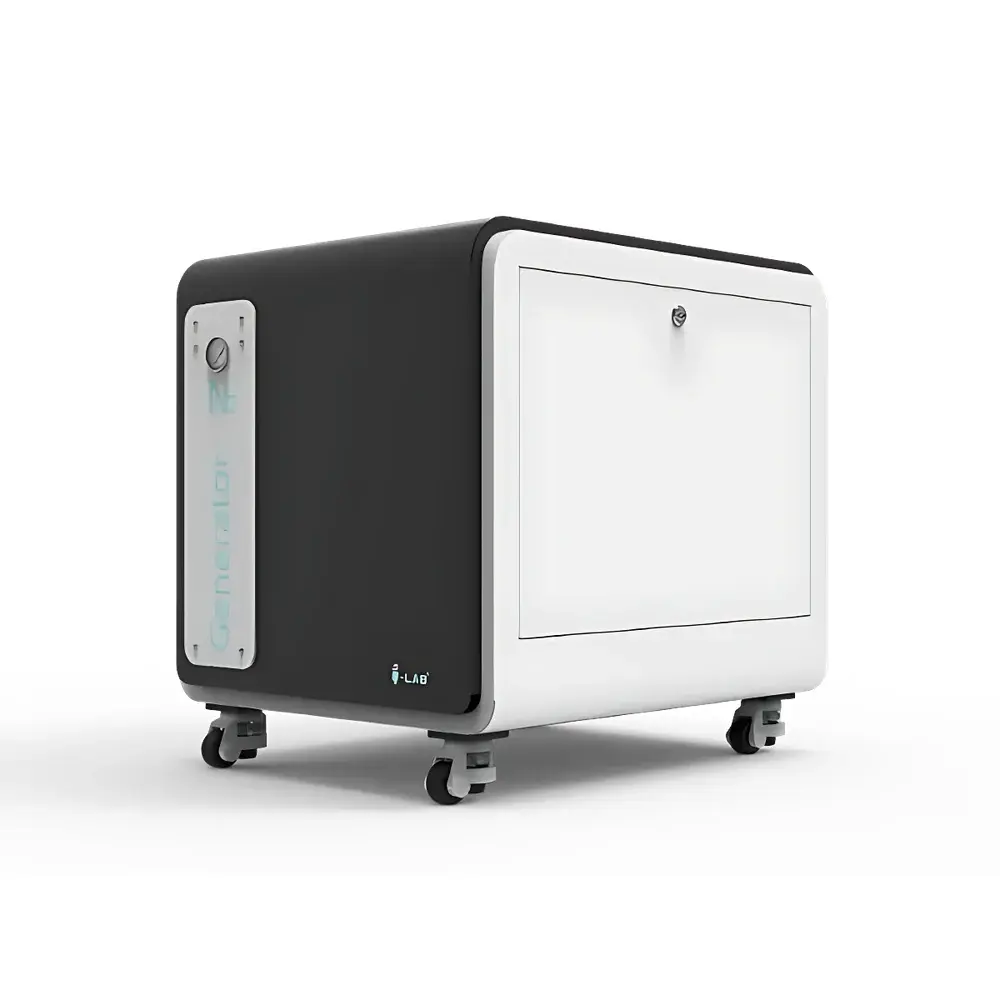
i-Lab KL35-1 Nitrogen Generator
| Brand | i-Lab |
|---|---|
| Origin | Shanghai, China |
| Manufacturer Type | Direct Manufacturer |
| Region of Origin | Domestic (China) |
| Model | KL35-1 |
| Instrument Type | Nitrogen Generator |
| Nitrogen Generation Principle | Hollow Fiber Membrane Separation |
| Output Flow Rate | 35 L/min |
| Output Pressure Range | 0–7 bar |
| Nitrogen Purity | ≥99.9% |
| Power Consumption | 500 W |
| Noise Level | ≤50 dB(A) |
| Annual Maintenance Time | ~30 minutes |
Overview
The i-Lab KL35-1 Nitrogen Generator is an engineered solution for laboratories and industrial facilities requiring continuous, on-demand supply of high-purity nitrogen gas. It utilizes hollow fiber membrane separation technology—a pressure-driven gas separation process based on differential permeability of gases through polymeric membranes. In this system, compressed air is fed into a bundle of microporous hollow fiber membranes; oxygen, water vapor, carbon dioxide, and other trace gases permeate through the membrane wall at higher rates, while nitrogen—being less permeable—is retained in the fiber lumen and delivered as the product stream. This principle enables stable, oil-free, and maintenance-light nitrogen generation without cryogenic or chemical processes. Designed specifically to support high-sensitivity analytical instrumentation—including LC-MS, CAD (Charged Aerosol Detection), and ELSD (Evaporative Light Scattering Detection)—the KL35-1 delivers ≥99.9% nitrogen purity at a rated flow of 35 L/min and adjustable output pressure from 0 to 7 bar, meeting stringent requirements for ion source cooling, nebulizer drying, and mobile phase sparging.
Key Features
- Hollow fiber membrane core with imported ultra-fine membrane modules, optimized for long-term flux stability and resistance to hydrocarbon fouling.
- Integrated multi-stage purification train: coalescing filter (0.01 µm), desiccant dryer (dew point ≤ −40 °C), and activated carbon trap for residual hydrocarbons and particulates.
- Intelligent pressure regulation system with built-in buffer tank and PID-controlled back-pressure valve, ensuring consistent delivery pressure and minimizing pulsation critical for LC-MS interface stability.
- Energy-efficient architecture: nominal power draw of only 500 W under full-load operation, significantly lower than PSA-based alternatives of comparable capacity.
- Compact, integrated enclosure with acoustic damping design—operating noise ≤50 dB(A) at 1 m distance—suitable for benchtop deployment in shared lab environments.
- Modular mechanical layout enabling rapid field service; annual preventive maintenance requires <30 minutes and involves only filter element replacement.
Sample Compatibility & Compliance
The KL35-1 is validated for seamless integration with major LC-MS platforms including Thermo Fisher Scientific (e.g., Q Exactive™, TSQ Altis™), Waters (Xevo™ TQ-S, Vion™ IMS QTof), and Agilent (6470/6495 Triple Quadrupole, 6545 Q-TOF). Its regulated output meets ASTM D852-22 specifications for instrument-grade nitrogen used in mass spectrometry. The system complies with IEC 61000-6-3 (EMC emission standards) and carries CE marking per Machinery Directive 2006/42/EC. While not certified to ISO 8573-1 Class 1 for particle/oil content, its filtration configuration achieves Class 2 (≤0.1 µm particles, ≤0.01 mg/m³ total oil) when operated with clean, dry feed air per ISO 8573-1:2010 Annex A guidelines. For GLP/GMP-regulated environments, optional audit-trail-enabled firmware supports 21 CFR Part 11-compliant data logging (requires external HMI or SCADA integration).
Software & Data Management
The KL35-1 operates in fully autonomous mode with no embedded software stack or touchscreen interface. All operational parameters—including inlet pressure, outlet pressure, flow rate, and runtime hours—are monitored via analog gauges and digital LED indicators. For laboratories requiring centralized monitoring, the unit provides 4–20 mA analog outputs for pressure and flow signals, compatible with standard PLCs, LabVIEW DAQ systems, or building management interfaces. Optional RS-485 Modbus RTU communication module (sold separately) enables remote status polling and alarm relay triggering (e.g., low inlet pressure, filter saturation). No proprietary software is required; configuration remains hardware-based to ensure deterministic response and eliminate cybersecurity attack surfaces common in networked gas generators.
Applications
- LC-MS ion source gas supply: provides stable, dry, hydrocarbon-free nitrogen for electrospray ionization (ESI) and atmospheric pressure chemical ionization (APCI) sources, directly improving signal-to-noise ratio and long-term calibration stability.
- Nitrogen blow-down concentration: adjustable flow control (0–35 L/min) supports quantitative solvent evaporation in sample prep workflows across environmental, pharmaceutical, and food safety labs.
- Electronics manufacturing: supplies inert atmosphere for reflow soldering, component passivation, and wafer handling where O₂ <100 ppm is mandated.
- Food packaging: compatible with modified atmosphere packaging (MAP) lines requiring ≥99.9% N₂ for shelf-life extension of perishables.
- Blanketing and purging: used in reactor headspace inerting, catalyst storage, and solvent transfer systems where moisture and oxygen exclusion are critical.
FAQ
What feed air quality is required for optimal KL35-1 performance?
A minimum inlet pressure of 7.5 bar(g) and dew point ≤ −40 °C (ISO 8573-1 Class 3.2.2) is recommended. Use of an upstream refrigerated dryer + coalescing filter is strongly advised to prevent membrane fouling and extend service intervals.
Can the KL35-1 be used for GC carrier gas?
No. While nitrogen purity meets many GC detector requirements, the KL35-1 is not qualified for use as carrier gas due to lack of helium-equivalent laminar flow stability and absence of ISO 8573-1 Class 1 certification for particulate/oil content.
Is the output pressure truly adjustable across the full 0–7 bar range?
Yes—via an integrated precision back-pressure regulator with fine-thread adjustment. However, maximum flow at 7 bar is reduced to ~28 L/min due to membrane permeation kinetics; full 35 L/min is guaranteed only up to 5 bar.
Does the unit require cooling water or external ventilation?
No. The KL35-1 is air-cooled and designed for ambient operation between 5–35 °C. No dedicated exhaust ducting or chilled water loop is needed.
How often must filters be replaced?
Under typical lab conditions (8 hrs/day, clean compressed air supply), the coalescing filter and desiccant cartridge should be replaced annually; the activated carbon trap every 24 months. Filter life is extended by using a properly maintained upstream air preparation system.



