
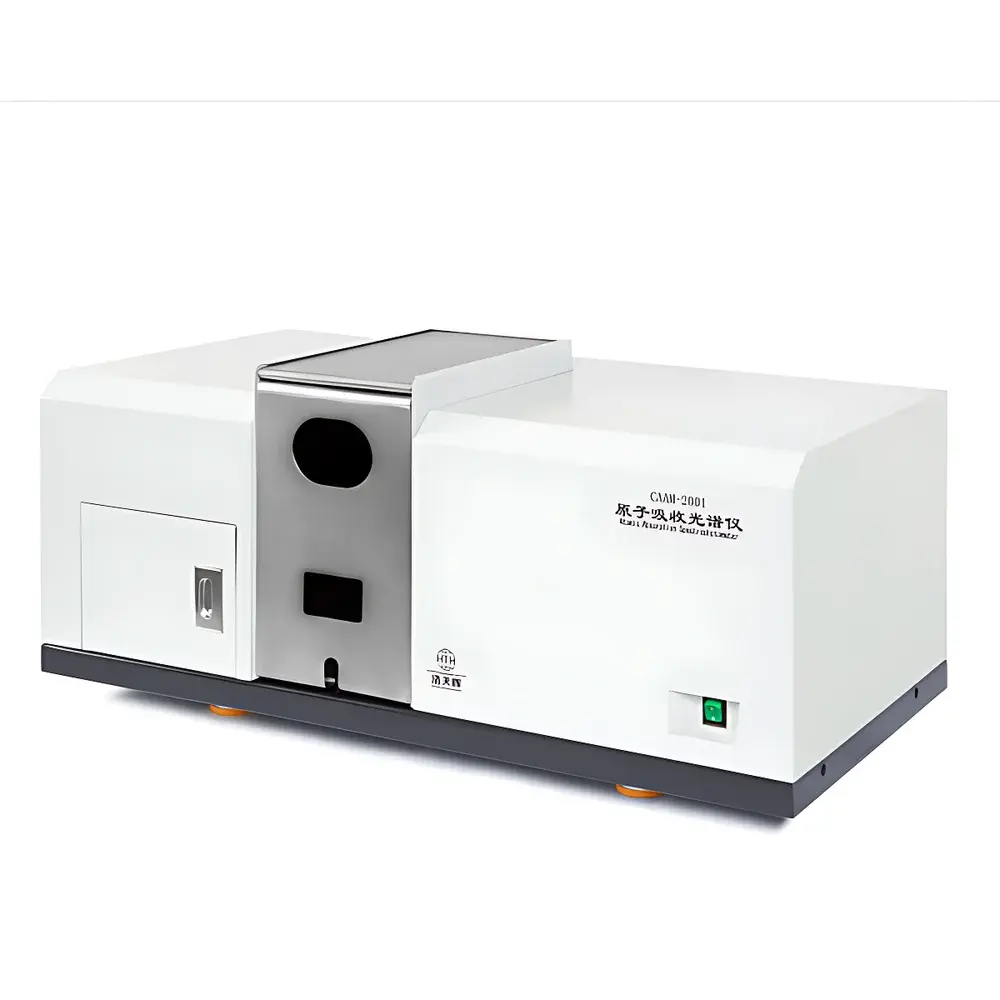
Huayisanpu CAAM-2001D Flame Atomic Absorption Spectrophotometer (8-Lamp Turret)
| Brand | Beijing Huayisanpu |
|---|---|
| Origin | Beijing, China |
| Model | CAAM-2001D |
| Detection Elements | Na, K, Mg, Ca, Cr, Mn, Fe, Co, Ni, Pt, Au, Cu, Ag, Zn, Cd, Pb, Bi, Li |
| Detection Limit | 0.002 µg/mL |
| Wavelength Range | 190–900 nm |
| Grating Density | 1800 lines/mm |
| Spectral Bandwidth | 0.1/0.2/0.4/1.0/2.0 nm (auto-selectable) |
| Wavelength Accuracy | ±0.15 nm |
| Baseline Drift (static) | ≤±0.002 A/30 min |
| Characteristic Concentration (Cu) | 0.015 µg/mL/1% |
| Precision (RSD) | ≤0.5% |
| Lamp Positions | 8-slot automated turret with auto-alignment |
| Background Correction | D₂ lamp (up to 1 A) |
| Atomization | Air-acetylene flame |
| Nebulizer | Metal-sheathed high-efficiency glass nebulizer |
| Burner Head | Titanium alloy |
| Power Requirement | 220 V ±5–10%, 50/60 Hz, 5000 VA |
Overview
The Huayisanpu CAAM-2001D Flame Atomic Absorption Spectrophotometer is a benchtop analytical instrument engineered for quantitative determination of trace metal elements in liquid samples using flame atomic absorption spectroscopy (FAAS). Based on the principle of Beer–Lambert law, the system atomizes sample solutions into free ground-state atoms within an air-acetylene flame; element-specific hollow cathode lamps emit narrow-line radiation, and absorbance at characteristic wavelengths is measured via a photomultiplier tube after dispersion through a 1800-line/mm grating monochromator. Designed for routine laboratory use in environmental monitoring, food safety, clinical diagnostics, metallurgy, and geological analysis, the CAAM-2001D integrates robust optical architecture, automated lamp management, and flame safety interlocks to ensure high reproducibility and operational reliability under ISO/IEC 17025-aligned workflows.
Key Features
- 8-position automated lamp turret with dual-lamp power supply and real-time auto-alignment—enabling rapid sequential multi-element analysis without manual intervention.
- High-stability optical path featuring a Czerny–Turner monochromator with 1800 lines/mm holographic grating, delivering spectral resolution down to 0.05 nm wavelength repeatability and ±0.15 nm absolute accuracy across 190–900 nm range.
- Flame atomization system with titanium burner head and metal-sheathed glass nebulizer—optimized for sensitivity (characteristic concentration for Cu: 0.015 µg/mL/1%) and long-term stability (RSD ≤0.5% over 10 replicate injections).
- D₂-lamp background correction capable of compensating up to 1 A absorbance—critical for complex matrices containing molecular absorption or light scattering interference.
- Integrated safety architecture: automatic flame ignition control, acetylene leak detection, flashback arrestor, gas pressure monitoring, and emergency shutdown triggered by abnormal cooling water flow or furnace temperature deviation.
- Modular hardware design compliant with CE electromagnetic compatibility (EMC) directives and IEC 61010-1 electrical safety standards.
Sample Compatibility & Compliance
The CAAM-2001D supports aqueous and dilute acid-digested samples compatible with standard EPA Method 7000B, ISO 11171, and ASTM D512/D1688 protocols. Its air-acetylene flame configuration enables direct quantification of alkali metals (Na, K, Li), alkaline earths (Mg, Ca), transition metals (Cu, Zn, Fe, Mn, Cr, Ni, Co), and heavy metals (Pb, Cd, Bi, Ag) at sub-ppb to ppm concentration levels. All critical system parameters—including lamp current, slit width, integration time, and background correction mode—are programmable per element and stored in method templates that meet GLP audit trail requirements. While not natively 21 CFR Part 11 compliant, the workstation software architecture allows integration with third-party electronic lab notebook (ELN) systems supporting digital signature and change control functions.
Software & Data Management
The CAAM2001 Workstation (v16.1.1, registered copyright No. 2016SR178400) provides a fully localized English/Chinese GUI for instrument control, data acquisition, and report generation. Key modules include: (i) method editor for defining lamp selection, wavelength, bandwidth, and flame parameters; (ii) calibration engine supporting linear/nonlinear curve fitting (1st–3rd order), standard addition, and duplicate validation; (iii) dynamic data processing with real-time absorbance plotting, peak integration, and statistical summary (mean, SD, RSD); (iv) comprehensive reporting—exportable to PDF, Excel, or Word formats with embedded metadata (operator ID, timestamp, instrument serial number, calibration history). Raw spectral data and processed results are stored in structured binary files with checksum integrity verification.
Applications
This instrument serves as a primary tool for regulated testing in public health laboratories (e.g., drinking water metal screening per WHO guidelines), agricultural product safety (soil extract analysis for Cd/Pb in rice paddies), industrial QA/QC (electroplating bath composition monitoring), and academic research (bioavailability studies of dietary minerals). Field-deployed units have been validated in South African mining labs for tailings leachate analysis and in Indonesian environmental agencies for coastal sediment heavy metal profiling. Its modular flame-only configuration ensures low consumables cost and minimal maintenance downtime—making it suitable for high-throughput routine analysis where graphite furnace capability is not required.
FAQ
What detection techniques does the CAAM-2001D support?
It operates exclusively in flame atomic absorption mode (air-acetylene), with optional hydrogenation accessory compatibility for hydride-forming elements (As, Se, Sb, Bi, Te, Sn, Pb, Ge, Cd) via external flow-injection module.
Is the instrument compliant with international regulatory standards?
Hardware meets IEC 61010-1 safety and EN 61326-1 EMC requirements. Software supports audit-ready data archiving but requires external validation for full FDA 21 CFR Part 11 compliance.
What is the typical lifetime of the titanium burner head and nebulizer?
Under normal operating conditions (≤5 mL/min aspiration rate, filtered 2% HNO₃ matrix), the titanium burner head exceeds 5 years of service life; the metal-sheathed glass nebulizer demonstrates >10,000 ignitions before performance degradation.
Can the CAAM2001 Workstation interface with LIMS systems?
Yes—via configurable ASCII output export or ODBC-compliant database drivers for integration with major laboratory information management systems.
What maintenance intervals are recommended for optimal performance?
Daily: burner head cleaning and alignment check; weekly: nebulizer inspection and drain line flush; quarterly: optical alignment verification and lamp energy calibration using certified reference materials (CRMs) traceable to NIST SRMs.






