
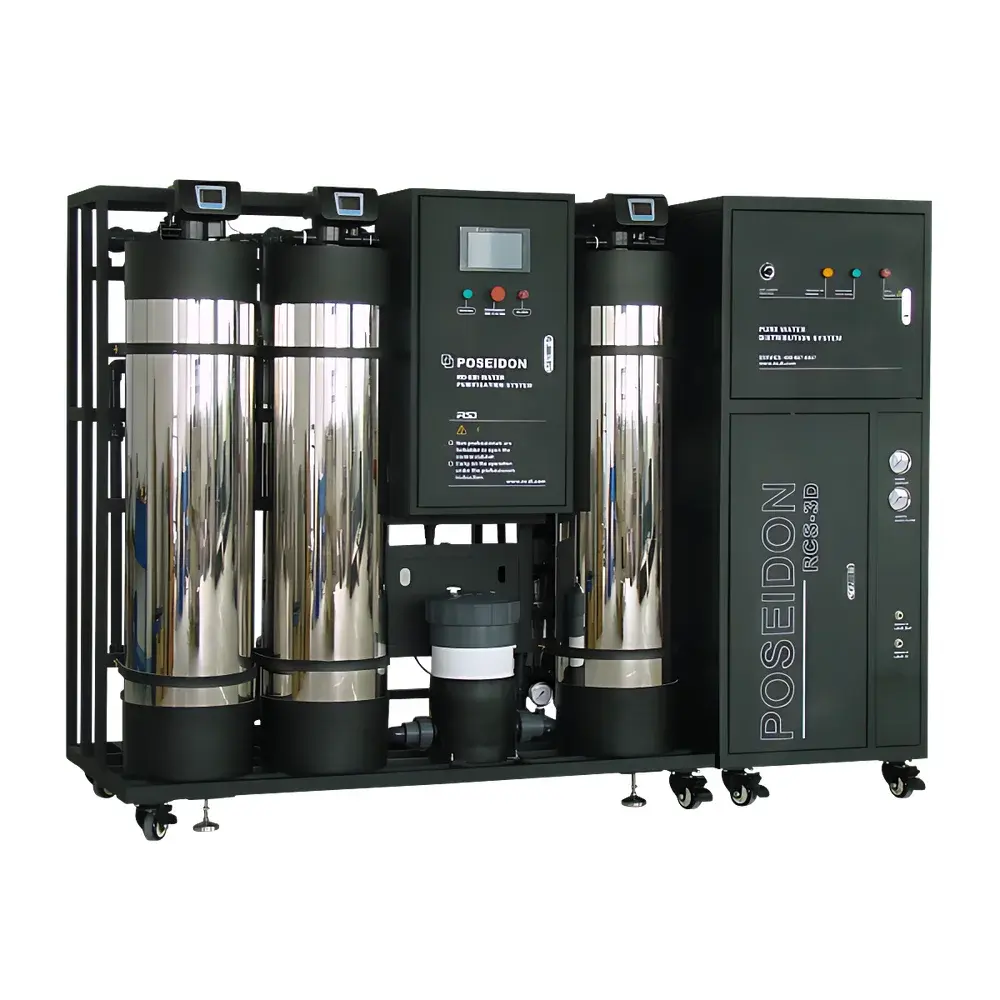
POSEIDON Standard Central Ultra-Pure Water System
| Brand | RSJ (Ruisijie) |
|---|---|
| Origin | Fujian, China |
| Manufacturer | Yes |
| Country of Origin | China |
| Model | POSEIDON |
| Pricing | Upon Request |
| Feedwater Grade | Municipal or Pre-treated Tap Water |
| Product Water Grade | GB/T 6682–2008 Grade II (Laboratory Pure Water) |
| Resistivity | ≥10 MΩ·cm @ 25 °C |
| Production Capacity | 500 L/h (at 5–35 °C), Variable-Frequency Constant-Output Control |
| Distribution Capacity | 1–10 m³/h (configurable) |
| Distribution Pressure | 2–8 bar (adjustable) |
| Conductivity Monitoring | Return-loop conductivity sensor (supply-loop optional) |
| Storage Tank Volume | 500–2000 L (SUS304/SUS316L sanitary grade, pressure-sensor level control, overflow protection, submerged 4× UV lamps, hydrophobic vent filter, spray ball) |
| Purification Technology | RO + EDI + Optional DI Polishing |
| Pre-treatment | Auto-regenerating sand filtration + activated carbon filtration + ion exchange softening (all auto-monitored and scheduled for maintenance) |
| Control System | Siemens PLC + 7" color touch HMI |
| Data Logging | SD card + USB print interface |
| Remote Access | Wired and wireless options supported |
| Disinfection | Automated chemical or ozone-based cycle (optional) |
| Power Consumption | ≤2 kW total (booster pump: 0.75 kW |
| main unit | 1.5 kW) |
| Footprint | W2300 × H1700 × D850 mm (main unit only, excluding tank and distribution skid) |
Overview
The POSEIDON Standard Central Ultra-Pure Water System is an engineered solution for centralized production and distribution of laboratory-grade pure water compliant with GB/T 6682–2008 Grade II specifications. Designed for continuous operation in multi-point laboratory environments, the system integrates reverse osmosis (RO), electrodeionization (EDI), and optional deionization (DI) polishing into a single robust architecture. Its core purification principle relies on sequential contaminant removal: particulate and chlorine reduction via automated pre-treatment stages (sand, carbon, and softening), followed by high-rejection RO membrane separation, continuous ionic purification through EDI under DC current, and final trace-ion scavenging when DI modules are deployed. The system maintains stable resistivity ≥10 MΩ·cm at 25 °C—validated against standard calibration protocols—and delivers consistent flow across variable ambient temperatures (5–35 °C) using intelligent variable-frequency drive (VFD) control to ensure constant output regardless of feed pressure fluctuations or demand shifts.
Key Features
- Automated pre-treatment regeneration: Sand filter, activated carbon column, and softener operate under programmable time- and flow-based cycles, minimizing manual intervention and ensuring long-term membrane protection.
- RO+EDI core configuration: Eliminates dependence on chemical regeneration, reduces operational waste, and enables uninterrupted 24/7 operation with minimal operator oversight.
- Variable-frequency constant-output control: Dynamically adjusts pump speed to maintain precise 500 L/h output across changing inlet conditions—critical for stable downstream analytical performance.
- Sanitary-grade storage and distribution: 500–2000 L vertical tanks fabricated from electropolished SUS304 or SUS316L stainless steel; equipped with submerged 254 nm UV lamps (4 units), hydrophobic 0.22 µm vent filters, and CIP-compatible spray balls.
- Full-digital process monitoring: Real-time display of feed conductivity, product resistivity, tank level, UV intensity, and system alarms via 7-inch color HMI; all data logged to removable SD card with timestamped records.
- Comprehensive automation suite: Scheduled disinfection cycles (chemical or ozone), predictive consumables replacement alerts, remote diagnostics via Ethernet/Wi-Fi, and configurable supply-pressure setpoints (2–8 bar).
Sample Compatibility & Compliance
The POSEIDON system is validated for use with municipal tap water, well water (after preliminary assessment), and other pre-treated sources meeting typical municipal utility specifications (e.g., turbidity <1 NTU, chlorine <2 mg/L, iron <0.3 mg/L). It meets Chinese national standard GB/T 6682–2008 for Grade II laboratory water, including maximum allowable limits for conductivity (<1 µS/cm), oxidizable substances (KMnO₄ test), and evaporative residue (<1 mg/L). While not certified to ISO 15195 or ASTM D1193 directly, its design principles—including sanitary material selection (SUS316L option), non-shedding filtration, and closed-loop recirculation—align with GLP-compliant infrastructure requirements. Optional DI polishing extends suitability toward applications demanding higher purity thresholds, such as buffer preparation for HPLC mobile phases or cell culture media formulation where endotoxin and silica content must be tightly controlled.
Software & Data Management
Control logic resides in a Siemens S7-1200 PLC platform, interfaced via a CE- and RoHS-compliant 7″ TFT-LCD touchscreen HMI with multilingual support (English default). All critical parameters—including conductivity/resistivity trends, pump run hours, UV lamp operational status, and alarm history—are stored locally on industrial-grade SD cards with cyclic overwrite protection. USB export enables CSV-formatted data transfer for external audit or trend analysis. Remote access is implemented via secure Modbus TCP or MQTT over wired Ethernet or IEEE 802.11 b/g/n Wi-Fi, supporting read-only monitoring and configurable alert notifications (email/SMS via gateway integration). Audit trails comply with basic ALCOA+ principles: attributable, legible, contemporaneous, original, accurate, complete, consistent, enduring, and available—though full 21 CFR Part 11 compliance requires supplemental validation documentation and role-based user authentication modules (available upon request).
Applications
- Centralized laboratory water supply for analytical instrumentation parks (e.g., ICP-MS, GC-MS, LC-MS/MS suites requiring stable Grade II feed).
- Process water for pharmaceutical and biotech pilot-scale manufacturing, including cleaning-in-place (CIP) rinse cycles and reagent dilution.
- High-volume biochemical and immunoassay platforms where >1 m³/h of low-conductivity water supports automated analyzers and wash stations.
- Cooling water circuits for high-power lasers, NMR spectrometers, and X-ray diffraction systems requiring thermal stability and corrosion resistance.
- Central animal drinking water systems in AAALAC-accredited facilities, where microbial control and heavy metal suppression are essential.
- Industrial R&D labs performing elemental analysis, semiconductor wafer testing, or nanomaterial synthesis where reproducible background ion levels impact detection limits.
FAQ
What feedwater quality is required to achieve guaranteed Grade II output?
Minimum recommended feed: municipal tap water meeting China’s GB 5749–2022 standards. For high-hardness, high-iron, or high-chloride sources, pre-screening with a benchtop RO unit (e.g., RSJ R10 series) is advised prior to full-scale deployment.
Can the system integrate with existing building management systems (BMS)?
Yes—Modbus RTU/TCP and analog 4–20 mA outputs are standard; BACnet/IP and Profibus DP gateways are available as optional field upgrades.
Is ozone disinfection compatible with polypropylene or UPVC distribution piping?
Ozone is only deployed during scheduled sanitization cycles and remains confined to the storage tank and recirculation loop; distribution piping downstream uses SUS304 or higher-grade stainless steel to prevent degradation.
How frequently must consumables be replaced under typical lab usage?
Pre-filters: every 6 months (auto-alert triggered at 500 operational hours); RO membranes: 2–3 years depending on feed silt density index (SDI); EDI stacks: 5+ years with proper pre-treatment; UV lamps: annual replacement per IEC 62471 photobiological safety guidelines.
Does the system support GMP-compliant validation documentation packages?
Factory acceptance testing (FAT) reports, IQ/OQ templates, and material traceability dossiers (including weld logs and surface roughness certificates for SS316L components) are provided; PQ support requires site-specific protocol development and execution assistance.



