
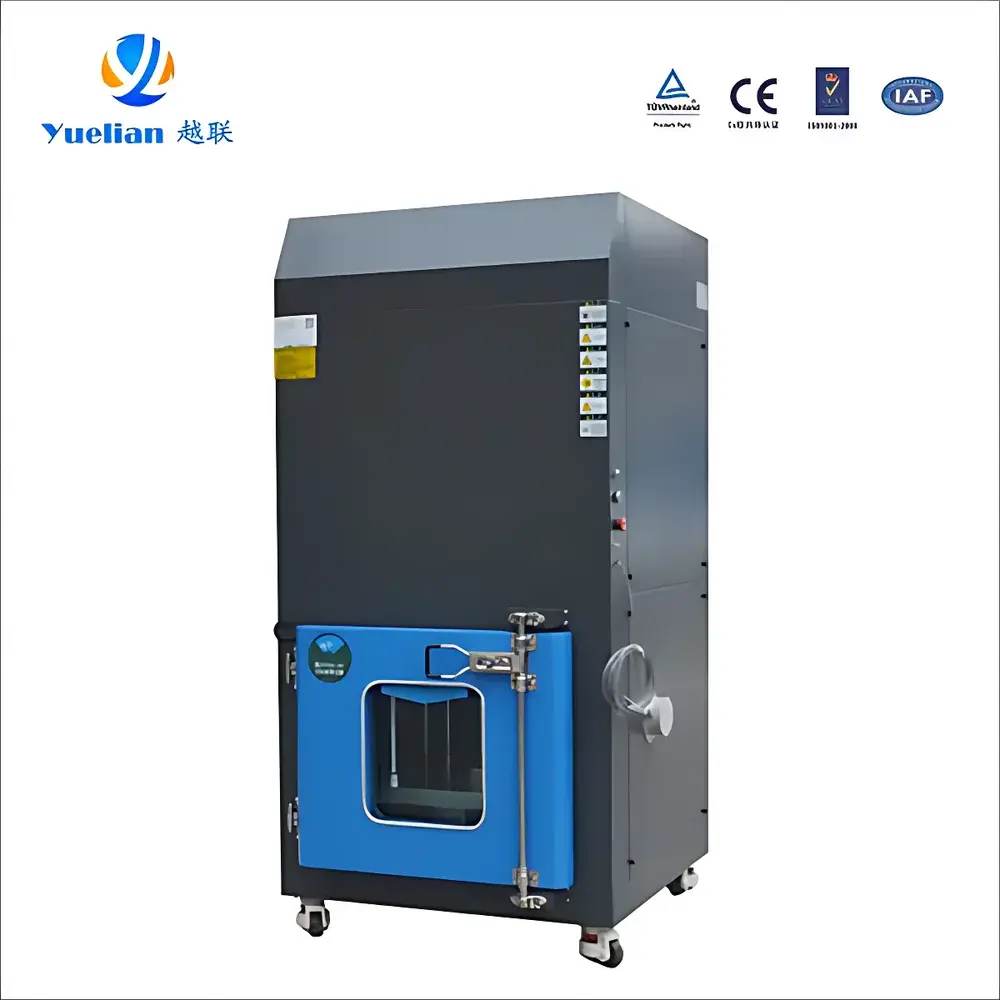
YL-JY-5T Vertical Battery Crush Tester (Servo-Controlled, 50 kN Capacity)
| Key Features | Max. crush force: 50 kN (5 T) |
|---|---|
| Sample chamber | W300 × D300 mm |
| Stroke range | 0–300 mm |
| Crush speed | 1–10 mm/s (adjustable, ±1 mm/s accuracy) |
| Force resolution | 1/500,000 FS |
| Force accuracy | ±0.5% of reading |
| Displacement resolution | 0.01 mm |
| Displacement accuracy | ±0.5% of reading |
| Data acquisition rate | ≥30 Hz |
| Voltage measurement | 0–36 V, ±0.1% FS |
| Temperature measurement | 0–600 °C, ±1 °C |
| Compliance | Designed per UN 38.3, GB/T 31485, IEC 62133, and ISO 12405 test protocols |
| Safety features | Dual-layer tempered explosion-proof observation window (350 × 400 mm), automatic pressure relief port, forced exhaust system, integrated LED lighting |
| Structural enclosure | Heavy-gauge cold-rolled steel (gray + blue epoxy finish) with stainless-steel interior |
Overview
The YL-JY-5T Vertical Battery Crush Tester is a servo-controlled mechanical safety evaluation system engineered for standardized mechanical abuse testing of lithium-ion and other rechargeable traction batteries used in electric vehicles, energy storage systems, and portable electronics. It operates on the principle of controlled uniaxial quasi-static compression, applying calibrated force perpendicular to the electrode plane—per critical requirements outlined in UN Manual of Tests and Criteria Part III, subsection 38.3.5, GB/T 31485–2015, and IEC 62133–2:2017. The system delivers repeatable, traceable load application with real-time synchronization of voltage, temperature, displacement, and time—enabling precise detection of thermal runaway initiation, structural deformation thresholds, and electrical failure modes under mechanical stress.
Key Features
- Servo-motor-driven actuation ensures smooth, programmable crush velocity (1–10 mm/s), compliant with the (5 ± 1) mm/s requirement specified in GB/T 31485 Clause 6.1.3 and UN 38.3 Section 38.3.5.
- High-resolution force transduction (±0.5% of reading, 1/500,000 full-scale resolution) and sub-0.01 mm displacement feedback support accurate determination of yield points, plateau forces, and collapse onset.
- Dual-sensor data fusion: Simultaneous acquisition of battery terminal voltage (0–36 V, ±0.1% FS), surface temperature (0–600 °C, ±1 °C), axial displacement, and applied load at ≥30 samples per second—ensuring temporal correlation of electrochemical and mechanical events.
- Integrated safety architecture includes a reinforced observation chamber with dual-layer 350 × 400 mm tempered explosion-proof glass, automatic pressure-relief venting, and forced exhaust to mitigate gas accumulation during thermal runaway events.
- Modular fixture interface accommodates standard semi-cylindrical crush platens (R = 75 mm, L > sample width) and enables rapid reconfiguration for cell formats from prismatic (up to W300 × D300 mm) to large-format pouch modules.
Sample Compatibility & Compliance
The YL-JY-5T is validated for single-cell and module-level testing per internationally recognized regulatory frameworks. It supports vertical compression alignment relative to electrode stacking direction—a prerequisite for evaluating separator integrity and anode/cathode delamination susceptibility. Test configurations comply with mandatory provisions in UN 38.3 (crush test), GB/T 31485 (safety requirements for power batteries), ISO 12405–2 (electric vehicle battery performance), and IEC 62133–2 (secondary cells for portable applications). The system’s mechanical design meets IP2X ingress protection standards for operator safety and is suitable for GLP-compliant laboratories conducting audit-ready safety qualification studies.
Software & Data Management
The proprietary control software provides ISO/IEC 17025-aligned test sequencing, including pre-defined protocols for voltage-triggered termination (0 V), deformation-based halt (30% height reduction), or force-limited stop (50 kN). All raw sensor streams—including synchronized voltage, temperature, force, displacement, and timestamp—are logged in binary+CSV format with embedded metadata (operator ID, test ID, ambient conditions). Audit trails record parameter changes, user logins, and calibration events—supporting FDA 21 CFR Part 11 compliance when deployed with electronic signature modules. Exported datasets integrate natively with MATLAB, Python (Pandas), and JMP for statistical analysis of crush-induced failure distributions.
Applications
- Pre-certification mechanical abuse validation for EV battery cells prior to UN 38.3 submission.
- Root-cause analysis of crush-induced internal short circuits via synchronized voltage drop and thermal imaging correlation.
- Material-level evaluation of separator tensile resilience, jelly-roll stability, and housing deformation limits.
- Design verification of battery pack mechanical protection structures (e.g., crush walls, beam reinforcements).
- Quality control screening of production batches against defined crush-force hysteresis envelopes.
FAQ
What safety certifications does the YL-JY-5T meet?
It is engineered to facilitate compliance with UN 38.3, GB/T 31485, IEC 62133–2, and ISO 12405–2; however, final certification requires third-party validation of test reports generated using the system.
Can the system accommodate larger battery modules beyond W300 × D300 mm?
Yes—the YL-JY-10T and YL-JY-20T variants extend chamber dimensions to W500 × D500 mm and support higher crush loads (100 kN / 200 kN); custom platen lengths and mounting interfaces are available upon request.
Is temperature measurement integrated or external?
A calibrated thermocouple input channel is built into the controller, supporting Type K probes with direct integration into the acquisition timeline—no external DAQ required.
How is data traceability ensured for regulatory audits?
All test sessions generate digitally signed, tamper-evident logs with checksums, user authentication, and immutable timestamps—fully compatible with 21 CFR Part 11 requirements when paired with validated identity management.
Does the system include test report generation templates?
Yes—preformatted PDF and Excel report templates align with GB/T 31485 Annex A and UN 38.3 reporting conventions, including pass/fail criteria evaluation and graphical overlay of force–displacement–voltage curves.



