
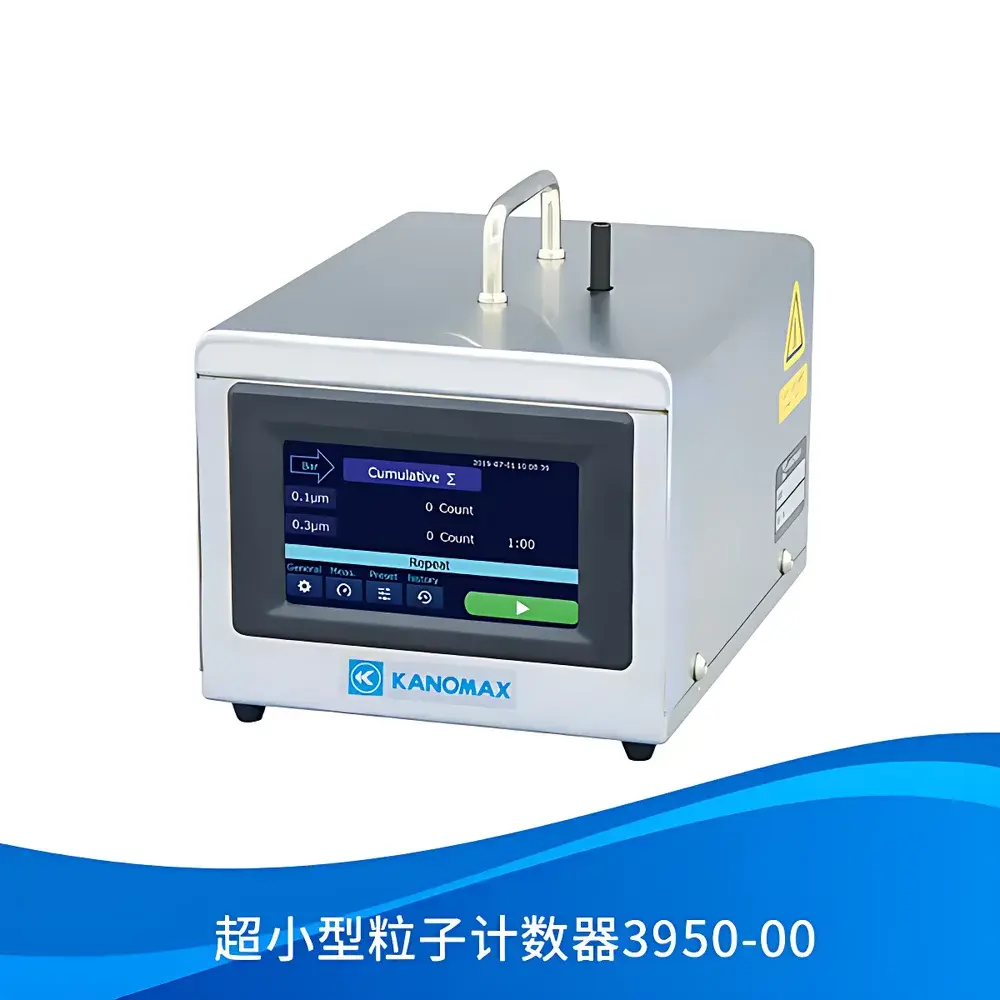
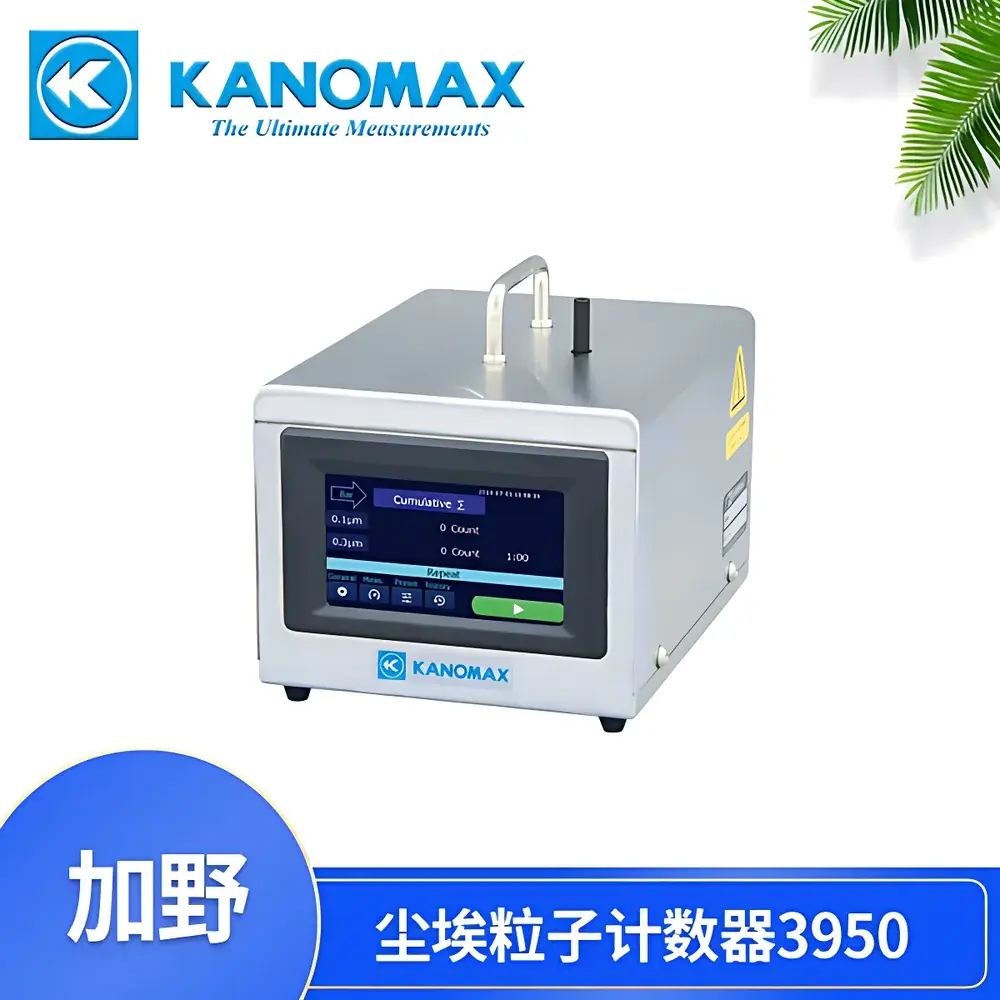
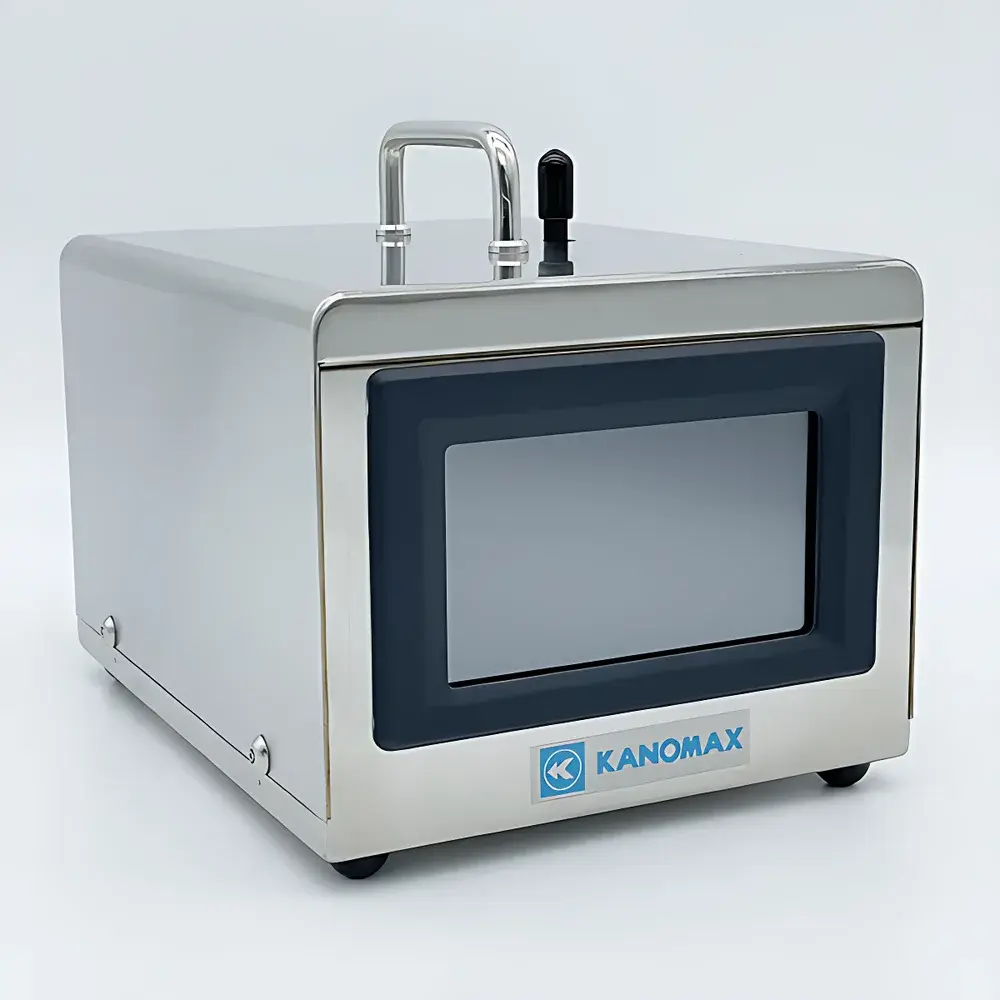
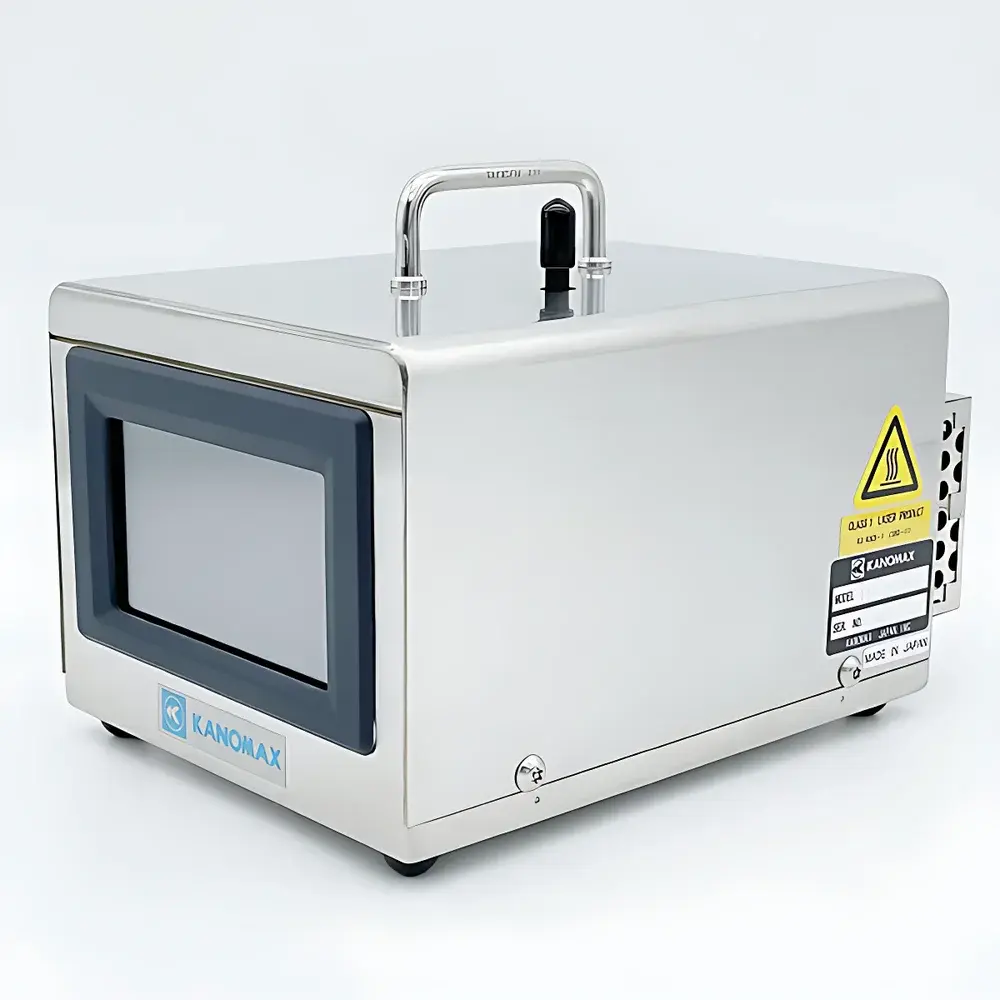
KANOMAX 3950-00 Ultra-Compact 0.1 µm Optical Particle Counter for Cleanroom Integration
| Brand | KANOMAX |
|---|---|
| Origin | Japan |
| Model | 3950-00 |
| Flow Rate | 2.83 L/min (0.1 CFM) |
| Flow Accuracy | ±5% |
| Timing Accuracy | ±1 s per 6 min |
| Repeatability | ±5% |
| Size Distribution Error | ±15% |
| Indication Error | ±30% |
| Particle Detection Principle | Light Scattering |
| Channel Sizes | 0.1 µm and 0.3 µm |
| Max Concentration | 10⁷ particles/m³ |
| Counting Efficiency | 50±20% at 0.1 µm (PSL), 100±10% at 0.15–0.2 µm (PSL) |
| Size Resolution | ≤15% (vs. 0.3 µm PSL) |
| Operating Temp. | 15–35 °C, RH: 0–85% non-condensing |
| Dimensions | 150 × 163 × 228 mm |
| Weight | 3.4 kg |
| Display | 4.3" color TFT touchscreen |
| Interface | USB Host/Device, Ethernet, RS-485 (9600–38400 baud) |
| Data Storage | Internal CSV (up to 10,000 records) |
| Compliance | JIS B9921, ISO 21501-4 |
Overview
The KANOMAX 3950-00 is an ultra-compact, high-sensitivity optical particle counter engineered for embedded integration into semiconductor fabrication tools, mini-environments, and cleanroom monitoring systems requiring real-time, sub-0.2 µm particle detection. Utilizing calibrated laser-based light scattering technology, the instrument detects and quantifies airborne particulates down to 0.1 µm with traceable metrological performance aligned with ISO 21501-4 and JIS B9921. Its compact form factor—measuring only 150 × 163 × 228 mm and weighing 3.4 kg—enables seamless integration into OEM process equipment where space, thermal footprint, and mechanical stability are constrained. Unlike benchtop or portable counters, the 3950-00 is designed for continuous in-line operation, supporting automated cleanroom classification (ISO Class 1–5), tool chamber qualification, and environmental monitoring in critical manufacturing zones such as photolithography, wafer handling, and advanced packaging.
Key Features
- Sub-micron resolution: Dual-channel detection at 0.1 µm and 0.3 µm—optimized for monitoring ultra-clean environments where nanoscale contamination directly impacts yield.
- Embedded-ready architecture: RS-485, Ethernet, and USB Device/Host interfaces support direct integration with PLCs, SCADA systems, and factory MES platforms without external gateways.
- High-stability optical path: Sealed laser diode and precision-aligned photodetector ensure long-term signal consistency under variable vibration and temperature gradients typical in tool-mounted applications.
- Real-time visualization: 4.3-inch full-color resistive touchscreen enables local configuration, live histogram display (Δ and ∑ modes), and on-device trend review—no PC required for basic operation.
- Regulatory-grade timing and flow control: Internal pump maintains nominal 2.83 L/min (0.1 CFM) sampling flow with ±5% accuracy; integrated quartz oscillator delivers ±1 s drift over 6 minutes—critical for audit-ready data logging.
- Low false-count design: <1 false count per 35 minutes, verified using ultra-pure compressed air filtration and background subtraction algorithms compliant with ISO 21501-4 Annex C.
Sample Compatibility & Compliance
The 3950-00 is validated for use with ambient air, filtered process gases (N₂, Ar, dry air), and low-humidity inert atmospheres common in lithography steppers and etch tools. It is not intended for corrosive, condensing, or oil-laden gas streams. All performance specifications—including counting efficiency, size resolution, and flow accuracy—were verified using NIST-traceable PSL (polystyrene latex) reference particles per ISO 21501-4 procedures. The device meets JIS B9921 Class 1 requirements for cleanroom instrumentation and supports ISO 14644-1 compliance reporting when deployed in fixed-location networks. Firmware and data handling protocols are compatible with GLP/GMP environments requiring audit trails; raw CSV logs include timestamps, location IDs (up to 99 preset zones), and measurement mode metadata—enabling traceability under FDA 21 CFR Part 11 when paired with validated third-party data management software.
Software & Data Management
Data output is natively formatted as UTF-8 CSV files containing timestamp (YYYY-MM-DD HH:MM:SS), location ID, channel counts (0.1 µm and 0.3 µm), differential/accumulated mode flags, and cycle duration. Internal memory stores up to 10,000 records with automatic overwrite protection. USB Host mode supports direct printing to ESC/POS-compatible thermal printers or bulk export to FAT32-formatted USB drives. Ethernet interface enables TCP/IP socket communication for custom API integration (e.g., Modbus TCP mapping available upon request). While KANOMAX provides a basic Windows-based configuration utility (v3.x), the 3950-00 is designed for headless operation—no proprietary software is required for core functionality. All firmware updates are delivered via signed .bin files through USB or Ethernet, with checksum verification and rollback capability.
Applications
- Embedded particle monitoring in semiconductor cluster tools, track-in/out modules, and FOUP load ports.
- Continuous ISO Class 1–3 cleanroom certification and dynamic classification per ISO 14644-2 Annex B.
- Filter integrity validation and leak testing of ULPA/HEPA systems in pharmaceutical isolators and aseptic filling lines.
- Environmental baseline establishment during facility commissioning and periodic requalification (PQ).
- Research-grade nanoparticle exposure assessment in microelectronics R&D labs and nanofabrication cleanrooms.
- Integration into smart HVAC control loops for demand-based airflow optimization based on real-time particle load.
FAQ
Is the 3950-00 suitable for measuring particles below 0.1 µm?
No. The instrument’s lower detection limit is 0.1 µm (with 50±20% counting efficiency at that threshold); it does not meet ISO 21501-4 requirements for sub-0.1 µm sizing and is not calibrated for nanoparticles (e.g., <100 nm).
Can the 3950-00 operate continuously for 24/7 monitoring?
Yes. Designed for unattended operation, it supports continuous sampling mode with configurable cycle intervals (6 sec to 99 min 59 sec) and internal thermal management validated for 35 °C ambient operation.
Does the unit require annual recalibration?
Per ISO 21501-4 Clause 8.3, users must verify counting efficiency and flow rate at least annually using certified reference aerosols and calibrated flow meters; KANOMAX recommends factory recalibration every 12 months for audit readiness.
What is the maximum allowable relative humidity for operation?
The device operates within 0–85% RH non-condensing; prolonged exposure above 85% RH may cause optical window fogging or internal condensation, invalidating measurements.
Is Modbus RTU or TCP protocol supported natively?
RS-485 supports Modbus RTU master/slave configuration (custom register map available); Ethernet supports raw socket communication—Modbus TCP implementation requires middleware or OEM-level firmware customization.
Related Products







