
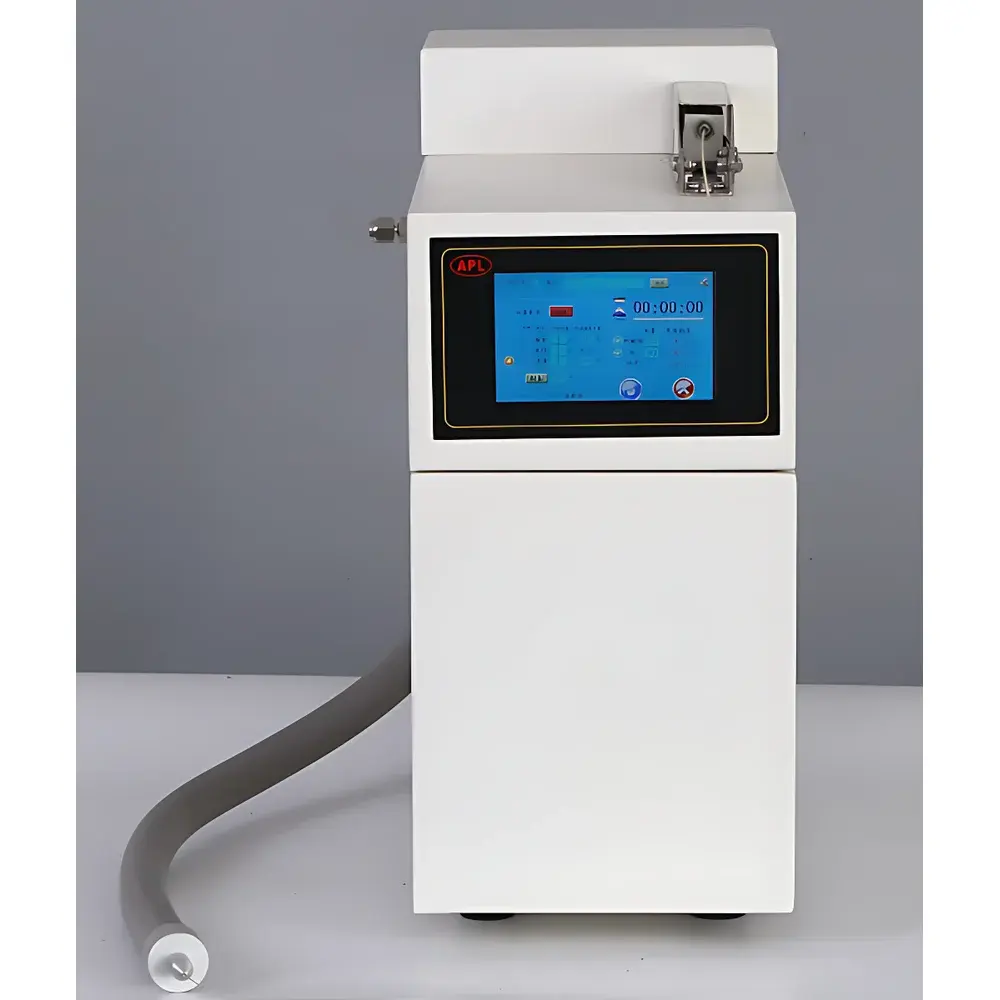
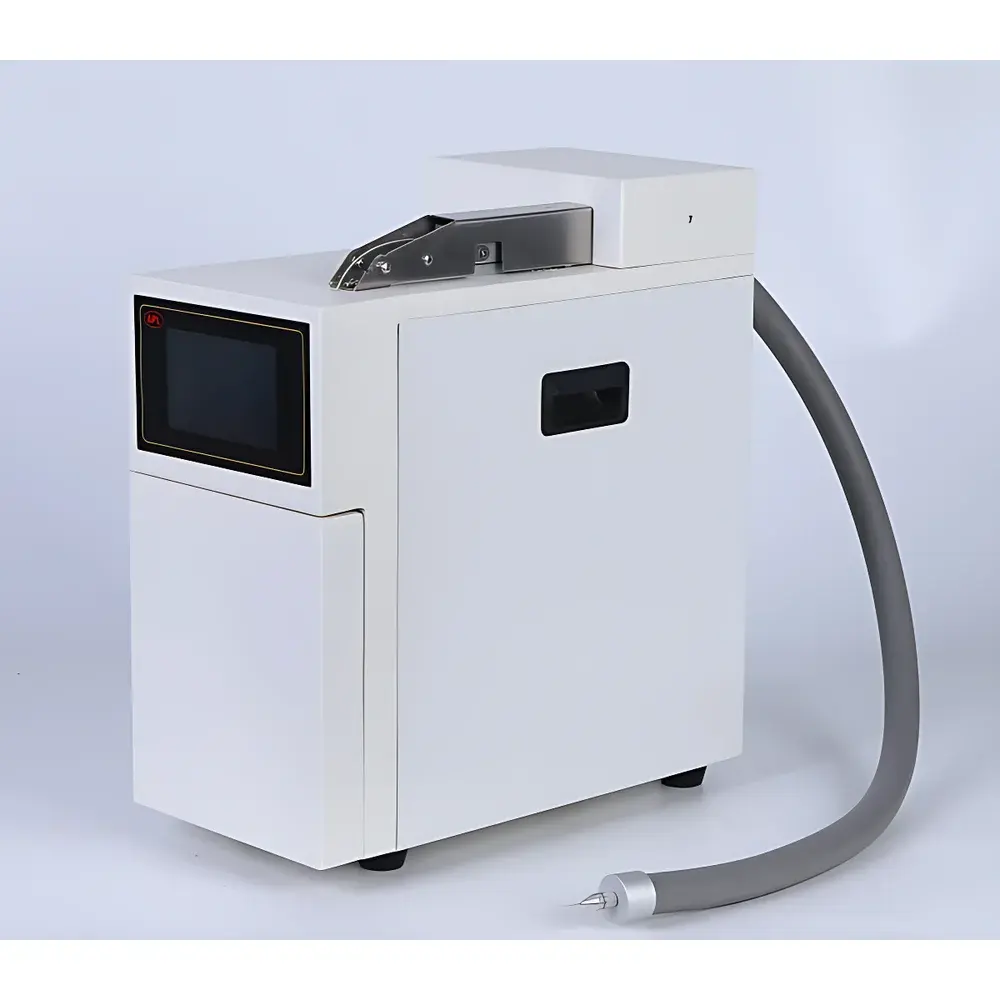
APL APL-TD-1 Single-Tube Automated Thermal Desorber
| Brand | APL |
|---|---|
| Origin | Sichuan, China |
| Manufacturer Type | Manufacturer |
| Product Category | Domestic |
| Model | APL-TD-1 |
| Instrument Type | Primary Thermal Desorber |
| Automation Level | Fully Automatic |
| Desorption Temperature Range | Ambient to 400 °C |
| Cold Trap Temperature Range | −35 °C to 25 °C (Note: Input states “25” — interpreted as upper limit of ambient-cooled trap |
| Desorption Recovery Rate | >98% |
| Sample Position Capacity | 1 |
Overview
The APL APL-TD-1 Single-Tube Automated Thermal Desorber is a precision-engineered primary thermal desorption system designed for reliable, reproducible transfer of volatile and semi-volatile organic compounds (VOCs and SVOCs) from sorbent-packed tubes into gas chromatography (GC) or GC–mass spectrometry (GC–MS) systems. It operates on the principle of controlled thermal desorption: analytes adsorbed onto standardized sorbent tubes (e.g., Tenax®, Carbopack™, or multi-bed configurations) are thermally released under inert carrier gas flow, then focused in a cryogenically cooled trap prior to rapid flash desorption and transfer to the GC inlet. This two-stage thermal process—primary desorption followed by cryo-focusing—ensures high sensitivity, minimal band broadening, and quantitative recovery across complex environmental and indoor air matrices. The APL-TD-1 is purpose-built for compliance-driven laboratories performing VOC analysis per major regulatory methods, including U.S. EPA TO-17, ISO 16017-1, and multiple Chinese environmental standards (HJ 644–2013, HJ 583–2010, HJ 734–2014).
Key Features
- Fully automated, touchscreen-controlled operation with intuitive method editing, saving, and recall—enabling seamless execution of desorption, GC trigger synchronization, backflush, and tube conditioning cycles.
- Independent temperature control zones: desorption oven (ambient to 400 °C, ±1 °C), six-port valve manifold (ambient to 220 °C, ±1 °C), and transfer line (ambient to 260 °C, ±1 °C), ensuring precise thermal management and eliminating condensation artifacts.
- Integrated Peltier-based cold trap capable of cooling to −35 °C (with optional upgrade path to −40 °C), eliminating reliance on liquid nitrogen or external chillers—reducing operational cost and increasing lab safety and uptime.
- Simple-Lock™ mechanical interface enables secure, leak-tight fixation of standard 89 mm × 6.4 mm OD sorbent tubes in ≤2 seconds, supporting rapid tube exchange without tools or alignment calibration.
- Programmable time-sequence logic for unattended operation: includes desorption, carrier gas purge, cryo-trap focusing, flash heating (>3000 °C/min ramp), GC injection trigger output, and post-run tube bake-out (up to 420 °C).
- Onboard simulated sampling function allows direct generation of calibration standards via dynamic spiking—supporting robust working curve development without external vapor generators.
- Universal GC interface: compatible with all major GC inlets (split/splitless, PTV, cold on-column) via adjustable needle depth and standard 0.53 mm or 0.32 mm ID transfer tubing.
Sample Compatibility & Compliance
The APL-TD-1 accepts industry-standard 1/4″ OD stainless steel or quartz sorbent tubes (length: 89 mm), sealed with PTFE-lined caps to ensure sample integrity during storage (validated stability up to 14 days at ambient conditions). Its thermal architecture supports single-bed (e.g., Tenax TA) and multi-bed (e.g., Carbopack B/C + Carbosieve SIII) configurations. The system meets design and performance requirements specified in HJ 644–2013, HJ 583–2010, HJ 734–2014, GB/T 18883–2002, and GB 50325–2010. While not certified to ISO/IEC 17025 out-of-the-box, its modular firmware architecture supports audit-ready logging when integrated with GLP-compliant LIMS or chromatography data systems (CDS) compliant with FDA 21 CFR Part 11.
Software & Data Management
Embedded firmware provides real-time status monitoring—including valve position, temperature profiles, pressure feedback, and event timestamps—displayed directly on the 7-inch capacitive touchscreen. All method parameters, run logs, and system diagnostics are stored locally in non-volatile memory with CSV export capability via USB. For enterprise integration, the APL-TD-1 features RS-232 and Ethernet ports supporting ASCII command protocol for remote control and synchronization with third-party CDS platforms (e.g., Thermo Chromeleon, Agilent OpenLab, Shimadzu LabSolutions). Audit trail functionality—including user login, method modification history, and run start/stop metadata—is configurable to align with internal QA/QC policies.
Applications
- Environmental air monitoring: ambient, stack, and fugitive emission testing for benzene, toluene, ethylbenzene, xylenes (BTEX), aldehydes, and halogenated VOCs.
- Indoor air quality (IAQ) assessment per GB/T 18883–2002 and HJ/T 400–2007—covering residential, office, and vehicle cabin environments.
- Building material emissions testing (e.g., carpets, adhesives, composite wood) under controlled chamber conditions.
- Workplace exposure monitoring in pharmaceutical, petrochemical, and coating manufacturing facilities.
- Method development and validation studies requiring high-recovery, low-memory-effect thermal desorption performance.
FAQ
Is the APL-TD-1 compatible with GC–MS systems?
Yes—it delivers sharp, narrow-band injections suitable for both quadrupole and high-resolution GC–MS platforms. Synchronization signals ensure precise timing between flash desorption and MS acquisition start.
What sorbent tube specifications does it support?
Standard 89 mm × 6.4 mm OD tubes (1/4″), rated to 420 °C; compatible with Tenax TA, Carbopack series, Carboxen, and custom multi-bed configurations.
Does it support secondary desorption?
The APL-TD-1 is a primary desorber. Secondary desorption capability (cold trap refocusing + flash) is available in the APL-TD-2 model; however, the APL-TD-1’s Peltier cold trap enables effective cryo-focusing for enhanced sensitivity in primary-mode operation.
Can it be used for regulatory reporting under Chinese EPA methods?
Yes—its thermal accuracy, recovery performance (>98%), and programmable sequence logic fully satisfy the instrumental requirements of HJ 644–2013, HJ 583–2010, and HJ 734–2014 for accredited environmental testing labs.
Is remote diagnostics or software update supported?
Firmware updates are performed via USB; remote troubleshooting is enabled through Ethernet-connected VNC-capable CDS integrations or vendor-supported SSH access (available under service contract).
Related Products





