
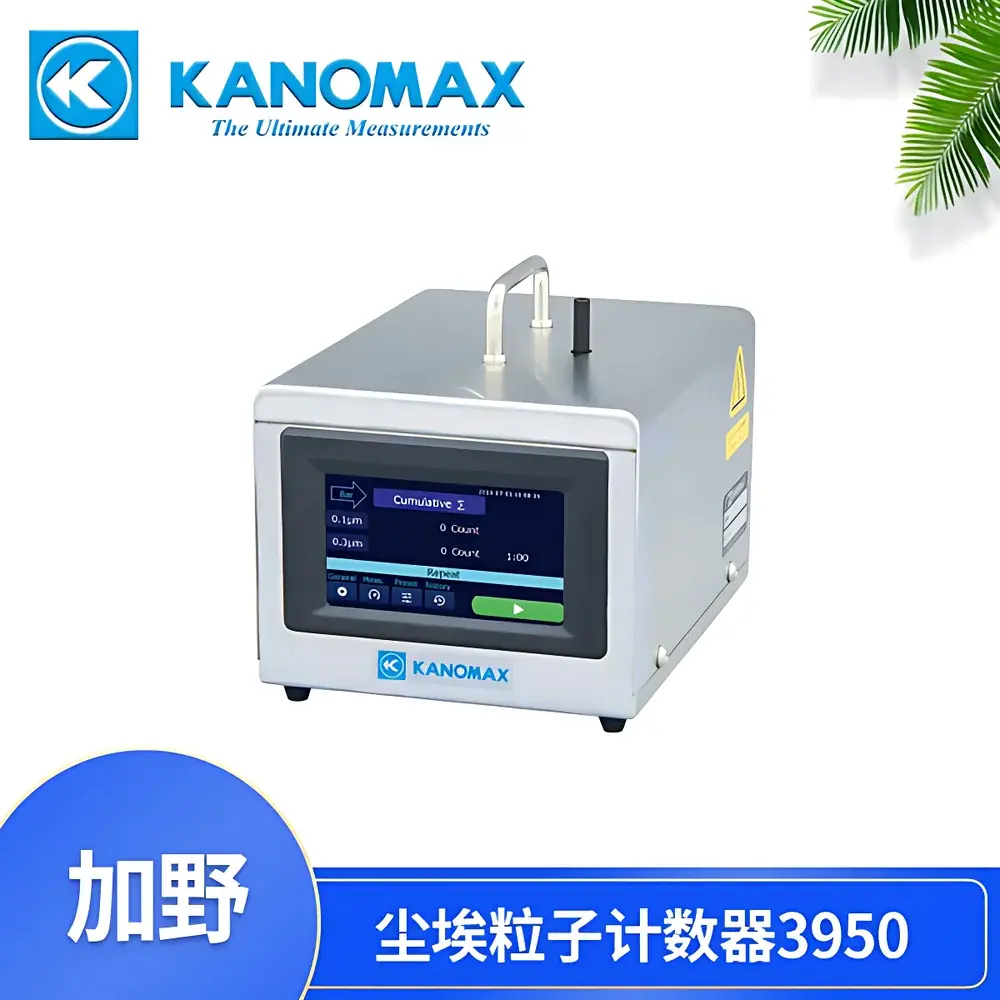
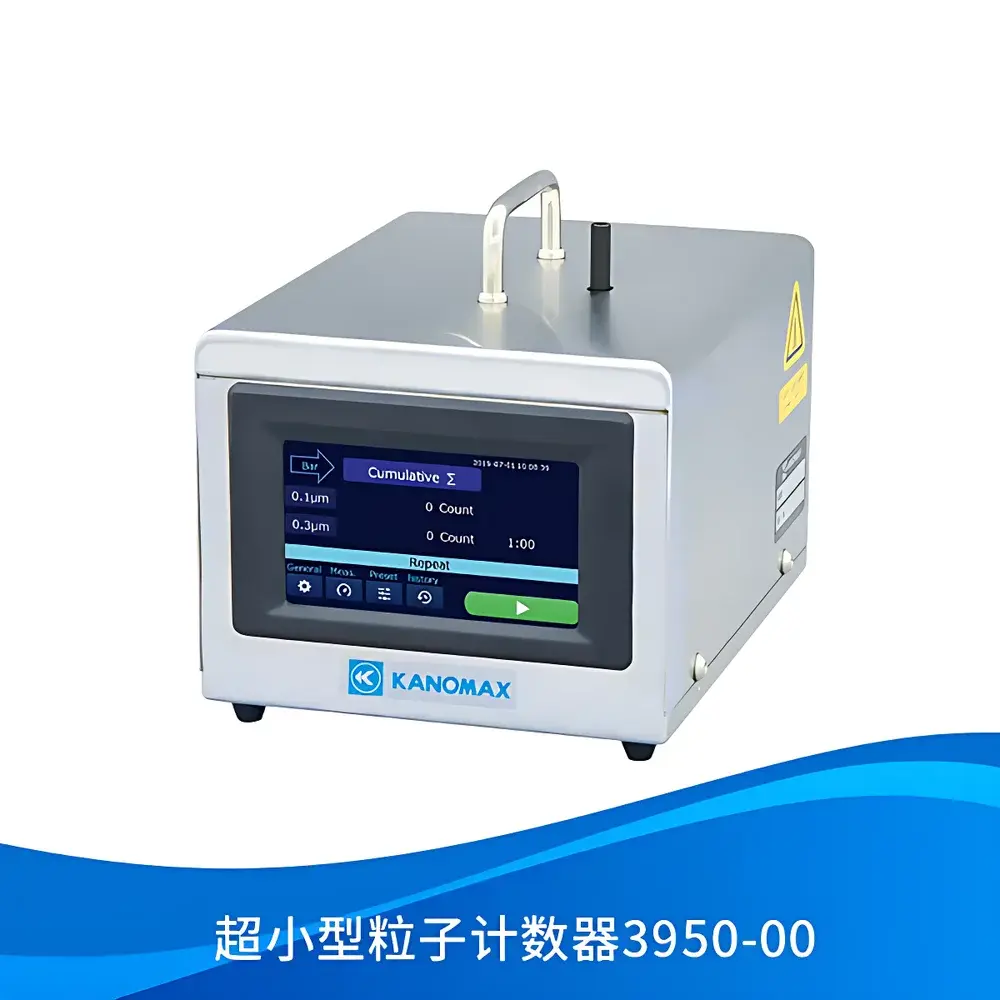
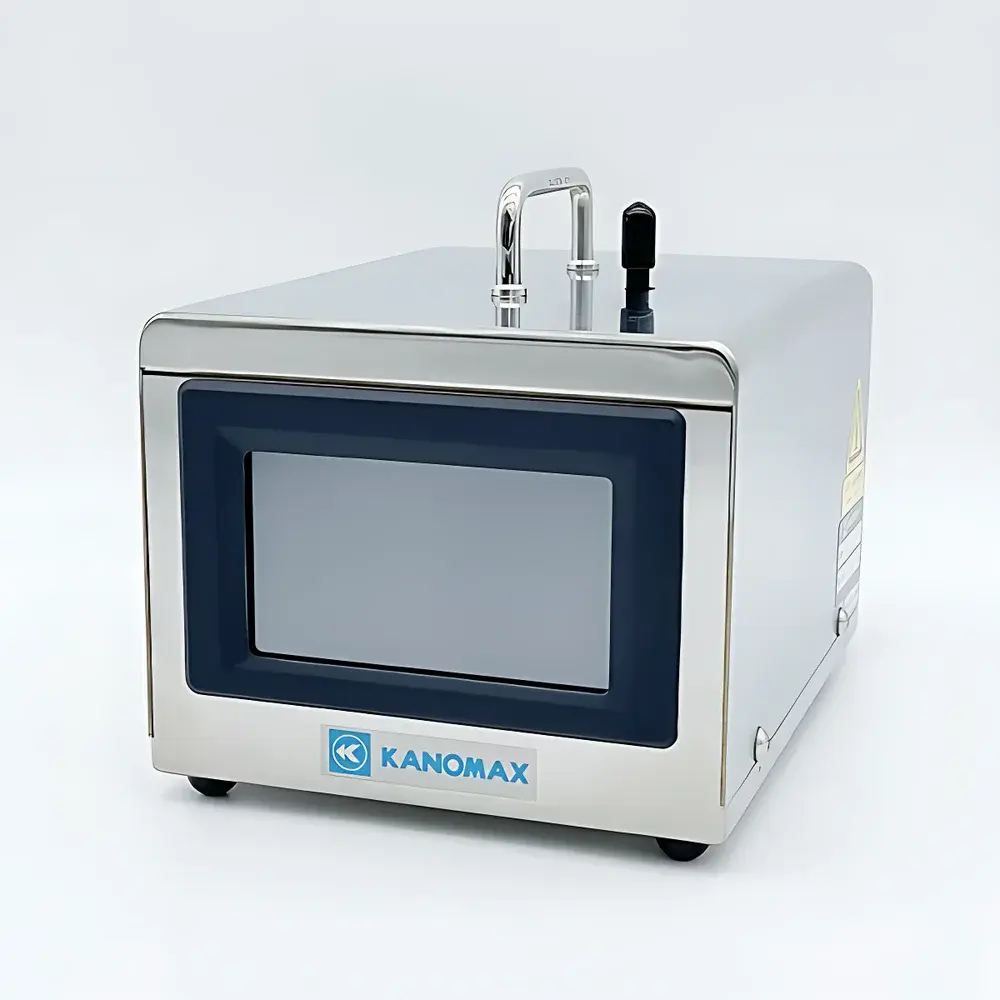
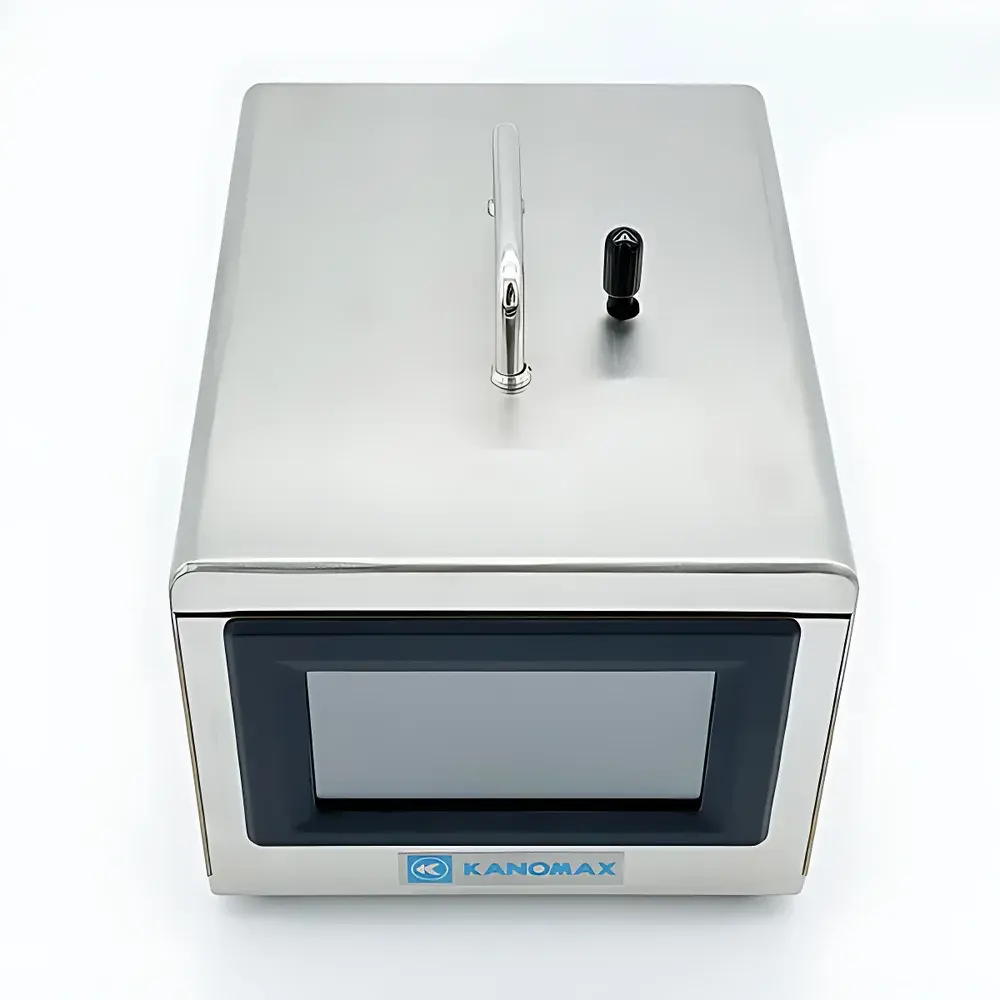
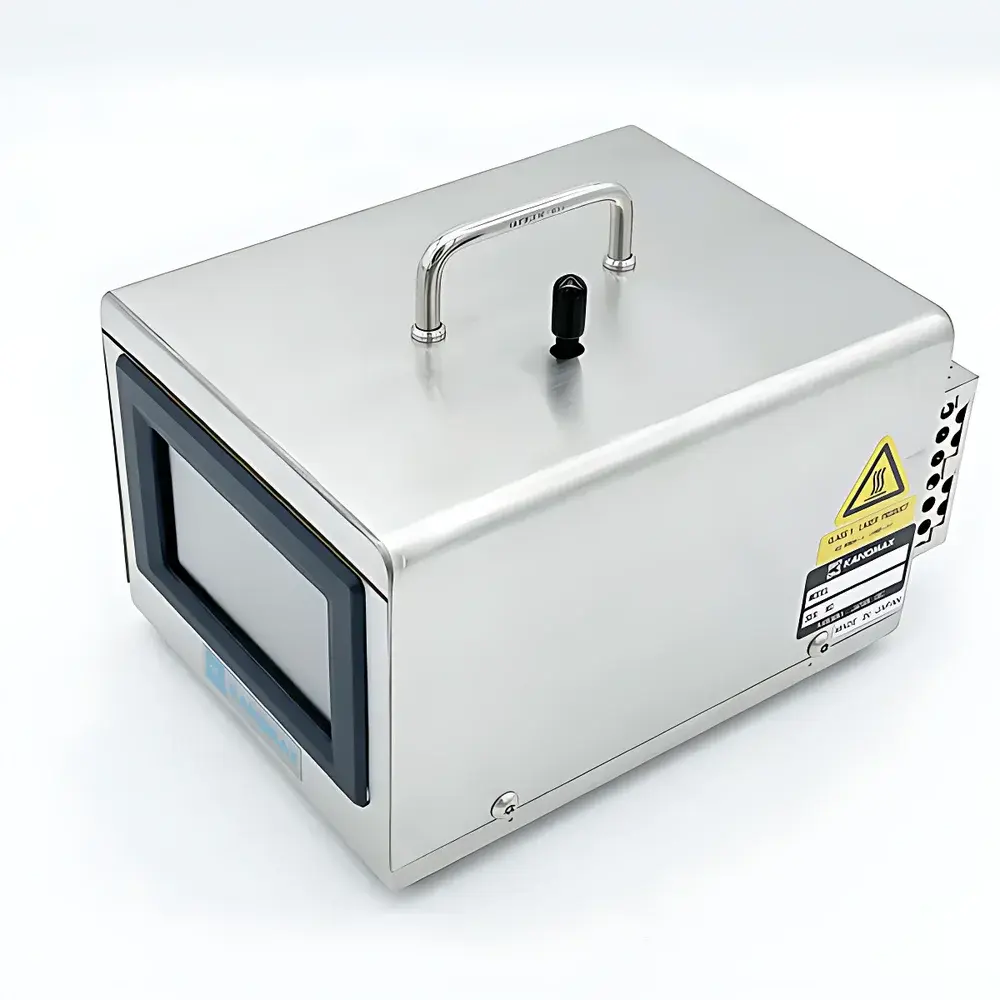
KANOMAX 3950-00 Ultra-Small Particle Counter for Semiconductor Cleanroom Monitoring (0.1 μm Detection)
| Brand | KANOMAX |
|---|---|
| Origin | Japan |
| Model | 3950-00 |
| Flow Rate | 2.83 L/min (0.1 CFM) |
| Flow Accuracy | ±5% |
| Timing Accuracy | ±1 s per 6 min |
| Repeatability | ±5% |
| Size Distribution Error | ±15% |
| Indication Error | ±30% |
| Particle Detection Channels | 0.1 μm & 0.3 μm |
| Compliance | JIS B9921 & ISO 21501-4 |
| Display | 4.3" Color Touchscreen LCD |
| Communication | RS-485, Ethernet, USB (Host/Device) |
| Data Storage | Up to 10,000 records (CSV) |
| Operating Environment | 15–35 °C, 0–85% RH (non-condensing) |
| Dimensions | 150 × 163 × 228 mm |
| Weight | 3.4 kg |
Overview
The KANOMAX 3950-00 is an ultra-compact, high-sensitivity optical particle counter engineered specifically for real-time airborne particulate monitoring in semiconductor-grade cleanrooms and critical process environments. Utilizing calibrated laser light scattering detection, it achieves reliable quantification of particles down to 0.1 μm—meeting the stringent requirements of Class 1 (ISO 3) and tighter controlled spaces where sub-0.2 μm contamination control is mission-critical. Its design prioritizes seamless integration: with a footprint of only 150 × 163 × 228 mm and weight of 3.4 kg, the unit is purpose-built for OEM embedding into lithography tools, wafer handling systems, mini-environments, and automated monitoring nodes. Unlike conventional benchtop counters, the 3950-00 operates at a nominal flow rate of 2.83 L/min (0.1 CFM), enabling precise sampling in low-flow or pressure-constrained ducts and laminar flow hoods without compromising detection fidelity.
Key Features
- Two-channel simultaneous detection at 0.1 μm and 0.3 μm—optimized for early-stage defect precursor identification in photolithography and etch processes
- 4.3-inch full-color resistive touchscreen interface with intuitive icon-based navigation and real-time graphical display (cumulative ∑, differential Δ, and histogram view)
- Embedded dual-mode pump system ensuring stable aspiration across variable backpressure conditions typical in integrated tool interfaces
- Comprehensive measurement flexibility: selectable modes include single-shot, repeat, continuous, calculation, ISO-compliant reporting, and GB-standard protocols
- Configurable sampling parameters—including measurement duration (6 s to 99:59 min), interval timing, and up to 99 distinct location IDs—for multi-point spatial mapping
- Onboard data logging capacity for 10,000 timestamped records in industry-standard CSV format, supporting post-acquisition traceability and batch review
Sample Compatibility & Compliance
The 3950-00 is validated per JIS B9921:2010 and ISO 21501-4:2018 for calibration, counting efficiency, size resolution, and false count performance. Its 0.1 μm channel demonstrates 50 ± 20% counting efficiency for PSL standards near the lower detection limit and ≥90% efficiency for particles ≥1.5× the threshold diameter—ensuring metrological integrity in ultra-clean applications. The instrument maintains <1 false count per 35 minutes under clean-air conditions and exhibits ≤15% relative size resolution error at 0.3 μm PSL. It supports environmental operation between 15–35 °C and 0–85% RH (non-condensing), making it suitable for both cleanroom ambient and equipment-integrated enclosures. No external vacuum or compressed air supply is required—the internal diaphragm pump delivers consistent aspiration without introducing cross-contamination risks.
Software & Data Management
Data export and remote configuration are supported via USB Device (for direct PC connection), USB Host (for printer output or flash drive logging), RS-485 (Modbus RTU protocol), and 10/100BASE-T Ethernet. The device natively outputs time-stamped CSV files compatible with LIMS, MES, and statistical process control (SPC) platforms. While no proprietary software is bundled, its open communication protocols enable integration with third-party SCADA systems and compliance-ready audit trails. All logged measurements retain full metadata—including date/time stamp, location ID, mode setting, and flow verification status—supporting GLP/GMP-aligned documentation workflows. Firmware updates are performed via USB storage, ensuring long-term maintainability without service visits.
Applications
- Real-time monitoring of FOUPs, EFEMs, and track-in/out zones in 300 mm wafer fabrication lines
- OEM integration into inspection tools, mask writers, and atomic layer deposition (ALD) chambers for embedded contamination feedback
- Validation and routine surveillance of ISO Class 3–5 cleanrooms per IEST-G-CC1002 and SEMI S2 guidelines
- Particle source identification during tool qualification, preventive maintenance, and filter integrity testing
- Environmental qualification of microelectronics packaging clean booths and compound semiconductor epitaxy labs
FAQ
What is the minimum detectable particle size, and how is calibration verified?
The instrument detects particles ≥0.1 μm using He-Ne laser scattering; calibration traceability follows JIS B9921 and ISO 21501-4 using NIST-traceable PSL standards.
Can the 3950-00 be used for continuous unattended monitoring?
Yes—it supports continuous sampling mode with programmable intervals and auto-logging to internal memory or external USB storage.
Does it meet FDA 21 CFR Part 11 requirements for electronic records?
While the device itself does not provide electronic signatures or role-based access control, its timestamped CSV output and immutable log structure support Part 11-compliant archival when deployed within validated IT infrastructure.
Is external power conditioning required in semiconductor fabs?
No—the unit accepts universal AC input (100–240 V, 50/60 Hz) and includes EMI filtering compliant with IEC 61326-1 for industrial electromagnetic environments.
How is flow rate accuracy maintained over time?
The built-in thermal mass flow sensor is factory-calibrated and drift-compensated; periodic verification against a primary standard (e.g., bubble flowmeter) is recommended per ISO 21501-4 Annex D every 12 months.
Related Products







