
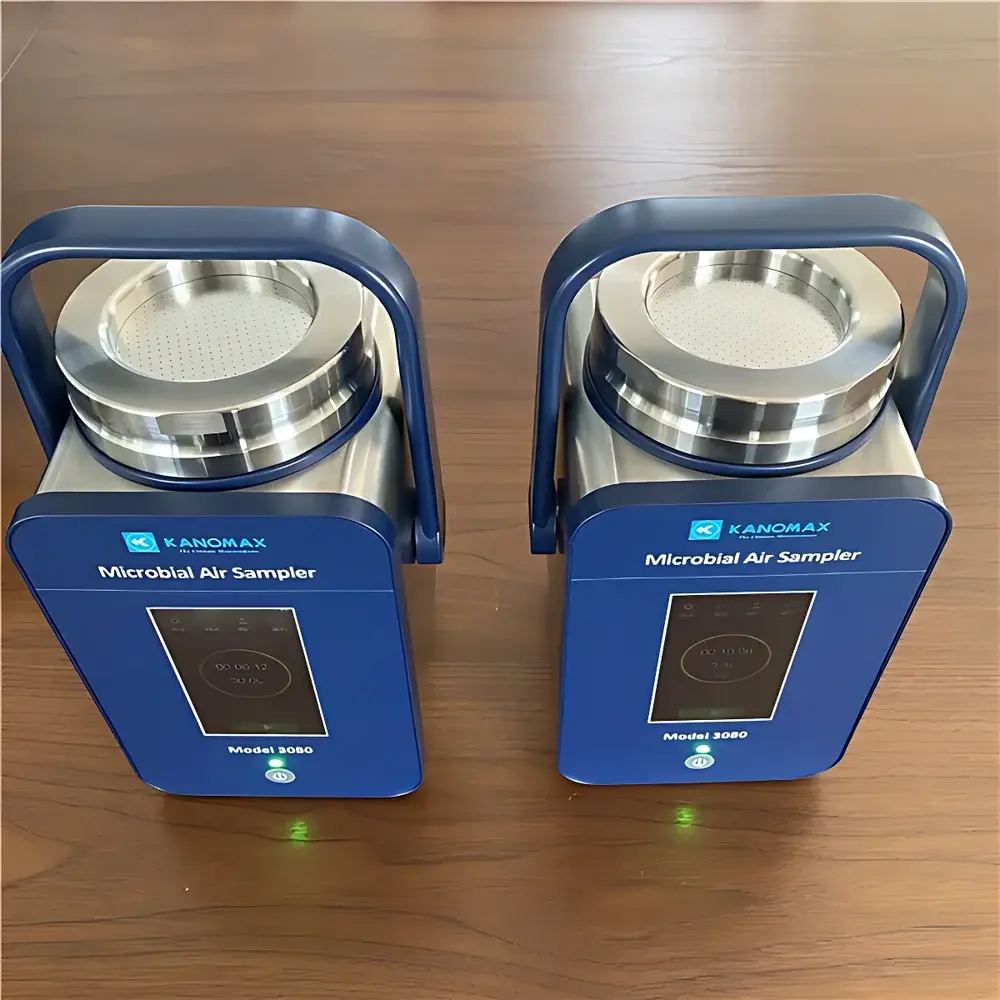
Kanomax Model 3080 Andersen-Principle Air Microbial Sampler
| Brand | Kanomax |
|---|---|
| Origin | Japan |
| Model | 3080 |
| Flow Rate | 100 L/min |
| Flow Accuracy | ±2.5% |
| Sampling Volume Range | 20–6000 L |
| Sampling Duration | Up to 7 h (battery operation) |
| Operating Temperature | 0–40 °C |
| Operating Humidity | 0–90% RH (non-condensing) |
| Sampling Principle | Andersen Impaction (6-stage cascade impactor) |
| Impact Velocity | <20 m/s |
| Exhaust Filtration | ISO Class 3 certified filter |
| Display | 4.3-inch color touchscreen |
| Data Storage | 10,000 internal records + USB export (CSV) |
| Communication | USB, RS485 (Modbus RTU) |
| Power | Rechargeable Li-ion battery + AC adapter (100–240 V) |
| Dimensions | 136 × 235 × 133 mm |
| Weight | 3.2 kg |
| Petri Dish Compatibility | 90–100 mm and 55–84 mm |
| User Management | 64 configurable users with multi-level permissions and audit trail |
| Remote Control | IR remote (supports up to 5 units simultaneously) |
Overview
The Kanomax Model 3080 is a precision-engineered, portable air microbial sampler designed for quantitative monitoring of viable airborne microorganisms in controlled environments. It operates on the well-established Andersen cascade impaction principle—a gravimetric and inertial separation method that classifies particles by aerodynamic diameter across six discrete stages. Each stage collects microorganisms onto standard agar-filled Petri dishes at defined cut-off sizes (ranging from >7.0 µm to <0.65 µm), enabling subsequent colony-forming unit (CFU) enumeration and size-resolved bioaerosol profiling. The instrument delivers a calibrated volumetric flow rate of 100 L/min with ±2.5% accuracy, ensuring compliance with international sampling standards including ISO 14698-1, ISO 14644-1 (cleanroom classification), and EU GMP Annex 1 requirements for environmental monitoring in pharmaceutical manufacturing. Its compact, stainless-steel (316 grade) sampling head is autoclavable and chemically resistant—critical for sterility assurance in aseptic processing areas.
Key Features
- Andersen-type 6-stage impactor with validated particle size cutoffs and impact velocity <20 m/s for high collection efficiency and minimal microbial stress
- Integrated ISO Class 3 exhaust filtration system to prevent cross-contamination and meet biosafety containment requirements
- 4.3-inch full-color touchscreen interface supporting English, Japanese, and Chinese language modes with intuitive workflow navigation
- Programmable sampling parameters: volume (20–6000 L), interval (10 s–1 h), delay (0–23:59:59), cycle count (2–300) or continuous mode
- Multi-level user authentication (64 configurable accounts) with role-based access control and time-stamped audit trail per ISO/IEC 17025 and FDA 21 CFR Part 11 data integrity expectations
- Onboard data storage for 10,000 sampling events; exportable via USB in CSV format with full metadata (date/time, location, operator ID, volume, status, alarm logs)
- Rechargeable Li-ion battery providing up to 7 hours of uninterrupted operation—ideal for mobile cleanroom mapping and dynamic environmental monitoring
- Infrared remote control capability for synchronized operation of up to five units, minimizing personnel intrusion during critical sampling phases
Sample Compatibility & Compliance
The Model 3080 accommodates two standard Petri dish diameters (90–100 mm and 55–84 mm), facilitating compatibility with widely adopted microbiological culture media such as Tryptic Soy Agar (TSA), Sabouraud Dextrose Agar (SDA), and malt extract agar. Its stainless-steel sampling head is fully autoclavable (121 °C, 20 min) and resistant to common disinfectants used in GxP facilities. The device meets electromagnetic compatibility (EMC) standards per IEC 61326-1 and safety requirements under IEC 61010-1. It supports integration into facility-wide environmental monitoring systems via Modbus RTU protocol over RS485, enabling real-time data aggregation and automated trend analysis in accordance with ISO 14644-2 surveillance protocols.
Software & Data Management
Data generated by the Model 3080 includes timestamped sampling records with operator ID, geotagged location (manually entered), volume, duration, flow stability status, and alarm flags (e.g., low flow, filter saturation, battery warning). All entries are digitally signed and immutable post-acquisition, satisfying ALCOA+ principles (Attributable, Legible, Contemporaneous, Original, Accurate, Complete, Consistent, Enduring, Available). Exported CSV files are compatible with LIMS platforms and statistical process control (SPC) software. Optional printer connectivity enables immediate hard-copy documentation for batch release or audit readiness. Firmware updates are performed securely via USB, with version logging maintained in the audit trail.
Applications
The Model 3080 is deployed across regulated and high-integrity environments where microbial contamination control is mission-critical: Grade A/B/C/D cleanrooms in pharmaceutical and biotechnology manufacturing; ISO Class 5–8 laminar flow hoods and isolators; hospital operating theatres and sterile compounding facilities; food and beverage production lines subject to HACCP and BRCGS requirements; museum and archival storage vaults requiring fungal spore surveillance; and biosafety laboratories conducting aerosolized pathogen research. Its portability and programmability make it equally suitable for static point monitoring and dynamic spatial mapping during qualification (IQ/OQ/PQ) and routine environmental monitoring (EM) programs.
FAQ
What is the recommended calibration frequency for the Model 3080?
Annual calibration against a NIST-traceable flow standard is recommended; field verification using a primary calibrator (e.g., dry gas meter or bubble flowmeter) should be performed before each critical sampling campaign.
Can the Model 3080 be integrated into a central environmental monitoring system (EMS)?
Yes—via RS485 Modbus RTU interface, the device transmits real-time flow status, sampling progress, and alarm conditions to supervisory SCADA or EMS platforms compliant with ISA-88/ISA-95 architecture.
Is the exhaust filter replaceable, and how often must it be changed?
The ISO Class 3 HEPA exhaust filter is user-replaceable; replacement frequency depends on cumulative sampling volume and ambient particulate load—typically every 500–1000 L under normal cleanroom conditions.
Does the instrument support GLP/GMP-compliant electronic signatures?
While the Model 3080 provides audit-trail functionality and user-level permissions, full 21 CFR Part 11 electronic signature implementation requires integration with a validated third-party EM system or LIMS.
What maintenance is required between sampling sessions?
Post-use decontamination of the stainless-steel impactor head via autoclaving or 70% ethanol wipe is mandatory; O-rings and nozzle seals should be inspected quarterly for wear or deformation.
Related Products







