
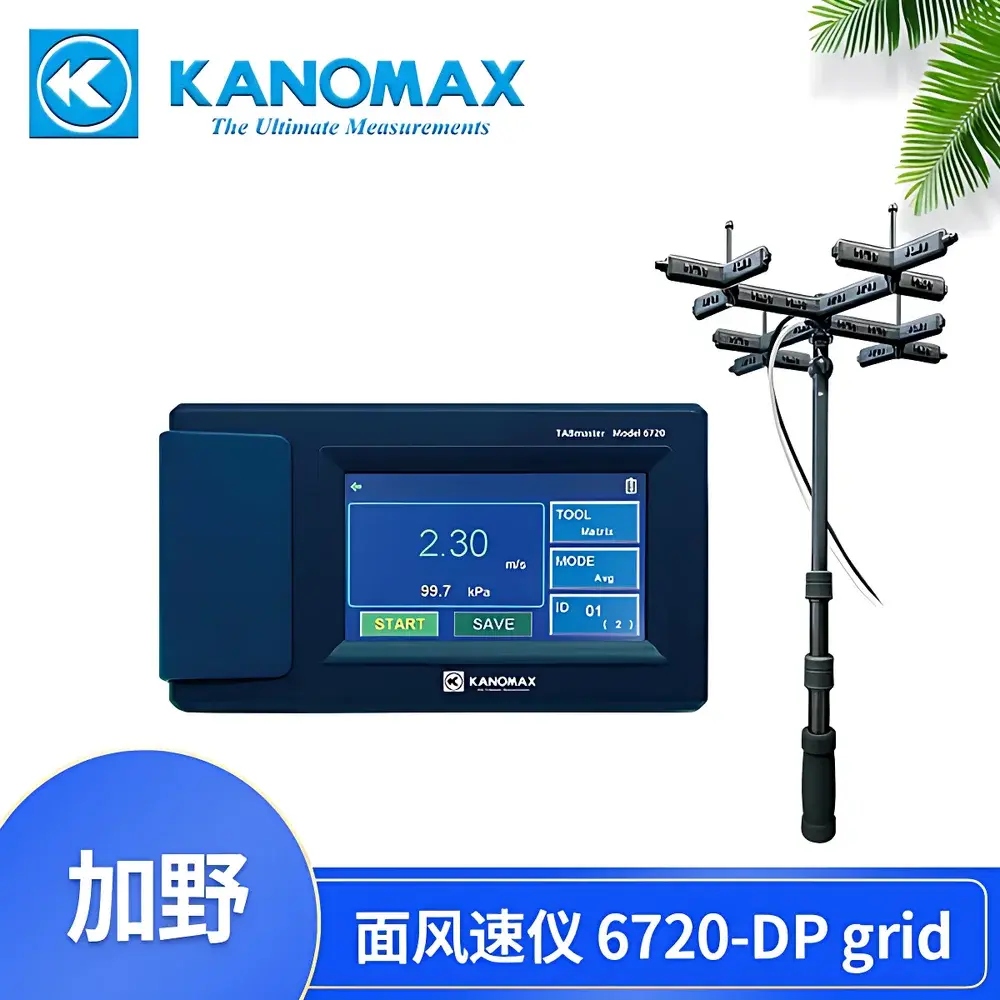
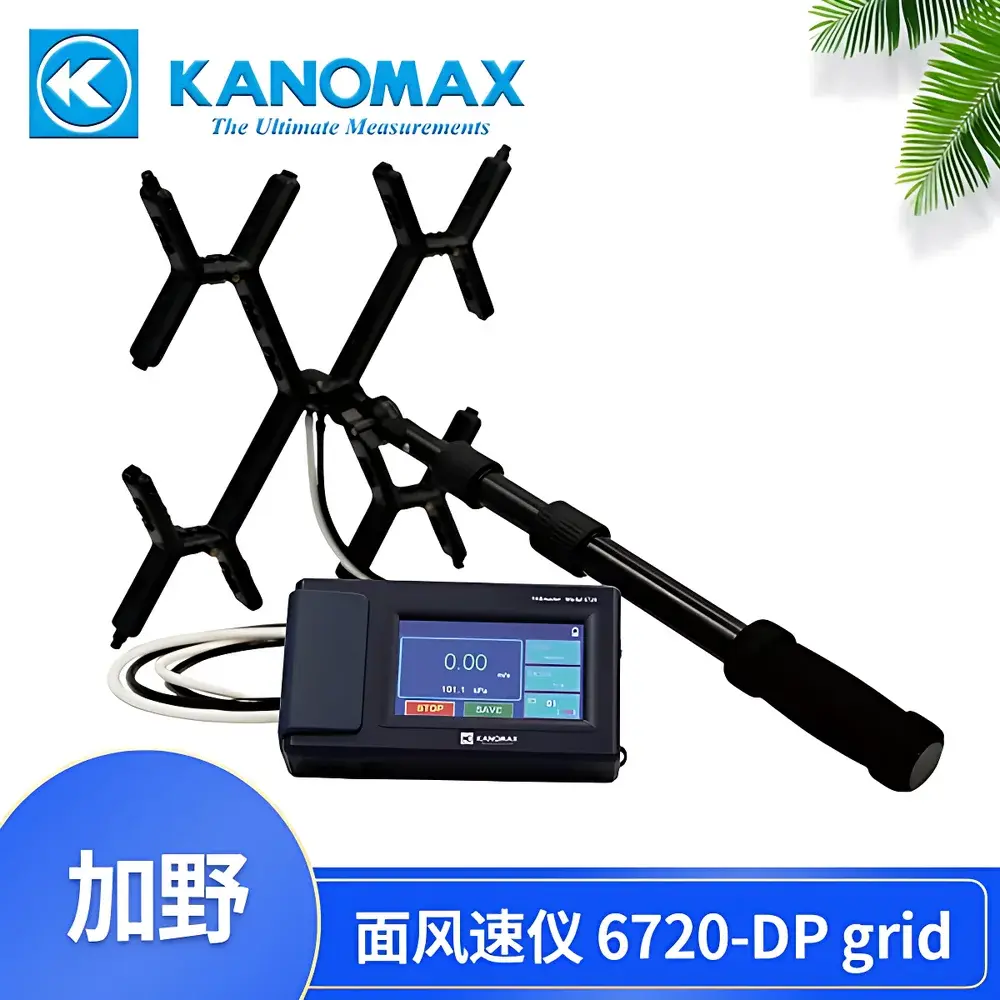
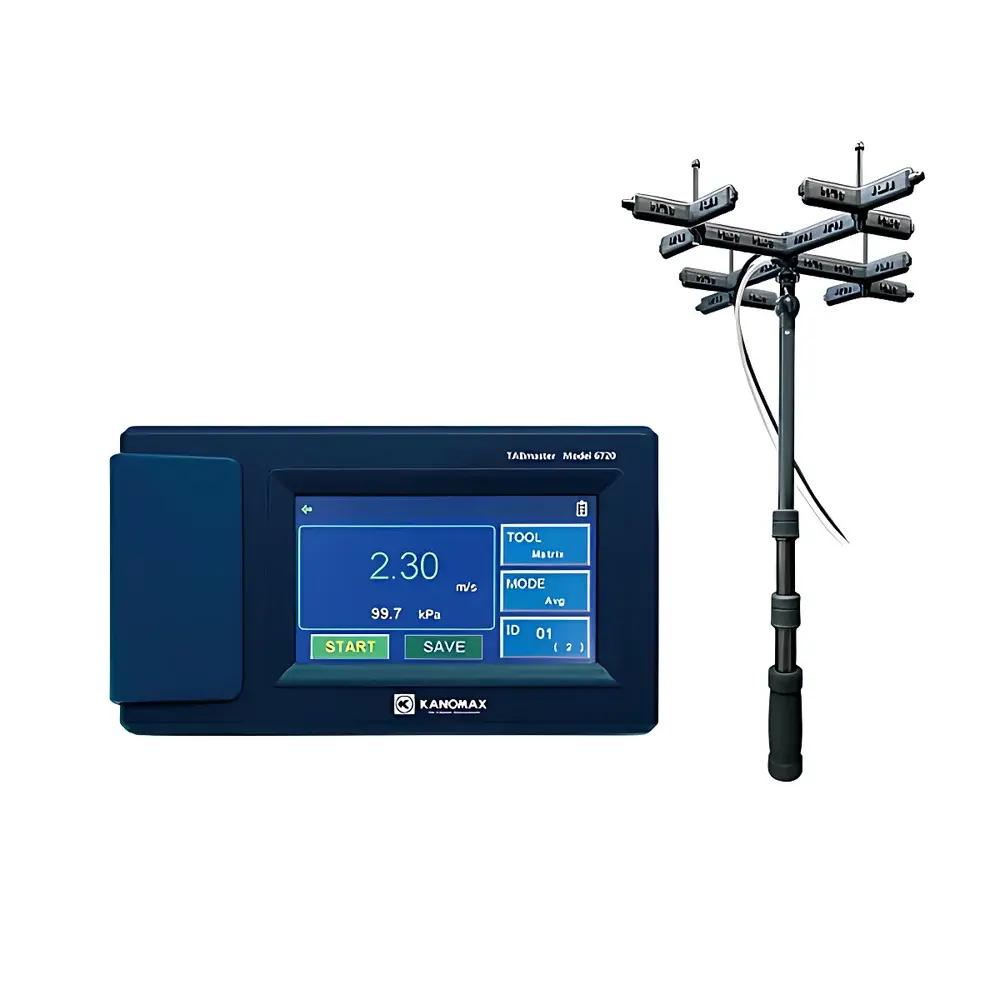
Kanomax 6720-DP Grid Multi-Function Air Velocity & Differential Pressure Analyzer
| Brand | Kanomax |
|---|---|
| Origin | Japan |
| Model | 6720-DP Grid |
| Instrument Type | Pitot Tube Anemometer with Grid Sensor Array |
| Resolution | 0.01 m/s (velocity), 0.001 Pa (differential pressure), 1 m³/h (airflow) |
| Measurement Range | 0.15–40 m/s (pitot tube), 0.15–15 m/s (grid sensor), −2500 to +2500 Pa (ΔP), 40–4300 m³/h (calculated airflow) |
| Accuracy | ±3% ±0.05 m/s (for v > 0.25 m/s), ±3% ±8 m³/h (for Q > 85 m³/h), ±1.5% ±0.25 Pa (ΔP) |
| Operating Temperature | 0–60 °C (non-condensing) |
| Operating Humidity | 0–100 %RH |
| Display | 4.3-inch full-color capacitive touchscreen |
| Data Storage | 8,000 records (host), 10,000 records (mobile app) |
| Power | 4 × AA alkaline batteries (~14 h continuous use) |
| Weight | ~3.6 kg |
Overview
The Kanomax 6720-DP Grid is a precision-engineered, multi-sensor environmental monitoring instrument designed for comprehensive air velocity, differential pressure, and volumetric airflow characterization in controlled and critical environments. Built upon a dual-sensing architecture—integrating both pitot tube and grid-type thermal anemometry—the device enables traceable, high-reproducibility measurements compliant with ISO 14644-3, ISO 14644-4, and NSF/ANSI 49 standards for biosafety cabinet certification, cleanroom commissioning, and HVAC system validation. Its core measurement principle combines dynamic pressure sensing (via calibrated pitot-static tubes) with spatially resolved thermal anemometric sampling across a 16-point grid array, allowing simultaneous point-wise velocity profiling and integrated face velocity calculation. The integrated differential pressure transducer operates on a high-stability silicon diaphragm platform, delivering sub-Pa resolution essential for low-delta applications such as fume hood face velocity verification and filter integrity assessment.
Key Features
- 4.3-inch full-color capacitive touchscreen interface with intuitive icon-driven navigation and real-time graphical display of velocity profiles, ΔP trends, and statistical summaries (max/min/avg/cumulative)
- Dual-sensing capability: interchangeable operation with pitot tube (0.15–40 m/s) or grid sensor array (0.15–15 m/s), enabling both point-source and area-averaged measurements per ISO 14644-3 Annex B.3
- Integrated differential pressure module (−2500 to +2500 Pa) with ±1.5% ±0.25 Pa accuracy, supporting ASHRAE 110 tracer gas testing and duct static pressure balancing
- Bluetooth 5.0 wireless connectivity for secure, low-latency pairing with iOS/Android mobile devices; supports direct printing via Bluetooth-enabled thermal printers
- K-factor compensation algorithm for customized calibration against NIST-traceable reference instruments, configurable per probe type and duct geometry
- Extended data logging: 8,000 measurement sets stored locally (with timestamp, location tag, operator ID, and environmental metadata); 10,000 records synchronized to cloud-ready mobile application
- Low-power architecture: 14-hour continuous runtime on standard AA alkaline cells; auto-sleep mode activates after 5 minutes of inactivity to preserve battery life
Sample Compatibility & Compliance
The 6720-DP Grid is validated for use across diverse air handling configurations including laminar flow hoods, biological safety cabinets (Class I, II, III), cleanroom supply diffusers, HVAC terminal units, and exhaust stacks. Its grid sensor conforms to the physical footprint requirements defined in EN 1822-4 for localized velocity mapping during HEPA filter scanning. All measurement modes support GLP-compliant audit trails when used with the companion Kanomax SmartLog Pro software—enabling electronic signatures, user access control, and 21 CFR Part 11–ready data export (CSV, PDF, XML). Device firmware and calibration certificates are maintained under Kanomax’s ISO/IEC 17025-accredited quality system, ensuring metrological traceability to JCSS (Japan Calibration Service System) and NIST.
Software & Data Management
The Kanomax SmartLog Pro mobile application (iOS/Android) provides full remote instrument control—including parameter configuration, K-factor adjustment, unit switching (m/s, ft/min, m³/h, CFM), language selection (English, Japanese, Chinese, German, French), and real-time data streaming. All datasets embed contextual metadata: date/time stamp, GPS coordinates (optional), ambient temperature/humidity (if external sensors connected), and operator credentials. Export options include encrypted USB transfer, email-attached PDF reports with embedded pass/fail indicators, and CSV files compatible with LIMS integration. Audit logs record all configuration changes, data deletions, and calibration events—supporting FDA inspection readiness and internal QA review cycles.
Applications
- Biosafety cabinet face velocity verification per NSF/ANSI 49 Section 6.3.1.1 and EU Annex 1 requirements
- Cleanroom airflow uniformity and directional flow assessment in ISO Class 5–8 environments
- HVAC system commissioning: duct traverse surveys, terminal unit balancing, and outdoor air intake quantification
- Fume hood performance validation using ASHRAE 110 methodology (face velocity + tracer gas capture efficiency)
- Filter leak testing support via upstream/downstream ΔP monitoring during PAO or DOP challenge tests
- Energy audit workflows requiring volumetric airflow reconciliation across AHUs and VAV boxes
FAQ
What standards does the 6720-DP Grid support for cleanroom certification?
It complies with ISO 14644-3 Annex B.3 for grid-based face velocity mapping and supports reporting formats required by EU GMP Annex 1 and FDA Aseptic Processing Guidance.
Can the grid sensor be calibrated independently from the pitot tube?
Yes—each sensor type has its own calibration certificate; field recalibration is performed using Kanomax’s traceable wind tunnel verification kit (Model CAL-6720-G).
Is the Bluetooth connection encrypted and secure for regulated environments?
All Bluetooth communication uses AES-128 encryption and adheres to IEEE 802.15.1 security protocols; pairing requires manual confirmation on both host and mobile device.
Does the device meet FDA 21 CFR Part 11 requirements for electronic records?
When used with SmartLog Pro v3.2+ and enabled audit trail settings, it satisfies Part 11 criteria for electronic signatures, data integrity, and system validation documentation.
What is the recommended recalibration interval?
Kanomax recommends annual recalibration against accredited standards; however, frequency may be adjusted per internal SOPs based on usage intensity and criticality of application.
Related Products







