
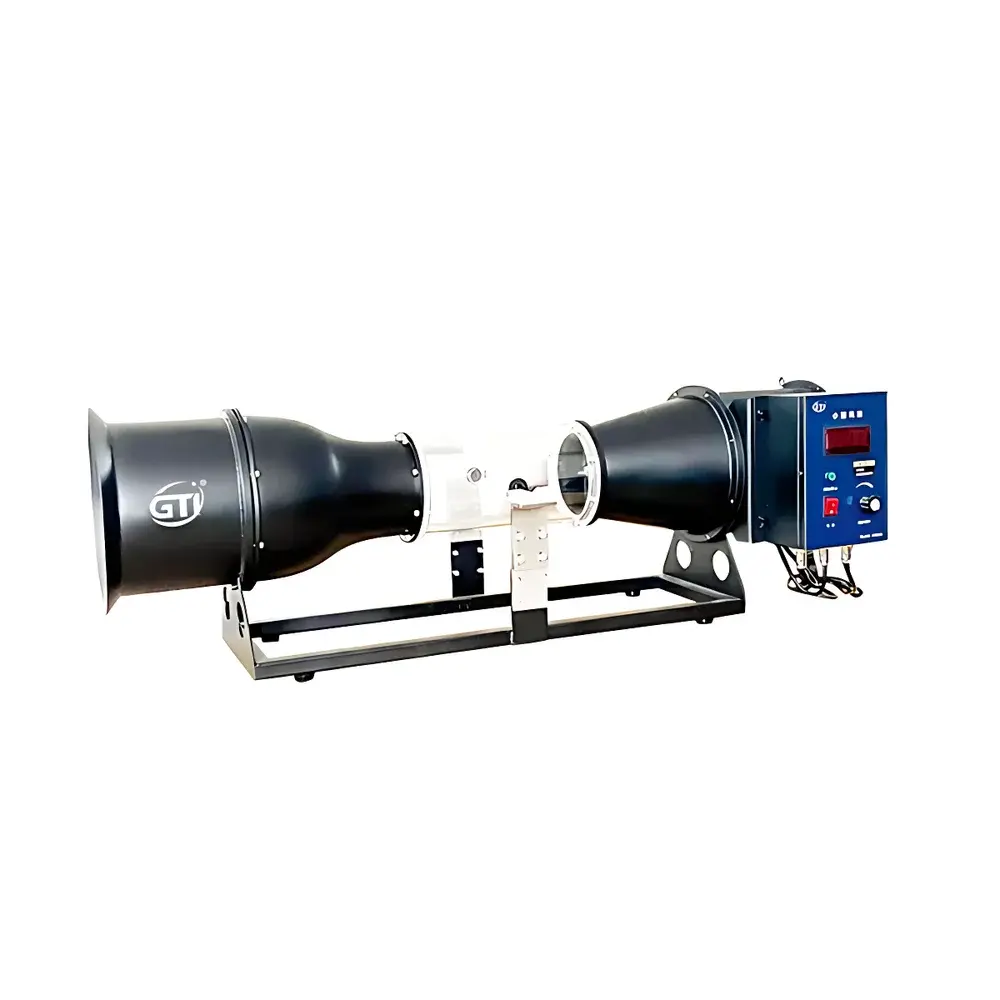
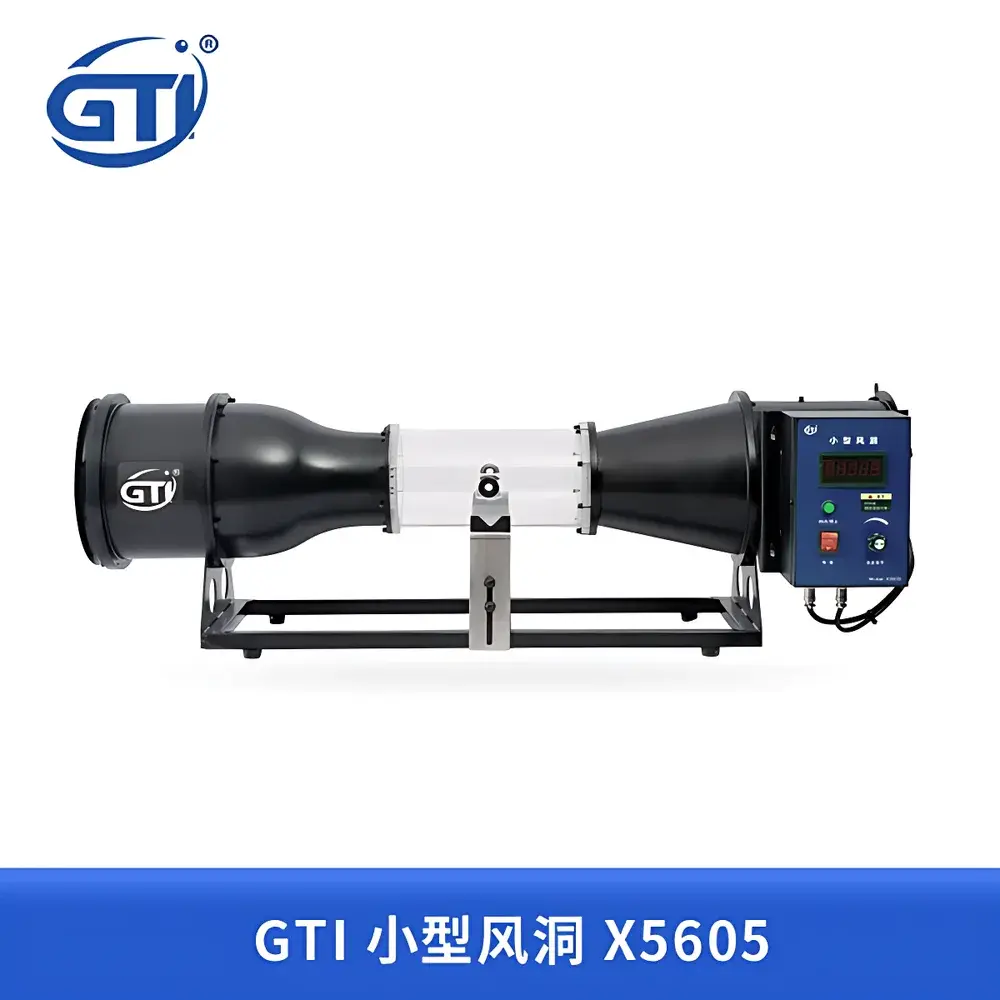
GTI X5605 Compact DC Suction-Type Experimental Wind Tunnel with Integrated Honeycomb Flow Straightener
| Key | Brand: GTI |
|---|---|
| Model | X5605 |
| Type | DC suction-type wind tunnel |
| Airspeed Range | 1–30 m/s |
| Test Section Dimensions | 230 mm (L) × φ120 mm (ID) |
| Test Port Diameter | φ2–20 mm |
| Overall Dimensions | 1002 × 237 × 319 mm |
| Power Supply | AC 220 V, 50 Hz, 450 W |
| Weight | ~20 kg |
| Flow Conditioning | Integrated honeycomb straightener |
| Visibility | Transparent test section |
| Compliance | Designed for ISO/IEC 17025-aligned calibration workflows and ASTM D2655-22 (Standard Practice for Calibration of Anemometers) |
Overview
The GTI X5605 Compact DC Suction-Type Experimental Wind Tunnel is an engineered flow calibration and aerodynamic research platform designed for laboratory-scale validation, sensor characterization, and small-model testing. Operating on the principle of controlled axial suction flow, the system generates a steady, low-turbulence airstream within a precisely dimensioned test section. Its core architecture integrates a high-efficiency DC-driven centrifugal blower, variable-frequency speed control, and a certified honeycomb flow straightener—ensuring laminarized, axis-aligned flow with minimal radial velocity deviation (< ±1.2% across the cross-section at 15 m/s, per internal verification protocol). Unlike open-loop or fan-bench setups, the X5605’s closed-loop suction configuration minimizes ambient interference and enables repeatable boundary-layer development, making it suitable for both quantitative metrology and qualitative flow visualization applications.
Key Features
- Stable, programmable airspeed range from 1 to 30 m/s, adjustable via digital speed controller with ±0.1 m/s resolution and < 0.5% full-scale repeatability over 8-hour continuous operation.
- Integrated aluminum honeycomb straightener (cell size: 6 mm, length-to-diameter ratio: 12) upstream of the test section, reducing turbulence intensity to ≤0.8% at mid-range velocities (10–25 m/s), as verified by hot-wire anemometry per ISO 20785-2:2021 Annex C.
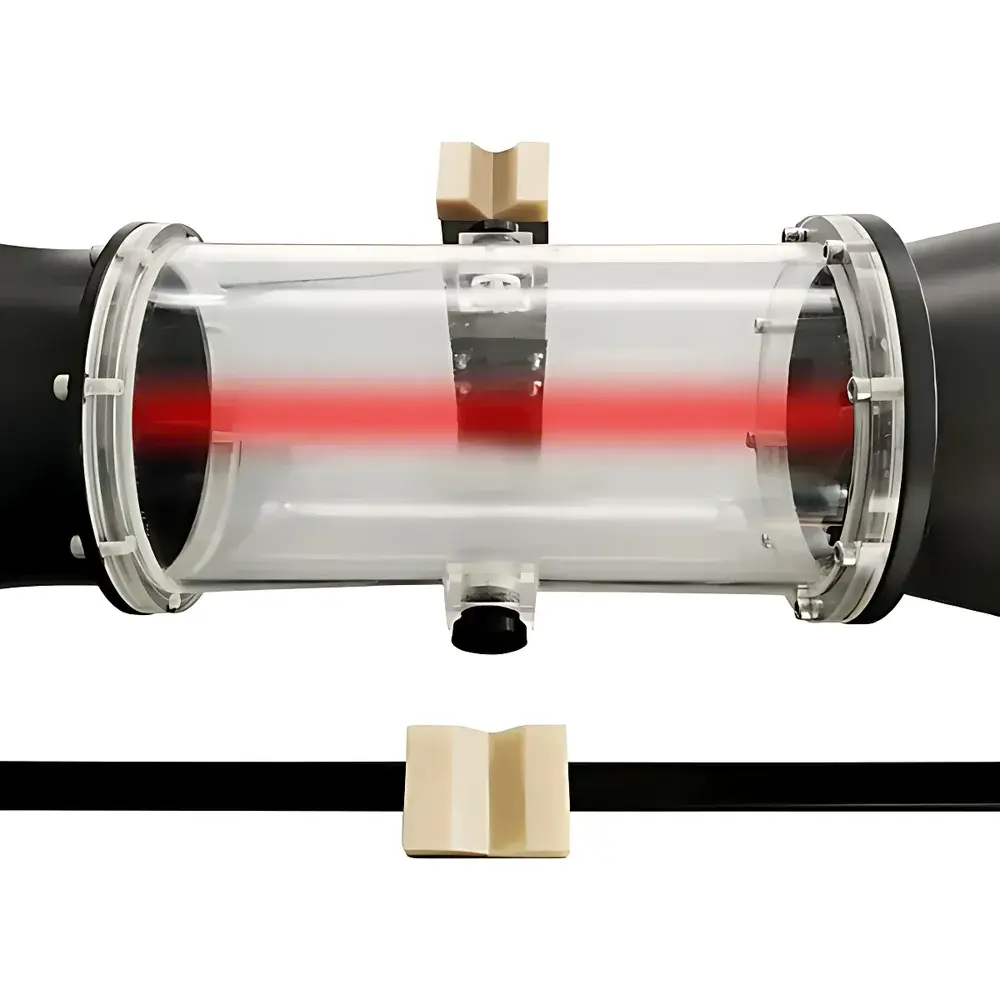
- Optically transparent acrylic test section (230 mm long × φ120 mm internal diameter) with dual side-view ports and top-mounted smoke injection port—enabling real-time PIV seeding, laser sheet illumination, or dye-stream visualization.
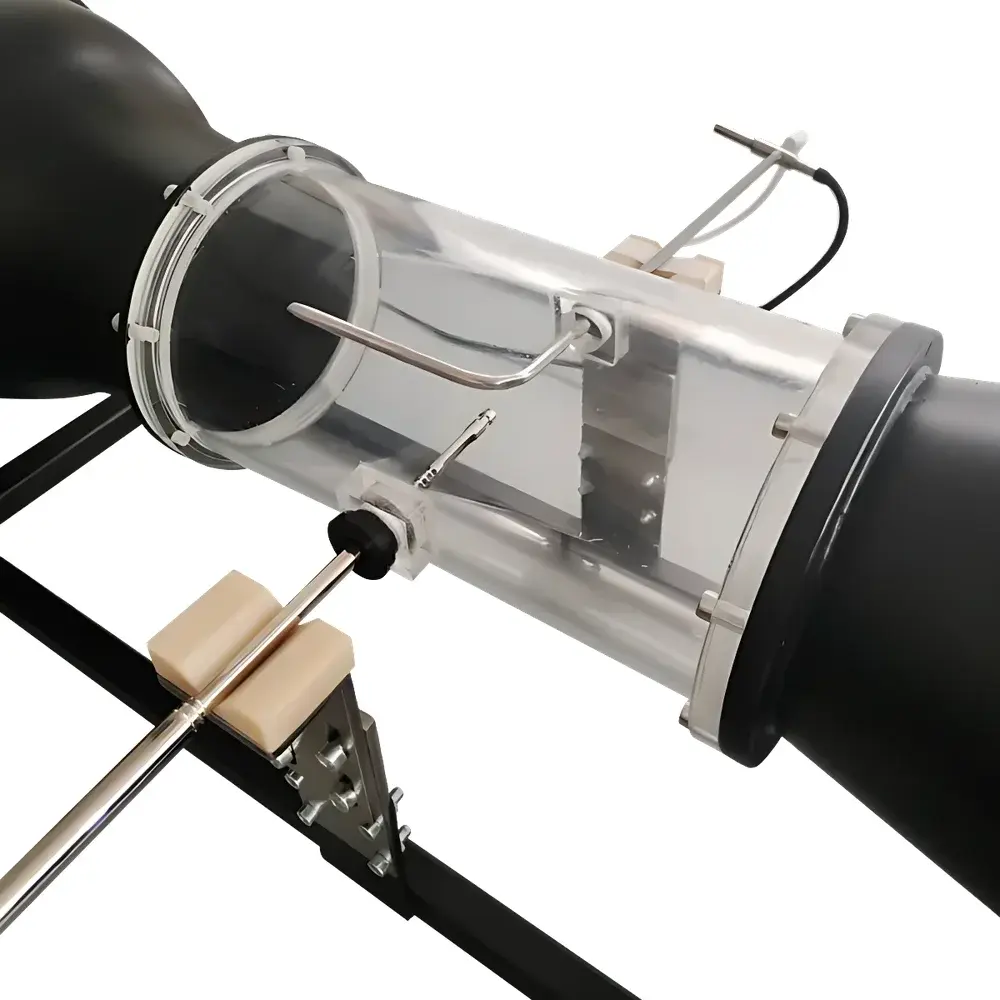
- Modular test port interface accommodating cylindrical sensors (φ2–20 mm) via interchangeable O-ring-sealed collars; includes standard NPT 1/4″ and metric M12×1.0 mounting adapters.
- Self-contained mechanical design: no external ducting, vibration isolation feet, and compact footprint (1002 × 237 × 319 mm); operates independently on standard 220 V / 50 Hz supply with peak power draw of 450 W.
- Pre-calibrated reference-grade pressure taps integrated at inlet and static wall positions, compatible with external differential manometers or data acquisition systems supporting 0–10 V analog output or RS-485 Modbus RTU.
Sample Compatibility & Compliance
The X5605 accommodates a broad spectrum of test objects: cup/vane anemometers, thermal anemometers, Pitot-static tubes, miniature airfoils (up to 80 mm chord), HVAC diffuser models, and MEMS-based flow sensors. Its test section geometry conforms to recommended dimensions for Class II wind tunnels under ASTM E741-21 (Standard Test Method for Determining Air Change Rates in a Single Zone by Means of a Tracer Gas). While not certified as a primary standard, the system meets functional requirements for secondary calibration per ISO/IEC 17025:2017 Clause 6.4.3 when operated within documented environmental conditions (20 ± 2 °C, RH < 70%, no direct airflow drafts). All structural components comply with RoHS Directive 2011/65/EU and CE machinery directive 2006/42/EC.
Software & Data Management
The X5605 operates in standalone mode but supports optional integration with GTI’s WindTune™ LabSuite v3.2—a Windows-based application enabling automated speed ramping, synchronized data logging (up to 1 kHz sampling), and real-time turbulence intensity calculation. The software exports time-stamped CSV files compliant with ASTM E29-23 rounding conventions and includes built-in audit trail functionality satisfying FDA 21 CFR Part 11 requirements for electronic records (user authentication, action logging, and immutable timestamps). Raw sensor inputs may be routed directly into third-party platforms including LabVIEW™, MATLAB® Data Acquisition Toolbox, or Python-based PyDAQmx libraries via USB-to-serial or analog voltage interfaces.
Applications
- Primary and secondary calibration of anemometers and air velocity sensors against traceable reference standards.
- Aerodynamic coefficient measurement (CL, CD, CM) on scaled models using six-component force balances mounted on the removable floor plate.
- Boundary layer profiling using traversing hot-film probes or micro-PIV systems.
- Smoke-wire and particle image velocimetry (PIV) training and method validation in university fluid mechanics laboratories.
- Product development support for HVAC component manufacturers—including grille, register, and damper airflow characterization under standardized test conditions.
- Validation of CFD simulation boundary conditions and turbulence model inputs through experimental velocity profile mapping.
FAQ
Is the X5605 suitable for ISO/IEC 17025 accredited calibration labs?
Yes—when used with documented procedures, environmental monitoring, and traceable reference instruments, the X5605 fulfills infrastructure requirements for wind speed calibration under Clause 6.4.3 of ISO/IEC 17025:2017.
Can the test section be modified for custom sensor integration?
The standard acrylic tube features four tapped M4 ports (two lateral, two axial); custom flanges or feedthroughs can be fabricated using GTI’s dimensional drawings (available under NDA).
Does the system include uncertainty budget documentation?
A comprehensive uncertainty analysis report (GUM-compliant, k=2) is provided with each unit, covering contributions from speed control, temperature drift, honeycomb degradation, and alignment tolerance.
What maintenance is required for long-term stability?
Annual inspection of honeycomb integrity, blower bearing lubrication, and recalibration of the speed controller’s tachometer feedback loop using a handheld optical tachometer.
Is remote operation supported?
Yes—via optional Ethernet-enabled controller module (part #X5605-ETH), supporting Modbus TCP and HTTP API for integration into building management or lab automation systems.
Related Products







