
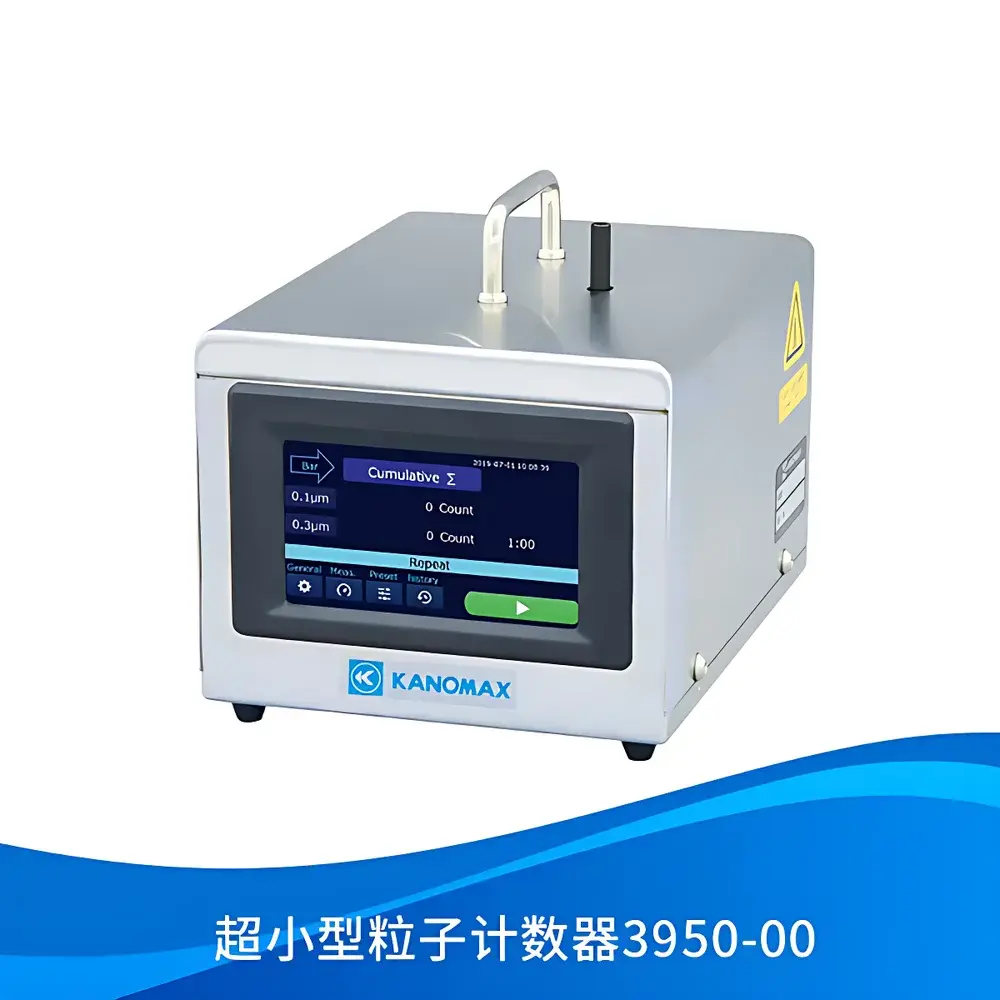
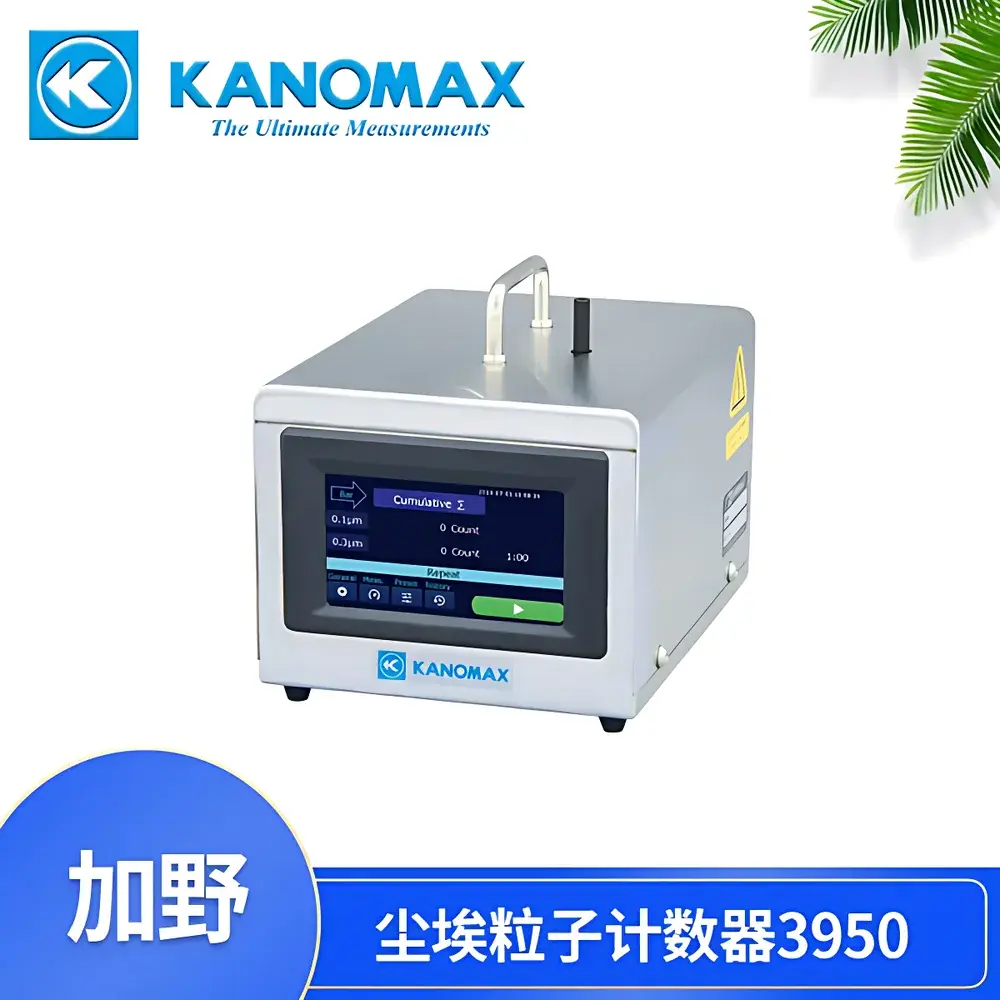
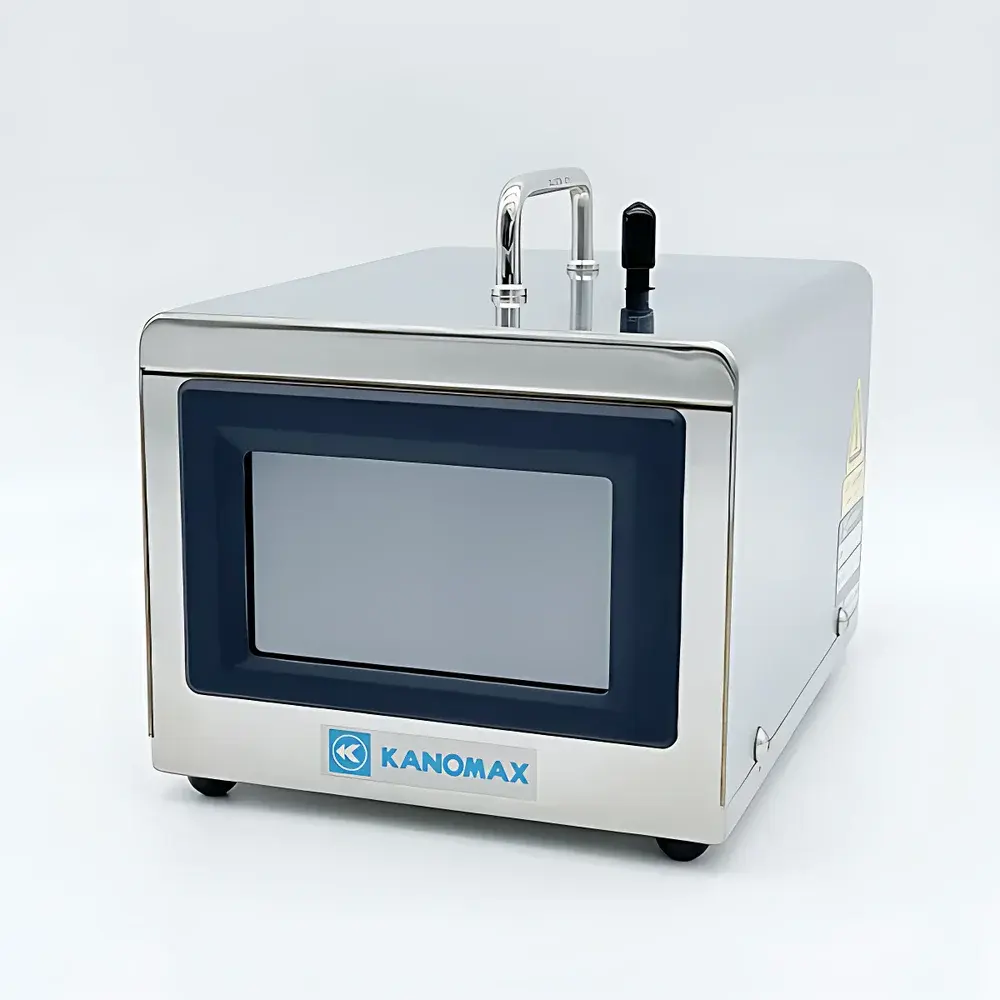
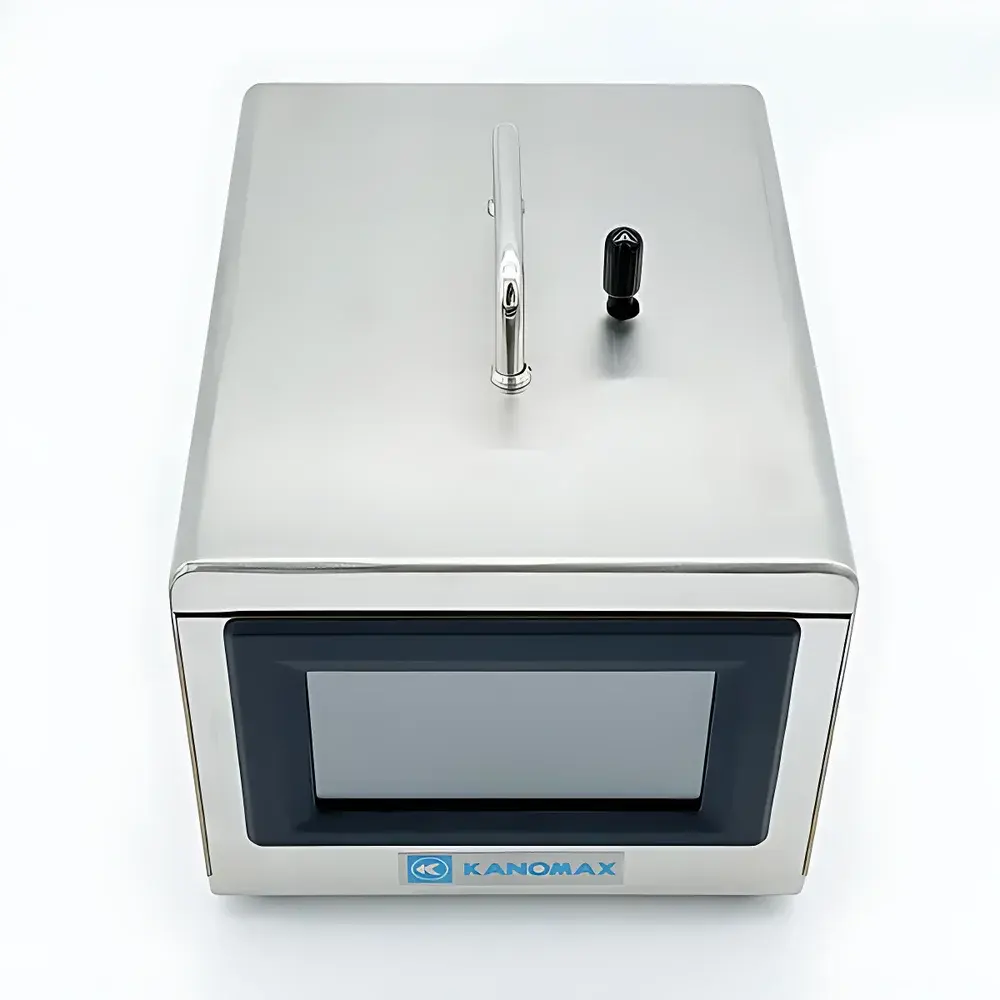
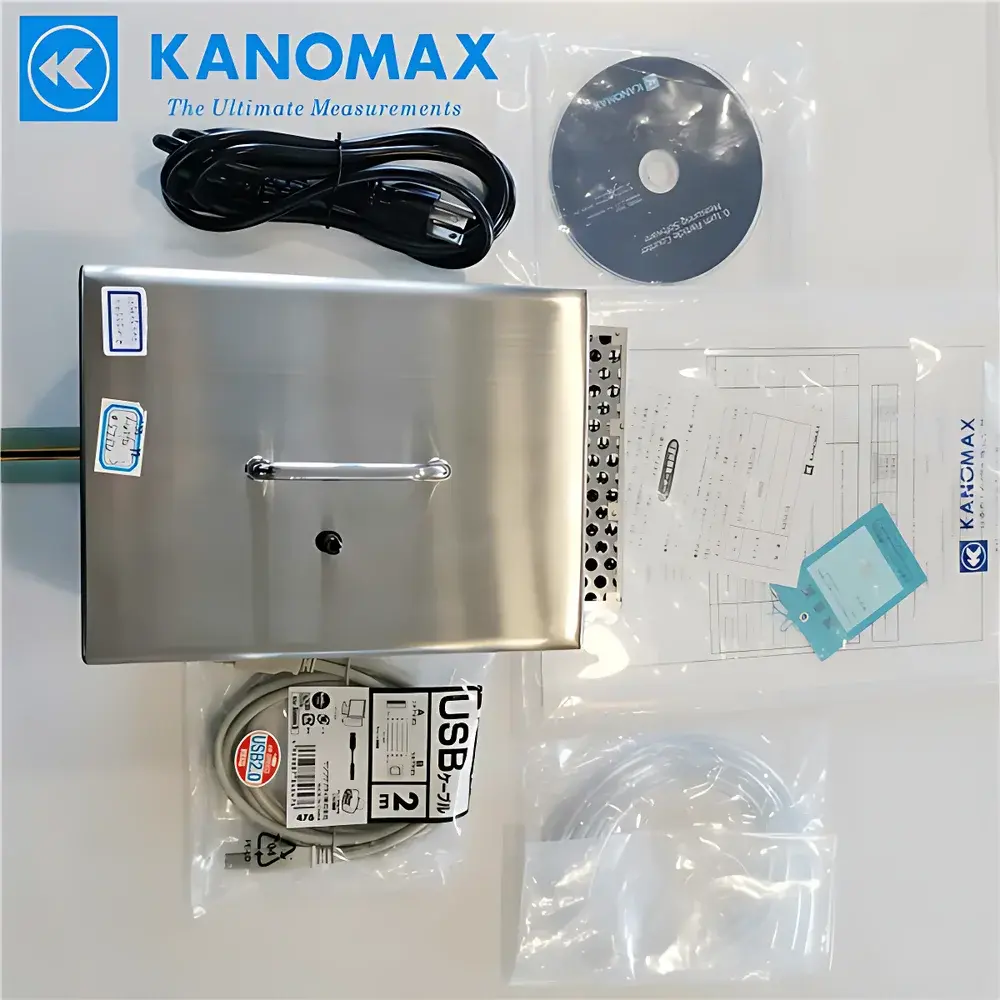
KANOMAX 3950-00 Ultra-Small Particle Counter for Semiconductor Cleanroom Monitoring (0.1 μm Detection Threshold)
| Brand | KANOMAX |
|---|---|
| Origin | Japan |
| Model | 3950-00 |
| Flow Rate | 2.83 L/min (0.1 CFM) |
| Flow Accuracy | ±5% |
| Timing Accuracy | ±1 s per 6 min |
| Repeatability | ±5% |
| Size Distribution Error | ±15% |
| Indication Error | ±30% |
| Particle Detection Channels | 0.1 μm & 0.3 μm |
| Max Concentration | 10⁷ particles/m³ |
| Counting Efficiency | 50±20% @ 0.1 μm (PSL), 100±10% @ 0.15–0.2 μm (PSL) |
| False Count Rate | <1 count/35 min |
| Size Resolution | ≤15% (vs. 0.3 μm PSL) |
| Display | 4.3″ color TFT touchscreen |
| Communication | RS-485, Ethernet (10/100BASE-T), USB Host/Device |
| Data Storage | internal memory (10,000 records, CSV) |
| Operating Environment | 15–35 °C, 0–85% RH (non-condensing) |
| Dimensions | 150 × 163 × 228 mm |
| Weight | 3.4 kg |
| Compliance | JIS B9921, ISO 21501-4 |
Overview
The KANOMAX 3950-00 is an ultra-compact, high-sensitivity optical particle counter engineered specifically for real-time airborne particulate monitoring in semiconductor cleanroom environments where sub-0.2 μm contamination control is critical. Utilizing calibrated light scattering detection with a 635 nm laser diode and optimized photodetector geometry, the instrument achieves reliable quantification of particles down to 0.1 μm—meeting the stringent resolution requirements of ISO Class 1–3 cleanrooms and advanced photolithography tool integration. Its design prioritizes embeddability: at just 3.4 kg and 150 × 163 × 228 mm, it integrates seamlessly into process tools, mini-environments, and automated monitoring subsystems without compromising metrological integrity. The device operates on the principle of single-particle light scattering intensity correlation, where pulse height analysis enables binary discrimination across two fixed size thresholds (0.1 μm and 0.3 μm), conforming to ISO 21501-4’s calibration and performance validation framework for condensation-free aerosol counters.
Key Features
- Sub-0.1 μm detection capability validated per ISO 21501-4 and JIS B9921, with counting efficiency certified at 50±20% for 0.1 μm PSL standards and 100±10% for particles ≥0.15 μm.
- Ultra-compact form factor (150 × 163 × 228 mm) and lightweight construction (3.4 kg) enabling OEM integration into track-in systems, FOUP load ports, and chamber-side monitoring nodes.
- 4.3-inch full-color resistive touchscreen interface supporting intuitive local operation, real-time histogram visualization, and on-device data review—including cumulative (∑), differential (Δ), and bar-chart display modes.
- Dual-channel simultaneous counting (0.1 μm and 0.3 μm) with 2.83 L/min (0.1 CFM) volumetric flow, maintained via integrated diaphragm pump and regulated to ±5% accuracy under variable backpressure conditions.
- Multi-mode measurement scheduling: configurable sampling duration (6 s – 99:59 min), interval timing, location tagging (up to 99 sites), and operational modes including repeat, single-shot, continuous, ISO-compliant statistical reporting, and GB/T-based classification.
- Robust communications architecture featuring isolated RS-485 (9.6–38.4 kbps), 10/100BASE-T Ethernet with DHCP/Static IP support, and dual-role USB (Host for direct printing or USB storage; Device for PC synchronization).
Sample Compatibility & Compliance
The KANOMAX 3950-00 is designed for ambient and process-air sampling in controlled environments with non-corrosive, non-explosive, and non-oily aerosols. It is not intended for use with aggressive solvents, high-humidity saturated streams (>85% RH), or particulates containing volatile organics that may coat optics. All optical path components are sealed and anti-static coated to minimize surface contamination drift. The instrument complies fully with ISO 21501-4:2018 (Determination of particle size distribution — Single particle light interaction methods) and JIS B9921:2010 (Cleanroom particle counters — Calibration and testing methods). Its counting uncertainty profile satisfies the maximum permissible error limits defined in Annex C of ISO 21501-4 for 0.1–0.3 μm size bins. While not intrinsically rated for hazardous locations, its low-power electronics (AC 100–240 V, 50/60 Hz) and thermal management permit deployment in Class 100–Class 1 clean zones under standard GMP and SEMI S2 guidelines.
Software & Data Management
Data acquisition and reporting are supported through KANOMAX’s proprietary PC software suite (compatible with Windows 10/11), which provides secure configuration, remote firmware updates, and time-synchronized multi-unit fleet monitoring. Raw measurements are stored internally as timestamped CSV files (up to 10,000 records), each containing channel-specific counts, sampling duration, location ID, and environmental timestamps. Exported datasets include metadata fields required for audit trails under FDA 21 CFR Part 11 (when used with validated software configurations and electronic signature protocols). The Ethernet interface supports Modbus TCP register mapping for SCADA-level integration into facility-wide environmental monitoring systems (EMS), enabling automated alarm triggering upon threshold exceedance in either size channel. USB Device mode allows direct connection to laboratory PCs for manual data retrieval without network dependency.
Applications
- Semiconductor front-end manufacturing: real-time monitoring at lithography steppers, etch cluster tools, and chemical vapor deposition (CVD) load locks.
- Advanced packaging cleanrooms: verification of particle excursions during wafer bumping, flip-chip assembly, and fan-out wafer-level packaging (FOWLP) processes.
- OEM equipment integration: embedded sensing in automated material handling systems (AMHS), mini-environment enclosures, and reticle storage cabinets.
- Pharmaceutical aseptic processing: supplemental monitoring in ISO 5 critical zones where 0.1 μm sensitivity enhances early detection of polymer shedding or filter degradation.
- Research cleanrooms: quantitative assessment of ULPA filter performance, airflow turbulence effects, and personnel gowning efficacy using standardized challenge aerosols.
FAQ
What calibration standards does the 3950-00 reference for 0.1 μm detection?
It uses NIST-traceable polystyrene latex (PSL) spheres calibrated per ISO 21501-4 Annex D, with primary validation performed against reference instruments accredited to ISO/IEC 17025.
Can the device operate continuously for unattended 24/7 monitoring?
Yes—its thermal design and solid-state pump support indefinite continuous sampling when powered from a stable AC source and deployed within specified temperature/humidity ranges.
Is the internal memory data export compliant with ALCOA+ principles?
Raw CSV exports contain immutable timestamps, instrument ID, and measurement metadata; full ALCOA+ compliance requires implementation of validated software controls and access governance per organizational SOPs.
Does the unit support external trigger inputs for synchronized sampling?
No native hardware trigger input is provided; synchronization is achieved via Ethernet-based command polling or scheduled interval execution.
How often is recalibration recommended for GMP-regulated use?
Annual recalibration is recommended per ISO 21501-4 Clause 8.3; more frequent verification (e.g., quarterly) using check particles is advised in high-criticality applications.
Related Products







