
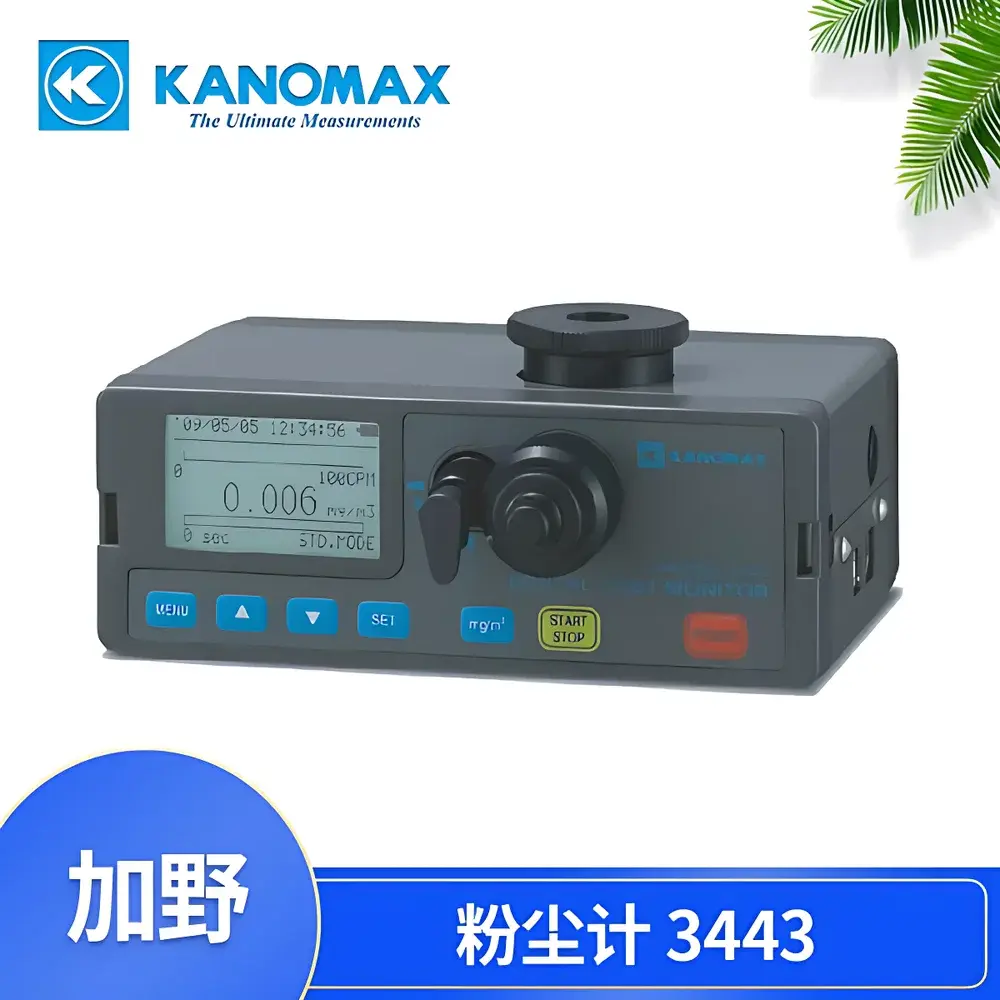
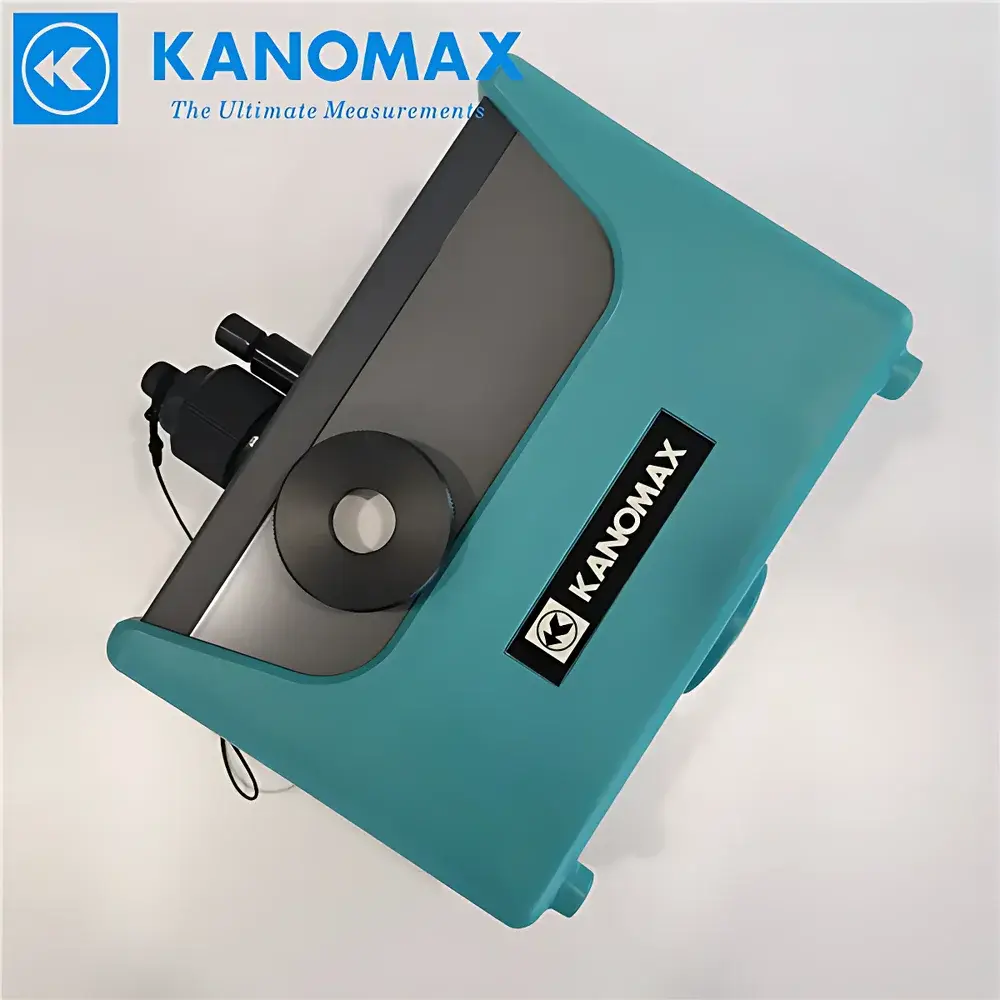
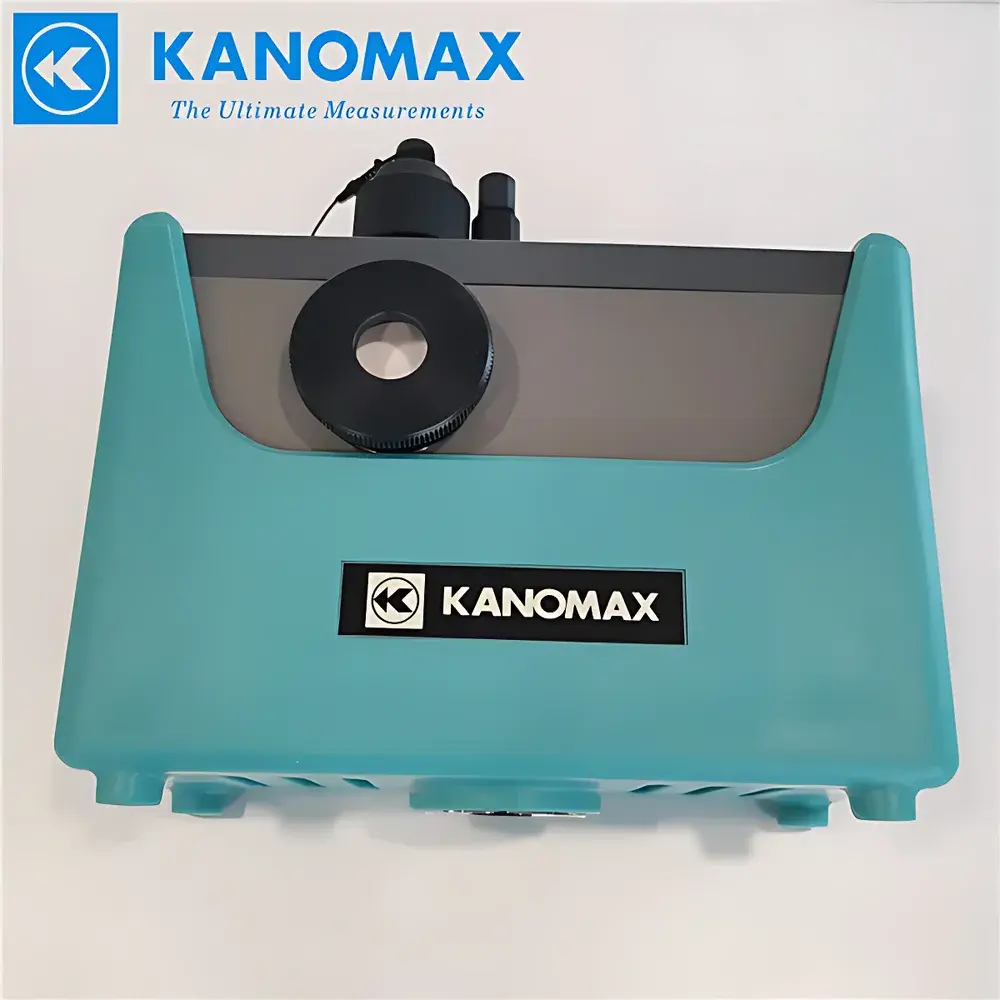
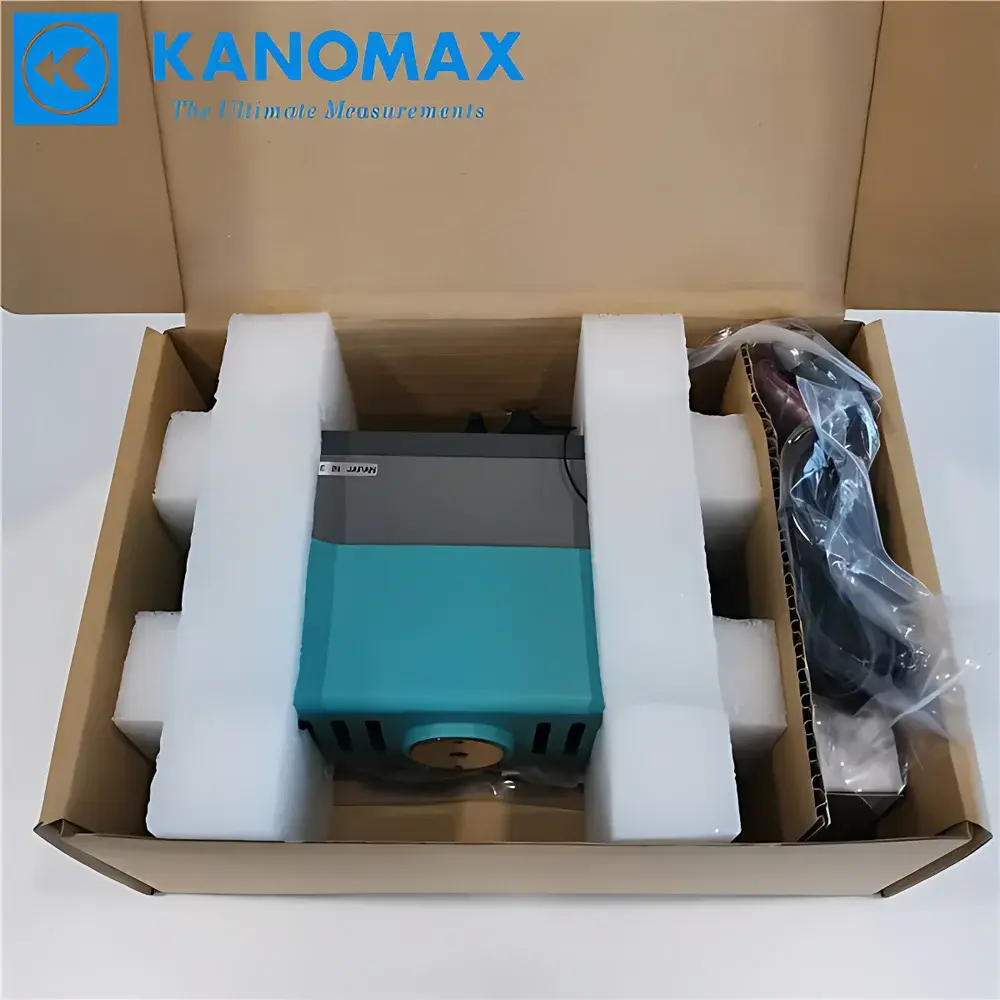
Kanomax Model 3443 Laser Light Scattering Dust Monitor
| Brand | Kanomax |
|---|---|
| Origin | Japan |
| Model | 3443 |
| Measurement Principle | Laser Light Scattering |
| Particle Size Range | 0.1–10 μm |
| Measurement Range | 0.001–10.000 mg/m³ |
| Resolution | 0.01 mg/m³ |
| Accuracy | ±10% |
| Relative Error | ≤±2% |
| Data Storage Capacity | 100,000 records |
| Communication Interface | USB |
| Analog Output | 0–1000 CPM / 0–1 V |
| Dimensions | 162 mm (W) × 60 mm (D) × 109 mm (H) |
| Weight | Approx. 1.3 kg (including rechargeable battery) |
| Safety Classification | Non-explosion-proof |
Overview
The Kanomax Model 3443 Laser Light Scattering Dust Monitor is a portable, high-sensitivity environmental particulate monitor engineered for real-time quantitative measurement of airborne dust mass concentration in ambient and occupational environments. It operates on the principle of laser light scattering—where a collimated diode laser beam interacts with suspended particles, generating scattered light intensity proportional to particle surface area and concentration. This optical signal is converted via calibrated photodetector electronics into mass concentration values (mg/m³), traceable to gravimetric reference methods. Designed to meet the technical requirements of China’s Ministry of Health PM10 monitoring standard (WS/T 206–2001), the instrument supports regulatory compliance in indoor air quality (IAQ) assessments, occupational hygiene surveys, and environmental baseline studies. Its compact form factor and integrated rechargeable battery enable unattended field deployment for up to 8 hours, while its robust mechanical architecture ensures stable performance across variable temperature and humidity conditions typical of industrial and laboratory settings.
Key Features
- Laser-based optical detection system optimized for 0.1–10 μm particle size range, covering respirable (PM4), thoracic (PM10), and coarse-mode aerosols
- High-resolution concentration readout at 0.01 mg/m³, with measurement range spanning three orders of magnitude (0.001–10.000 mg/m³)
- Onboard data logging capacity for 100,000 timestamped records, including instantaneous values, min/max extremes, and arithmetic mean over user-defined intervals
- Dual analog output channels (0–1 V) supporting simultaneous connection to external data acquisition systems or PLCs for continuous process monitoring
- USB interface compliant with CDC/ACM class protocols, enabling direct communication with Windows- and macOS-based PCs for configuration, real-time streaming, and post-processing via Kanomax-provided software
- Self-contained operation with internal Ni-MH rechargeable battery, eliminating dependency on external power during mobile surveys or emergency response scenarios
Sample Compatibility & Compliance
The Model 3443 is validated for use in non-explosive atmospheres and is intended for sampling ambient air, indoor workplace air, and controlled environment spaces such as cleanrooms (ISO Class 5–8), pharmaceutical manufacturing zones, and HVAC ductwork. It does not require sample filtration or pre-conditioning—measurements are performed in-situ on undiluted air streams. The instrument conforms to international performance benchmarks for optical dust monitors, including ISO 17170:2013 (air quality—determination of mass concentration of inhalable, thoracic and respirable fractions of airborne particles) and aligns with the functional specifications outlined in ASTM D6245–21 (Standard Guide for Using Indoor Air Quality Investigation Protocols). While not certified to ATEX or IECEx standards, its non-sparking design and low-power electronics meet general-purpose safety requirements per IEC 61010-1 for electrical equipment used in measurement, control, and laboratory applications.
Software & Data Management
Kanomax provides dedicated PC software compatible with Windows 10/11 and macOS 12+ for instrument configuration, real-time visualization, and batch export of logged datasets in CSV and Excel formats. The software supports time-synchronized multi-channel plotting, statistical summary generation (e.g., TWA, STEL, ceiling limits), and customizable report templates compliant with GLP documentation workflows. All data transfers include embedded metadata (instrument ID, calibration date, operator tag, GPS coordinates if enabled via external module), ensuring auditability. The firmware implements secure internal clock synchronization and maintains full data integrity during power interruption—no record loss occurs during battery replacement or unexpected shutdown. For regulated environments, optional software validation packages are available to support FDA 21 CFR Part 11 compliance, including electronic signature capture, audit trail logging, and role-based access control.
Applications
- Occupational health monitoring in construction, mining, foundry, and cement production facilities
- Indoor air quality assessment in schools, hospitals, office buildings, and public transportation hubs
- Validation and routine surveillance of local exhaust ventilation (LEV) systems and dust suppression controls
- Baseline environmental monitoring near landfill sites, demolition zones, and unpaved roadways
- Research-grade particulate exposure studies in epidemiological and toxicological laboratories
- Commissioning and periodic verification of cleanroom classification per ISO 14644-1 and EU GMP Annex 1
FAQ
What particle size distribution does the Model 3443 assume for mass concentration conversion?
The instrument applies a fixed Mie scattering calibration curve derived from polydisperse PSL (polystyrene latex) aerosols, with default density and refractive index assumptions consistent with urban ambient dust (1.5 g/cm³, n = 1.54). Users may apply site-specific correction factors when characterizing known aerosol types.
Is the device suitable for outdoor long-term unattended operation?
While weather-resistant, the Model 3443 is not IP-rated for rain or dust ingress. For extended outdoor deployment, it must be installed within a NEMA 4X enclosure with temperature stabilization and inlet isokinetic sampling probe.
How often does the optical chamber require cleaning or recalibration?
Under normal indoor use, optical path inspection is recommended every 6 months; cleaning is required only if visible contamination is observed. Annual factory recalibration against NIST-traceable gravimetric standards is advised to maintain stated accuracy.
Can the analog outputs be configured for different concentration ranges?
Yes—the two analog channels are independently programmable via software to map custom linear spans (e.g., 0–2 mg/m³ → 0–1 V), supporting integration with legacy building management systems.
Does the device comply with US EPA or EU EN 12341 reference equivalency requirements?
It is not designated as an FRM/FEM device under 40 CFR Part 53, nor certified to EN 12341:2014. However, its optical methodology and performance parameters fall within the acceptable uncertainty envelope for indicative monitoring per EU Directive 2008/50/EC Annex III.
Related Products







