
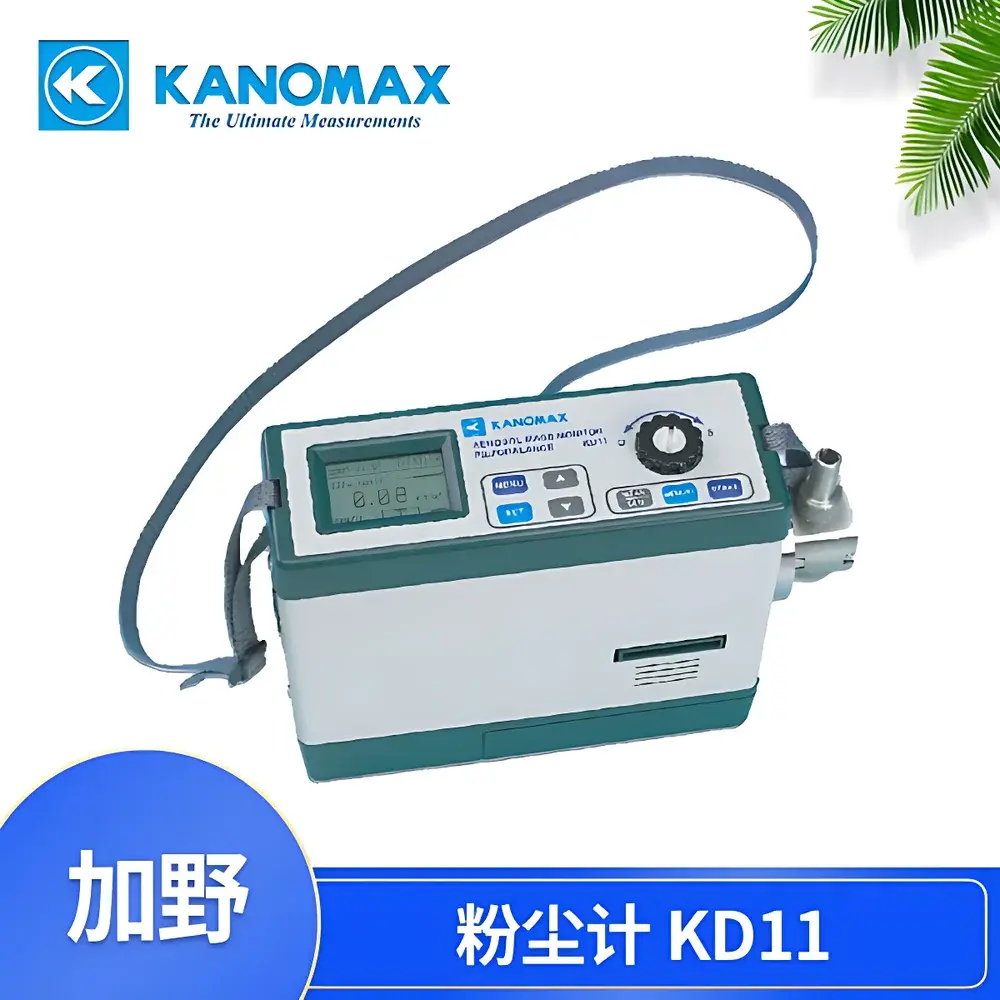
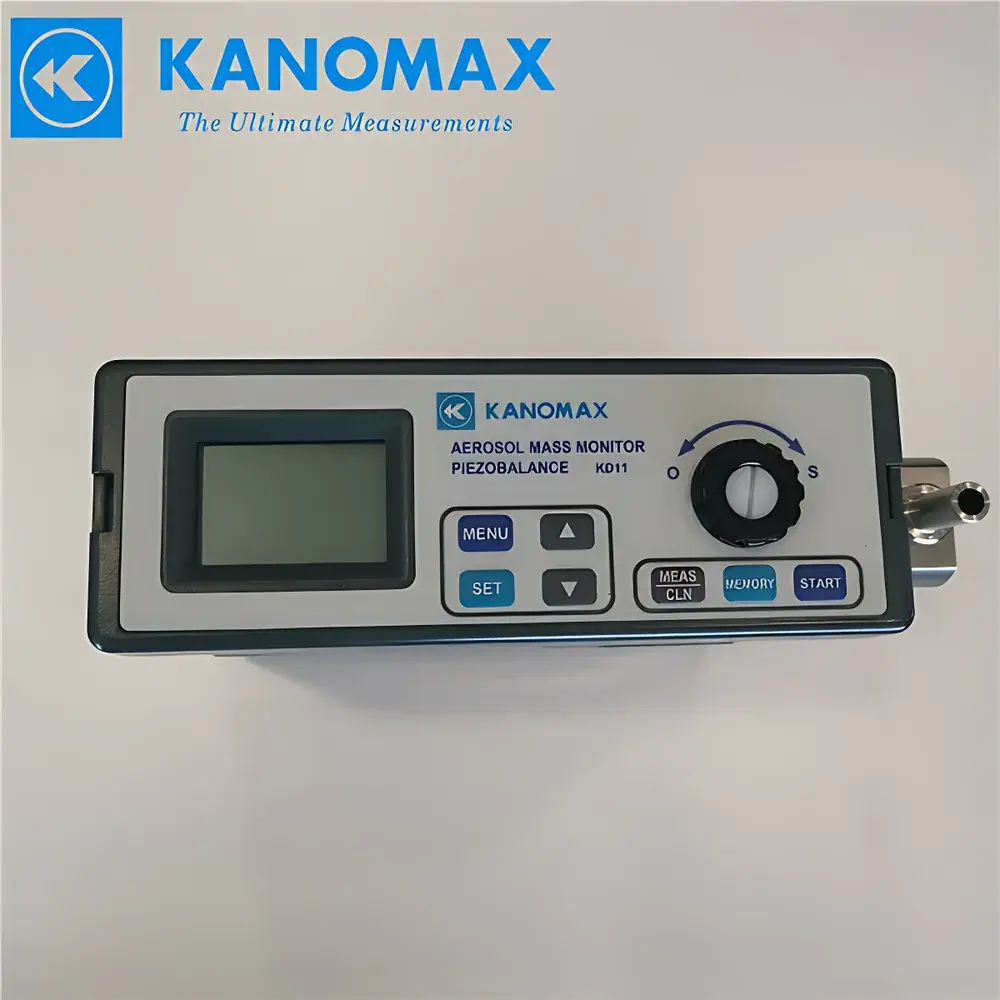
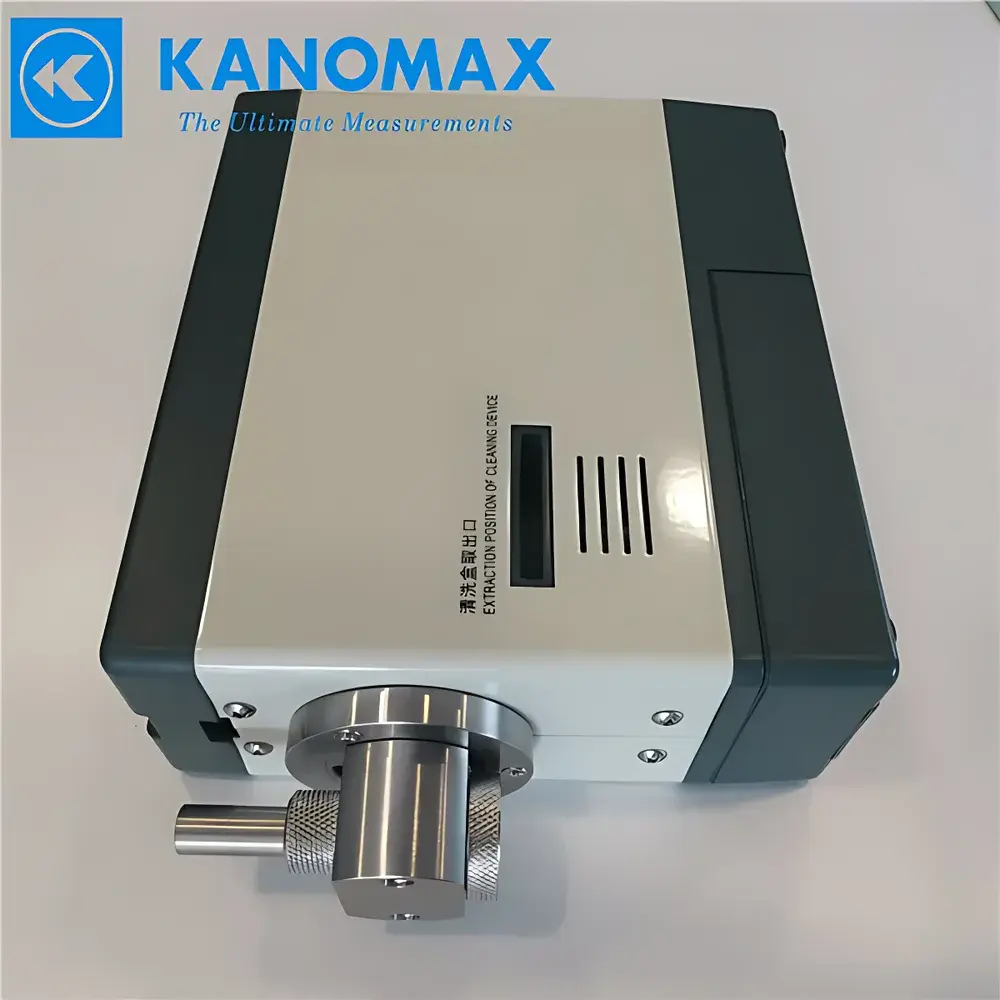
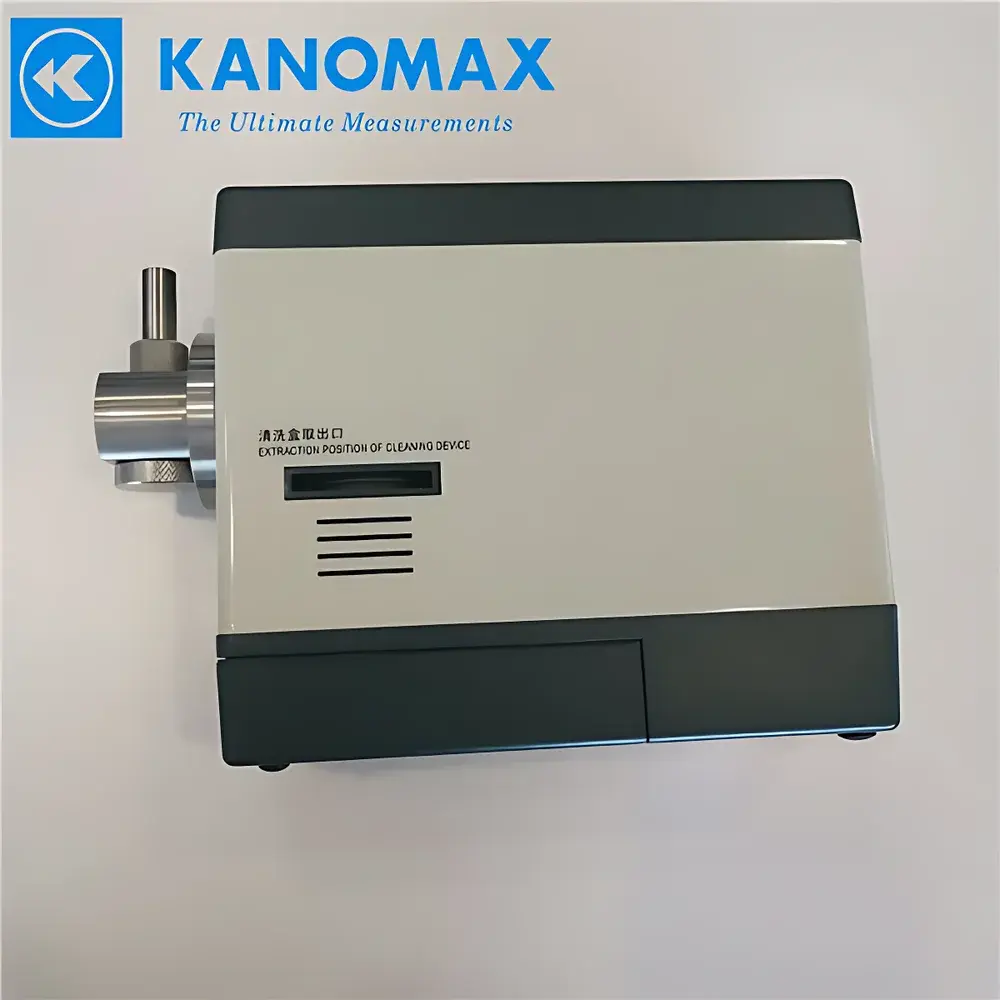
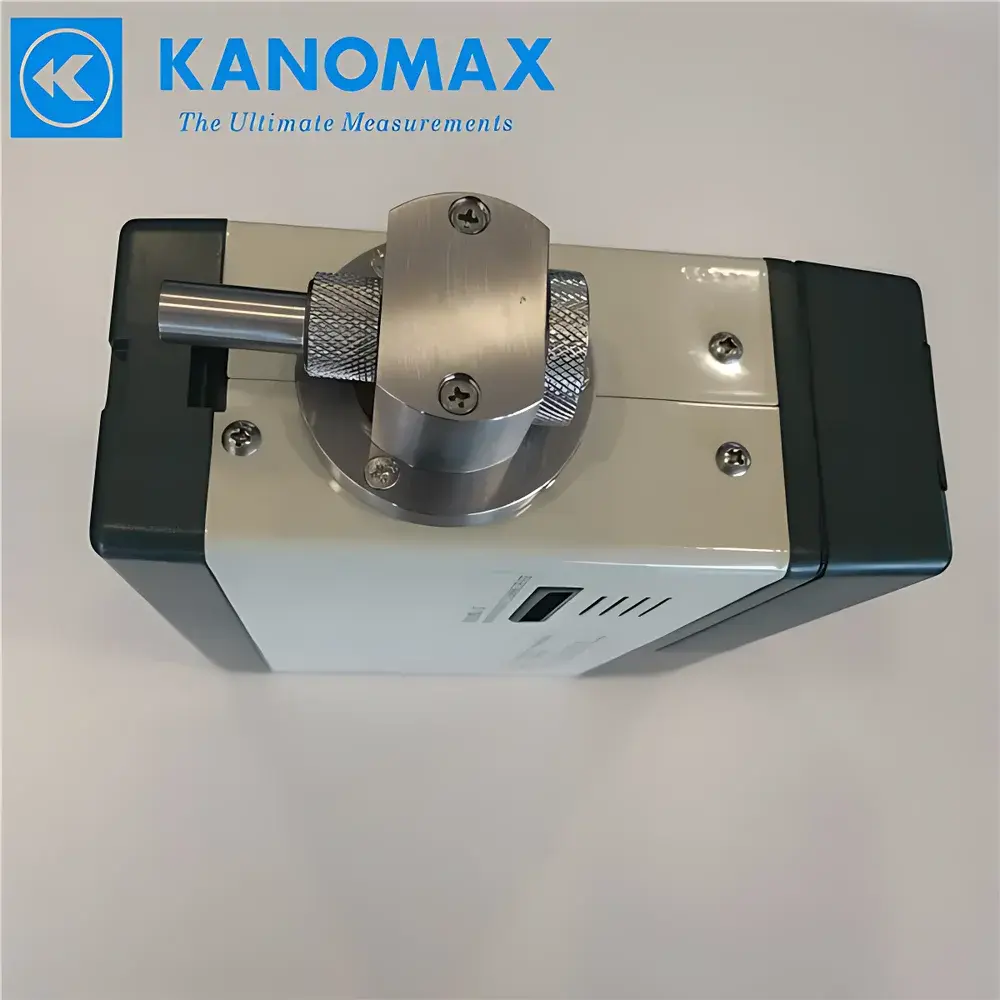
Kanomax KD11 Piezoelectric Microbalance Dust Monitor
| Brand | Kanomax |
|---|---|
| Model | KD11 |
| Measurement Principle | Piezoelectric Microbalance (Quartz Crystal Microbalance, QCM) |
| Particle Size Range | 0.1–10 µm (PM10), 0.1–2.5 µm (PM2.5) |
| Concentration Range | 0.01–10.00 mg/m³ |
| Sampling Flow Rate | 1.0 L/min |
| Data Storage Capacity | 500 measurement records |
| Communication Interface | RS-232C |
| Power Supply | Rechargeable Ni-MH battery or AC adapter (100–240 V AC) |
| Battery Life | ~4.5 hours continuous operation |
| Charging Time | 5–8 hours |
| Operating Temperature | −20 to +70 °C |
| Operating Humidity | 0–100 % RH |
| Dimensions (W×L×H) | 65 × 182 × 150 mm |
| Weight | ~1.75 kg |
| Sampling Duration Options | Fixed modes (24 s, 120 s) or user-defined interval (10–3600 s) |
| Auto-Cleaning Alert | Activated when crystal mass loading exceeds preset threshold |
Overview
The Kanomax KD11 is a real-time, direct-reading piezoelectric microbalance dust monitor engineered for quantitative gravimetric assessment of airborne particulate matter in ambient and occupational environments. Unlike optical scattering or beta attenuation methods, the KD11 employs a calibrated quartz crystal oscillator operating on the Sauerbrey principle: particle deposition on the crystal surface induces a measurable frequency shift proportional to mass accumulation. This enables trace-level, high-reproducibility measurement of total suspended particulates (TSP), PM10, and PM2.5 mass concentrations—without reliance on empirical calibration curves or Mie scattering assumptions. Designed for field-deployable environmental monitoring, the instrument delivers continuous, time-resolved data suitable for regulatory compliance screening, indoor air quality (IAQ) audits, and source emission characterization.
Key Features
- Piezoelectric microbalance (QCM) sensor with temperature-compensated frequency detection for stable gravimetric response across variable ambient conditions.
- Dual-range particle capture capability: configurable inlet assemblies support selective measurement of PM10 (0.1–10 µm) and PM2.5 (0.1–2.5 µm) fractions per ISO 7708 and EPA Method A.
- Fixed and programmable sampling durations—from 24 seconds for rapid spot checks to fully customizable intervals (10–3600 seconds) for time-series profiling.
- Onboard memory stores up to 500 timestamped measurement records, each including concentration value, sampling duration, date/time stamp, and sensor status flags.
- Integrated auto-cleaning alert system monitors crystal mass loading in real time; triggers visual and audible notification when deposition approaches saturation threshold—minimizing drift and ensuring measurement integrity.
- RS-232C serial interface compliant with EIA/TIA-232 standards, enabling bidirectional communication with host PCs using Kanomax-supplied software for data export, report generation, and firmware updates.
- Robust portable form factor (65 × 182 × 150 mm, ~1.75 kg) with sealed housing rated for operation in high-humidity (0–100 % RH) and wide-temperature (−20 to +70 °C) environments.
Sample Compatibility & Compliance
The KD11 is validated for use with standard 37-mm or 25-mm diameter filter substrates compatible with NIOSH and OSHA-approved sampling cassettes. Its QCM-based methodology aligns with the fundamental principles of gravimetric reference methods described in ISO 7708:1995 (Airborne particles — Size fraction definitions for health-related sampling), ASTM D1357 (Standard Practice for Planning the Sampling of the Ambient Atmosphere), and EN 12341:2014 (Ambient air — Standardization of the measurements of PM10 and PM2.5). While not a certified reference method per se, the KD11 serves as a performance-verified screening tool supporting GLP-aligned field studies, workplace exposure assessments, and pre-compliance verification prior to formal filter-based analysis. It does not require radioactive sources or hazardous consumables, facilitating safe deployment in laboratories, cleanrooms, construction sites, and industrial facilities.
Software & Data Management
Kanomax provides dedicated Windows-compatible communication software that supports full configuration of sampling parameters, real-time data visualization, and batch download of stored records. Export formats include CSV and TXT for integration into LIMS, statistical analysis platforms (e.g., JMP, R), and regulatory reporting templates. The software enforces audit-trail functionality—recording operator ID, parameter changes, calibration events, and data export actions—supporting documentation requirements under ISO/IEC 17025 and FDA 21 CFR Part 11 when used in GxP environments. No cloud dependency or subscription model is required; all data remains locally controlled and encrypted during transfer.
Applications
- Ambient air quality monitoring networks requiring low-power, maintenance-light particulate sensors for urban, rural, and roadside stations.
- Occupational hygiene surveys in mining, foundries, pharmaceutical manufacturing, and construction where real-time feedback informs respiratory protection protocols.
- Indoor air quality diagnostics in schools, hospitals, and office buildings—correlating dust spikes with HVAC operational states or renovation activities.
- Research-grade validation of optical particle counters (OPCs) and low-cost sensor arrays via co-located gravimetric reference measurements.
- Process control in powder handling systems, baghouse efficiency testing, and fugitive emission tracking at stack or duct locations.
FAQ
How does the piezoelectric microbalance principle differ from optical particle counting?
Unlike light-scattering instruments that infer mass from assumed particle density and refractive index, the KD11 measures deposited mass directly via resonant frequency shift—eliminating size- and composition-dependent biases inherent in optical methods.
Can the KD11 be used for regulatory compliance reporting?
It is not a certified reference method per EPA or EU directives but is widely accepted for indicative monitoring, trend analysis, and preliminary exposure assessment in accordance with ISO 16000-22 and EN 15251.
What maintenance is required between calibrations?
Routine cleaning of the quartz crystal and inlet assembly is recommended after each 50 hours of cumulative sampling or upon auto-alert activation; no routine recalibration is needed if operated within specified environmental limits.
Is the RS-232 interface compatible with modern laptops lacking serial ports?
Yes—standard USB-to-RS232 adapters (FTDI chipset recommended) are fully supported; driver installation and port mapping are handled by the included software.
Does the instrument meet IP rating requirements for outdoor deployment?
The KD11 housing provides ingress protection equivalent to IP54 (dust-protected, splash-resistant); for extended outdoor use, optional weatherproof enclosures and solar-charged battery packs are available through Kanomax distributors.
Related Products







