
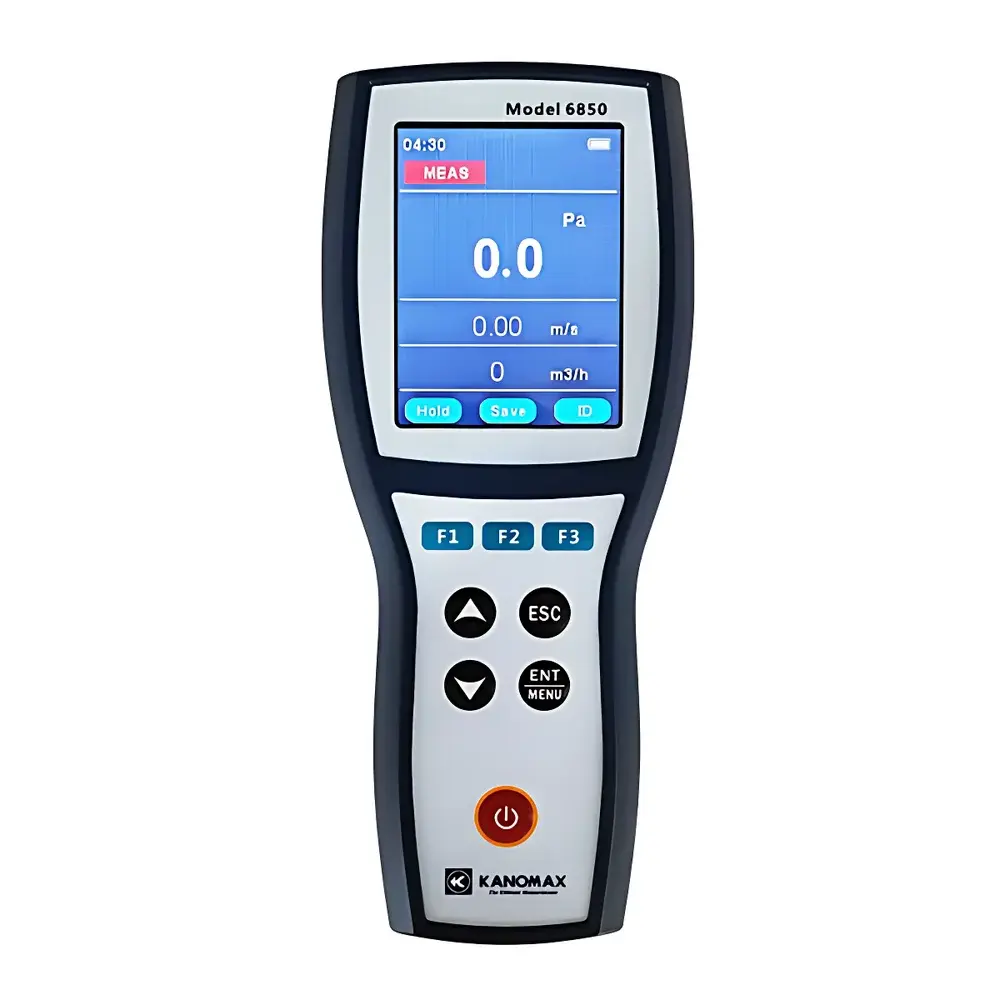
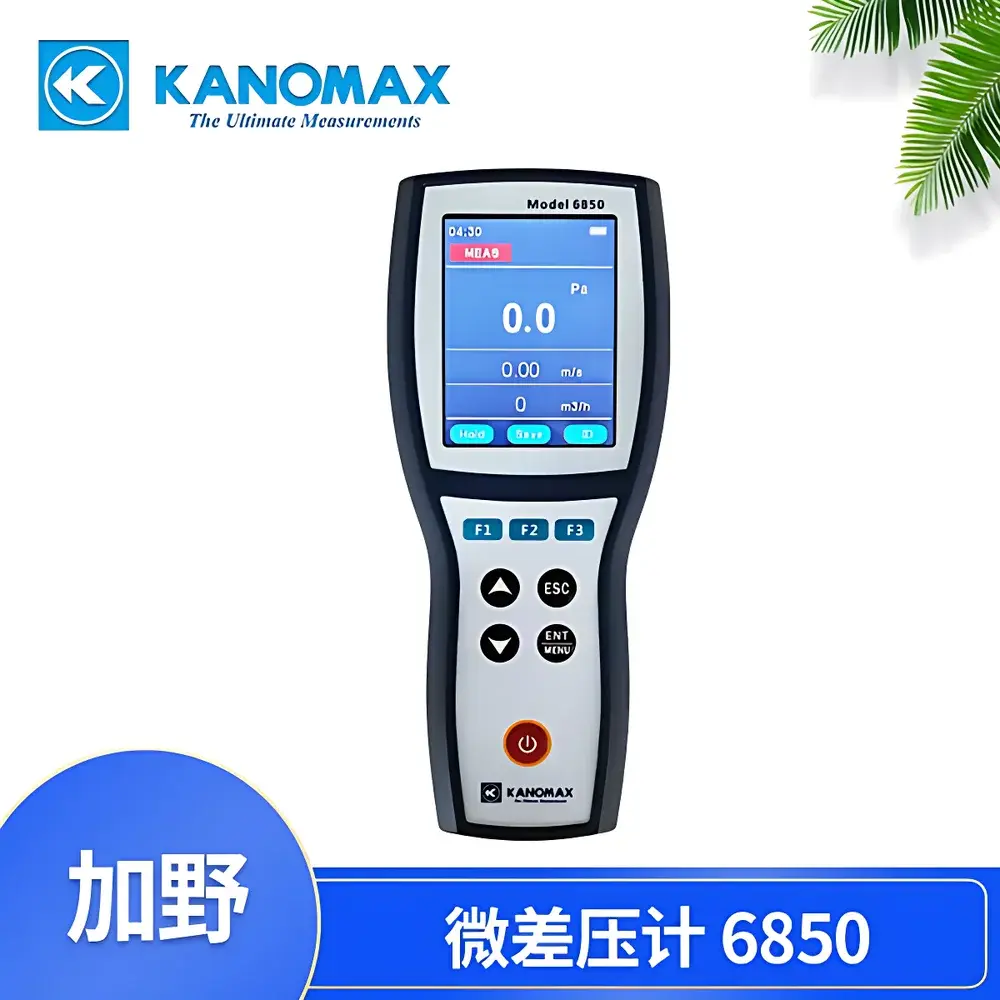
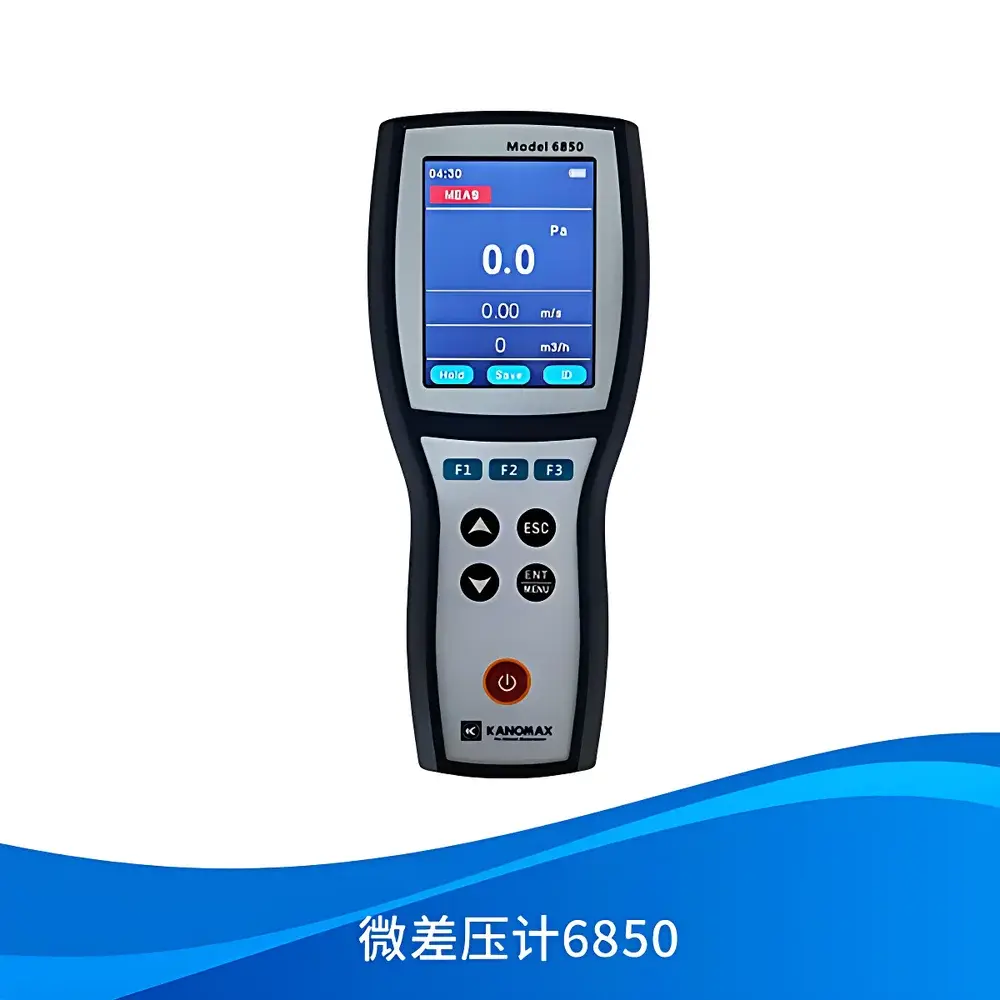
Kanomax Model 6850 Digital Micro Differential Pressure Meter for Biosafety Cabinet Face Velocity Verification
| Brand | Kanomax |
|---|---|
| Origin | Japan |
| Model | 6850 |
| Differential Pressure Range | −2500 to +2500 Pa |
| Accuracy | ±0.5% of reading ±1 Pa |
| Resolution | 0.1 Pa |
| Air Velocity Range | 0.20–60.0 m/s |
| Velocity Accuracy | ±1.5% of reading (at 10.0 m/s) |
| Velocity Resolution | 0.01 m/s |
| Airflow Range | 0–999999 m³/h |
| Flow Resolution | 1 m³/h |
| Operating Temperature | 0–60 °C (non-condensing) |
| Storage Temperature | −20–70 °C (non-condensing) |
| Power | 4 × AA batteries or DC 5 V AC adapter |
| Battery Life | >15 hours |
| Weight (with batteries) | ~360 g |
Overview
The Kanomax Model 6850 Digital Micro Differential Pressure Meter is a precision-engineered handheld instrument designed specifically for quantitative verification of face velocity and inflow performance in Class I, II, and III biosafety cabinets (BSCs), as required by NSF/ANSI 49, ISO 14644, and WHO TRS 961 Annex 5. It operates on the principle of differential pressure measurement using a high-stability silicon piezoresistive sensor, enabling direct calculation of air velocity via Pitot tube integration under Bernoulli’s equation assumptions. The device supports real-time conversion between differential pressure (ΔP), face velocity (v), and volumetric airflow (Q), providing traceable, repeatable data essential for GLP-compliant facility validation and routine operational qualification (OQ). Its compact form factor, low thermal drift, and dual-mode operation (differential pressure only or full ΔP/v/Q) make it suitable for both field service engineers and laboratory QA/QC personnel conducting annual BSC certification per CDC/NIH guidelines.
Key Features
- High-resolution differential pressure sensing with ±0.5% of reading ±1 Pa accuracy across the full −2500 to +2500 Pa range, optimized for low-velocity cabinet inflow measurements (typically 0.3–0.5 m/s corresponding to ΔP ≈ 10–50 Pa)
- Integrated Pitot tube compatibility for simultaneous, synchronized acquisition of differential pressure, calculated face velocity (0.20–60.0 m/s), and derived volumetric airflow (0–999999 m³/h)
- True-color backlit LCD display showing up to three parameters concurrently—e.g., ΔP (Pa), v (m/s), and Q (m³/h)—with intuitive unit switching and real-time trend indicators
- Onboard memory capacity for 10,000 measurement records, each timestamped with date/time and user-configurable ID tags for audit trail integrity
- Direct USB mass-storage mode for seamless export of CSV-formatted datasets to U disk—no proprietary software required for raw data retrieval
- Robust industrial housing rated IP54 for resistance to dust and incidental moisture; operating temperature range (0–60 °C) accommodates typical cleanroom and containment lab environments
Sample Compatibility & Compliance
The Model 6850 is routinely deployed with stainless-steel or aluminum Pitot tubes (e.g., Kanomax 6810 series) calibrated to NIST-traceable standards. It satisfies critical regulatory expectations for biosafety cabinet testing, including compliance with NSF/ANSI 49-2022 Section 6.3.2 (face velocity uniformity and average value verification), EU GMP Annex 1 (2022) requirements for airflow directionality and velocity mapping, and ISO 14644-3:2019 Annex D protocols for localized velocity assessment. While the instrument itself does not carry CE marking for medical devices, its metrological performance aligns with ISO/IEC 17025:2017 calibration requirements when used within an accredited laboratory’s uncertainty budget. Data logging functionality supports 21 CFR Part 11–compliant workflows when paired with validated electronic record systems that enforce user authentication and audit trail retention.
Software & Data Management
The Model 6850 operates autonomously without host software dependency. All stored data—including min/max/average statistics per session—are accessible directly via on-device navigation menus. When connected to a PC via USB, the unit appears as a standard removable drive, allowing drag-and-drop transfer of timestamped CSV files. Each record includes column headers: “Timestamp”, “ΔP_Pa”, “Velocity_m_s”, “Flow_m3_h”, “Battery_V”, and “User_ID”. For laboratories requiring automated reporting, third-party tools (e.g., Python pandas scripts or Excel Power Query) can parse these files to generate summary tables, histograms, or SPC control charts aligned with ISO 13485 or ICH Q7 documentation standards. Firmware updates are delivered via downloadable .bin files from Kanomax’s global technical support portal.
Applications
- Annual certification and periodic requalification of biosafety cabinets in clinical microbiology labs, vaccine manufacturing suites, and BSL-2/BSL-3 research facilities
- Commissioning and recommissioning of HVAC systems serving containment laboratories, including supply/exhaust balancing and pressure cascade verification
- Validation of laminar flow hoods, isolators, and gloveboxes where differential pressure gradients must be maintained within ±5 Pa tolerance
- Root cause analysis during airflow anomalies—e.g., filter loading effects, damper misalignment, or fan degradation—by trending ΔP over time
- Educational use in university bioprocess engineering and pharmaceutical sciences curricula for hands-on instruction in fluid dynamics and containment system fundamentals
FAQ
Is the Model 6850 suitable for ISO 14644-1 cleanroom classification?
No—it measures localized velocity and differential pressure, not particle concentration. However, it supports ancillary cleanroom qualification tasks such as airflow uniformity mapping and room pressurization verification.
Can the device be calibrated in-house?
Yes, but only for zero-point adjustment using atmospheric reference; full span calibration requires accredited external service against NIST-traceable deadweight testers or precision pressure controllers.
Does it meet FDA requirements for electronic records?
The hardware provides raw data integrity; compliance with 21 CFR Part 11 depends on how the exported CSV files are managed within your organization’s validated document control system.
What Pitot tube models are compatible?
Kanomax 6810 series (stainless steel, 3 mm tip diameter) and equivalent ISO 10780-compliant tubes with static/total pressure ports spaced per ASHRAE Guideline 12.
How is battery life affected by backlight or data logging frequency?
Continuous backlight reduces runtime by ~20%; logging interval has negligible impact, as memory writes occur only at measurement trigger—not continuously.
Related Products







