
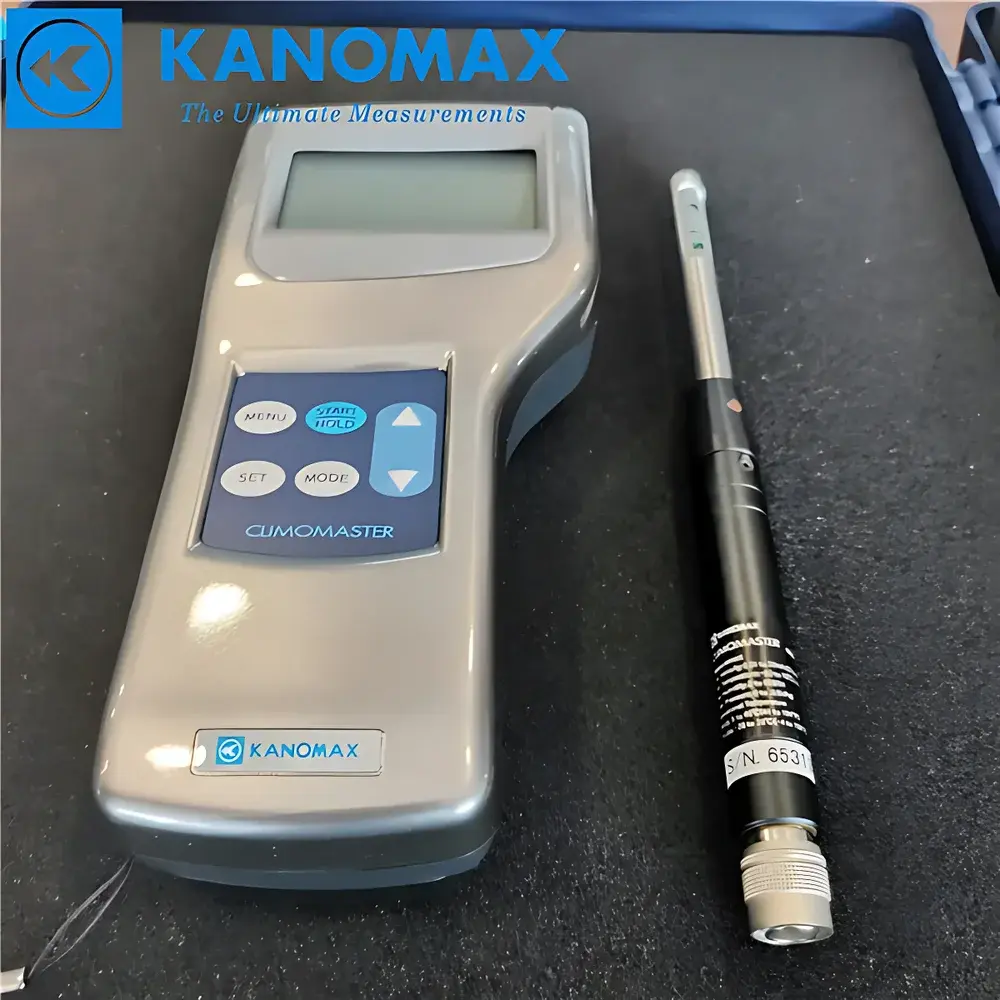
KANOMAX Model 1550 Hot-Wire Anemometer
| Brand | KANOMAX |
|---|---|
| Origin | Japan |
| Instrument Type | Thermal Anemometer |
| Resolution | 0.01 m/s |
| Measurement Range | Dependent on Probe Model (e.g., 0.05–30 m/s for standard hot-wire probe) |
| Accuracy | ±2% of reading |
| Operating Temperature | −20 to +70 °C |
| Operating Humidity | 2.0–98.0% RH |
| Data Storage Capacity | Up to 20,000 records |
| Probe Interface | Interchangeable 8-probe modular system |
| Built-in Functions | Real-time hold, statistical calculation (mean, max, min), cross-sectional area input for volumetric flow derivation |
| Accessories | 2 m probe cable ×1, carrying case ×1, operation manual ×1 |
Overview
The KANOMAX Model 1550 Hot-Wire Anemometer is a precision-engineered thermal anemometer designed for simultaneous, real-time measurement of air velocity, volumetric airflow, temperature, relative humidity, and differential pressure in HVAC commissioning, indoor air quality (IAQ) assessment, cleanroom validation, and environmental chamber monitoring. Based on constant-temperature anemometry (CTA), the instrument maintains a heated sensing wire at a fixed temperature differential above ambient; convective heat loss from the wire is directly correlated to local airflow velocity via calibrated Nusselt–Reynolds relationships. This principle enables high-sensitivity, low-inertia response—critical for capturing transient airflow dynamics in ducts, grilles, and laminar flow hoods. Unlike cup or vane anemometers, the hot-wire design achieves sub-0.1 m/s threshold detection and minimal flow disturbance, making it suitable for low-velocity applications such as fume hood face velocity verification (per ASHRAE 110) and ISO 14644-3 airflow uniformity mapping.
Key Features
- Multi-parameter acquisition: Simultaneous display of air velocity (m/s), volumetric airflow (m³/h or CFM), ambient temperature (°C/°F), relative humidity (%RH), and differential pressure (Pa or inH₂O) on a high-contrast backlit LCD.
- Modular probe architecture: Supports eight interchangeable hot-wire and thermistor-based probes—including straight, 90° bent, retractable, and multi-point array variants—enabling rapid adaptation to duct geometry, grille types, and confined access points.
- Volumetric flow computation engine: Accepts user-defined duct cross-section parameters (rectangular, circular, or irregular polygon) with automatic area calculation; integrates velocity profiles across multiple points to compute total airflow per ISO 12599 and EN 12599 standards.
- On-device data processing: Real-time statistical functions include arithmetic mean, peak hold (max/min), and time-weighted averaging over user-selectable intervals (1 s to 60 min).
- Robust environmental rating: Operates reliably from −20 °C to +70 °C ambient temperature and 2–98% RH, with IP54-rated housing for resistance to dust ingress and incidental moisture exposure during field use.
Sample Compatibility & Compliance
The Model 1550 is compatible with standard KANOMAX hot-wire probes (e.g., 0301, 0302, 0305 series) featuring platinum-coated tungsten filaments and ceramic insulation, ensuring long-term stability and repeatability. Its measurement methodology aligns with ASTM D1072–21 (Standard Test Method for Air Velocity in Ducts Using Thermal Anemometers) and ISO 8540-3:2022 (Air velocity measurement—Part 3: Thermal anemometers). The device supports GLP-compliant workflows through timestamped data logging, non-volatile memory retention, and traceable calibration certificate options (NIST-traceable upon request). While not FDA 21 CFR Part 11–certified out-of-the-box, audit trails and exportable CSV logs facilitate integration into GMP-aligned environmental monitoring programs when paired with validated data management protocols.
Software & Data Management
Data collected by the Model 1550 is stored internally in non-volatile memory (up to 20,000 records), with each entry containing timestamp, all measured parameters, probe ID, and user-defined location tags. A USB-C interface enables direct transfer to Windows/macOS systems using KANOMAX’s proprietary PC Link software (v3.2+), which provides graphical trend analysis, report generation (PDF/Excel), and batch export compliant with ISO/IEC 17025 documentation requirements. Raw datasets include metadata fields required for laboratory accreditation—such as operator ID, calibration due date, and environmental conditions at time of measurement—supporting full traceability in QA/QC audits.
Applications
- HVAC system balancing and TAB (Testing, Adjusting, Balancing) per ASHRAE Guideline 12–2022.
- Cleanroom airflow visualization and ISO 14644-1 classification testing (uniformity, turbulence index, recovery time).
- Fume hood and biosafety cabinet performance verification (face velocity, inflow velocity, sash position correlation).
- Indoor air quality surveys including thermal comfort evaluation (PMV/PPD modeling inputs) and ventilation rate estimation (per ANSI/ASHRAE Standard 62.1).
- Environmental chamber qualification and stability monitoring in pharmaceutical stability testing suites.
FAQ
What probe types are supported by the Model 1550?
The instrument accepts eight KANOMAX hot-wire and thermistor probe models, including single-point linear (0301), 90° angled (0302), telescoping (0305), and multi-point array probes (0310 series), all connected via standardized 6-pin LEMO interface.
Is calibration traceable to national standards?
Yes—factory calibration is performed against NIST-traceable reference anemometers in controlled wind tunnels; optional on-site recalibration services include full uncertainty budget reporting per ISO/IEC 17025.
Can the device calculate airflow in non-rectangular ducts?
Yes—the built-in geometry calculator supports circular, oval, and user-defined polygonal cross-sections; users enter dimensional coordinates or select preset shapes to derive area automatically before integrating velocity measurements.
How is data integrity ensured during field use?
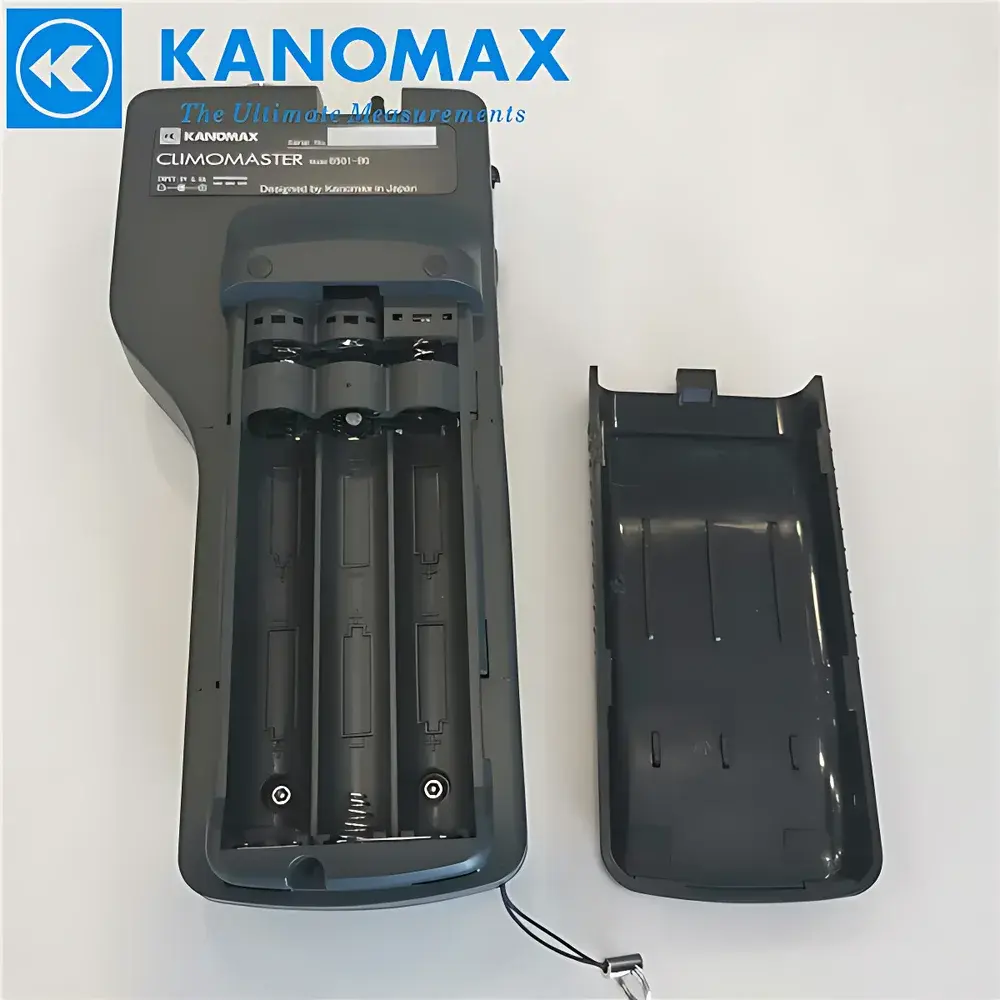
All stored records include embedded timestamps, probe serial numbers, and environmental context flags; internal memory retains data during battery replacement or power interruption.
Does the Model 1550 meet cleanroom certification requirements?
It satisfies instrumentation requirements for ISO 14644-3 Annex B (anemometer specifications) and supports test protocols defined in EU GMP Annex 1 (2022) for airflow direction and uniformity verification.







