
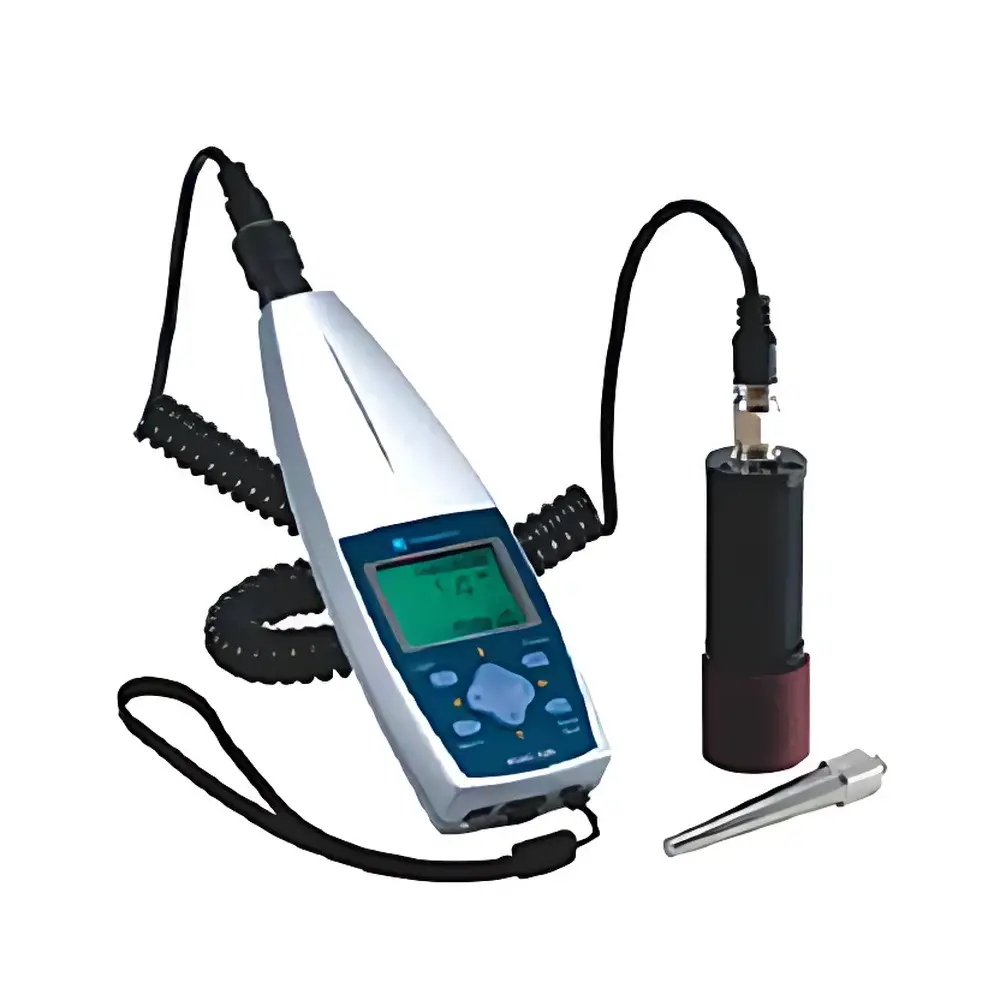
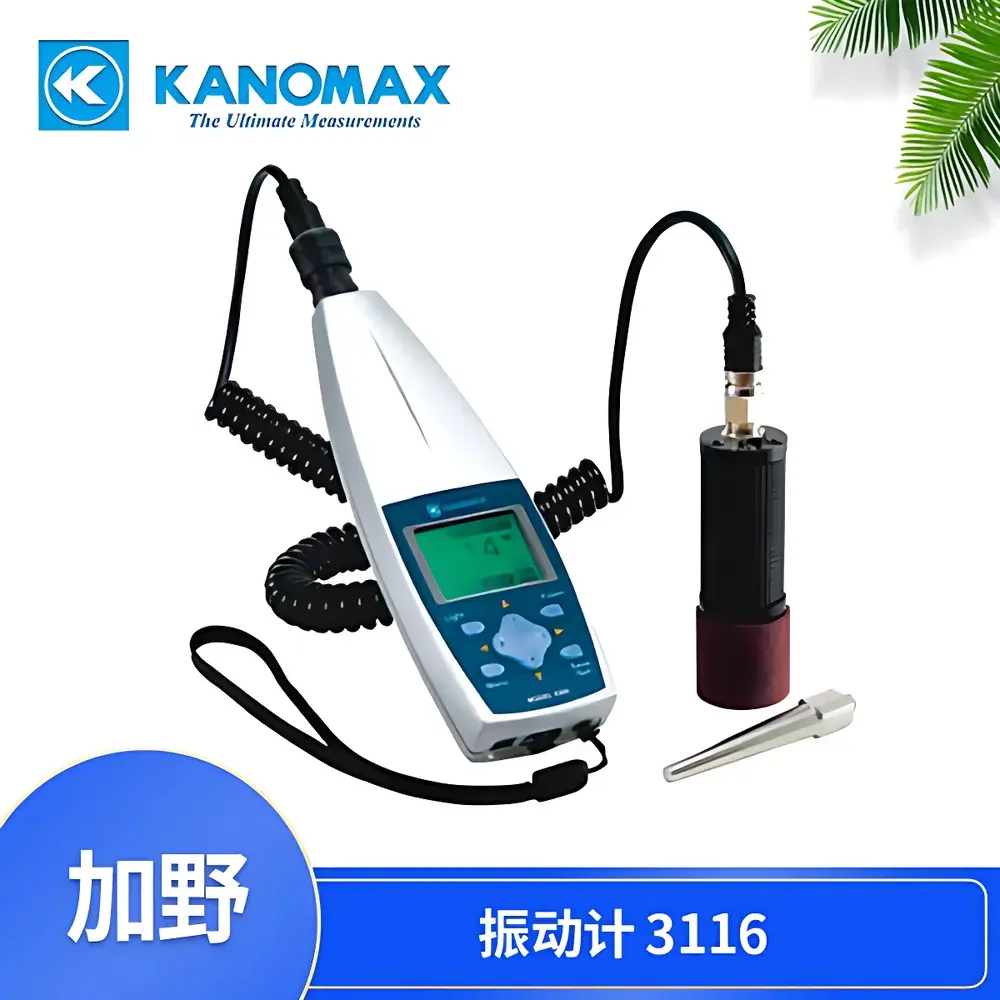
Kanomax Model 3116 Portable Digital Vibration Meter
| Brand | Kanomax |
|---|---|
| Origin | Japan |
| Model | 3116 |
| Acceleration Range | 0.02–200 m/s² RMS |
| Velocity Range | 0.02–200 mm/s RMS |
| Displacement Range | 2–2000 μm EQp-p |
| Accuracy | ±5% |
| Acceleration Frequency Range | 3 Hz–10 kHz |
| Velocity Frequency Range | 10 Hz–1 kHz (compliant with JIS B 0907:1989) |
| Displacement Frequency Range | 10–400 Hz |
| AC Output | 1 Vrms (full scale) |
| Audio Output | Built-in headphone jack with volume control |
| Communication Interface | RS-232C |
| Power Supply | Two AAA batteries or optional AC adapter |
| Dimensions | 145 mm (H) × 48 mm (W) × 23 mm (D) |
| Weight | Approx. 130 g |
Overview
The Kanomax Model 3116 Portable Digital Vibration Meter is a compact, hand-held instrument engineered for precision vibration analysis in industrial mechanical maintenance, predictive maintenance programs, and field-based machinery health assessment. Based on piezoelectric acceleration sensing technology, the device measures vibration in three fundamental physical domains—acceleration, velocity, and displacement—enabling comprehensive condition monitoring of rotating equipment such as motors, pumps, gearboxes, fans, and compressors. Its design adheres to JIS B 0907:1989 for velocity measurement validation, ensuring metrological traceability and repeatability in routine inspections. The integrated magnetic base and optional contact probe facilitate stable coupling to metallic surfaces without external fixtures, minimizing signal attenuation and mounting-induced resonance artifacts.
Key Features
- Triple-parameter real-time display: Simultaneous numerical readout of acceleration (m/s² RMS), velocity (mm/s RMS), and displacement (μm EQp-p) on a high-contrast LCD screen.
- Integrated triaxial-capable sensor architecture: The built-in piezoelectric accelerometer supports single-axis measurements with optional orthogonal orientation via detachable probe or magnetic mount.
- Frequency-selective filtering: Hardware-implemented analog bandpass filters align with ISO 10816 and JIS B 0907 standards—acceleration (3 Hz–10 kHz), velocity (10 Hz–1 kHz), and displacement (10–400 Hz)—to isolate relevant fault frequency bands.
- RS-232C serial interface: Enables direct data logging to PC-based vibration analysis software for trend reporting, spectral comparison, and archival compliance under GLP/GMP frameworks.
- Low-power dual power system: Operates up to 20 hours on two standard AAA alkaline cells; AC adapter option ensures uninterrupted operation during extended bench testing or calibration verification.
- Ergonomic, ruggedized housing: IP54-rated enclosure with rubberized grip and shock-absorbing corners protects internal electronics during transport and field use.
Sample Compatibility & Compliance
The Model 3116 is optimized for surface-mounted vibration measurement on ferromagnetic machinery casings, bearing housings, and structural supports. Magnetic base attachment provides secure coupling on flat or slightly curved steel surfaces (>0.5 mm thickness); the included contact probe extends usability to non-magnetic materials (e.g., aluminum housings, composite enclosures) and irregular geometries. Calibration is performed per ISO 17025-accredited procedures at Kanomax’s Tokyo facility, with documented traceability to NMIJ (National Metrology Institute of Japan). The instrument meets electromagnetic compatibility requirements per IEC 61326-1 and safety standards IEC 61010-1 for portable measuring equipment used in industrial environments.
Software & Data Management
Data export via RS-232C supports ASCII-formatted time-stamped records compatible with industry-standard platforms including MATLAB, LabVIEW, and proprietary CMMS (Computerized Maintenance Management Systems). Optional Kanomax Vibration Analysis Suite (v3.x) provides FFT spectrum generation, envelope detection for bearing defect frequencies, and automated pass/fail thresholding based on ISO 2372 and ISO 10816-3 severity charts. Audit trail functionality—including operator ID, timestamp, measurement mode, and sensor coupling status—is retained locally and transferable for FDA 21 CFR Part 11-compliant environments when paired with validated software configurations.
Applications
- Routine vibration screening of HVAC systems, CNC spindles, and conveyor drive trains in manufacturing plants.
- Bearing fault detection through velocity amplitude trending and 1×/2×/3× harmonic analysis.
- Baseline signature acquisition prior to commissioning or after repair interventions.
- Vibration severity classification per ISO 10816-3 (machines with power ratings <15 kW) and ISO 20816-1 (general purpose machines).
- Supporting root cause analysis in failure investigations by correlating time-domain waveforms with historical operational logs.
- Field verification of balancing corrections and alignment adjustments.
FAQ
Is the Model 3116 suitable for ISO 10816-compliant machinery evaluation?
Yes—the velocity measurement channel is certified to JIS B 0907:1989, which is technically harmonized with ISO 10816-3 for small industrial machines.
Can the unit store measurement data internally?
No—data must be captured in real time via RS-232C connection; no onboard memory is provided.
What is the recommended recalibration interval?
Kanomax recommends annual calibration against certified reference shakers, or after any impact event exceeding 500 g peak acceleration.
Does the device support A-weighted or other frequency weighting filters?
No—this model implements fixed bandpass filters aligned with mechanical vibration standards, not human-vibration-weighted metrics (e.g., ISO 5349 or ISO 2631).
Is the magnetic base removable for non-magnetic surfaces?
Yes—the base is threaded and detachable; the contact probe and optional adhesive pads provide alternative coupling methods.







