
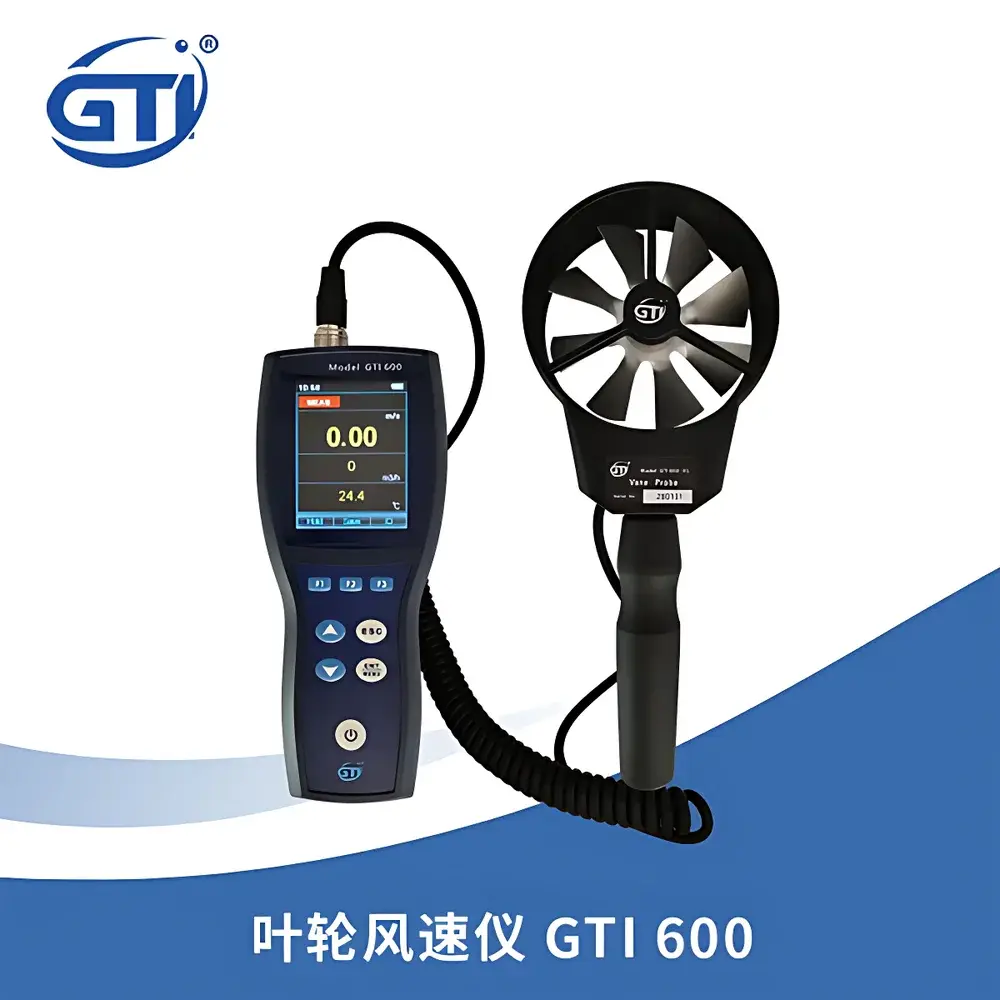
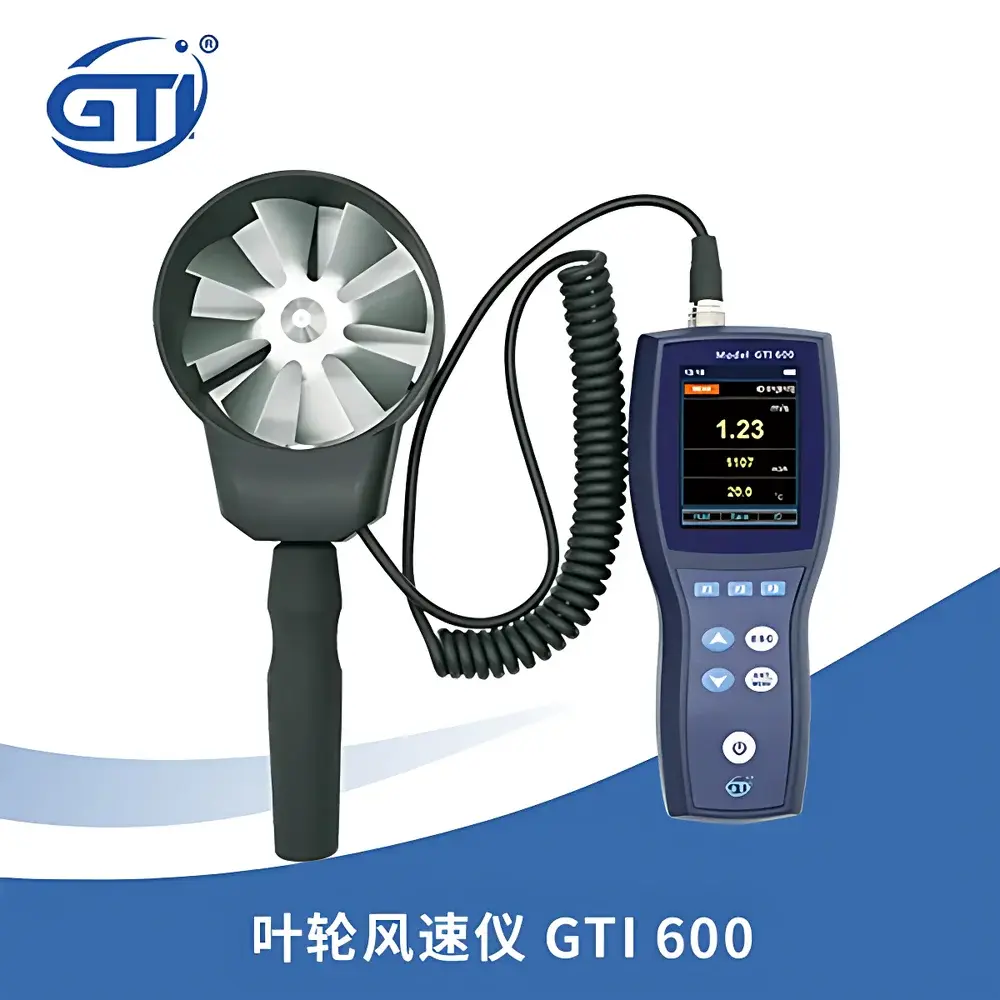
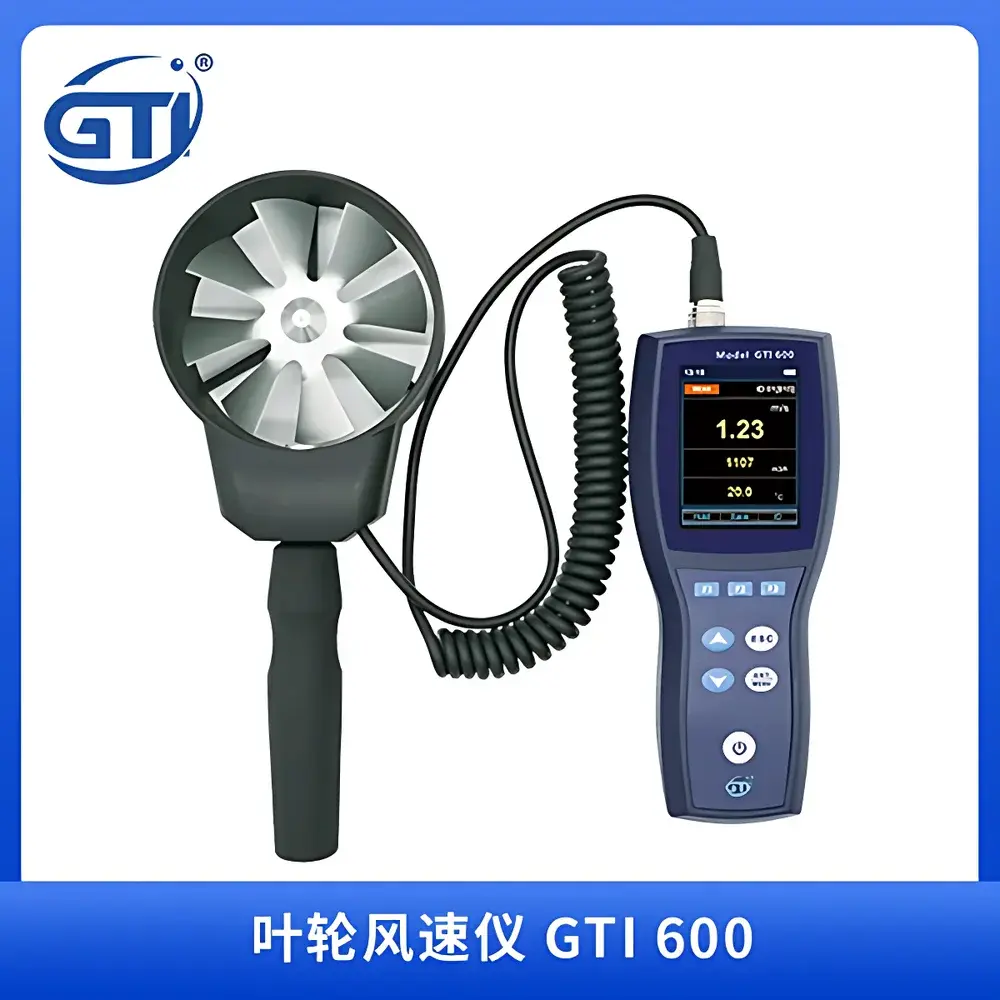
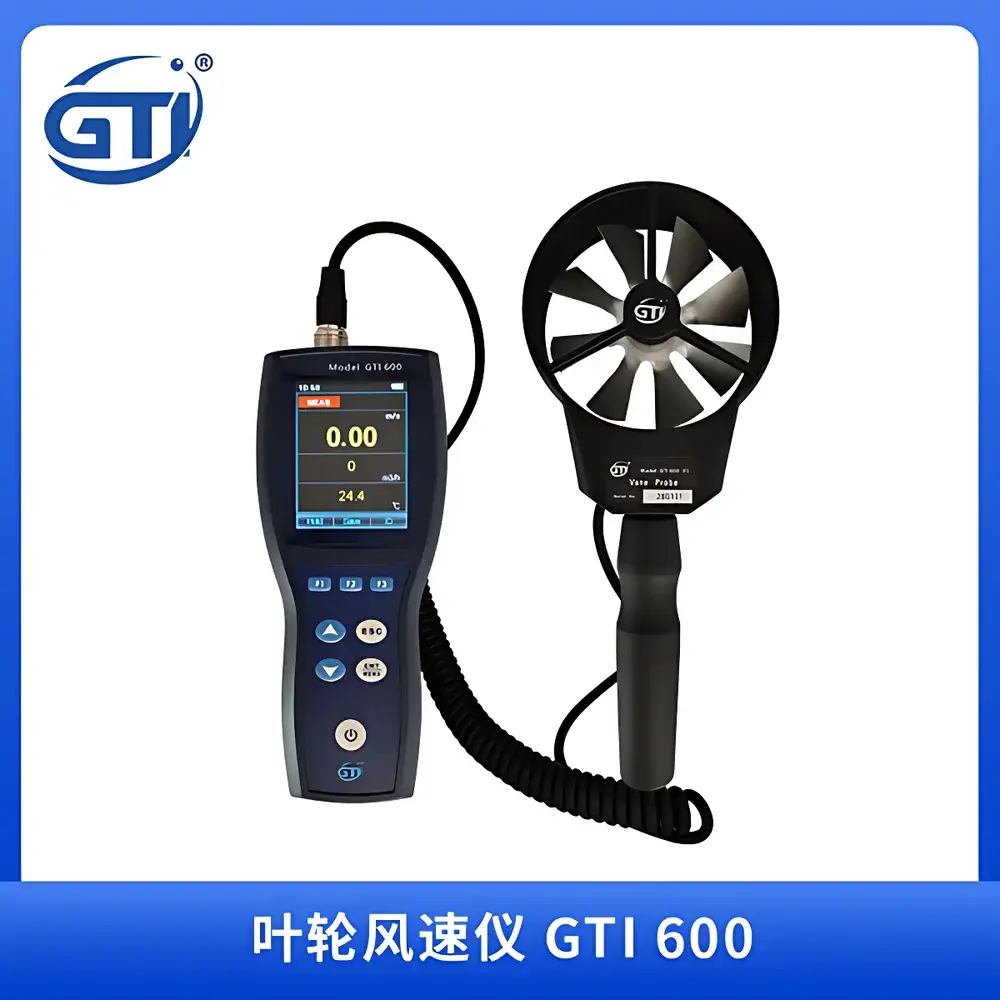
GTI GTI600 Vane Anemometer for Diffuser and Air Terminal Testing
| Brand | GTI |
|---|---|
| Model | GTI600 |
| Instrument Type | Vane Anemometer |
| Wind Speed Range (FV100) | 0.30–35 m/s |
| Wind Speed Range (FV70) | 0.10–35 m/s |
| Wind Speed Range (FV14) | 0.80–25 m/s |
| Accuracy | ±3% ±0.1 m/s (low range), ±1% ±0.3 m/s (high range) |
| Temperature Range | 0–60 °C |
| Temperature Accuracy | ±0.5 °C |
| Resolution | 0.01 m/s (wind), 0.1 °C (temp) |
| Data Storage | 10,000 records |
| Power | 4×AA batteries or AC adapter |
| Operating Temperature | 0–60 °C |
| Weight | ~600 g |
Overview
The GTI GTI600 Vane Anemometer is an engineered field instrument designed for quantitative airflow characterization in HVAC commissioning, balancing, and indoor air quality (IAQ) validation. It operates on the principle of rotational torque measurement: airflow imparts angular momentum to interchangeable vane sensors, whose rotational speed is converted to linear velocity via calibrated transfer functions traceable to NIST-traceable wind tunnel standards. Unlike thermal anemometers, the GTI600 maintains stability under transient thermal gradients and high-humidity conditions typical near diffusers, grilles, and terminal units. Its core application domain includes volumetric flow verification across non-uniform velocity profiles—particularly critical for ASHRAE Guideline 12 and ISO 16813-compliant air distribution system performance assessment.
Key Features
- Tri-sensor interchangeability: FV100 (100 mm diameter), FV70 (70 mm), and FV14 (14 mm) vane probes enable optimized resolution and dynamic response across duct sizes—from large main supply plenums to compact ceiling diffusers and HEPA filter face testing.
- Real-time dual-parameter display: Simultaneous readout of air velocity (m/s), temperature (°C), and calculated volumetric flow rate (m³/h) with auto-scaling based on user-input geometric dimensions.
- Configurable averaging modes: Selectable moving average (1–30 s window) suppresses turbulence-induced fluctuations; instantaneous mode captures transient events during damper modulation or fan startup.
- Geometric flow computation engine: Supports rectangular and circular duct input—accepts width/height or diameter values directly, then applies ISO 5167-2-compliant area-weighted integration logic for derived flow rate.
- On-device statistical analysis: At a fixed measurement location, multi-point sampling triggers automatic calculation of min/max/mean values with standard deviation—essential for ANSI/ASHRAE Standard 111 compliance reporting.
- Robust data handling: 10,000-record internal memory with timestamp, sensor ID, and environmental metadata; USB export via standard FAT32-formatted USB flash drive (no proprietary software required).
Sample Compatibility & Compliance
The GTI600 accommodates heterogeneous airflow geometries without recalibration: its modular probe design permits physical adaptation—including telescopic extension rods and flexible gooseneck mounts—for access to recessed diffusers, perforated panels, and laminar flow hoods. All three vane sensors meet IEC 61260-1:2014 Class 2 frequency response specifications for broadband airflow measurement. The instrument’s firmware implements audit-ready data logging compliant with GLP principles: each stored record includes operator ID (configurable), UTC timestamp, probe serial number, ambient temperature, and measurement mode flag. While not FDA 21 CFR Part 11-certified out-of-box, its immutable data export format supports integration into validated LIMS environments requiring electronic record integrity per 21 CFR Part 11 Subpart B.
Software & Data Management
Data retrieval requires no vendor-specific drivers: exported .CSV files contain comma-delimited columns—Time_UTC, Velocity_m_s, Temp_C, Flow_m3_h, Sensor_ID, Avg_Mode, Geometry_Type, Dimensions_mm—with UTF-8 encoding and BOM-free headers. Field technicians may import datasets directly into Excel, MATLAB, or Python pandas for custom uncertainty propagation analysis (e.g., combining velocity uncertainty per ISO 5167-3 Annex C with dimensional tolerance inputs). Firmware updates are delivered via signed .BIN files loaded from USB—version history and checksums are logged internally for configuration management traceability.
Applications
- HVAC system commissioning per ASHRAE Guideline 0 and TAB (Testing, Adjusting, Balancing) protocols
- Air terminal device (ATD) performance validation including swirl diffusers, linear slot outlets, and displacement ventilation nozzles
- Filter bank face velocity uniformity assessment per ISO 14644-3 Annex B
- Room air change rate verification for cleanroom classification (ISO 14644-1) and hospital isolation rooms (ASHE Guidelines)
- Energy audit baseline measurements supporting ASHRAE Standard 211 retrocommissioning workflows
- Academic and industrial lab ventilation safety monitoring per OSHA 1910.141(c)(1)(ii)
FAQ
What calibration standards does the GTI600 reference?
The GTI600 vane sensors are factory-calibrated against NIST-traceable rotating vane standards at five points across each range (0.3, 1.0, 5.0, 20.0, and 35.0 m/s) in a closed-loop wind tunnel meeting ISO/IEC 17025-accredited laboratory requirements.
Can the GTI600 measure airflow in exhaust hoods?
Yes—the FV14 micro-vane probe (14 mm diameter) is specifically designed for high-velocity, low-profile applications such as fume hood face velocity surveys per ANSI/AIHA Z9.5.
Is temperature compensation applied during velocity calculation?
No—air density effects are omitted per default operation, consistent with industry-standard volumetric flow reporting; users may apply manual correction factors using recorded temperature and local barometric pressure if mass flow derivation is required.
Does the device support Bluetooth or Wi-Fi connectivity?
No—wireless interfaces are intentionally excluded to ensure electromagnetic compatibility in electrically noisy mechanical rooms and eliminate cybersecurity attack surfaces in regulated facilities.
How often should field recalibration be performed?
GTI recommends annual verification against a secondary standard; more frequent checks are advised after mechanical shock, exposure to particulate-laden airstreams, or when operating outside 0–60 °C ambient limits.
Related Products







