
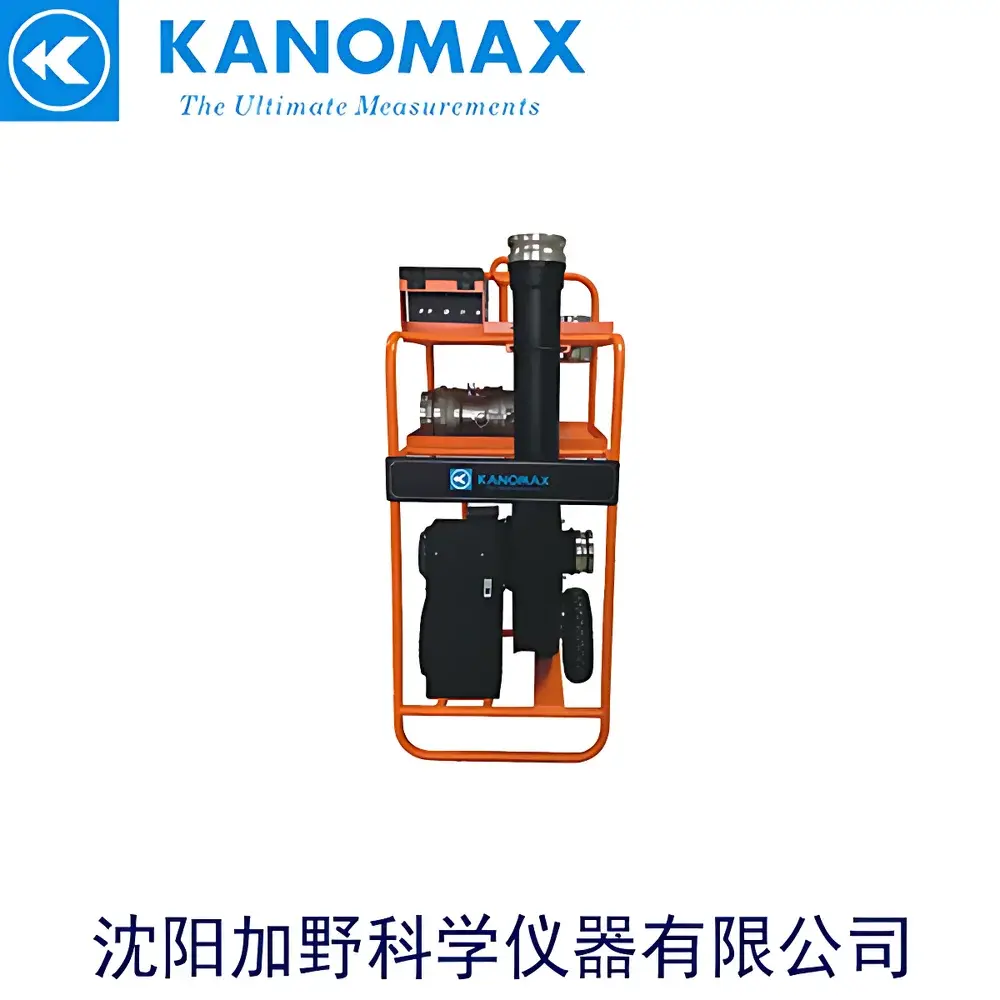
Kanomax DALT6900 Positive/Negative Pressure Duct Leakage Tester
| Brand | Kanomax |
|---|---|
| Origin | Liaoning, China |
| Manufacturer Type | Authorized Distributor |
| Country of Origin | China |
| Model | DALT6900 |
| Pricing | Available Upon Request |
| Flow Range | 36–640 m³/h (main channel), 4–36 m³/h (nozzle bank) |
| Accuracy | ±2.5% of reading ±0.1 m³/h (flow), ±1% of reading ±1 Pa (static pressure), ±0.5 °C (temperature), ±2% of reading (atmospheric pressure) |
| Resolution | 0.01 m³/h (flow), 0.1 Pa (pressure), 0.1 °C (temperature), 0.1 kPa (atmospheric pressure) |
| Static Pressure Range | ±2500 Pa |
| Temperature Range | 0–60 °C |
| Atmospheric Pressure Range | 70–130 kPa |
| Power Supply | DALT6900-0E: 110–120 V, 1-Phase, 50/60 Hz, 16 A |
| DALT6900-1E | 220–240 V, 1-Phase, 50/60 Hz, 10 A |
| Net Weight | ~72 kg |
| Dimensions | 540 × 500 × 1200 mm |
| Data Storage | 1000 test records |
Overview
The Kanomax DALT6900 Positive/Negative Pressure Duct Leakage Tester is a precision-engineered instrument designed for quantitative, standardized assessment of air leakage in HVAC ductwork systems. It operates on the principle of controlled pressurization—either positive or negative—followed by real-time volumetric flow measurement via calibrated nozzle banks and differential pressure transducers. This method conforms to internationally recognized duct airtightness testing protocols, enabling direct evaluation of system integrity against defined leakage class thresholds. The DALT6900 is not a qualitative smoke or pressure decay indicator; rather, it delivers traceable, repeatable, and audit-ready quantitative leakage data (in m³/h at specified pressure differentials), essential for compliance verification, energy performance certification (e.g., ASHRAE 90.1, EN 13779), and commissioning documentation under ISO 16813 and EN 12599.
Key Features
- Simultaneous dual-mode operation: certified testing under both positive and negative static pressure conditions up to ±2500 Pa, supporting full compliance with EN 1507:2006 (rectangular ducts), EN 12237:2002 (circular ducts), Eurovent 2/2, DW/143, SMACNA HVAC Air Duct Leakage Test Manual, and GB 50243–2002.
- Dual-range flow measurement architecture: primary channel (36–640 m³/h) and high-resolution nozzle bank (4–36 m³/h), automatically selected based on system size and target test pressure—ensuring optimal signal-to-noise ratio and minimizing uncertainty across low- and high-leakage scenarios.
- Integrated environmental compensation: real-time concurrent measurement of static pressure, ambient temperature (0–60 °C), and atmospheric pressure (70–130 kPa), with automatic correction applied to volumetric flow calculations per ISO 5167 and CEN/TR 15239.
- 4.7-inch color LCD touchscreen interface with intuitive workflow navigation, graphical pressure stabilization monitoring, and on-device pass/fail judgment based on user-defined leakage class (e.g., Class A, B, C per SMACNA or EN standards).
- Robust mechanical design: modular aluminum frame, sealed electronics enclosure, and vibration-damped flow conditioning elements—engineered for field deployment in construction sites, mechanical rooms, and rooftop units without recalibration drift.
- Built-in non-volatile memory storing up to 1000 complete test records, each timestamped and containing pressure curve, flow rate history, environmental parameters, operator ID, and pass/fail status.
Sample Compatibility & Compliance
The DALT6900 is validated for use on rigid and semi-rigid duct systems—including galvanized steel, aluminum, fiberglass-reinforced plastic (FRP), and flexible insulated ducts—across residential, commercial, and institutional HVAC installations. It supports testing of individual duct sections (e.g., after fabrication but before insulation) as well as whole-system validation post-installation. All measurement algorithms and calibration traceability align with national metrological requirements in China (JJF 1059.1–2012) and are compatible with third-party accreditation to ISO/IEC 17025. Test reports generated by the device satisfy documentation requirements for LEED EA Prerequisite 1 (Fundamental Commissioning), BREEAM Hea 02, and local building code enforcement (e.g., China’s JGJ/T 430–2018 Technical Specification for Duct Airtightness Testing).
Software & Data Management
Data export is supported via USB 2.0 to standard CSV format, enabling seamless integration with commissioning management platforms (e.g., Tridium Niagara, Schneider EcoStruxure), QA/QC databases, and PDF report generators. Each stored record includes raw sensor outputs, corrected flow values, pressure ramp profiles, and environmental metadata—supporting full traceability for GLP/GMP-aligned projects. While the DALT6900 does not feature embedded network connectivity or cloud synchronization, its structured output format complies with ASTM E2813–19 Annex A1 for digital test record retention and satisfies FDA 21 CFR Part 11 requirements when used in conjunction with validated external data management systems employing electronic signatures and audit trails.
Applications
- Pre-commissioning verification of ductwork airtightness prior to insulation and ceiling closure.
- Post-installation system-level leakage quantification for ASHRAE Guideline 0–2019 and ISO 16813-compliant commissioning.
- Periodic maintenance auditing of aging HVAC infrastructure to quantify degradation trends and prioritize retrofit interventions.
- Third-party inspection services for municipal building departments, provincial construction quality supervision stations, and national HVAC testing laboratories.
- Educational use in HVAC engineering programs for hands-on instruction in duct system performance, fluid mechanics, and standards-based testing methodology.
FAQ
Does the DALT6900 require annual factory recalibration?
Yes. Kanomax recommends annual recalibration against NIST-traceable standards to maintain stated accuracy specifications, particularly for pressure and flow sensors. Calibration certificates include as-found/as-left data and uncertainty budgets per ISO/IEC 17025.
Can the instrument be used for testing fire dampers or volume control dampers?
Yes—provided the damper is installed in a sealed test section and the duct configuration meets minimum straight-run requirements (≥5D upstream, ≥2D downstream) per EN 12237 Annex B. The DALT6900 measures total system leakage; isolation techniques must be employed to attribute leakage to specific components.
Is the device compliant with US-based energy codes such as IECC or California Title 24?
It meets the technical measurement requirements of IECC Section C403.2.1 and Title 24, Part 6, §140.4, provided testing is conducted per SMACNA’s “HVAC Air Duct Leakage Test Manual” and documented with calibrated instrumentation. Final acceptance remains subject to jurisdictional authority interpretation.
What is the maximum duct cross-sectional area the DALT6900 can effectively test?
There is no fixed area limit—the constraint is achievable pressure stability. For large low-leakage systems (e.g., Class A ducts >10 m² cross-section), extended stabilization time and careful sealing of access points are required. Field experience shows reliable results up to 25 m² when using appropriate auxiliary sealing materials and blower capacity matching.
Does the unit support multi-point pressure logging during ramp-up?
Yes. The internal datalogger captures pressure, flow, temperature, and barometric data at 1 Hz resolution throughout the entire test sequence—from initial pressurization through stabilization and final measurement—enabling post-test analysis of transient behavior and identification of intermittent leaks.
Related Products







