
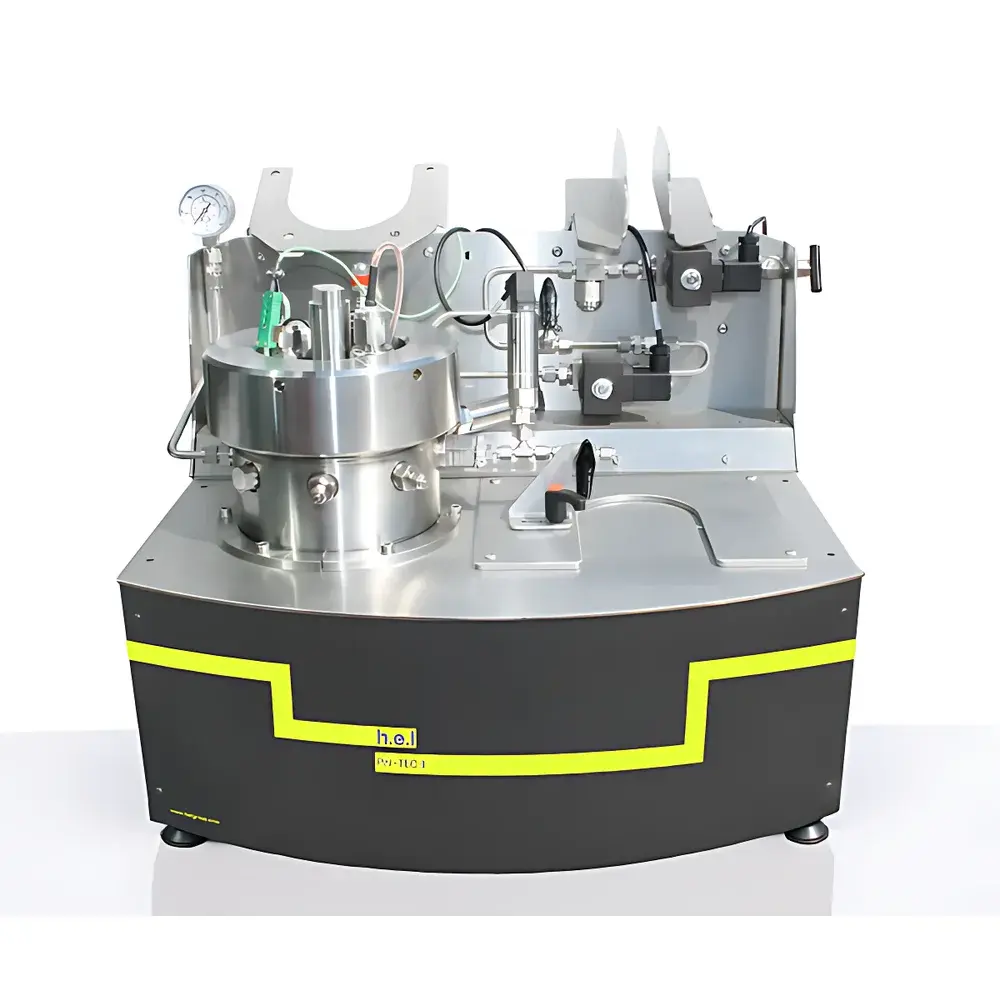
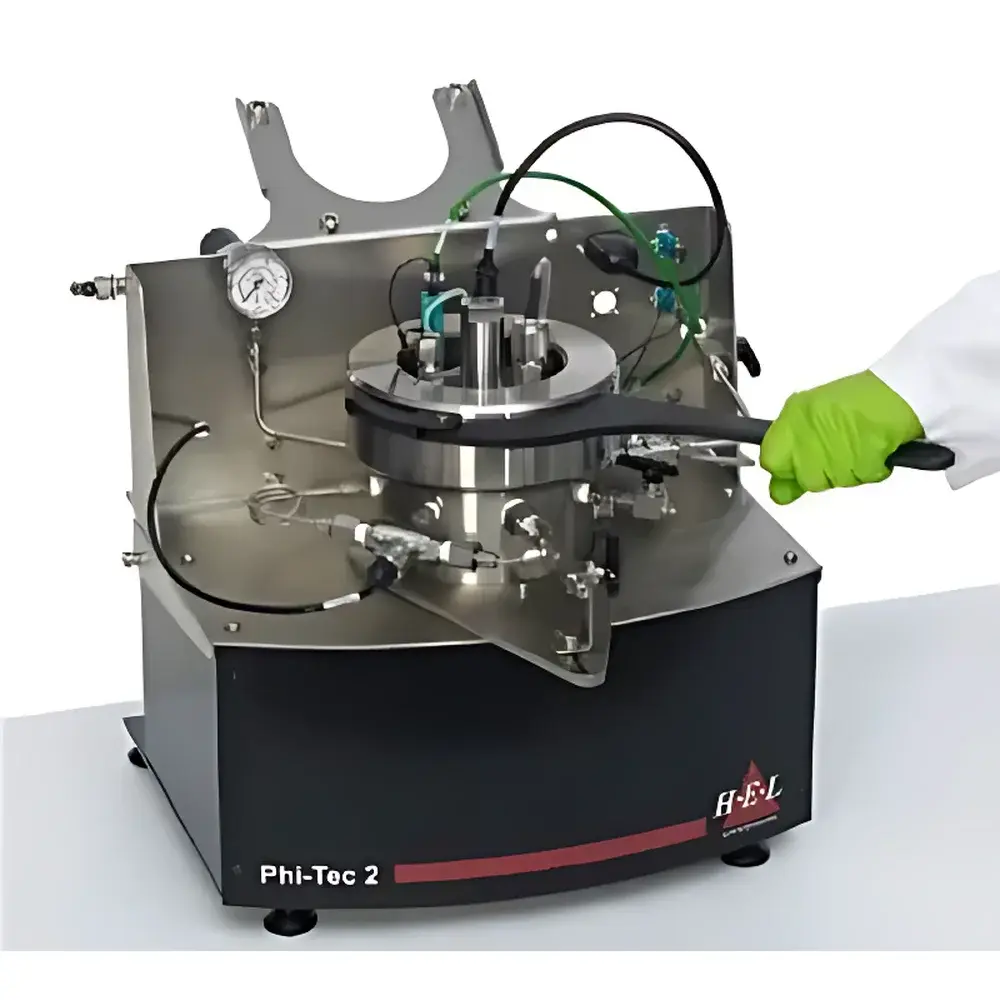
HEL Phi-TEC II Low-Phi Adiabatic Calorimeter
| Brand | H.E.L |
|---|---|
| Origin | United Kingdom |
| Manufacturer Type | Authorized Distributor |
| Origin Category | Imported |
| Model | Phi-TEC II |
| Price Range | USD 135,000–270,000 (FOB UK) |
| Instrument Type | Accelerating Rate Calorimeter (ARC) |
| Measurement Mode | Adiabatic Calorimetry |
| Temperature Range | −80 °C to 500 °C |
| Temperature Resolution | 0.001 K |
| Temperature Accuracy (Direct Sample Mode) | ±0.001 °C |
| Temperature Tracking Rate | Up to 400 °C/min (Low-Φ mode) |
| Standard | 50 °C/min |
| Pressure Range | 0–300 bar (optional up to 1000 bar) |
| Pressure Tracking Rate | 0–200 bar/min (optional 700 bar/min) |
| Pressure Accuracy | ±0.05% FS |
| Pressure Resolution | 0.01 bar |
| Heat Release Detection Sensitivity | 0.002–0.2 °C/min |
| Sample Mass Capacity | 0.5–80 g |
| Adiabatic Correction Factor (Φ) | ≤1.05 (optimized for Phi-TEC II) |
| Outer & Inner Dewar Volume | 60 mL each |
| Thermal Capacity | 60,000 J |
| Single-Test Duration | Up to 1000 min |
| Stirring | Electromagnetic, 0–500 rpm (mechanical option available) |
| Operating Modes | HWS (Heat-Wait-Search), RAMP, ISO (Isothermal) |
| Dimensions | 30 cm × 37 cm × 50 cm |
| Power Supply | 220 V AC, 13 A, single-phase |
Overview
The HEL Phi-TEC II is a third-generation low-phi (Φ ≤ 1.05) adiabatic calorimeter engineered for high-fidelity thermal runaway characterization of energetic materials, reactive chemicals, and battery systems under near-adiabatic conditions. Building upon the foundational ARC (Accelerating Rate Calorimetry) principle—where a sample is thermally insulated and its self-heating rate is measured while actively compensating for heat loss via dynamic temperature and pressure tracking—the Phi-TEC II introduces dual-parameter tracking (temperature + pressure) to maintain true adiabaticity across wide-ranging reaction kinetics. Unlike conventional ARC instruments limited to thermal tracking only (≤20 °C/min), the Phi-TEC II achieves up to 400 °C/min temperature tracking and 700 bar/min pressure tracking, enabling accurate simulation of large-scale process scenarios including vent sizing, relief system design, and thermal stability assessment under realistic confinement conditions. Its low-phi cell architecture minimizes heat loss through cell walls while preserving mechanical integrity at full operational pressure—critical for extrapolating laboratory-scale data to pilot or production-scale hazard analysis per ASTM E1981, ISO 8007-2, and CCPS Guidelines.
Key Features
- Dual-parameter adiabatic control: Simultaneous real-time temperature and pressure tracking ensures minimal deviation from ideal adiabatic conditions (Φ ≤ 1.05), significantly improving data fidelity over standard ARC systems (Φ ≈ 1.1).
- High-speed thermal response: Programmable heating rates up to 400 °C/min in low-Φ mode support rapid screening of highly exothermic decompositions without thermal lag artifacts.
- Full-pressure compatibility: Operates at up to 300 bar (optionally 1000 bar) with pressure tracking up to 700 bar/min—enabling safe evaluation of gas-generating reactions, pressurized battery failure modes, and confined decomposition events.
- Modular cell configuration: Supports interchangeable sample cells (0.5–80 g capacity; max 110 mL volume), including custom geometries for slurry, paste, or electrode stack testing.
- Multi-mode operation: HWS (Heat-Wait-Search), RAMP, and ISO protocols comply with UN Test Series H.2, EU CLP Annex I, and USP <1058> for thermal safety qualification.
- Electromagnetic stirring (0–500 rpm) with optional mechanical agitator for representative mixing dynamics—essential for heterogeneous reaction systems and slurry-based APIs.
Sample Compatibility & Compliance
The Phi-TEC II accommodates solid, liquid, semi-solid, and composite samples—including pharmaceutical intermediates, nitrocellulose formulations, lithium-ion battery electrodes, polymer precursors, and propellants. Its low-Φ cell design meets ICH Q5C stability guidance requirements for thermal degradation profiling and supports regulatory submissions requiring GLP-compliant raw data archives. The system is fully compatible with FDA 21 CFR Part 11–compliant software (via optional audit trail module), and all calibration records, method parameters, and raw thermograms are timestamped, user-authenticated, and exportable in ASTM E1461-compliant ASCII format. Pressure transducers are NIST-traceable and certified to EN 837-1 for industrial pressure instrumentation.
Software & Data Management
Control and analysis are performed using HEL’s proprietary ThermoKinetics™ v5.2 software, which provides automated method setup, real-time adiabatic deviation monitoring, and kinetic parameter extraction (Ea, A, n) via ASTM E698 and Ozawa-Flynn-Wall methods. All data—including time-stamped temperature, pressure, heating rate, and power compensation signals—are logged at ≥10 Hz resolution. The software supports batch processing, comparative overlay of multiple runs, and direct export to Excel, MATLAB, and Aspen Process Safety Suite for consequence modeling. Audit trails record operator actions, parameter changes, and calibration events in accordance with ISO/IEC 17025 and GMP Annex 11 requirements.
Applications
- Process safety assessment: Determination of Tonset, ΔHrxn, self-heating rate (dT/dt), and pressure rise rate (dP/dt) for RC1, DSC, and vent sizing calculations per DIERS methodology.
- Battery safety testing: Thermal runaway propagation analysis of 18650, pouch, and prismatic cells under adiabatic confinement—aligned with UL 1642, UN 38.3, and IEEE 1624.1.
- Chemical compatibility screening: Identification of hazardous interactions between reagents, solvents, or impurities during scale-up.
- Regulatory dossier support: Generation of kinetic and thermodynamic data required for REACH registration, EPA TSCA submissions, and MHRA/EMA CMC sections.
- Hazard ranking and prioritization: Integration with Dow Fire & Explosion Index (F&EI) and Layer of Protection Analysis (LOPA) frameworks.
FAQ
What distinguishes Phi-TEC II from conventional ARC instruments?
The Phi-TEC II uniquely combines temperature and pressure tracking to maintain Φ ≤ 1.05 across broad kinetic regimes, whereas traditional ARC systems track temperature only and exhibit Φ ≥ 1.1—introducing systematic error in activation energy and time-to-maximum-rate predictions.
Can Phi-TEC II be used for battery testing per UN 38.3?
Yes—its low-Φ cell and pressure tracking capability satisfy thermal runaway test requirements for Section 38.3.3 (T.4) and support failure mode analysis under realistic confinement.
Is calibration traceable to international standards?
All temperature sensors are calibrated against ITS-90 reference standards; pressure transducers carry EN 837-1 certification and NIST-traceable calibration certificates.
Does the system support remote operation and data review?
ThermoKinetics™ includes secure client-server architecture with role-based access control, allowing authorized users to monitor live tests and review historical data via web browser without local installation.
How does Phi-TEC II ensure data integrity for regulatory audits?
With optional 21 CFR Part 11 compliance package, it enforces electronic signatures, immutable audit trails, and encrypted data storage—fully aligned with ALCOA+ principles for GxP environments.



