
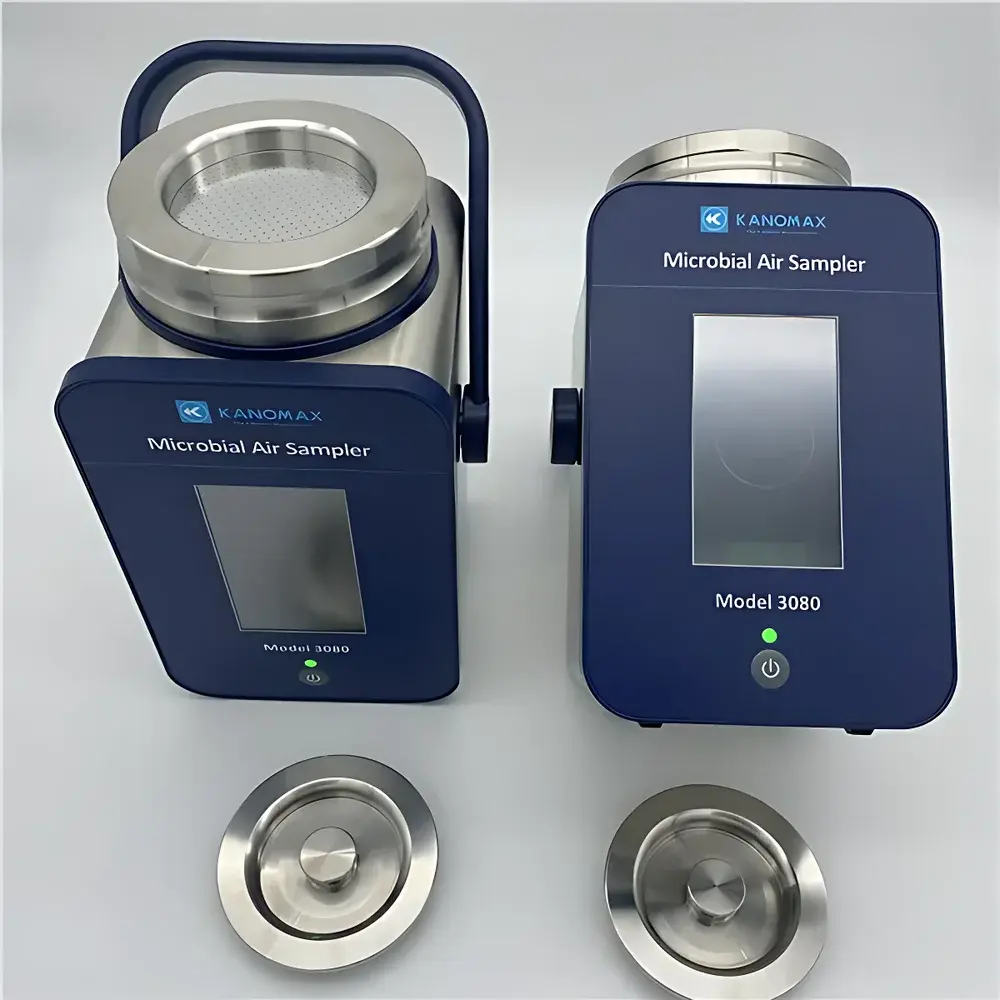
Kanomax Model 3080 Andersen-Principle Air Microbial Sampler
| Brand | Kanomax |
|---|---|
| Origin | Japan |
| Model | 3080 |
| Flow Rate | 100 L/min |
| Flow Accuracy | ±2.5% |
| Sampling Volume Range | 20–6000 L |
| Sampling Time Range | Up to 7 h (battery operation) |
| Operating Temperature | 0–40 °C |
| Operating Humidity | 0–90% RH (non-condensing) |
| Sampling Principle | Andersen Impaction (6-stage cascade impactor) |
| Impact Velocity | <20 m/s |
| Exhaust Filtration | ISO Class 3 HEPA filter integrated |
| Display | 4.3-inch color touchscreen |
| Data Storage | 10,000 internal records + USB export (CSV format) |
| Communication | USB, RS-485 (Modbus RTU) |
| Power | Rechargeable Li-ion battery + AC adapter (100–240 V) |
| Dimensions | 136 × 235 × 133 mm |
| Weight | 3.2 kg |
| Sample Support | 90–100 mm or 55–84 mm Petri dishes |
| User Management | 64 configurable users with multi-level permission control and audit trail |
| Remote Control | Infrared remote (supports up to 5 units simultaneously) |
Overview
The Kanomax Model 3080 is a precision-engineered, portable air microbial sampler designed for quantitative monitoring of viable airborne microorganisms in controlled environments. It operates on the well-established Andersen cascade impaction principle—a gravimetric and inertial separation method that classifies particles by aerodynamic diameter across six discrete stages. Each stage targets specific size fractions (from >7 µm down to 0.65 µm), enabling stratified collection of bacteria, fungi, yeasts, and spores onto standard agar-filled Petri dishes. With a calibrated nominal flow rate of 100 L/min and an impact velocity maintained below 20 m/s, the Model 3080 ensures high collection efficiency while preserving microbial viability—critical for subsequent colony-forming unit (CFU) enumeration and identification. Its compact, ergonomic design, combined with robust stainless-steel (316 grade) sampling head, supports repeated sterilization via autoclaving or chemical disinfection, making it suitable for repeated use in GMP-regulated cleanrooms, isolators, and biosafety cabinets.
Key Features
- Andersen 6-stage impactor architecture with validated particle-size cutoffs per ISO 14698-1 and USP <71> guidance
- High-precision mass flow control system with real-time digital feedback and ±2.5% volumetric accuracy over full operating range
- Programmable sampling parameters: volume (20–6000 L), interval (10 s–1 h), delay (0–23 h 59 min 59 s), and cycle count (2–300 cycles or continuous mode)
- Multi-language interface (English, Japanese, Chinese) on a responsive 4.3-inch color touchscreen with intuitive icon-driven navigation
- Integrated ISO Class 3 exhaust filtration to prevent operator exposure and cross-contamination during sampling
- Comprehensive audit trail functionality: time-stamped logs record operator ID, location tag, sampling volume, duration, status flags, and parameter changes
- Remote infrared operation supporting synchronized control of up to five units—ideal for multi-point environmental monitoring campaigns
- Onboard data storage (10,000 entries) with CSV export via USB and Modbus RTU protocol support for integration into centralized BMS or MES platforms
Sample Compatibility & Compliance
The Model 3080 accommodates dual Petri dish formats: standard 90–100 mm and compact 55–84 mm plates, facilitating flexibility across laboratory workflows and regulatory requirements. Its stainless-steel sampling head complies with ASTM E2994-15 standards for material biocompatibility and cleanability. The instrument meets essential electromagnetic compatibility (EMC) and safety requirements per IEC 61326-1 and IEC 61010-1. While not certified as a medical device, its performance aligns with ISO 14698-1 (Biocontamination control) and EU GMP Annex 1 (2022 revision) expectations for environmental monitoring in sterile manufacturing. Data integrity features—including user authentication, role-based permissions, and immutable operation logs—support compliance with FDA 21 CFR Part 11 and EU Annex 11 when deployed within validated systems.
Software & Data Management
All operational data—including date/time stamps, operator credentials, sampling location metadata, volumetric totals, cycle counts, alarm events, and system diagnostics—are stored locally with timestamped granularity. Export is supported in open CSV format for traceable post-processing in LIMS or statistical analysis tools (e.g., JMP, Minitab). The built-in Modbus RTU interface enables seamless integration with building management systems (BMS), SCADA networks, or custom dashboards for real-time environmental trending. Optional printer connectivity allows immediate hard-copy generation of sampling reports at point-of-use—particularly valuable during routine audits or shift handovers. Audit logs retain full edit history, including who modified parameters and when, satisfying GLP/GMP documentation rigor.
Applications
The Model 3080 is widely deployed across industries requiring rigorous airborne bioburden assessment: pharmaceutical aseptic processing suites (Grade A–D zones), hospital clean utility rooms and operating theatres, food and beverage production lines, semiconductor fabrication cleanrooms, biosafety level 2+ laboratories, museum archival storage facilities, and cosmetic manufacturing environments. It is routinely used for qualification of HVAC systems, validation of isolator decontamination cycles, routine environmental monitoring (EM) programs, and investigation of microbiological excursions. Its portability and battery autonomy (up to 7 hours) make it equally effective for both static and dynamic monitoring scenarios—including manned operations under ISO 14644-1 Class 5 conditions.
FAQ
What sampling principle does the Model 3080 employ?
It utilizes the Andersen six-stage cascade impactor principle, separating viable particles by aerodynamic size for deposition onto agar media.
Is the sampling head autoclavable?
Yes—the 316 stainless-steel head is fully autoclavable (121 °C, 20 min) and compatible with common disinfectants including 70% ethanol and hydrogen peroxide vapor.
Can the instrument be integrated into a facility-wide monitoring network?
Yes—via RS-485 Modbus RTU, it supports integration with central data acquisition systems, SCADA, or cloud-based EM platforms.
Does it comply with FDA 21 CFR Part 11 requirements?
When configured with enabled audit trail, multi-level user roles, and electronic signature protocols within a validated environment, it satisfies core Part 11 expectations for electronic records and signatures.
What is the maximum sampling volume per run?
6000 liters, programmable in 1-liter increments, with automatic termination upon reaching the set volume or elapsed time limit.
Related Products







