
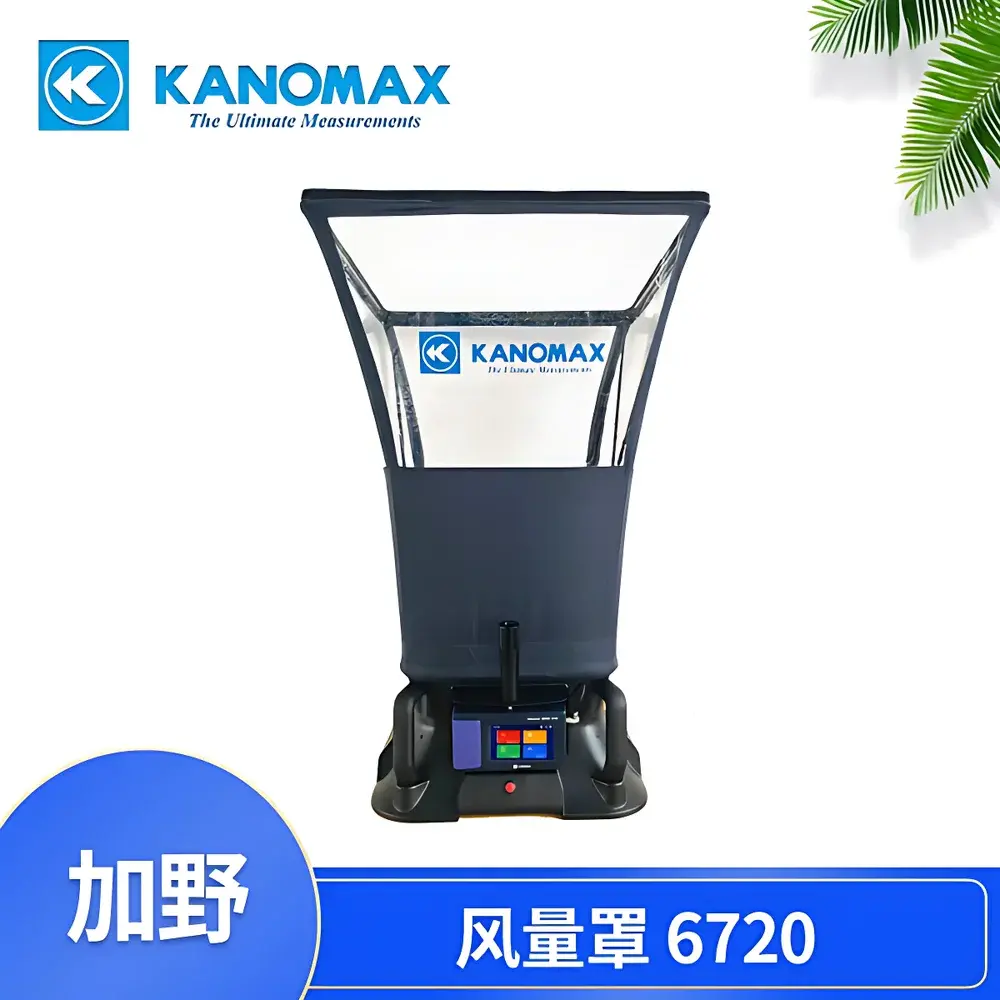
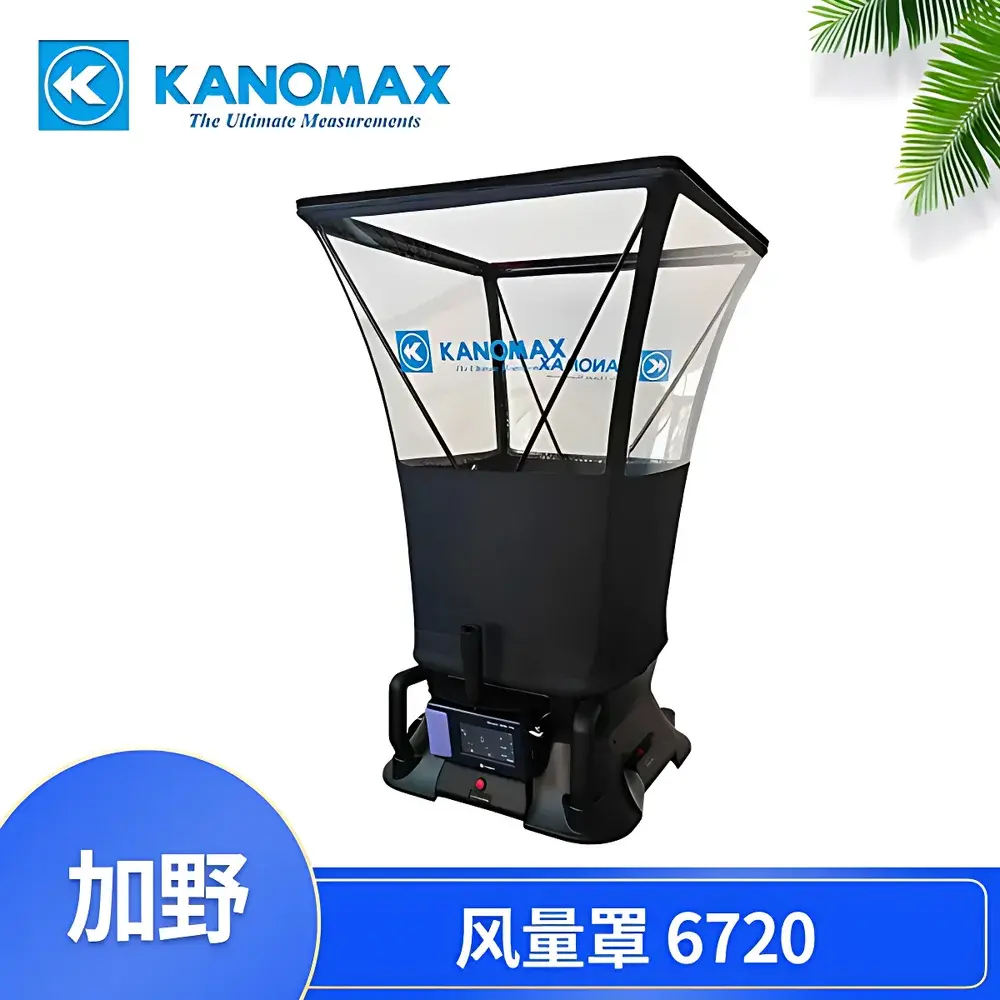
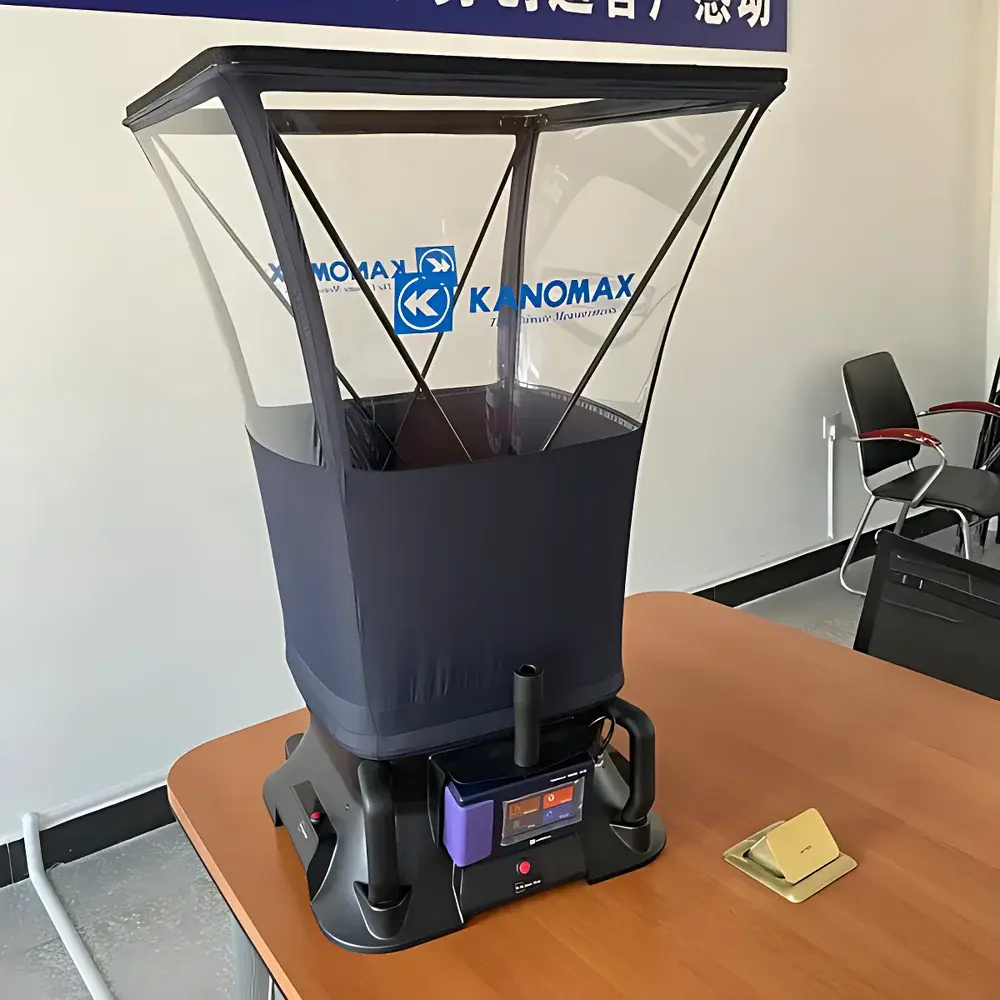
Kanomax 6720 Air Flow Hood
| Brand | Kanomax |
|---|---|
| Origin | Japan |
| Model | 6720 |
| Air Flow Range | 40–4300 m³/h |
| Accuracy | ±3% of reading ±8 m³/h |
| Air Velocity Range (with Pitot Tube) | 0.15–40 m/s |
| Air Velocity Range (with Grid Sensor) | 0.15–15 m/s |
| Velocity Accuracy | ±3% of reading ±0.05 m/s |
| Differential Pressure Range | −2500 to +2500 Pa |
| DP Accuracy | ±1.5% of reading ±0.25 Pa |
| Temperature Range | 0–60 °C |
| Temp Accuracy | ±0.5 °C |
| Humidity Range | 0–100 %RH |
| RH Accuracy | ±3 %RH (10–90 %RH) |
| Operating Environment | 0–60 °C, 0–100 %RH |
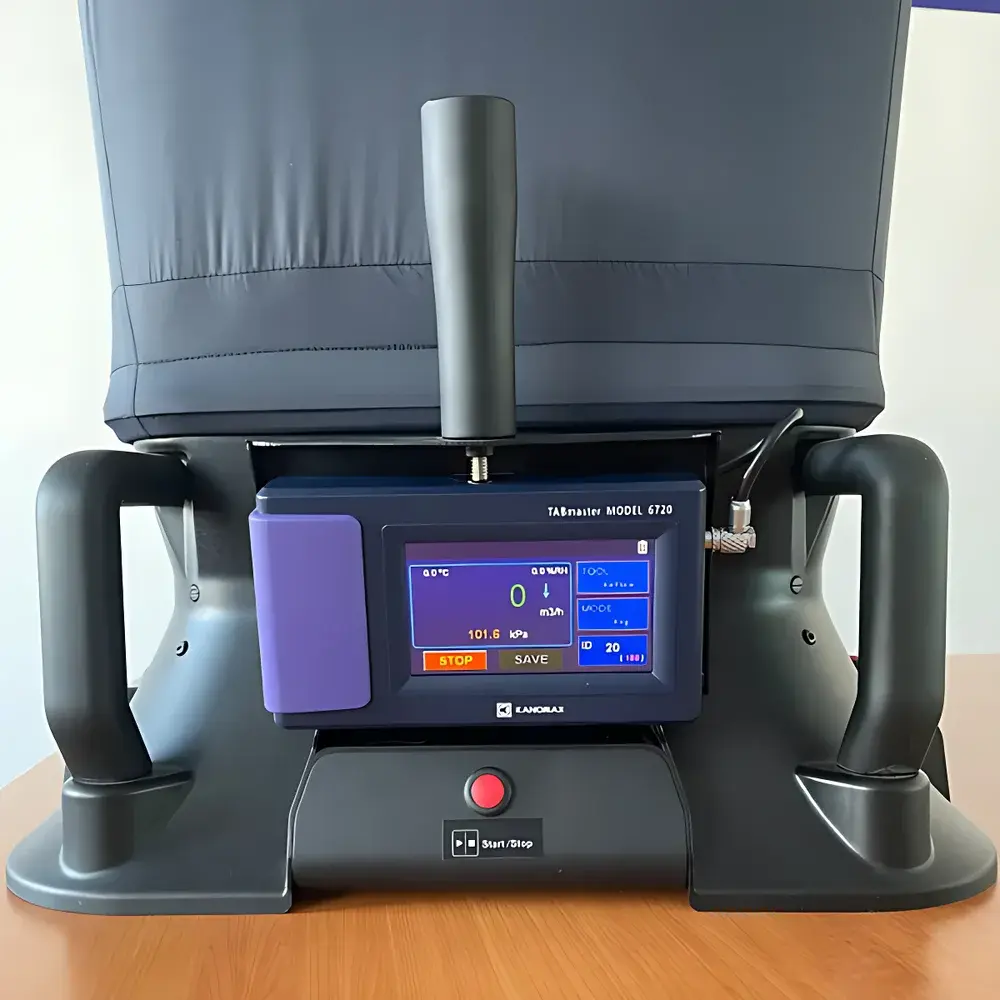
| Display | 4.3-inch full-color touchscreen LCD |
| Data Storage | 8,000 measurements (host), 10,000 (via companion app) |
| Power | 4 × AA batteries (≈9 h), or DC 5 V adapter |
| Weight | 3.6 kg |
| Standard Hood Size | 610 × 610 mm |
| Optional Hood Sizes | 610×1220 mm, 305×1220 mm, 500×500 mm, 915×915 mm, 915×610 mm, 800×1400 mm |
| Key Functions | Inlet/exhaust mode detection, backpressure compensation, barometric pressure correction, 16-point differential pressure grid, detachable velocity matrix, transparent viewing window, Bluetooth 4.2, USB data export, real-time thermal/hygrometric/differential pressure/airflow concurrent display |
Overview
The Kanomax 6720 Air Flow Hood is a portable, multi-parameter environmental balancing instrument engineered for precision volumetric airflow measurement in HVAC, cleanroom, and laboratory containment applications. It operates on the principle of integrated velocity-area integration: airflow is determined by measuring localized air velocities across a calibrated 16-point differential pressure grid mounted within a sealed hood enclosure, then computing volumetric flow using real-time cross-sectional area, temperature, atmospheric pressure, and backpressure-corrected static pressure differentials. Unlike single-point anemometers, the 6720’s grid-based architecture ensures representative sampling across irregular or turbulent discharge profiles—critical for compliance with ISO 14644-3, ISO 14644-4, EN 15237, and ASHRAE Guideline 12–2020. Its dual-sensor capability supports both pitot tube (for high-velocity ducts) and grid matrix (for grille, diffuser, and fume hood face velocity) configurations, enabling traceable, NIST-traceable calibration paths per ANSI/ASHRAE Standard 111.
Key Features
- Simultaneous real-time measurement and display of volumetric airflow (m³/h), face velocity (m/s), ambient temperature (°C), relative humidity (%RH), and differential pressure (Pa) on a 4.3-inch full-color capacitive touchscreen
- Backpressure compensation algorithm automatically corrects for hood-induced resistance, ensuring accuracy across variable static pressure conditions—essential for low-flow fume hood certification and high-resistance HEPA filter testing
- Integrated 16-point differential pressure grid with uniform port distribution enables spatially resolved velocity mapping and automatic averaging; supports both inlet and exhaust mode identification via sign-sensitive ΔP interpretation
- Barometric pressure and temperature correction applied in real time per ISO 5167-2:2003 methodology, minimizing density-related errors in non-standard ambient conditions
- Detachable velocity matrix and modular hood interface allow rapid reconfiguration between standard (610 × 610 mm) and six optional hood sizes—including oversized formats up to 800 × 1400 mm—for grilles, VAV boxes, and biological safety cabinets
- Bluetooth 4.2 Class 2 wireless module enables secure pairing with iOS/Android mobile devices running the official Kanomax AirFlowLink app for remote parameter configuration, live data streaming, statistical analysis (min/max/avg/cumulative), and timestamped export in CSV or PDF format
- Transparent polycarbonate viewing window permits visual verification of hood-to-grille seal integrity prior to measurement—reducing operator-induced leakage error, a primary source of noncompliance in ISO 14644-3 Annex B audits
Sample Compatibility & Compliance
The 6720 is validated for use with supply air diffusers, return grilles, VAV terminal units, laminar flow hoods, biosafety cabinets (Class I, II, III), fume hoods (per ANSI/ASHRAE 110), and cleanroom ceiling modules. Its airflow range (40–4300 m³/h) and velocity sensitivity (0.15 m/s minimum) meet the operational envelope required by USP , EU GMP Annex 1 (2022), and FDA Aseptic Processing Guidance. The instrument’s differential pressure sensor conforms to IEC 61260-1:2014 Class 1 specifications, while its temperature and humidity sensors are factory-calibrated against NIST-traceable references. All firmware and embedded algorithms comply with GLP data integrity requirements, including audit-trail-enabled user login, electronic signature support (via app), and tamper-evident timestamping per 21 CFR Part 11 when used with Kanomax-certified software.
Software & Data Management
The bundled AirFlowLink application (v3.2+) provides full instrument control and post-processing capabilities. Each measurement record includes metadata: operator ID, location tag, hood size, test date/time, ambient conditions, and raw 16-point velocity array. Data is stored locally on-device (8,000 records) and redundantly in the cloud-synced app (10,000 records). Export options include CSV (for Excel or LIMS import), PDF reports with Kanomax logo and calibration certificate reference, and direct Bluetooth printing to Zebra ZQ520 or Brother QL-1115 label printers. Firmware updates are delivered over-the-air via HTTPS-secured channels; version history and change logs are retained for regulatory review.
Applications
- HVAC system commissioning and TAB (Testing, Adjusting, Balancing) per NEBB Procedural Standards
- Cleanroom airflow uniformity and total air change rate verification (ISO 14644-3 Clause 8.2)
- Biosafety cabinet inflow and downflow velocity profiling (NSF/ANSI 49-2022 Section 7.3)
- Fume hood face velocity validation and alarm threshold setup (OSHA 1910.1200 Appendix A)
- LEED IEQ Credit 1 – Indoor Air Quality Assessment documentation
- Pharmaceutical facility qualification (IQ/OQ/PQ) of air handling units and isolators
- Educational lab demonstrations of fluid continuity, Bernoulli effects, and boundary layer development
FAQ
What standards does the Kanomax 6720 comply with for cleanroom certification?
It meets measurement uncertainty and procedural requirements outlined in ISO 14644-3:2019 Annex B, ISO 14644-4:2022 Clause 7.3.2, and EU GMP Annex 1 (2022) Section 4.32 for volumetric airflow verification.
Can the 6720 measure both supply and exhaust airflow without hardware modification?
Yes—the instrument auto-detects flow direction based on differential pressure polarity and applies appropriate sign convention and compensation logic for both modes.
Is backpressure compensation mandatory for accurate readings?
It is enabled by default and cannot be disabled; the algorithm is integral to achieving ±3% accuracy across the full 40–4300 m³/h range under variable system resistance.
How is calibration traceability maintained?
Each unit ships with a NIST-traceable calibration certificate (accredited to ISO/IEC 17025:2017); field recalibration is performed using Kanomax-certified pitot tubes and reference manometers per ASTM D5469-21.
Does the device support FDA 21 CFR Part 11 compliance?
When used with the AirFlowLink app v3.2+ and Kanomax’s validated IT infrastructure, it supports electronic signatures, audit trails, and role-based access control required for regulated environments.
Related Products







