
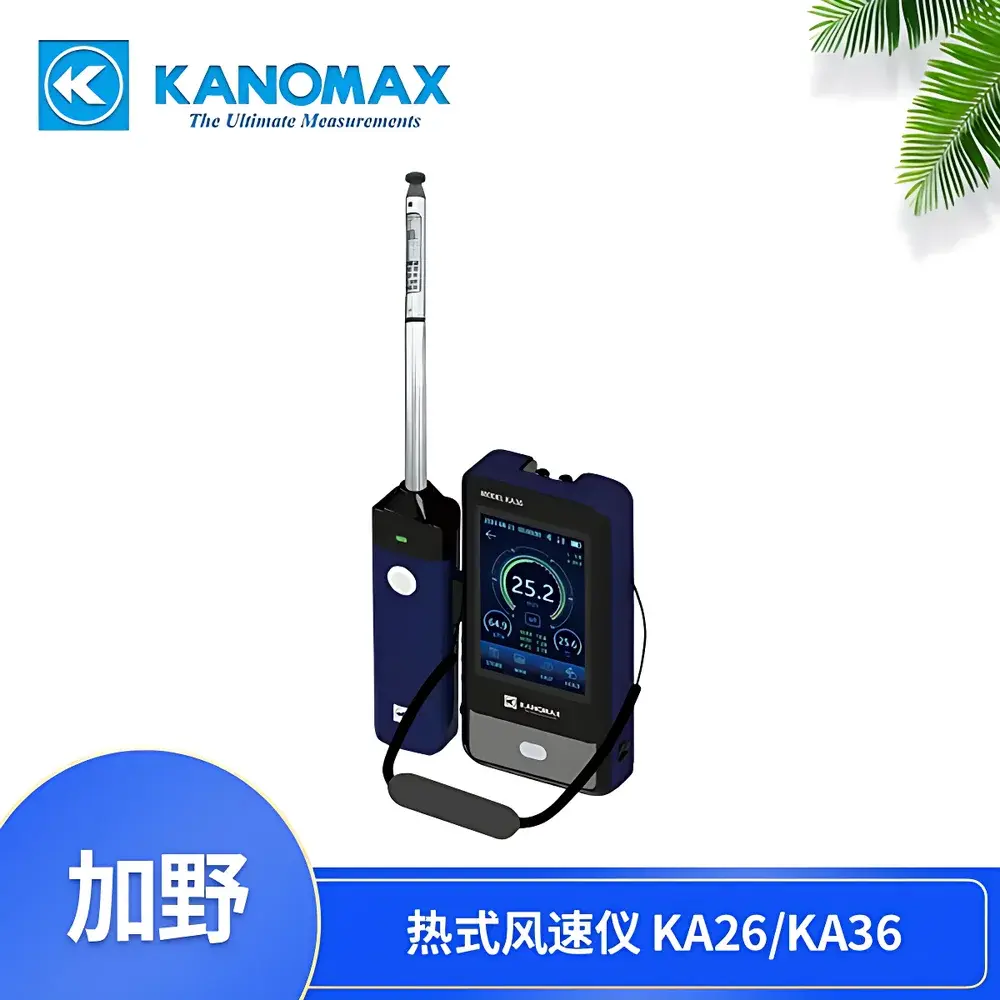
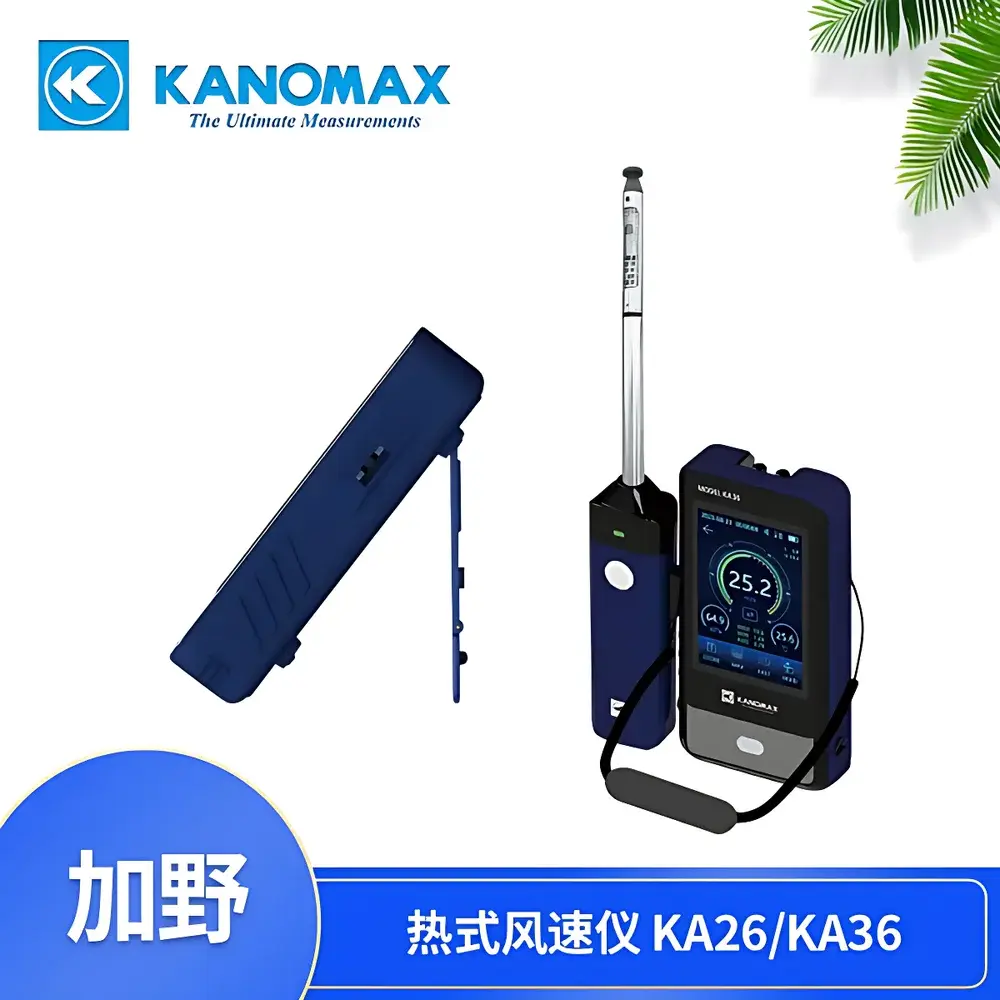
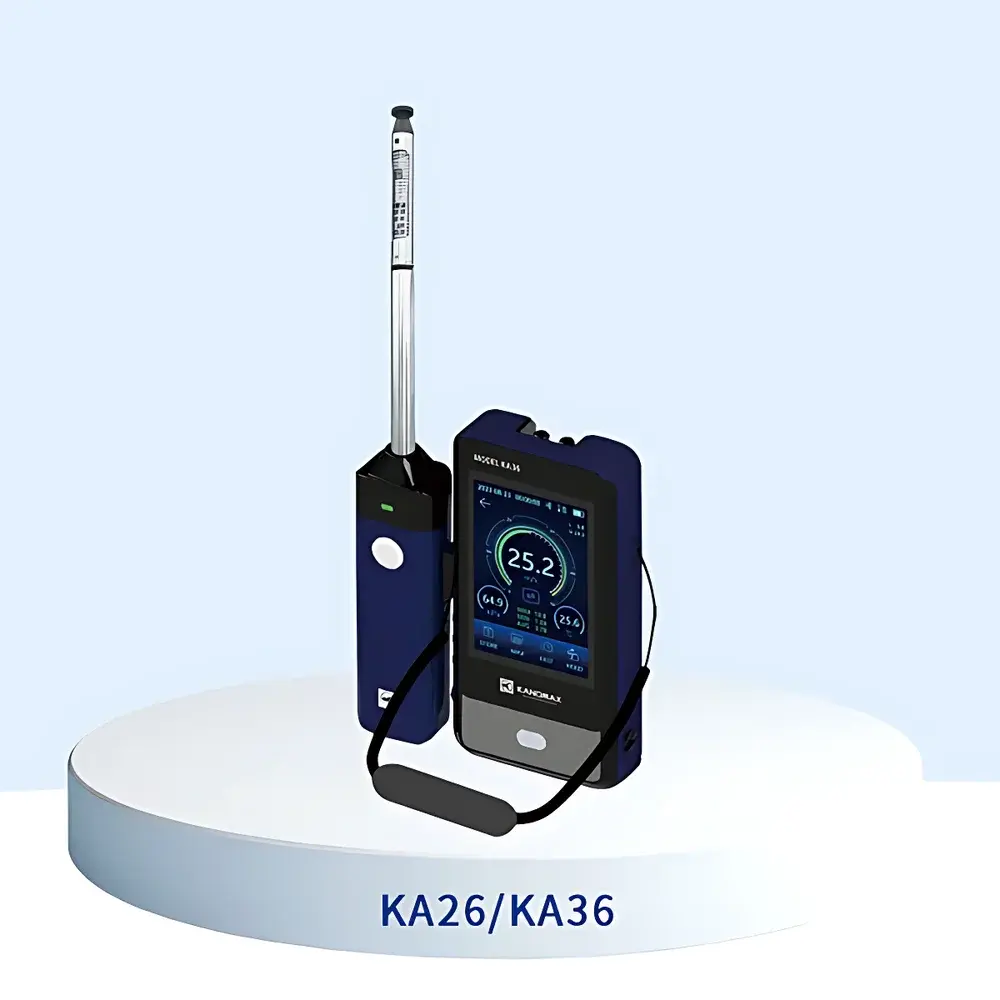
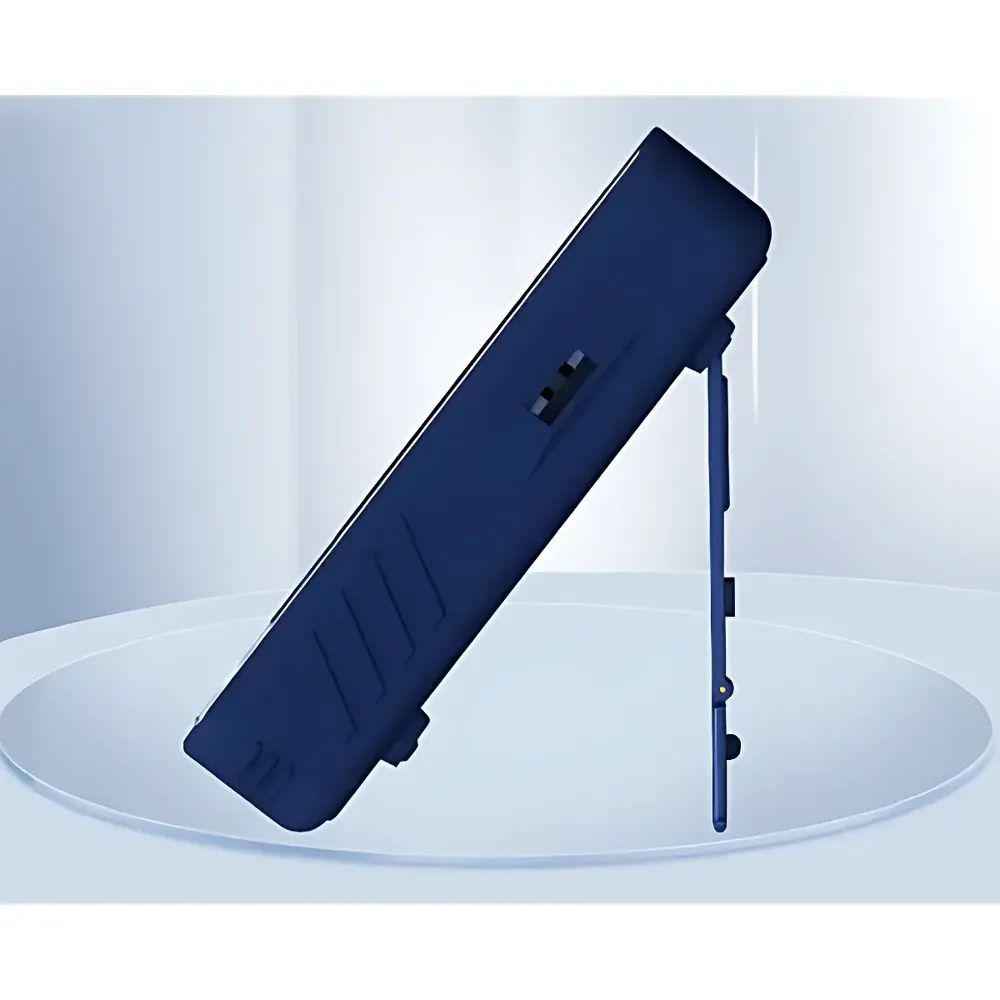
Kanomax KA26/KA36 Thermal Anemometer
| Brand | Kanomax |
|---|---|
| Origin | Japan |
| Model | KA26 / KA36 |
| Instrument Type | Thermal Anemometer |
| Velocity Range | 0.00–50.0 m/s |
| Velocity Resolution | 0.01 m/s (0.00–9.99 m/s), 0.1 m/s (10.0–50.0 m/s) |
| Temperature Range | −20.0–100.0 °C |
| Temperature Resolution | 0.1 °C |
| Pressure Range | −5.00 to +5.00 kPa |
| Pressure Resolution | 0.01 kPa |
| Velocity Accuracy | ±3% of reading or ±0.015 m/s, whichever is greater |
| Temperature Accuracy | ±0.3 °C (−20.0–0.00 °C and 60.0–100.0 °C: ±0.5 °C) |
| Pressure Accuracy | ±0.1 kPa |
| Response Time | ~1 s (velocity & pressure), ~30 s (temperature) |
| Display | 3.5-inch resistive touchscreen |
| Data Storage | 5,000 records |
| Communication | Bluetooth 5.0, USB-C |
| Battery Life | ~10 hours (typical use at 5 m/s, 20 °C) |
| Operating Environment (Body) | 5–40 °C |
| Operating Environment (Probe) | −20–100 °C |
| Storage Temperature | −30–60 °C |
| Weight | ~600 g |
| Probe Extendable Length | up to 1240 mm |
| Probe Diameter | Φ10 mm (sensor), 40×27×125 mm (handle), 260–330 mm (adjustable) |
Overview
The Kanomax KA26 and KA36 are precision thermal anemometers engineered for simultaneous measurement of air velocity, temperature, and differential pressure in demanding environmental and industrial settings. Based on constant-temperature anemometry (CTA) principles, these instruments utilize a heated thermistor sensor whose cooling rate correlates directly with local airflow velocity—enabling high-sensitivity, low-inertia response across a broad dynamic range (0.00–50.0 m/s). Unlike cup or vane anemometers, thermal sensors provide true vector-averaged velocity readings in turbulent or low-velocity conditions, making them especially suitable for HVAC commissioning, cleanroom qualification, indoor air quality (IAQ) surveys, and laboratory ventilation validation where spatial resolution and temporal fidelity are critical. The integrated tri-parameter architecture eliminates the need for multiple instruments during system balancing or airflow mapping, reducing measurement uncertainty introduced by sequential probing.
Key Features
- Simultaneous real-time acquisition of air velocity, temperature, and differential pressure—each with dedicated calibration traceability to JIS Z 8000 and ISO/IEC 17025-accredited reference standards.
- 3.5-inch resistive touchscreen display supporting dual-view mode: numeric readouts paired with analog bar graphs for intuitive trend visualization and transient behavior assessment.
- Bluetooth 5.0 wireless communication between probe and main unit—eliminating cable constraints during duct traverse, ceiling diffuser testing, or remote exhaust stack evaluation.
- Modular, interchangeable probe design with telescoping extension rod (up to 1240 mm) and flexible articulation—enabling access to confined or elevated locations without auxiliary fixtures.
- Configurable pass/fail threshold alarms with audible alert and visual highlight—supporting compliance checks against ASHRAE 62.1, ISO 14644-3, or internal SOPs during routine monitoring.
- On-device statistical processing including min/max/average calculation, data hold, and time-stamped logging—facilitating GLP-compliant field documentation without external software dependency.
- Integrated status indicators for battery level, Bluetooth link quality, signal strength, and active measurement mode—ensuring operational transparency under variable ambient lighting or glove use.
Sample Compatibility & Compliance
The KA26 and KA36 are validated for use with clean, dry air—consistent with ISO 14644-1 particle-free environments and non-corrosive HVAC airstreams. While not rated for explosive atmospheres (ATEX/IECEx) or saturated steam, their probe housing meets IP54 ingress protection for dust and splash resistance during portable operation. All factory calibrations are performed per JIS B 7555 and documented with NIST-traceable certificates. The devices support audit-ready data integrity through timestamped internal storage (5,000 records), user-configurable date/time settings, and firmware-locked calibration parameters—aligning with FDA 21 CFR Part 11 requirements when used in regulated pharmaceutical or medical device manufacturing facilities.
Software & Data Management
Data export is supported via USB-C interface using standard CSV format, compatible with Excel, MATLAB, and LabVIEW for post-processing. Bluetooth connectivity enables live streaming to Kanomax’s optional PC-based analysis suite (Kanomax AirFlow Manager™), which provides automated duct traverse reporting, ISO 14644-3 compliant uniformity maps, and customizable PDF certificate generation. All stored measurements include metadata such as probe ID, operator tag, location code, and environmental timestamps—enabling full traceability per ISO/IEC 17025 clause 7.7. No cloud synchronization or proprietary cloud services are required; local file management ensures data sovereignty and network isolation in secure lab environments.
Applications
- HVAC system commissioning and TAB (Testing, Adjusting, Balancing) per SMACNA and NEBB guidelines
- Cleanroom airflow uniformity and velocity profiling in ISO Class 5–8 environments
- Indoor air quality (IAQ) assessments including thermal comfort (PMV/PPD) and ventilation rate verification
- Industrial exhaust hood face velocity validation per OSHA 1910.145 and ANSI Z9.5
- Laboratory fume hood certification and containment testing
- Manufacturing process airflow control in semiconductor, biotech, and food packaging lines
- Educational fluid dynamics demonstrations and undergraduate engineering labs
FAQ
What distinguishes the KA26 from the KA36 model?
The KA36 includes an integrated differential pressure transducer and bundled 1.5 m silicone pressure tubing, enabling simultaneous static pressure drop measurement across filters, coils, or dampers—while the KA26 measures velocity and temperature only.
Can the instrument be calibrated in-house?
Field calibration is not supported; however, the probe and main unit are designed for modular return-to-factory recalibration with documented uncertainty budgets per ISO/IEC 17025. Optional annual calibration service contracts include NIST-traceable certificates and adjustment reports.
Is the probe suitable for high-humidity or condensing environments?
The probe is rated for operation up to 100 °C but is not sealed against condensation; prolonged exposure to saturated air may affect sensor stability. Use in dew-point-controlled environments or with desiccant-dried purge air is recommended for long-term accuracy.
Does the device meet regulatory requirements for GMP or ISO 13485 environments?
Yes—the firmware enforces immutable audit trails, user-access controls, and electronic signature capability when paired with Kanomax AirFlow Manager™, satisfying Annex 11 and ISO 13485 clause 7.6 for measurement equipment management.
How is measurement uncertainty quantified for velocity readings?
Total expanded uncertainty (k=2) is stated as ±3% of reading or ±0.015 m/s, whichever is greater—derived from combined contributions of sensor drift, linearity error, temperature compensation residuals, and digital quantization, all verified during type testing per JIS B 7555 Annex B.







