
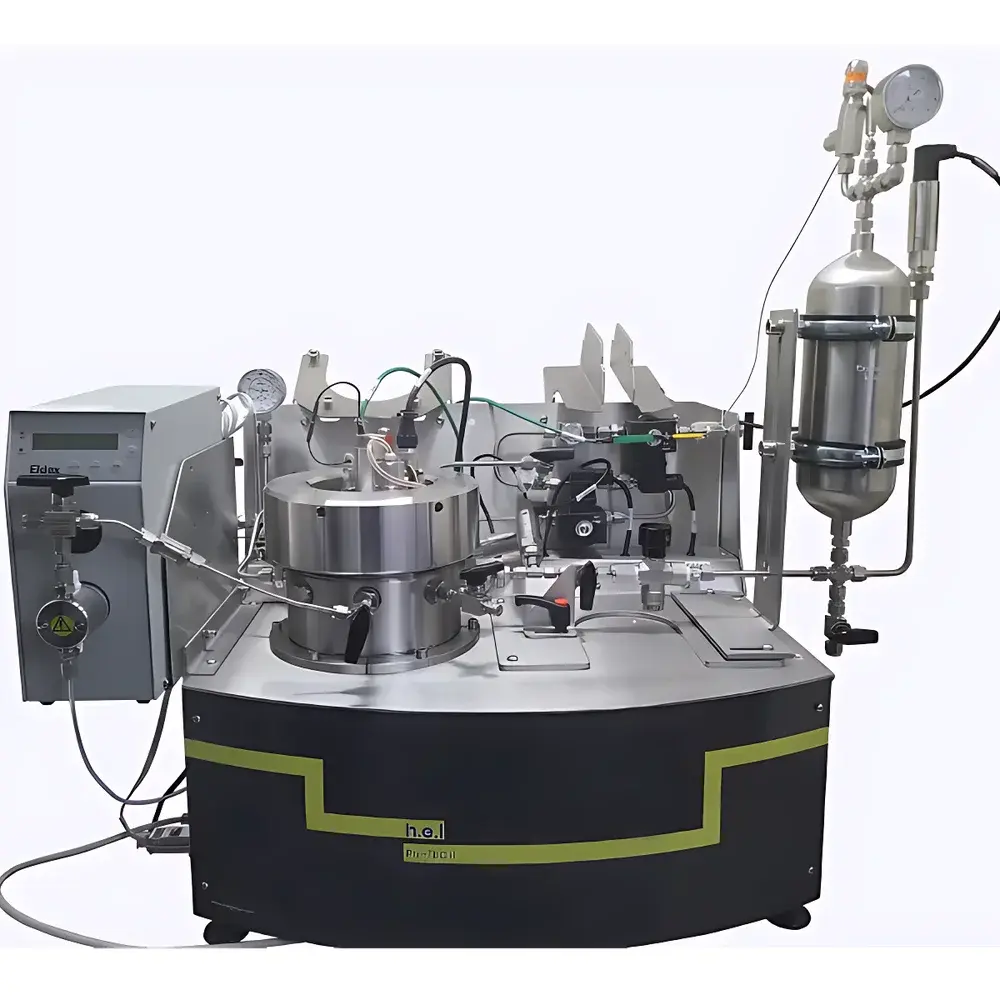
HEL PhiTEC II Micro Reaction Calorimeter
| Brand | HEL (Hazard Evaluation Laboratories) |
|---|---|
| Origin | UK |
| Model | PhiTEC II |
| Measurement Mode | Adiabatic Calorimetry |
| Instrument Type | Reaction Calorimeter |
| Function | Micro-scale |
| Temperature Range | 0–500 °C |
| Temperature Detection Threshold | 0.02 °C/min |
| Adiabatic Temperature Tracking Rate | 200 °C/min |
| Maximum Calorimetric Chamber Pressure Rating | 137 bar |
Overview
The HEL PhiTEC II Micro Reaction Calorimeter is an adiabatic reaction calorimeter engineered for precise, high-sensitivity thermal hazard assessment of small-scale chemical reactions. Operating on the principle of dynamic adiabatic compensation—where a feedback-controlled heater actively tracks and matches the sample’s temperature rise during exothermic events—the PhiTEC II enables quantitative measurement of heat flow, adiabatic temperature rise (ΔTad), time-to-maximum-rate (TMR), and kinetic parameters under near-ideal adiabatic conditions. Designed specifically for laboratory-scale process safety screening, it bridges the critical gap between synthetic chemistry and scalable manufacturing by identifying latent thermal hazards—including “silent exotherms”—before scale-up. Its micro-volume capability (0.5–110 mL test volumes across three interchangeable cell configurations) ensures representative data from early-stage reaction screening while minimizing material consumption and containment risk.
Key Features
- Adiabatic operation with real-time heater compensation, maintaining <0.01 K deviation from sample temperature during exotherms
- Ultra-low thermal detection threshold of 0.02 °C/min—capable of resolving subtle, delayed, or autocatalytic onset events
- High-speed adiabatic tracking up to 200 °C/min, enabling reliable characterization of rapid runaway scenarios
- Robust calorimetric chamber rated to 137 bar, with integrated pressure compensation to maintain mechanical integrity during gas-evolving or high-pressure reactions
- Multi-material reaction vessels: borosilicate glass, 316 stainless steel, Hastelloy C-276, and titanium—selected per compatibility with corrosive, halogenated, or highly reactive chemistries
- Integrated stirring: standard magnetic drive (300 rpm), optional mechanical stirrer (600–2000 rpm) with torque monitoring for heterogeneous or viscous systems
- Automated reagent addition: dual-channel high-pressure liquid dosing (0.01–40 mL/min, up to 200 bar) and mass-flow-controlled gas injection (N2, O2, H2, etc.)
Sample Compatibility & Compliance
The PhiTEC II supports diverse reaction chemistries—including nitration, hydrogenation, polymerization, oxidation, and Grignard formation—across organic, inorganic, and pharmaceutical synthesis workflows. Vessel material selection adheres to ASTM E2550 and ISO 11357-7 guidelines for calorimetric compatibility. The system meets essential requirements for Process Safety Management (PSM) per OSHA 1910.119 and CCPS Risk-Based Process Safety frameworks. Data acquisition and audit trails comply with ALCOA+ principles; optional 21 CFR Part 11-compliant software modules support GxP environments including GLP and GMP-regulated development labs.
Software & Data Management
Controlled via HEL’s proprietary iCIRUS™ software, the PhiTEC II provides synchronized acquisition of temperature, pressure, stirring torque, dosing volume, and heater power. Real-time visualization includes dynamic adiabatic curves, dT/dt vs. T plots, and cumulative energy release profiles. Post-run analysis delivers derived outputs: apparent activation energy (Ea), pre-exponential factor (A), reaction order (n), and self-heating rates. All raw and processed data are stored in encrypted, timestamped binary files with full metadata tagging (operator, batch ID, vessel ID, ambient conditions). Export formats include CSV, PDF reports, and XML for LIMS integration.
Applications
- Early-stage thermal hazard identification in API route scouting and impurity profiling
- Reaction calorimetry for Design of Experiments (DoE)-driven process optimization
- Validation of kinetic models used in dynamic simulation tools (e.g., Dynochem, gPROMS)
- Supporting CCPS Layer of Protection Analysis (LOPA) and Quantitative Risk Assessment (QRA)
- Generating input data for Emergency Relief System Design (ERSD) per DIERS methodology
- Investigating decomposition pathways of unstable intermediates or energetic materials
FAQ
What distinguishes PhiTEC II from conventional RC1-type reaction calorimeters?
The PhiTEC II operates exclusively in adiabatic mode—eliminating heat loss artifacts—and achieves significantly higher sensitivity (0.02 °C/min) and faster tracking (200 °C/min) than isothermal or heat-flow-based systems.
Can PhiTEC II be used for reactions involving hazardous gases such as chlorine or phosgene?
Yes—when configured with Hastelloy or titanium vessels and appropriate gas-handling modules (including scrubber-integrated vent lines), it supports toxic and corrosive gas-phase reagents under controlled containment.
Is calibration traceable to national standards?
Temperature sensors are calibrated against NIST-traceable reference cells; energy calibration employs certified electrical substitution methods per ISO/IEC 17025-accredited procedures.
Does the system support automated method sequencing for unattended overnight runs?
Yes—iCIRUS™ supports fully programmable multi-step protocols, including timed heating ramps, sequential dosing, and conditional trigger logic based on dT/dt thresholds.
How is data integrity ensured during long-duration decomposition studies?
Continuous checksum validation, redundant storage buffers, and hardware-monitored power-fail recovery prevent data corruption—even during 72+ hour tests.
Related Products



