
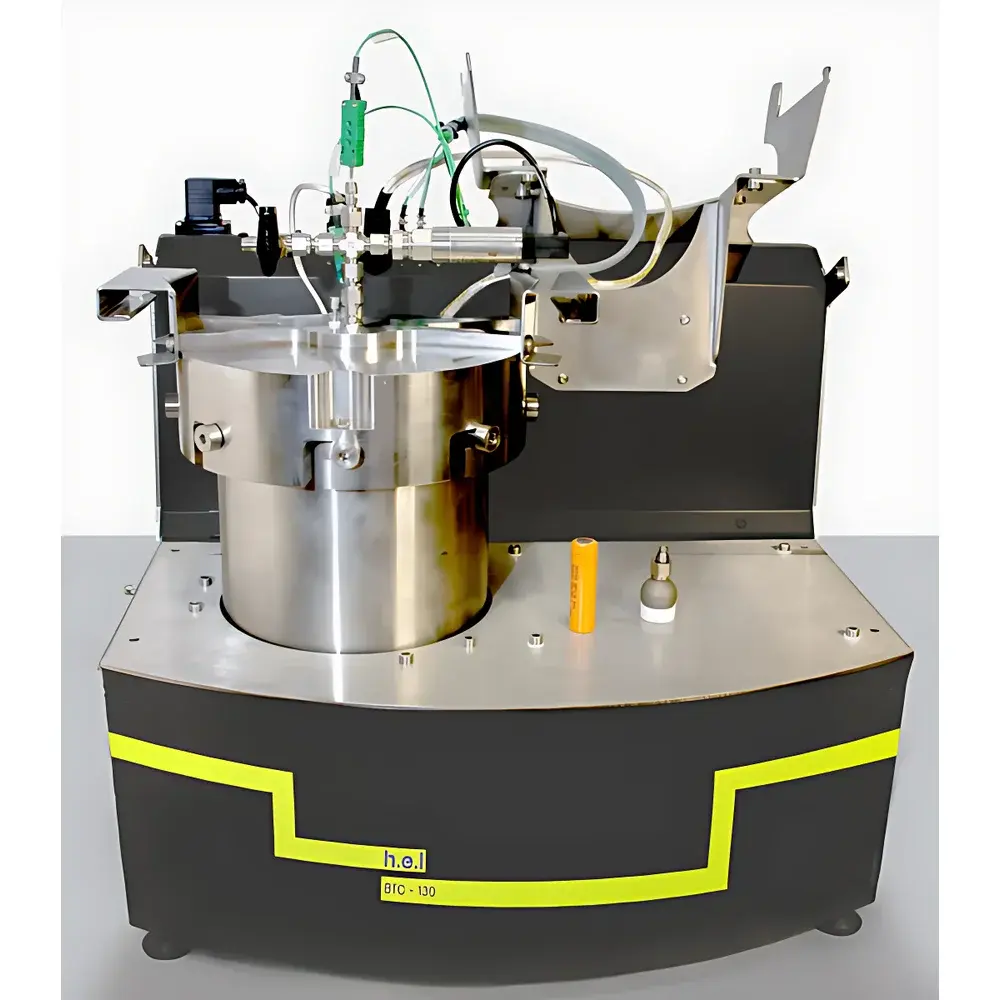
H.E.L BTC-130 Battery Thermal Safety Accelerating Rate Calorimeter (ARC)
| Brand | H.E.L |
|---|---|
| Origin | United Kingdom |
| Model | BTC-130 |
| Measurement Mode | Adiabatic Calorimetry |
| Instrument Type | Accelerating Rate Calorimeter (ARC) |
| Temperature Range | 25–500 °C |
| Temperature Resolution | 0.001 K |
| Precision | ±0.01 K |
| Single-Sample Test Duration | up to 1000 min |
| Heat Capacity | 60,000 J |
| Outer Bath Volume | 1000 mL |
| Inner Bath Volume | 1000 mL |
| Sample Chamber Diameter | 130 mm |
| Sample Chamber Height | 200 mm |
Overview
The H.E.L BTC-130 Battery Thermal Safety Accelerating Rate Calorimeter is a purpose-engineered adiabatic calorimetric system designed for rigorous thermal hazard assessment of electrochemical energy storage devices and their constituent materials. Built upon the proven PhiTEC (ARC) platform—originally developed from Dow Chemical’s foundational ARC technology—the BTC-130 integrates advanced thermal control architecture with battery-specific mechanical and electrical interfaces to deliver quantitative, reproducible data on self-heating onset, adiabatic temperature rise, pressure evolution, and reaction energetics under realistic abuse conditions. Its core operating principle relies on dynamic adiabatic control: the instrument continuously adjusts the surrounding furnace temperature to match the sample temperature in real time, thereby minimizing heat loss (φ-factor < 1.1 typical for standard configurations) and enabling true adiabatic simulation of thermal runaway propagation. This capability is essential for predicting large-scale thermal behavior in battery packs, validating thermal management system (TMS) designs, and supporting safety-critical regulatory submissions under UN 38.3, IEC 62133, UL 1642, and ISO 12405-4 frameworks.
Key Features
- Five programmable test modes: Adiabatic, Heat-Wait-Seek (HWS), Ramp, Isothermal, and Single HWS—enabling flexible screening and deep kinetic characterization
- Real-time online adiabatic calibration: fully automated 30-minute initial calibration followed by optional 10-minute in-run recalibrations, eliminating reliance on empirical “blank bomb” corrections
- High-fidelity thermal tracking: adiabatic temperature ramp rate up to 30 °C/min; 100 Hz high-speed temperature acquisition for accurate detection of onset events (±0.01 K resolution)
- Robust containment architecture: multi-layer stainless-steel pressure-rated housing (rated to 30 MPa), integrated rupture disc and pressure-relief valve, emergency stop, and optional rapid-cooling module
- Battery-specific mechanical interface: 130 mm diameter × 200 mm height test chamber accommodates cylindrical cells up to 120 mm Ø × 190 mm h (e.g., 4680, prismatic modules), with interchangeable sample holders in stainless steel, Hastelloy®, or borosilicate glass
- Integrated electrochemical stimulation: programmable charge/discharge current and power control (up to 100 A, 1000 W), short-circuit and nail-penetration test modules, and optional Cp measurement accessory for specific heat capacity determination
Sample Compatibility & Compliance
The BTC-130 supports comprehensive thermal safety evaluation across the full battery value chain—from raw electrode materials (anodes, cathodes, solid/liquid electrolytes, SEI precursors) to finished cells in any state-of-charge (including overcharged and deeply discharged conditions). It is validated for testing coin cells, cylindrical (AA to 4680), prismatic, pouch, and custom-format cells. All operational protocols comply with GLP-aligned data integrity requirements, including full audit trail logging, user access controls, and electronic signature support per FDA 21 CFR Part 11. Test methodologies align with ASTM E1981 (adiabatic calorimetry), ISO/IEC 17025 (testing laboratory competence), and IEC TR 62914 (battery thermal runaway guidance). The system’s compact footprint permits safe operation inside standard fume hoods or inert-atmosphere gloveboxes (O₂ < 1 ppm).
Software & Data Management
Control and analysis are executed via HEL’s proprietary Thermal Hazard Analysis Software (THAS), a Windows-based platform compliant with GxP data governance standards. THAS provides synchronized acquisition of temperature, pressure, voltage, current, and time-stamped event markers. Raw data files are stored in non-proprietary HDF5 format with embedded metadata (instrument ID, operator, calibration history, environmental logs). Kinetic modeling tools include ASTM E698 and Friedman analysis for activation energy estimation, as well as numerical integration for total enthalpy (ΔHrxn) and time-to-maximum-rate (TMRad) calculations. Export options include CSV, PDF reports with traceable calibration certificates, and direct integration with LIMS or enterprise analytics platforms via OPC UA or REST API.
Applications
- Thermal runaway onset temperature (Tonset) determination under adiabatic and HWS conditions
- Quantitative assessment of self-heating rates, adiabatic temperature rise (ΔTad), and maximum self-heat rate (dT/dt)max
- Evaluation of abuse tolerance: nail penetration, crush, external short-circuit, overcharge, and thermal propagation testing
- Electrolyte decomposition kinetics and gas evolution profiling (when coupled with optional FTIR or GC-MS)
- Validation of thermal barrier materials, phase-change composites, and cell-to-pack (CTP) thermal interface designs
- Supporting FMEA, HAZOP, and DFMEA workflows for battery pack development and ISO 26262 functional safety certification
FAQ
How does the BTC-130 differ from conventional ARC instruments?
The BTC-130 extends the PhiTEC platform with battery-optimized hardware (larger chamber, electrochemical interfaces, pressure-rated containment) and software workflows specifically validated for electrochemical systems—not merely adapted from chemical process safety applications.
Can the BTC-130 perform both adiabatic and isothermal calorimetry?
Yes. It natively supports dual-mode operation: true adiabatic tracking and precise isothermal hold at user-defined setpoints, enabling comparative studies of thermal stability vs. operational temperature limits.
Is calibration traceable to national standards?
All temperature sensors are NIST-traceable platinum resistance thermometers (PRTs); calibration procedures follow ISO/IEC 17025 and include documented uncertainty budgets for each test mode.
What sample preparation is required for electrode material testing?
Powdered anode/cathode materials are typically loaded into sealed stainless-steel crucibles with inert gas purging; slurry-based samples may require solvent stabilization or controlled drying prior to loading.
Does the system support automated test sequencing?
Yes. THAS enables unattended execution of multi-step protocols—including preconditioning cycles, HWS scans, adiabatic runs, and post-test cooldown—with full fault recovery and email alerts on completion or error.
Related Products



