
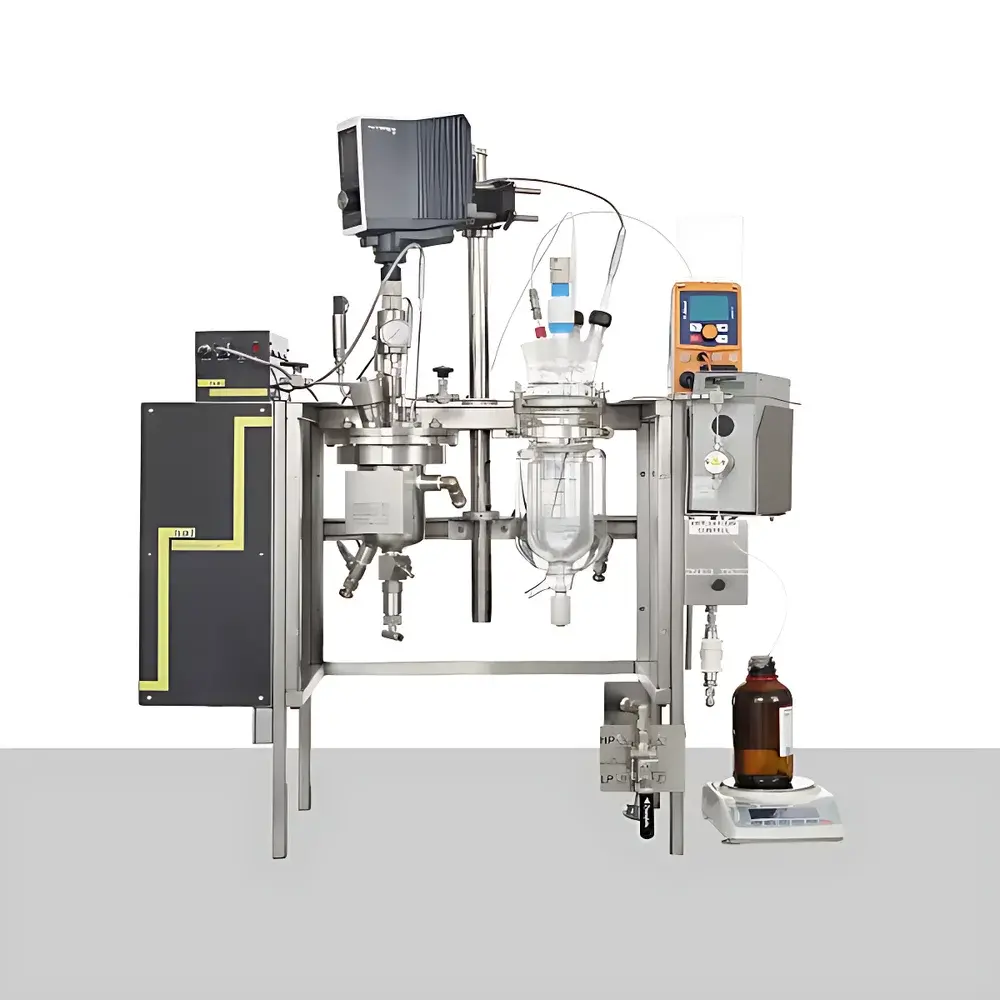
H.E.L Dual Simular Ambient/High-Pressure Dual-Reactor Calorimetry System
| Brand | H.E.L (UK) |
|---|---|
| Origin | United Kingdom |
| Model | H.E.L Dual Simular Ambient/High-Pressure Dual-Reactor Calorimetry System |
| Instrument Type | Reaction Calorimeter |
| Measurement Modes | Isothermal Power Compensation Calorimetry, Isothermal Heat-Flow Calorimetry, Isoperibolic Reflux Calorimetry, Dynamic Ramp Calorimetry |
| Temperature Range | −30 °C to 225 °C |
| Maximum Pressure Rating | 100 Pa (vacuum to 100 Pa absolute) |
| Reactor Volumes | 0.5 L, 1 L, 2 L |
| Materials | Borosilicate Glass, 316 Stainless Steel, Hastelloy C-276 |
| Calibration Heater | 150 W |
| Automation Level | Fully Automated with Integrated Feedback Control |
| Sensor Integration | pH, Turbidity, In-situ FTIR, Raman, Particle Size Probes, Mass Flow Controllers (MFCs), Precision Load Cells |
| Software Compliance | Supports ALCOA+ principles, audit trail, electronic signatures (21 CFR Part 11–ready configuration available) |
Overview
The H.E.L Dual Simular Ambient/High-Pressure Dual-Reactor Calorimetry System is an engineered platform for quantitative thermochemical characterization of chemical reactions under controlled process conditions. It operates on the fundamental principles of reaction calorimetry—measuring heat flow (dQ/dt) as a function of time, temperature, and composition—to derive thermodynamic and kinetic parameters including reaction enthalpy (ΔHr), heat release rate, adiabatic temperature rise (ΔTad), and time-to-maximum-rate (TMR). Unlike single-vessel systems, the Dual Simular architecture enables simultaneous or sequential operation of two independent reactors—one configured for ambient-pressure glass-jacketed operation and the other for high-pressure metal containment—within a shared thermal management and data acquisition framework. This dual-path design supports direct comparison of reaction behavior across pressure regimes, critical for assessing vapor-phase participation, gas solubility effects, and phase-dependent kinetics during process safety evaluation and scale-up.
Key Features
- Modular dual-reactor configuration supporting concurrent ambient- and high-pressure experiments within one instrument footprint
- Material flexibility: interchangeable reactor vessels in borosilicate glass (for visual monitoring and low-pressure synthesis), 316 stainless steel (for moderate corrosion resistance), and Hastelloy C-276 (for aggressive halide- or acid-containing chemistries)
- Integrated precision temperature control: jacketed cooling/heating with ±0.1 °C stability over −30 °C to 225 °C range, validated per ASTM E1970 and ISO 11357-4
- Dual calorimetric methodologies: selectable isothermal power compensation (with 150 W calibrated heater) and heat-flow modes; optional isoperibolic reflux and dynamic ramp calorimetry for non-isothermal scenarios
- Automated liquid dosing via high-pressure syringe pumps (up to 200 bar) and gas introduction via mass flow controllers (MFCs) with sub-1% full-scale accuracy
- Real-time mass tracking via integrated feedback balance (±0.01 g resolution) enabling precise stoichiometric accounting and evaporation loss correction
- Expandable PAT interface: native support for in-situ spectroscopic probes (FTIR, Raman), turbidity sensors, pH electrodes, and particle size analyzers—all synchronized with calorimetric data streams
Sample Compatibility & Compliance
The Dual Simular accommodates heterogeneous, multiphase, and catalytic reaction systems—including exothermic nitrations, hydrogenations, Grignard formations, polymerizations, and crystallization processes. Its reactor material options ensure compatibility with organic solvents, aqueous electrolytes, strong acids/bases, and reactive gases (e.g., Cl2, H2, CO). All hardware and software modules comply with IEC 61511 for functional safety in laboratory-scale process hazard analysis. The system meets GLP requirements for raw data integrity, with timestamped, uneditable measurement logs and configurable user access levels. When deployed with 21 CFR Part 11–enabled software, it provides electronic signature capability, audit trail generation, and data archival compliant with FDA and EMA regulatory expectations for process development documentation.
Software & Data Management
Control and analysis are executed through H.E.L’s UniQ software—a modular, Windows-based platform designed for both novice operators and expert process safety engineers. UniQ features a drag-and-drop experiment builder, real-time visualization of up to 64 synchronized channels (temperature, pressure, heat flow, pH, absorbance, etc.), and embedded calculation engines for instantaneous ΔHr, accumulation index, and thermal runaway onset detection. Data export is supported in CSV, Excel, and ASTM E2554-compliant .qdx formats. All raw datasets include metadata headers (instrument ID, calibration history, operator ID, environmental conditions) and are stored with SHA-256 hash verification to ensure forensic traceability. Optional cloud-sync and LIMS integration enable centralized data governance across multi-site R&D networks.
Applications
- Process safety assessment: determination of MTSR (maximum temperature of synthesis reaction), TMRad, and RC1-style thermal stability profiles
- Reaction mechanism elucidation: correlation of heat flow signatures with in-situ spectral changes to identify intermediates and side reactions
- Scale-up risk mitigation: identification of heat transfer limitations, mixing sensitivity, and accumulation thresholds prior to pilot plant trials
- Catalyst screening and optimization: quantification of enthalpic efficiency and selectivity trade-offs under varied pressure/temperature conditions
- Crystallization thermodynamics: monitoring of dissolution enthalpy, supersaturation profiles, and nucleation onset via combined calorimetry and turbidity
- Regulatory dossier preparation: generation of ICH Q5, Q8, and Q9-aligned thermal hazard reports for drug substance manufacturing submissions
FAQ
What pressure range does the Dual Simular support?
The system operates from full vacuum up to 100 Pa absolute pressure—optimized for low-pressure gas evolution studies and solvent degassing protocols. For higher-pressure applications (up to 200 bar), H.E.L offers the associated AutoCLAVE or Reaction Calorimeter Series platforms.
Can the Dual Simular perform adiabatic calorimetry?
No—it is not an adiabatic system. It is a high-fidelity isothermal/isoperibolic calorimeter designed for precise heat flow quantification under controlled thermal boundary conditions. Adiabatic assessments require complementary ARC or Phi-TEC instrumentation.
Is third-party sensor integration supported?
Yes. UniQ provides open OPC UA and TCP/IP APIs for integration with external analytical devices, including commercial FTIR spectrometers, Raman systems, and laser diffraction particle analyzers.
How is calibration traceability maintained?
Each unit ships with NIST-traceable calibration certificates for temperature sensors (Pt100), load cells, and the 150 W heater. Annual recalibration services are available through H.E.L’s UKAS-accredited service center.
Does the system support GMP-compliant operation?
When configured with 21 CFR Part 11 option, UniQ delivers role-based access control, electronic signatures, immutable audit trails, and data backup protocols aligned with Annex 11 and EU GMP Chapter 4 requirements.



