
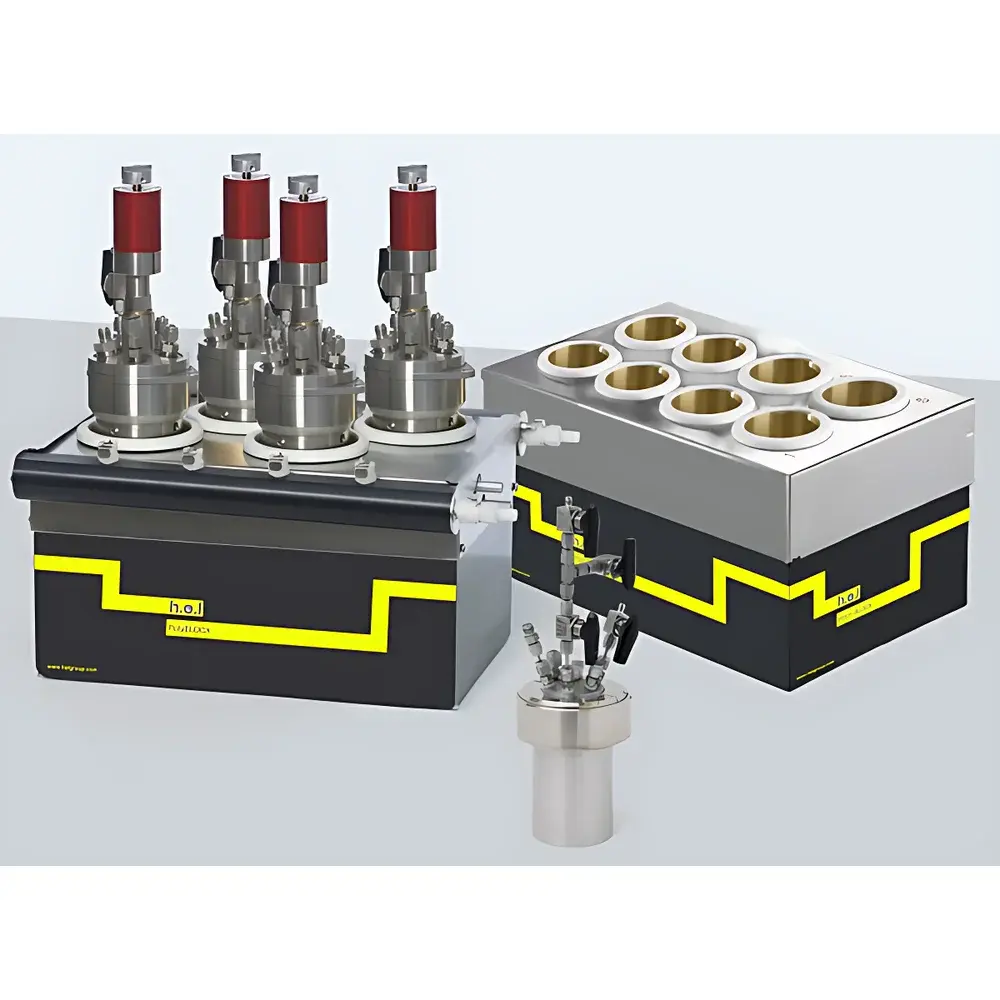
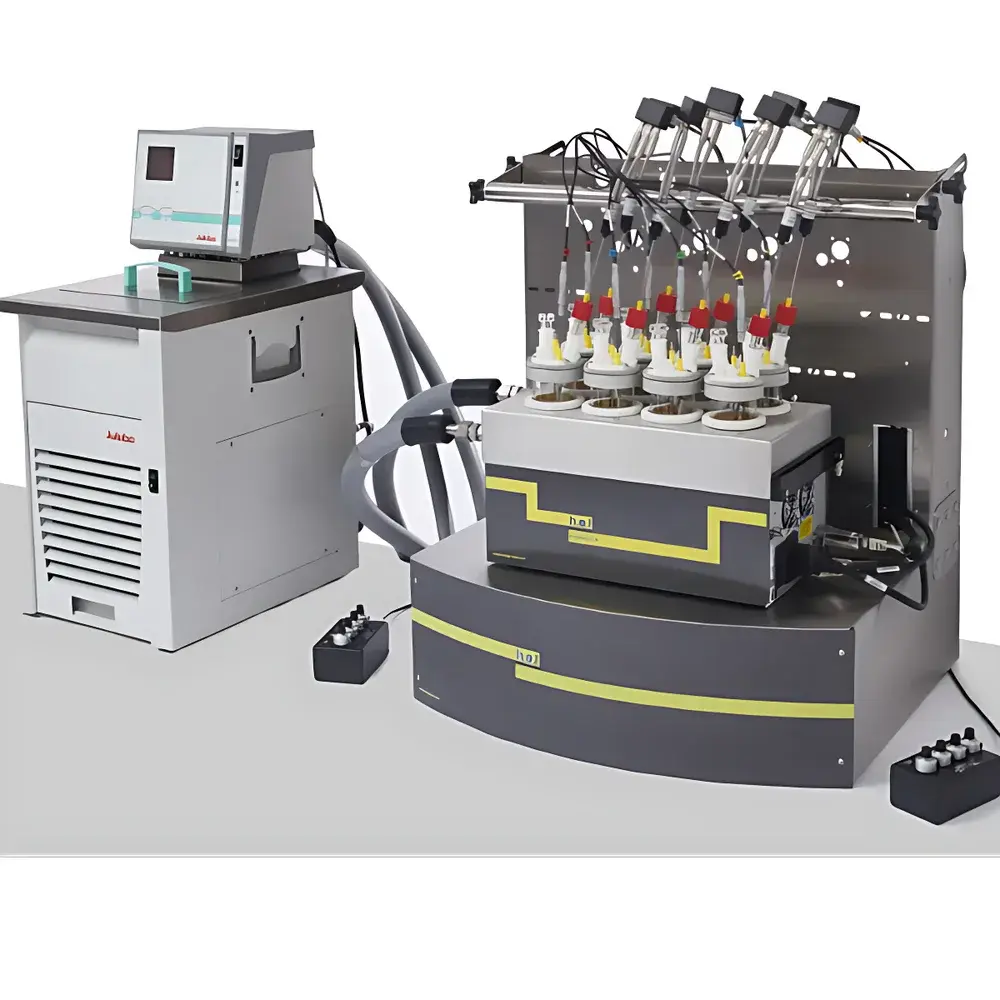
HEL PolyBLOCK High Pressure Automated Parallel Synthesis Reactor
| Brand | HEL |
|---|---|
| Origin | United Kingdom |
| Model | PolyBLOCK High Pressure |
| Reactor Type | Modular Parallel Reaction System |
| Number of Independent Reaction Zones | 4 or 8 |
| Temperature Range | –60 °C to +230 °C (per zone) |
| Max. Inter-Zone ΔT | 100 °C |
| Pressure Rating | High-Pressure Compatible (up to 100 bar, per standard configuration) |
| Vessel Capacity | 1 mL to 500 mL (standard), extendable to 1000 mL with custom vessels |
| Vessel Material | 316 Stainless Steel (standard) |
| Stirring | Magnetic and overhead mechanical stirring (hover-drive, torque-controlled) |
| Control Interface | WinISO v6.x Software (Windows-based, FDA 21 CFR Part 11 compliant audit trail option) |
| Data Output Format | CSV, Excel (.xlsx), XML |
| Compliance | CE, UKCA, ISO 9001-certified manufacturing |
| Module Compatibility | Fully modular—supports liquid dosing, inline calorimetry (RC1e-style), pH/DO/turbidity probes, reflux condensers, inert gas purging, and automated venting |
| Dimensions (4-zone base unit) | 520 × 420 × 310 mm (W × D × H) |
Overview
The HEL PolyBLOCK High Pressure Automated Parallel Synthesis Reactor is an engineered platform for reproducible, scalable, and data-rich chemical process development under controlled high-pressure conditions. Based on a dual-zone modular architecture—supporting either four or eight thermally and mechanically isolated reaction stations—it implements precise Couette-flow stirring, jacketed or immersion-based temperature control, and real-time parameter acquisition across all vessels simultaneously. Designed for synthetic chemists, process engineers, and catalysis researchers, the system enables parallel execution of reaction screening protocols under rigorously defined pressure–temperature–stirring–addition trajectories. Its core measurement principles include PID-regulated thermal exchange via integrated heating/cooling jackets, closed-loop torque-sensing mechanical agitation, and pressure-compensated volumetric liquid delivery. The platform operates within a validated pressure envelope up to 100 bar (dependent on vessel specification), making it suitable for hydrogenation, hydroformylation, supercritical fluid chemistry, and accelerated crystallization studies where phase behavior and mass transfer limitations are pressure-sensitive.
Key Features
- Independent thermal control per reaction zone with ±0.1 °C stability and ramp rates from 0.1 to 20 °C/min
- Overhead mechanical stirring with hover-drive technology—capable of sustaining >500 rpm at viscosities up to 10,000 mPa·s without slippage or vortex collapse
- Integrated WinISO software with full method scripting, real-time parameter overlay, and synchronized timestamped logging of T, P, rpm, power, pH, turbidity, and exotherm profiles
- Modular add-ons including RC1e-compatible reaction calorimetry (no calibration required), multi-channel syringe pump dosing (±1 µL accuracy), and inert gas management with auto-purge sequencing
- Reflux-ready configuration with individual water/gas manifolds per zone, quick-connect condenser interfaces, and vacuum-assisted sealing when condensers are disengaged
- Full 21 CFR Part 11 compliance package available—including electronic signatures, audit trails, role-based access control, and raw data immutability safeguards
Sample Compatibility & Compliance
The PolyBLOCK accommodates a broad spectrum of reactor geometries—from 1 mL micro-vials to 500 mL jacketed stainless steel vessels—using standardized flange interfaces (DIN 28120, ISO-KF, or custom ANSI B16.5). All standard vessels are fabricated from electropolished 316 stainless steel, certified to ASME BPVC Section VIII Div. 1 for pressure service. Optional materials include Hastelloy C-276 for aggressive halide-containing media and borosilicate glass inserts for UV-transparent photochemical applications. The system meets IEC 61000-6-2 (EMC immunity) and IEC 61010-1 (safety for laboratory equipment). It supports ASTM E2554 (uncertainty quantification in DoE), ISO 16142-1 (medical device validation principles), and USP analytical instrument qualification frameworks when deployed in regulated environments.
Software & Data Management
WinISO v6.x serves as the unified control and analysis engine, supporting both local touchscreen operation and remote PC-based supervision over Ethernet or Wi-Fi. The software architecture separates method definition (pre-run), live monitoring (during-run), and post-processing (post-run) into discrete, version-controlled modules. All raw sensor data—including time-stamped analog inputs from external probes—are stored in HDF5 binary format with embedded metadata (user ID, method hash, calibration timestamps). Export options include native Excel (.xlsx) with embedded charts, CSV for LIMS integration, and XML for ELN ingestion (e.g., LabArchives, Benchling). Audit trails record every parameter change, user login/logout, file export, and firmware update—retained for ≥36 months unless manually archived per site SOP.
Applications
- High-throughput catalyst screening under industrially relevant pressure conditions (e.g., asymmetric hydrogenation at 30–80 bar H₂)
- Polymorph and solvate screening via pressure-modulated anti-solvent crystallization
- Reaction kinetics profiling using online calorimetry and in situ FTIR coupling (via fiber-optic ports)
- Process safety evaluation—including adiabatic temperature rise (ΔTad) and time-to-maximum-rate (TMRad) determination
- Continuous flow pre-screening using segmented batch-to-flow translation protocols
- DoE-driven optimization of multivariate reaction spaces (T, P, [cat], t, stoichiometry) with statistical confidence intervals
FAQ
What pressure ratings are supported, and how is pressure monitored?
Each reaction zone supports up to 100 bar nominal working pressure using certified 316 SS vessels. Pressure is measured via calibrated 0.1% FS piezoresistive transducers with digital compensation; readings are logged synchronously with temperature and stirring data.
Can the system operate unattended overnight or over weekends?
Yes—WinISO supports fully autonomous execution with hardware-triggered emergency shutdown (over-T, over-P, stir-fail, coolant loss) and email/SMS alerts via SMTP/HTTP API integration.
Is third-party probe integration supported (e.g., Raman, FTIR, or pH)?
All analog input channels (8 per base unit) accept 4–20 mA or 0–10 V signals from validated OEM probes; digital I²C and RS-485 interfaces are available via optional expansion cards.
How is cleaning and cross-contamination prevented between runs?
Vessels are manually cleaned per SOP; automated solvent rinse cycles can be scripted using the integrated dosing module. Gas purge sequences (N₂/Ar) and vacuum drying steps are programmable per zone.
Does the system support GMP documentation packages for regulatory submissions?
Yes—validated IQ/OQ documentation, 21 CFR Part 11 compliance kits, and URS traceability matrices are available upon request and delivered with installation qualification support.
Related Products



