
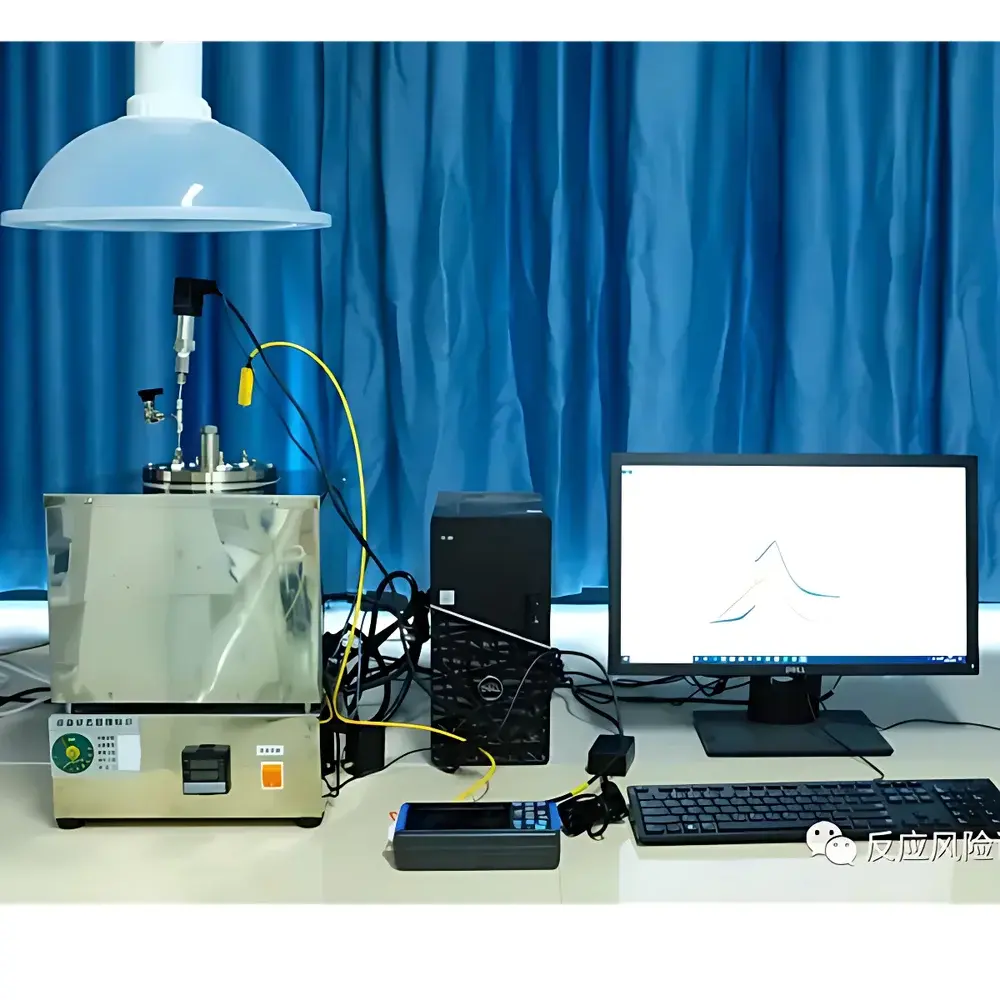
H.E.L PAC-02 Advanced Adiabatic Accelerating Rate Calorimeter
| Brand | H.E.L |
|---|---|
| Model | PAC-02 |
| Measurement Mode | Adiabatic Calorimetry |
| Instrument Type | Accelerating Rate Calorimeter (ARC) |
| Temperature Range | 20–350 °C |
| Temperature Resolution | 0.1 °C/min |
| Precision | ≤0.1 °C |
| Sample Chamber Volume | 2015 mL |
| Automation Level | Fully Automated |
| Origin | Fujian, China |
Overview
The H.E.L PAC-02 Advanced Adiabatic Accelerating Rate Calorimeter is a high-fidelity thermal runaway screening platform engineered for rigorous safety evaluation of lithium-ion battery cells and electrode materials. Operating on the fundamental principle of adiabatic calorimetry—where heat loss from the sample is actively minimized via real-time temperature feedback control—the PAC-02 maintains near-zero heat exchange between the sample and its surroundings. This enables precise quantification of self-heating rates, onset temperatures, and pressure evolution under thermally isolated conditions, critical for identifying exothermic thresholds and runaway propagation kinetics. Designed specifically for battery safety R&D, the system supports controlled ramp-heating protocols (e.g., 0.2–1.0 °C/min), dynamic pressure monitoring up to 14 MPa, and integrated gas capture for downstream compositional analysis. Its robust adiabatic architecture complies with core methodology standards referenced in UN Manual of Tests and Criteria Part III, Subsection 38.3, ASTM E1981, and ISO 11357-7 for polymer and electrochemical material thermal stability assessment.
Key Features
- Fully automated adiabatic control loop with real-time thermal compensation, ensuring <0.1 °C deviation from sample surface temperature during heating
- Large-volume sealed reaction chamber (2015 mL) accommodating cylindrical (14500 to 4680), prismatic (smartphone, action camera cells), and pouch-format batteries (up to 10 cm × 12 cm, ≤5 Ah capacity)
- Synchronized acquisition of temperature, pressure, and time-resolved self-heating rate (dT/dt), enabling derivation of key safety parameters: Tonset, Tcr (critical temperature defined as dT/dt > 100 °C·min−1), and Tmax
- Integrated pressure transducer with ±0.05 MPa accuracy and gas sampling port compatible with GC-TCD/FID or FTIR for quantitative off-gas analysis (CO, CO2, H2, C2H4, HF, etc.)
- Programmable heating profiles including constant-rate, heat-wait-search, and isothermal hold modes—fully compliant with IEC 62660-2 and UL 1642 thermal abuse test sequencing
Sample Compatibility & Compliance
The PAC-02 accommodates full-cell formats across major cathode chemistries (LCO, NMC, NCA, LMO, LFP) and anode configurations (graphite, silicon-dominant, Li-metal). Its mechanical and thermal design meets CE marking requirements for laboratory equipment (2014/30/EU EMC Directive, 2014/35/EU Low Voltage Directive). Data integrity and audit readiness are supported through GLP-compliant electronic records, user access controls, and optional 21 CFR Part 11–enabled software modules. All thermal data outputs conform to ASTM E698 kinetic analysis conventions and support Arrhenius parameter extraction for decomposition activation energy modeling.
Software & Data Management
The proprietary H.E.L Thermokinetics Suite provides intuitive workflow management—from method setup and real-time monitoring to post-run analysis and report generation. Raw sensor data (temperature, pressure, time) is logged at ≥10 Hz resolution and stored in vendor-neutral CSV and HDF5 formats. Built-in analysis tools compute derivative curves (dT/dt vs. T), identify inflection points using Savitzky-Golay smoothing, and overlay multiple runs for comparative thermal profiling. Exported datasets integrate seamlessly with MATLAB, Python (SciPy/Pandas), and commercial kinetics packages (e.g., Thermo-Calc, Kinetics Neo). Audit trails record all operator actions, parameter changes, and calibration events per ISO/IEC 17025 traceability requirements.
Applications
- Thermal runaway screening of commercial and prototype Li-ion cells under varied SOC (0–100%), aging states, and mechanical damage conditions
- Comparative safety assessment of novel cathode/anode materials, solid-state electrolytes, and flame-retardant additives
- Quantitative gas evolution kinetics during SEI decomposition, electrolyte oxidation, and cathode-oxygen release
- Input parameter generation for battery thermal modeling (e.g., COMSOL Multiphysics, STAR-CCM+) and BMS thermal runaway prediction algorithms
- Regulatory documentation support for UN 38.3 certification, OEM safety qualification dossiers, and DOE-funded battery safety initiatives
FAQ
What distinguishes adiabatic calorimetry from differential scanning calorimetry (DSC) for battery safety testing?
Adiabatic calorimetry measures self-heating behavior under near-zero heat-loss conditions—essential for capturing true thermal runaway dynamics at scale. DSC operates under fixed heating rates with significant thermal lag and cannot resolve pressure buildup or gas evolution.
Can the PAC-02 be used for non-battery applications?
Yes—it is validated for energetic material characterization (e.g., propellants, pharmaceutical intermediates), polymer decomposition studies, and catalytic reaction hazard assessment per CCPS Guidelines.
Is remote operation and data export supported?
The system supports Ethernet-based remote monitoring, scheduled unattended runs, and automated daily backup to network drives or cloud storage via configurable SFTP protocols.
How is temperature uniformity ensured across large-format pouch cells?
A dual-sensor strategy—surface thermocouple + embedded fiber-optic probe—is recommended; chamber geometry and forced-convection pre-conditioning minimize radial thermal gradients within ±0.3 °C.
What calibration standards are provided with the instrument?
NIST-traceable reference materials (indium, zinc, tin) for temperature verification and dead-weight pressure calibrators (0.1–10 MPa range) are included with annual calibration certificates.



