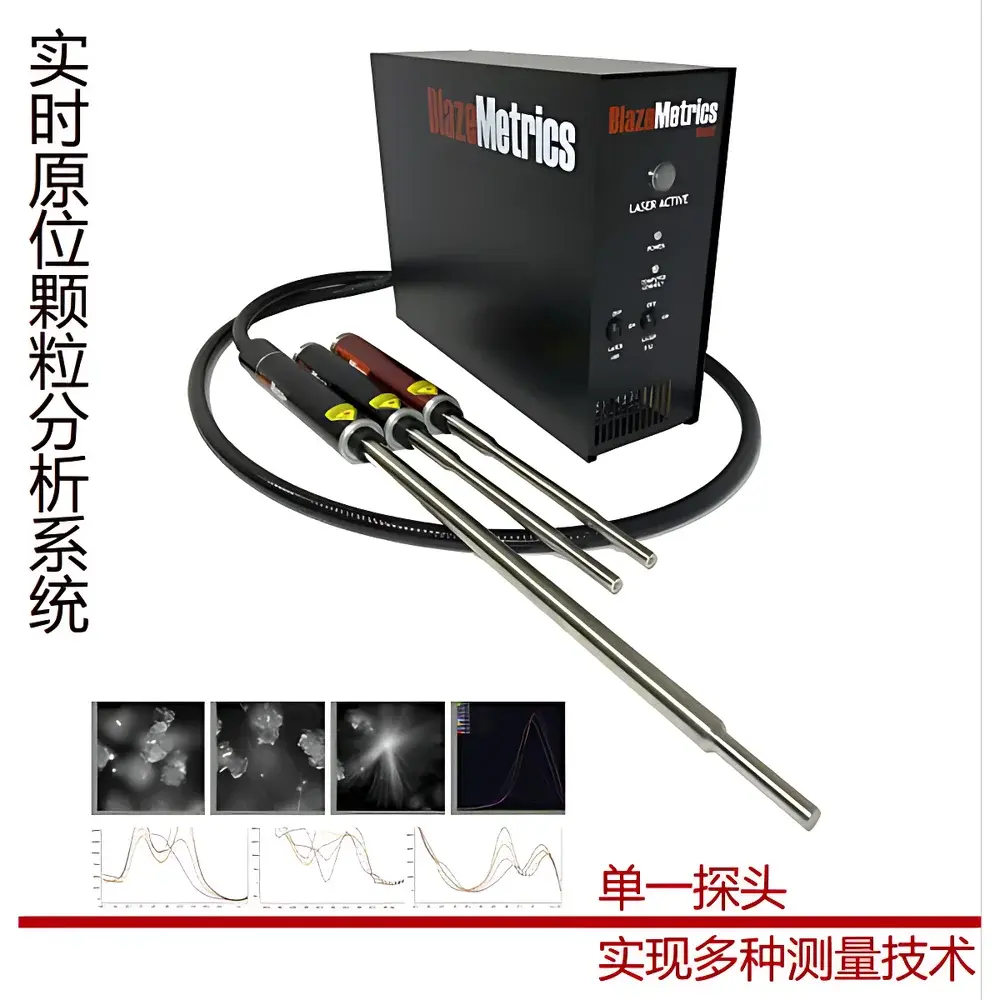
BlazeMetrics Blaze Basic Micro Online Imaging and Particle Size Analyzer
| Brand | BlazeMetrics |
|---|---|
| Origin | USA |
| Manufacturer Type | Authorized Distributor |
| Origin Category | Imported |
| Model | Blaze Basic Micro |
| Pricing | Upon Request |
| Measurement Range | 230 µm – 4.4 mm |
| Number of Optional Lenses | 1 |
| Sample Dispersion Method | In-line liquid-phase measurement / in-situ reaction system monitoring |
| Image Resolution Precision | Sub-nanometer (optical resolution limited by diffraction |
| Measured Parameters | High-resolution micro-imaging, turbidity, chord-length-based particle size and count distribution, integrated Raman spectroscopy |
Overview
The BlazeMetrics Blaze Basic Micro Online Imaging and Particle Size Analyzer is an engineered solution for real-time, in-situ morphological and dimensional characterization of particulates within dynamic industrial processes. Operating on the principle of high-magnification optical imaging coupled with chord-length distribution analysis—complemented by integrated fiber-coupled Raman spectroscopy—the system delivers concurrent quantitative data on particle size, shape, count, turbidity, and chemical identity without offline sampling or process interruption. Designed specifically for continuous manufacturing environments, the Blaze Basic Micro enables direct insertion into pipelines, reactors, or crystallizers, supporting ASTM E2927-22 (Standard Guide for In-Line Particle Characterization), ISO 13322-2 (Imaging-based particle size analysis), and alignment with FDA’s Process Analytical Technology (PAT) framework for quality-by-design (QbD) implementation.
Key Features
- Single-probe, multi-modal architecture integrating optical microscopy, chord-length statistics, and Raman spectroscopy—eliminating cross-probe calibration drift and flow disturbance associated with multi-sensor configurations.
- In-situ imaging capability with sub-100 nm effective lateral resolution (dependent on objective lens and illumination coherence), enabling visualization of surface texture, agglomeration state, and crystal habit evolution during crystallization or precipitation.
- Real-time chord-length distribution generation compliant with ISO 9276-2:2015 for equivalent spherical diameter (ESD) derivation, supporting both number-weighted and volume-weighted distributions.
- Patented Raman coupling ensures spectral acquisition synchronized with image capture—allowing simultaneous correlation of morphology with polymorphic or phase-specific molecular signatures (e.g., α vs. β lactose, monoclinic vs. orthorhombic paracetamol).
- Modular probe design conforms to ANSI/ISA-76.00.02-2014 hygienic interface standards and supports IP67-rated wet-process installation with optional sapphire window and CIP/SIP compatibility.
Sample Compatibility & Compliance
The Blaze Basic Micro is validated for use in opaque and translucent slurries, emulsions, and reactive suspensions across pH 1–14 and temperatures up to 120 °C (with appropriate probe housing). It meets IEC 61326-1:2013 for electromagnetic compatibility in industrial settings and supports 21 CFR Part 11-compliant audit trails when deployed with BlazeMetrics’ certified software suite. Instrument qualification documentation—including IQ/OQ protocols aligned with ASTM E2500-13 and EU GMP Annex 15—is available upon request. The system is routinely deployed in facilities operating under cGMP (pharmaceuticals), ITAR-controlled energetic materials synthesis, and ISO 9001-certified fine chemical production.
Software & Data Management
Control and analysis are executed via BlazeMetrics’ proprietary BlazeVision™ v4.x software, a Windows-based platform supporting role-based access control, electronic signatures, and time-stamped metadata logging. All image frames, chord histograms, turbidity trends, and Raman spectra are stored in HDF5 format with embedded EXIF-like metadata (flow rate, temperature, timestamp, probe ID). Batch export to CSV, MATLAB .mat, or ASTM E2807-21-compliant .pdx files is supported. Integration with DeltaV™, Emerson DCS, or Siemens PCS7 is achieved through OPC UA 1.04 or Modbus TCP, enabling closed-loop feedback to antisolvent dosing or cooling profiles.
Applications
- Pharmaceutical crystallization: Monitoring polymorphic transition kinetics, nucleation onset, and agglomeration thresholds in API batch and continuous manufacturing.
- Energetic materials development: In-reactor tracking of HMX, RDX, or CL-20 crystal habit evolution under controlled thermal ramping and solvent composition gradients.
- Food & beverage colloidal stability: Quantifying fat globule coalescence in dairy emulsions or starch granule swelling kinetics during thermal processing.
- Chemical catalyst synthesis: Correlating metal nanoparticle morphology (via chord-length shape factors) with catalytic activity metrics derived from inline FTIR or GC-MS.
- Bioprocess monitoring: Detecting mycelial fragmentation or inclusion body formation in fungal or bacterial fermentations without sterile break.
FAQ
Is the Blaze Basic Micro suitable for highly viscous or abrasive slurries?
Yes—probe housings with tungsten carbide wear sleeves and high-viscosity flow cells (Re < 200) are available as configurable options.
Can it distinguish between particles and air bubbles in gas-liquid systems?
Yes—Raman spectral fingerprinting combined with refractive index contrast analysis in image segmentation reliably differentiates solid particles from gaseous voids.
Does the system require periodic recalibration against reference standards?
No—hardware-level calibration is factory-performed using NIST-traceable stage micrometers and polystyrene latex standards; software auto-validates focus and illumination stability before each acquisition cycle.
What is the minimum detectable particle concentration?
Detection threshold is system-dependent but typically ≥ 10⁴ particles/mL for 500 µm particles at 10 mL/min flow; lower limits apply for larger particles or reduced flow rates.
Is remote diagnostics and firmware updates supported?
Yes—secure TLS 1.3-enabled remote access allows authorized service engineers to perform health checks, log analysis, and over-the-air firmware patches without site visit.