
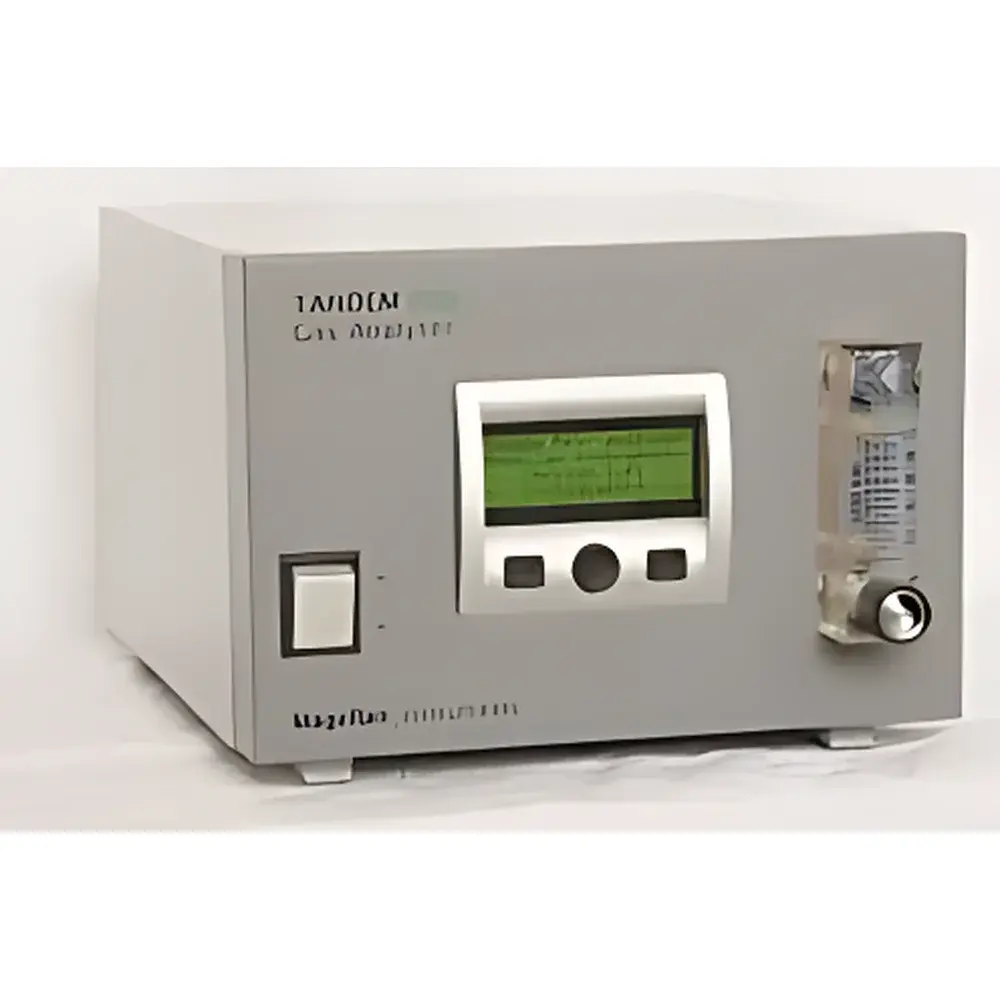
HEL Tandem PRO Gas Analyzer for Bioreactor Off-Gas Monitoring
| Brand | HEL (UK) |
|---|---|
| Origin | United Kingdom |
| Model | Tandem PRO |
| Construction Material | Stainless Steel |
| Operating Pressure | Low-Pressure System |
| Vessel Capacity | 5 L |
| Vacuum Range | 0–1 MPa |
| Gas Measurement | CO₂ (IR Absorption), O₂ (Electrochemical Sensor) |
| CO₂ Range Options | 5%, 10%, 20%, 50%, 60%, 100% |
| O₂ Range Options | 25%, 30%, 50%, 60%, 100% |
| Resolution | 0.01% (both gases) |
| Accuracy | ±2% of Full Scale |
| Drift | <0.05% FS/month |
| Response Time (T90) | <50 s (CO₂), <10 s (O₂) |
| Flow Rate | 25–1000 mL/min |
| Operating Temperature | 0–45 °C |
| Temperature Compensation | Integrated |
| Local Display | Yes |
| Calibration | Manual & Auto |
| Internal Sample Pump | Yes |
| Analog Outputs | Dual 0–10 V and 4–20 mA |
| Digital Interface | RS232 |
| Compatibility | Scalable from lab-scale (250 mL) to industrial bioreactors (up to 100 m³) |
Overview
The HEL Tandem PRO Gas Analyzer is a dedicated, real-time off-gas monitoring system engineered for quantitative analysis of carbon dioxide (CO₂) and dissolved oxygen (O₂) concentrations in bioprocess exhaust streams. Utilizing dual-sensor architecture—non-dispersive infrared (NDIR) absorption for CO₂ and galvanic electrochemical detection for O₂—the instrument delivers high reproducibility and low-drift performance under dynamic fermentation and cell culture conditions. Designed explicitly for integration into aerobic bioreactor workflows, the Tandem PRO enables continuous acquisition of respiratory quotient (RQ), oxygen uptake rate (OUR), carbon dioxide evolution rate (CER), and volumetric mass transfer coefficient (kLa) without requiring offline sampling or gas chromatography. Its stainless steel wetted path and low-pressure-rated construction ensure compatibility with standard laboratory and pilot-scale stirred-tank reactors operating within 0–1 MPa vacuum/pressure envelopes.
Key Features
- Real-time, simultaneous CO₂ and O₂ measurement with independent sensor modules and auto-compensated temperature drift correction
- Configurable range selection (e.g., CO₂: 5–100%; O₂: 25–100%) to match specific metabolic profiles across microbial, mammalian, and insect cell cultures
- Integrated sample pump and flow-controlled manifold (25–1000 mL/min) ensuring stable laminar flow and minimizing condensation artifacts
- Dual analog outputs (0–10 V and 4–20 mA) compliant with PLC, DCS, and SCADA systems for seamless process automation integration
- RS232 serial interface supporting ASCII-based command protocol for remote configuration, data logging, and firmware updates
- On-device LCD display with live concentration readouts, calibration status, and alarm indicators—no external PC required for basic operation
- Modular design enabling field-upgradable firmware and sensor replacement without recalibration of adjacent channels
Sample Compatibility & Compliance
The Tandem PRO interfaces directly with sterile off-gas lines from single-use and stainless-steel bioreactors ranging from 250 mL benchtop vessels to 100 m³ production systems. Its gas path meets ISO 8573-1 Class 3 purity requirements for compressed air and inert gas handling. While not intrinsically rated for hazardous areas, it complies with IEC 61000-6-2 (EMC immunity) and IEC 61000-6-4 (EMC emission) standards. The analyzer supports GLP-compliant data integrity through time-stamped analog output records and optional audit-trail-enabled software (via third-party SCADA platforms). It is routinely deployed in environments governed by USP , ASTM E2500, and EU Annex 11 principles for analytical instrumentation qualification.
Software & Data Management
No proprietary software is bundled; instead, the Tandem PRO adheres to open communication protocols to facilitate integration with industry-standard platforms including DeltaV, Siemens Desigo, LabVIEW, and custom Python-based acquisition scripts. All analog outputs are linearized and digitally compensated prior to transmission, eliminating the need for post-processing scaling. RS232 output provides raw concentration values (ppm or %), sensor health diagnostics, and calibration timestamps at user-defined intervals (default: continuous). For regulated environments, customers commonly route signals through validated historian systems (e.g., OSIsoft PI, Inductive Automation Ignition) to satisfy FDA 21 CFR Part 11 requirements for electronic records and signatures.
Applications
- Metabolic flux analysis during fed-batch and perfusion mammalian cell culture processes
- Respiratory quotient trending to detect shifts in substrate utilization (e.g., glucose vs. lactate metabolism)
- Online determination of viable cell density (VCD) proxies via OUR/CER correlation models
- Automated feed control logic triggered by RQ thresholds or O₂ depletion events
- Batch-to-batch consistency assessment in vaccine and monoclonal antibody manufacturing
- Scale-down model validation for process characterization studies per ICH Q5A(R2)
- Wastewater treatment bioreactor optimization using real-time nitrification/denitrification monitoring
FAQ
Is the Tandem PRO suitable for anaerobic fermentation monitoring?
No—it is optimized for aerobic and microaerobic off-gas streams where CO₂ and O₂ coexist at measurable levels. For strict anaerobic applications requiring H₂ or CH₄ detection, HEL offers complementary GC-based solutions.
Can the instrument be calibrated in situ without removing sensors?
Yes—both CO₂ and O₂ modules support zero/span calibration using certified gas standards introduced via the front-panel inlet port; no disassembly is required.
What maintenance intervals are recommended for long-term operation?
Electrochemical O₂ sensors typically require replacement every 12–18 months depending on cumulative exposure to humid, particulate-laden gas streams; NDIR CO₂ cells have no consumables and retain calibration for >24 months under stable thermal conditions.
Does the Tandem PRO meet explosion-proof certification requirements?
It does not carry ATEX, IECEx, or UL HazLoc certification. Installation in classified zones requires external barrier systems or placement in ventilated enclosures per NEC Article 500 guidelines.
How is moisture handled in the sample stream?
Users must install an inline PTFE membrane filter and chilled condenser upstream of the analyzer inlet; HEL supplies compatible accessories meeting ISO 8573-6 dew point specifications.



