
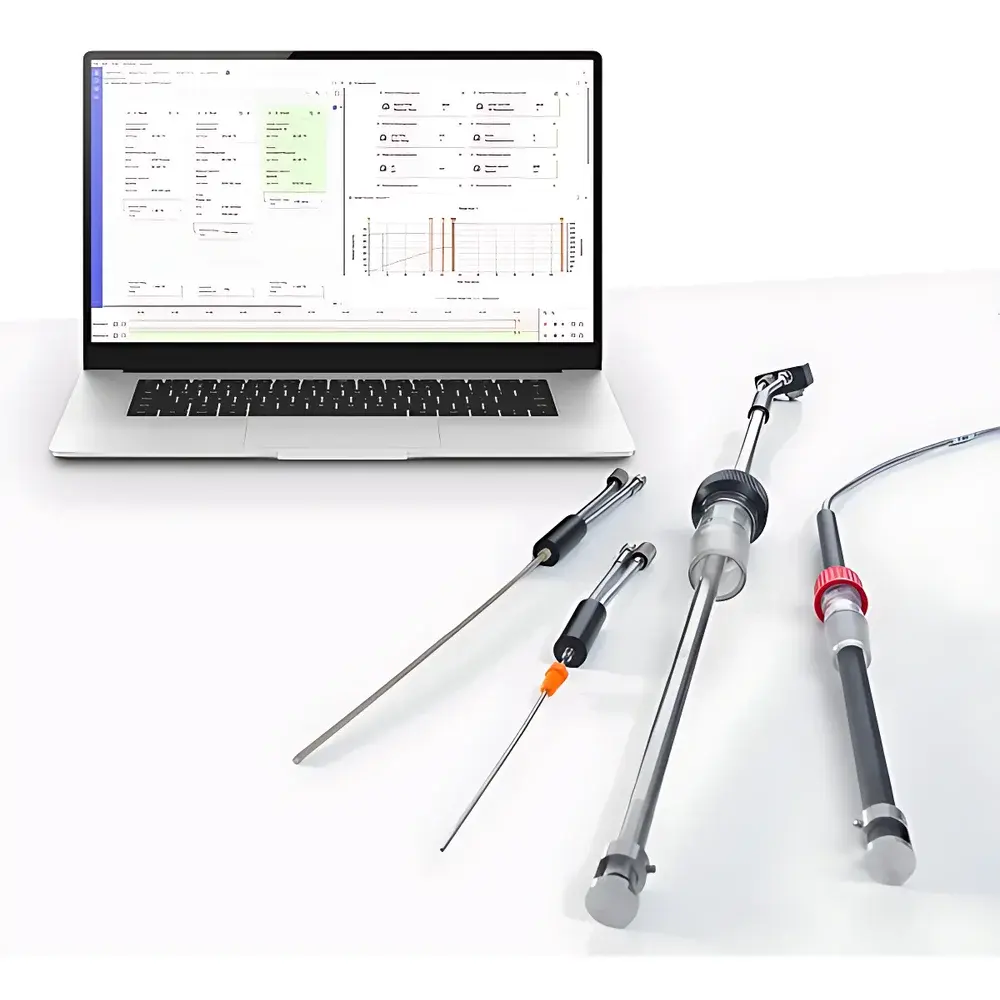
CrystalEYES Crystallization Monitoring System by HEL (UK)
| Brand | HEL (UK) |
|---|---|
| Origin | United Kingdom |
| Model | CrystalEYES |
| Temperature Range | −40 °C to 200 °C |
| Detection Principle | Near-Infrared (NIR) Laser Turbidity Sensing |
| pH Monitoring | Integrated Auto-Logging |
| Data Output | CSV/Excel-Compatible Export |
| Software | Real-Time Graphical Acquisition & MSZW Analysis Module |
| Compliance | Designed for GLP/GMP-Aligned Process Development Environments |
Overview
The CrystalEYES Crystallization Monitoring System is a bench-scale, non-invasive process analytical technology (PAT) platform engineered by HEL (UK) for real-time, in-situ quantification of crystallization onset, dissolution behavior, and metastable zone width (MSZW). Operating on the principle of near-infrared (NIR) laser turbidity detection, CrystalEYES measures light scattering intensity changes induced by nucleation events and crystal growth within a solution—enabling precise identification of solubility limits, supersaturation profiles, and phase transition boundaries without sampling or optical window fouling. The system integrates high-stability temperature control feedback, calibrated thermistor-based thermal sensing (±0.1 °C accuracy), and optional pH electrode interfacing—all synchronized at 1 Hz acquisition rate. It is designed for use in early-phase crystallization screening, polymorph selection, cooling/antisolvent addition protocol optimization, and quality-by-design (QbD) workflows compliant with ICH Q5, Q8, and FDA PAT guidance.
Key Features
- Non-contact NIR turbidity probe: 850 nm laser source with photodiode detector; optimized for aqueous and organic solvent systems including DMSO, acetone, ethyl acetate, and alcohols
- Wide operational temperature range: −40 °C to +200 °C, compatible with Peltier, cryogenic, and oil-bath thermal environments
- Modular probe architecture: Standalone sensor unit or retrofit-capable for integration into existing jacketed reactors, stirred tank reactors (STRs), or automated synthesis platforms
- Real-time dual-parameter logging: Simultaneous acquisition of turbidity (mV or arbitrary units), temperature (°C), and optional pH (via standard BNC input)
- Automated MSZW determination: Algorithm-driven identification of induction time, nucleation threshold, and metastable zone boundaries using derivative-based slope analysis
- Embedded data management: On-device storage (SD card), timestamped binary logging, and export-ready CSV/Excel formatting for statistical post-processing in MATLAB, JMP, or Python
Sample Compatibility & Compliance
CrystalEYES supports transparent to semi-opaque solutions across pharmaceutical, fine chemical, and agrochemical development laboratories. Probe compatibility extends to glass, stainless steel (316L), Hastelloy C-276, and quartz reaction vessels with minimum internal diameters ≥25 mm. The system meets electromagnetic compatibility (EMC) requirements per EN 61326-1 and carries CE marking for laboratory instrumentation. While not a regulated medical device, its data acquisition architecture supports audit trail generation, user access control, and electronic signature readiness—facilitating alignment with 21 CFR Part 11, EU Annex 11, and GLP/GMP documentation standards when deployed in validated environments.
Software & Data Management
The CrystalEYES Control Suite runs on Windows OS (10/11, 64-bit) and provides a deterministic, low-latency interface for hardware configuration, real-time visualization, and offline analysis. Key software modules include: (1) Live Plotter with multi-axis overlay (turbidity vs. temperature vs. time), (2) MSZW Analyzer with configurable noise filtering and baseline correction, (3) Batch Comparison Tool for cross-experiment trend evaluation, and (4) Export Wizard supporting ANSI-compliant CSV, Excel (.xlsx), and PDF report generation. All raw data files are stored with embedded metadata (operator ID, vessel ID, calibration timestamp, sensor serial number), ensuring traceability required for regulatory submissions.
Applications
- Early-stage solubility mapping and solvent selection studies
- Robustness testing of crystallization processes under variable cooling rates and seeding protocols
- Polymorphic form screening via controlled antisolvent addition kinetics
- Supersaturation profiling during continuous manufacturing unit operations
- Root cause analysis of batch-to-batch variability in crystal size distribution (CSD)
- Supporting QbD elements in ANDA, NDA, and MAA dossiers through mechanistic process understanding
FAQ
Can CrystalEYES be used with opaque or highly colored solutions?
Turbidity sensitivity decreases with increasing absorbance above 1.5 AU at 850 nm; validation against reference gravimetric or FBRM data is recommended for strongly absorbing systems.
Is calibration required before each experiment?
The NIR sensor is factory-calibrated for water/ethanol baselines; users perform solvent-specific zero-point adjustment prior to each run using clear solution hold period.
Does CrystalEYES support automated reaction control?
It functions as a monitoring-only PAT tool; integration with third-party PID controllers (e.g., Huber, Julabo, ChemSpeed) requires analog 0–10 V or Modbus RTU interface extension.
What is the minimum detectable crystal size?
Detection threshold corresponds to ~0.5–1.0 µm primary particles under optimal optical path conditions; nucleation onset is reliably captured prior to significant particle growth.
How is temperature accuracy maintained during rapid cooling?
The integrated Pt100 sensor features 100 ms thermal response time and active compensation for heat conduction lag in probe shaft geometry.
Related Products



