
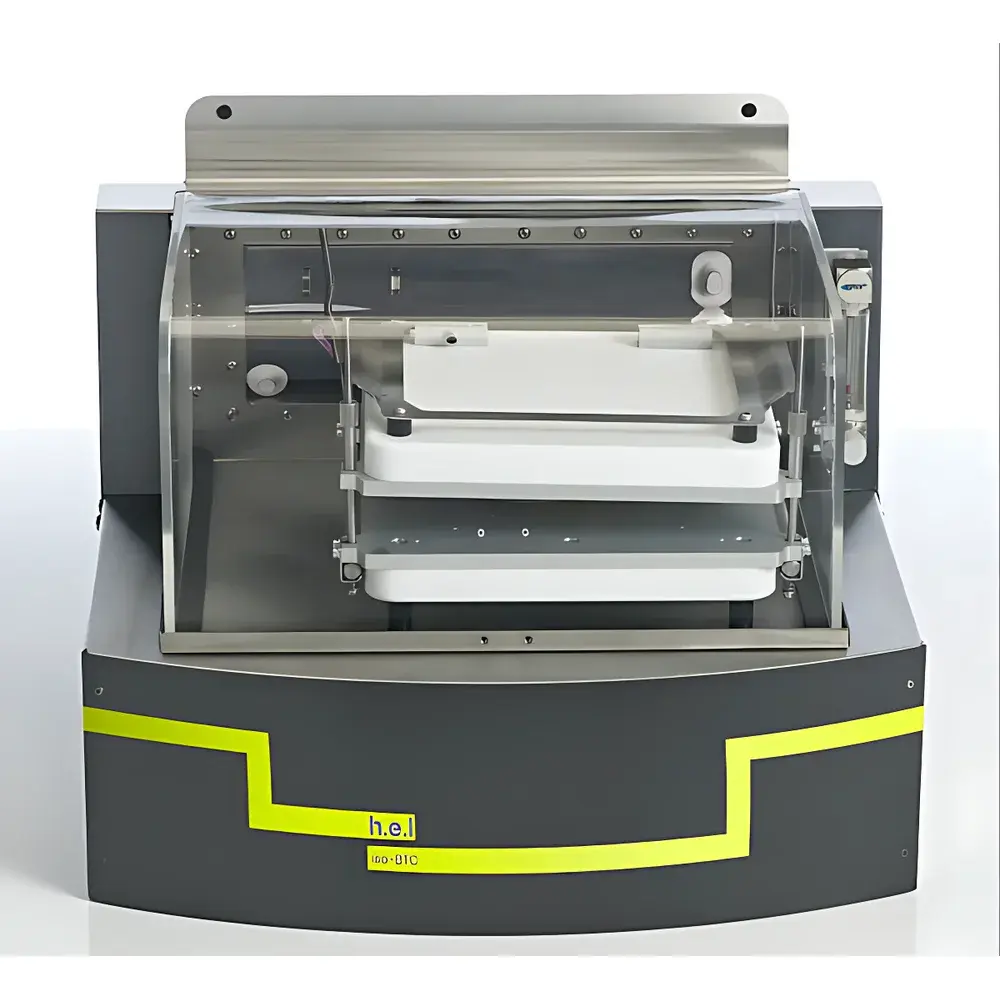
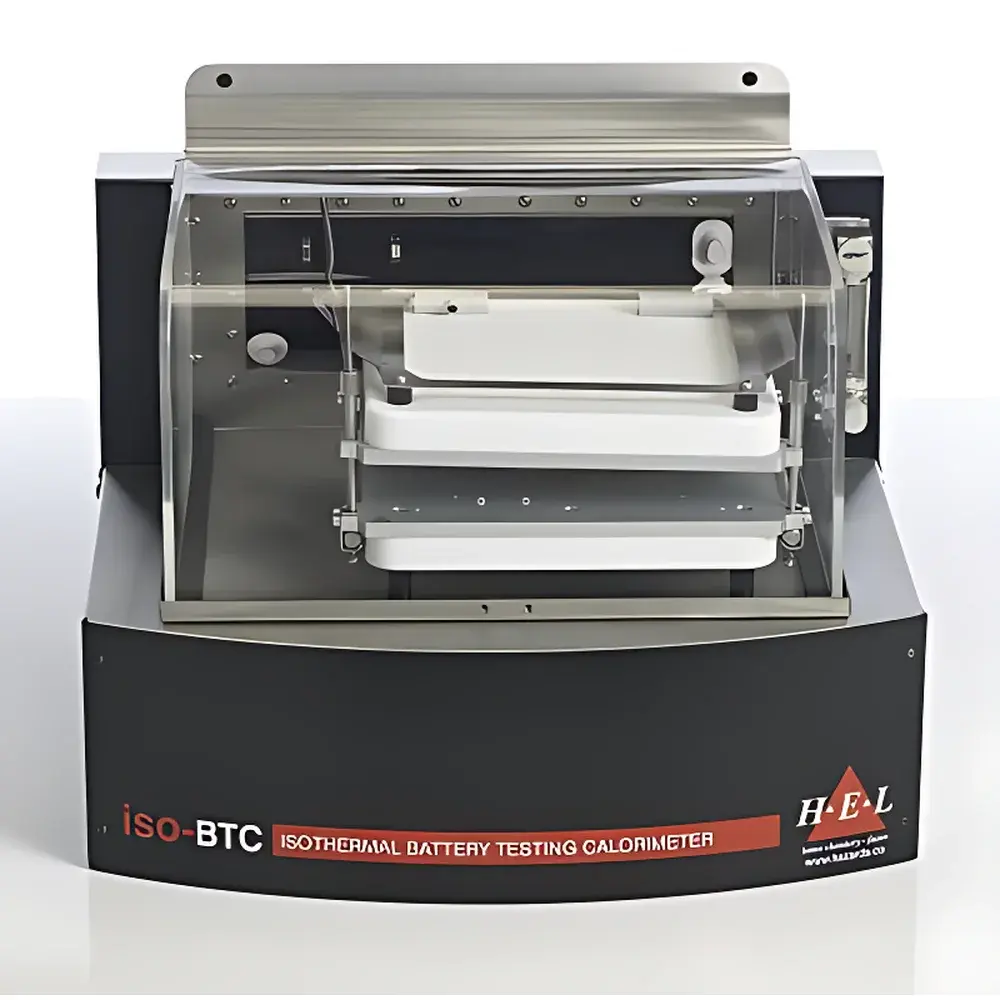
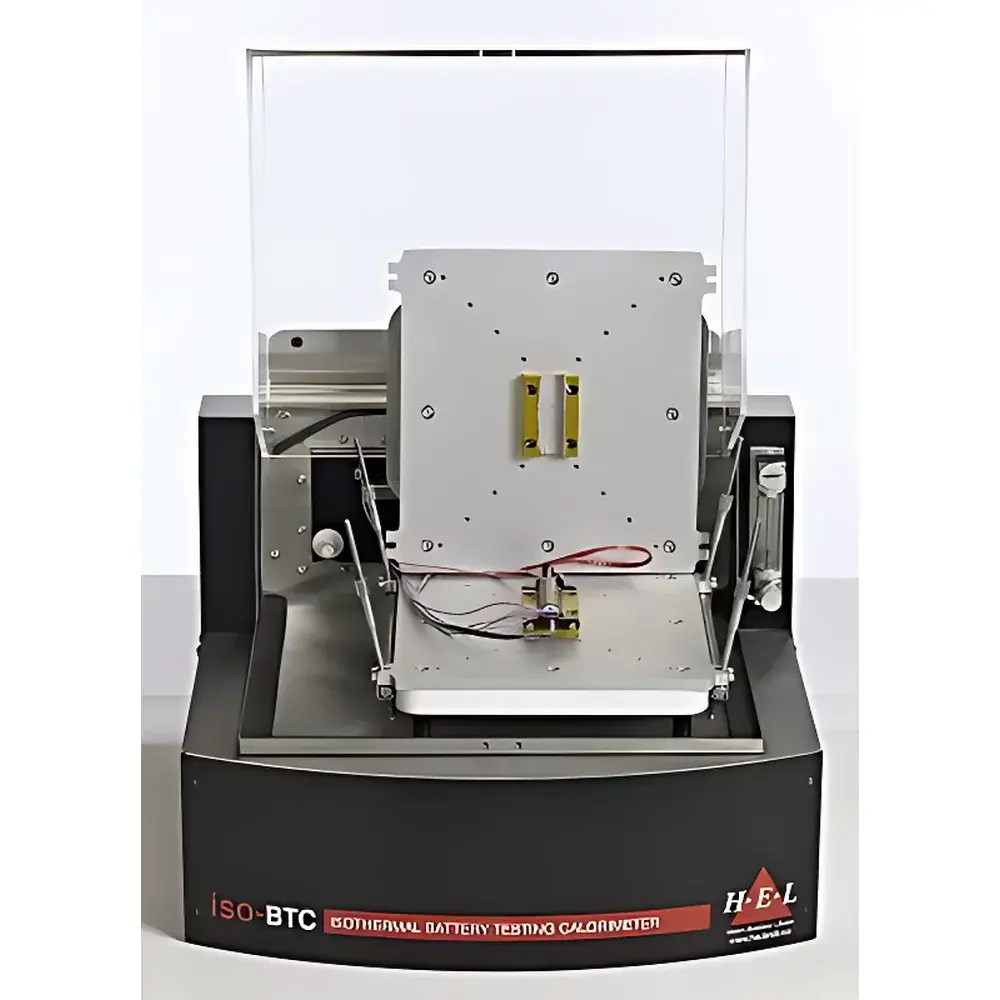
HEL iso-BTC-500 Isothermal Battery Calorimeter
| Brand | HEL |
|---|---|
| Origin | United Kingdom |
| Model | isoBTC-500 |
| Temperature Range | −60 °C to 100 °C |
| Temperature Resolution | 0.001 °C |
| Temperature Precision | ±0.01 °C |
| Single-Sample Test Duration | up to 1000 min |
| Heat Capacity | 10,000 J/K |
| Outer Bath Volume | 1000 mL |
| Inner Bath Volume | 1000 mL |
| Instrument Type | Accelerating Calorimeter |
| Measurement Mode | Isothermal Calorimetry |
| Compliance | Designed for GLP/GMP-aligned battery thermal safety testing |
Overview
The HEL isoBTC-500 Isothermal Battery Calorimeter is a high-precision, dual-bath calorimetric system engineered for quantitative thermal characterization of lithium-ion and next-generation electrochemical cells under rigorously controlled isothermal conditions. Unlike adiabatic or heat-flow calorimeters, the isoBTC-500 employs a dynamic dual-loop temperature control architecture—comprising independent inner and outer water baths—to maintain sample temperature within ±0.01 °C across the full operational range (−60 °C to 100 °C). This enables direct, real-time measurement of heat flow (in mW) generated or absorbed by the cell during charge/discharge cycling, self-heating events, or thermal runaway initiation. The system operates on the principle of power compensation calorimetry: heat exchanged between the cell and its thermally anchored environment is continuously balanced via active heating/cooling of the inner bath, with the required compensation power serving as a linear, calibrated proxy for instantaneous heat flow. This methodology delivers traceable, absolute thermal data without reliance on calibration standards for each test—critical for comparative safety analysis across cell chemistries, formats, and aging states.
Key Features
- Dual-isothermal bath design: 1000 mL inner bath directly coupled to the cell via custom thermal interface; 1000 mL outer bath provides high-inertia thermal shielding and stability against ambient fluctuations
- Sub-millidegree temperature regulation: PID-controlled circulation with 0.001 °C resolution and ±0.01 °C long-term stability over 1000-minute tests
- Modular sample adaptability: Interchangeable cell holders accommodate cylindrical (18650, 21700, 4680), prismatic (up to 300 mm × 200 mm × 50 mm), and pouch cells—including multi-cell modules—with integrated pressure and voltage monitoring ports
- Real-time heat flow quantification: Continuous output of dQ/dt (mW) and cumulative Q (J) synchronized with external battery cyclers (e.g., Arbin, BioLogic, MACCOR) via analog/digital I/O and CAN bus
- Robust mechanical architecture: Stainless-steel insulated chamber with vacuum-jacketed bath vessels, minimizing parasitic heat loss and ensuring reproducibility across laboratories
Sample Compatibility & Compliance
The isoBTC-500 supports thermal testing of single cells, stacked pouch assemblies, and small-format battery modules under ISO 12405-4, UN 38.3 Thermal Stability, and IEC 62660-2 safety evaluation protocols. Its isothermal mode satisfies ASTM E1970 requirements for constant-temperature calorimetry in energy storage systems. All hardware and firmware are designed to support audit-ready documentation per FDA 21 CFR Part 11 and EU Annex 11, including electronic signatures, user access levels, and immutable audit trails for heat flow data, setpoint logs, and environmental metadata. Calibration certificates are NIST-traceable and include uncertainty budgets for temperature and power channels.
Software & Data Management
Control and analysis are performed using HEL’s proprietary BTC-Soft v4.x platform, which provides synchronized acquisition of calorimetric, electrical (voltage/current), and environmental (ambient temperature, humidity) parameters at up to 10 Hz. The software includes preconfigured test templates for standard protocols (e.g., 0.2C–3C discharge at fixed T, SOC-dependent thermal mapping, overcharge/overdischarge stress), automated event detection (onset of exothermic deviation >5 mW), and export to CSV, HDF5, or MATLAB-compatible formats. Raw heat flow time-series data retain full bit-depth resolution (24-bit ADC) and are timestamped to UTC with microsecond precision. Data integrity is enforced through cyclic redundancy checks and optional encrypted local storage compliant with ISO/IEC 27001 information security frameworks.
Applications
- Quantitative determination of enthalpic and ohmic heat contributions during galvanostatic and potentiostatic operation
- Thermal runaway onset temperature (Tonset) and propagation kinetics under isothermal hold conditions
- Calorimetric validation of electrochemical-thermal models (e.g., Newman-type simulations)
- Comparative safety screening of anode/cathode material substitutions, electrolyte additives, or separator coatings
- Thermal management system (TMS) specification—deriving cell-level heat generation profiles for CFD input
- Accelerated aging studies correlating cumulative heat release with capacity fade and impedance rise
FAQ
What distinguishes isothermal calorimetry from adiabatic or heat-flux methods?
Isothermal calorimetry maintains constant sample temperature while measuring compensatory power—yielding direct, absolute heat flow values. Adiabatic methods infer heat from temperature rise under near-zero heat loss, introducing integration errors; heat-flux sensors require empirical calibration and suffer from thermal resistance artifacts.
Can the isoBTC-500 measure endothermic processes such as lithium plating or SEI formation?
Yes. Its bidirectional power compensation capability detects heat absorption down to ±0.1 mW, enabling resolution of subtle endothermic transitions during low-rate charging or low-temperature operation.
Is remote monitoring and multi-user access supported?
The system supports secure TLS-encrypted web-based monitoring via Ethernet, with role-based access control (RBAC) for operators, engineers, and QA reviewers—all actions logged in the audit trail.
How is thermal contact resistance minimized between the cell and inner bath?
HEL-supplied thermal interface materials (TIMs), including phase-change pads and conformal silicone gels, are qualified for use across the full temperature range and included with each cell holder kit.



