
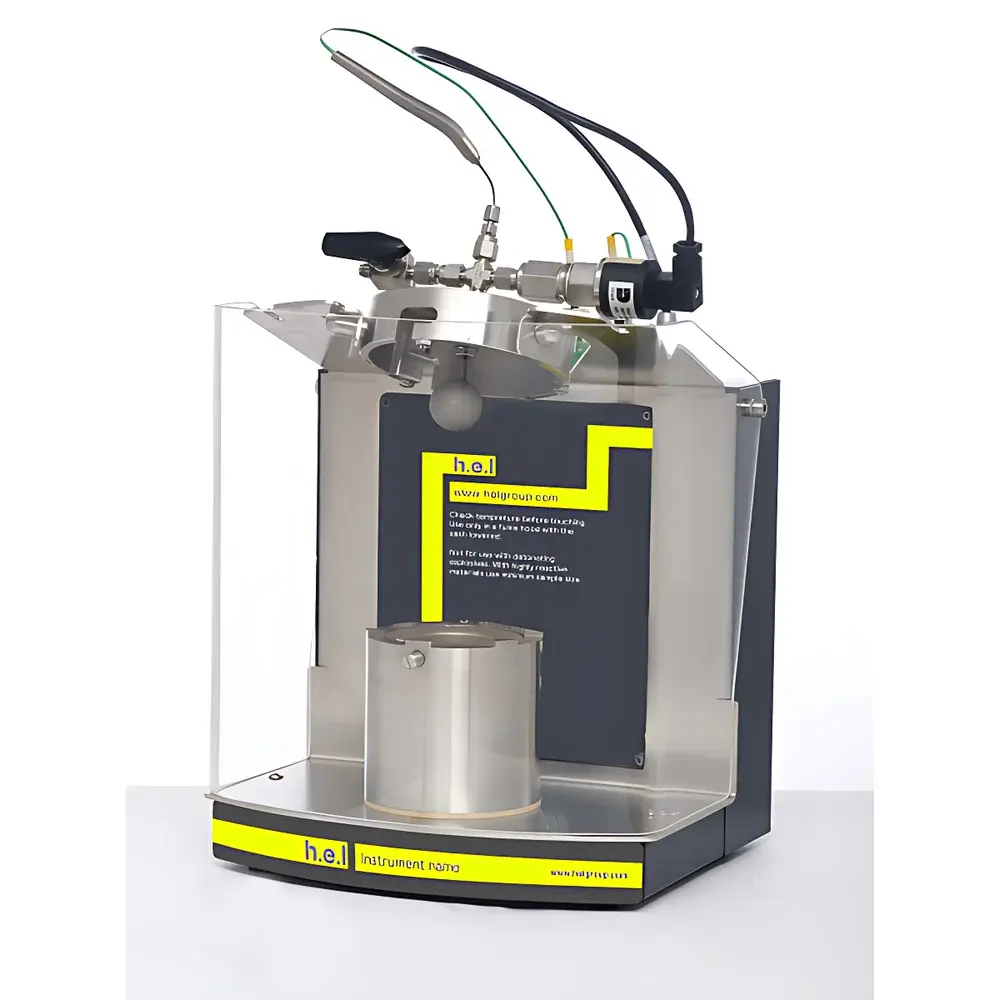
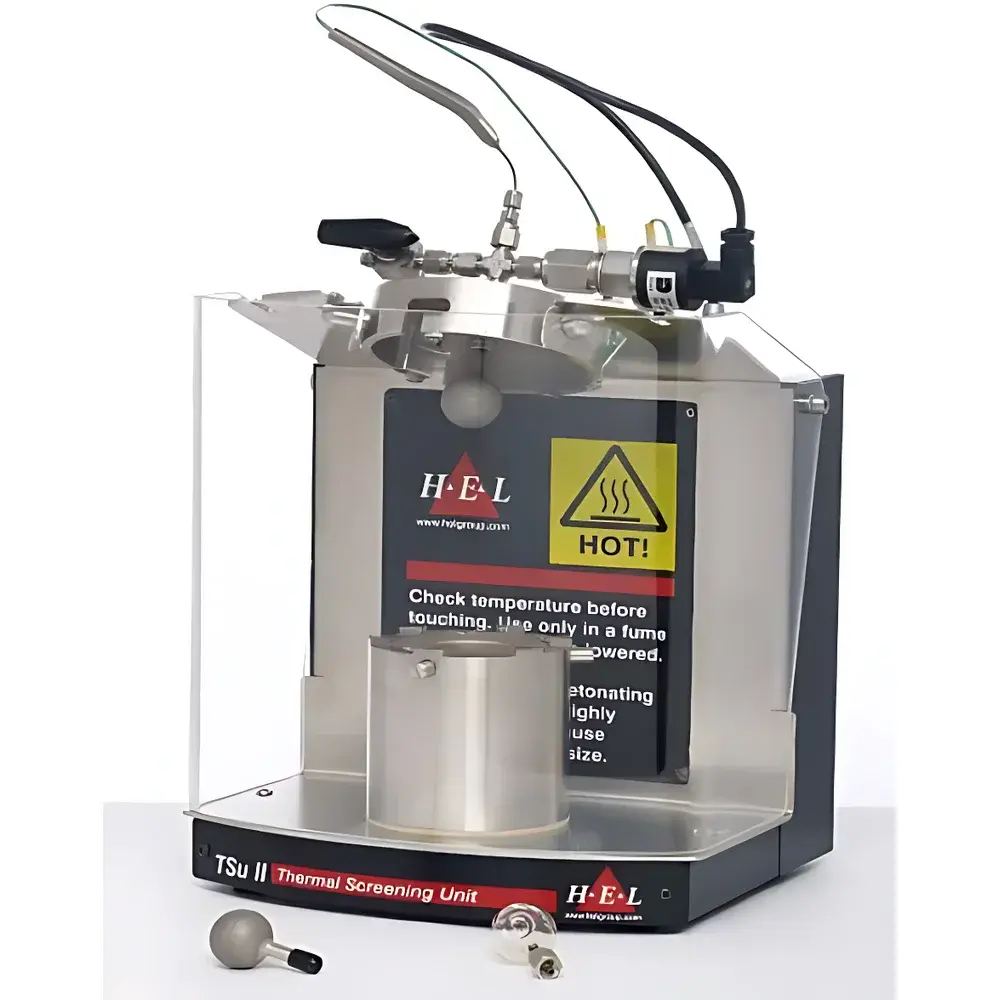
HEL TSu Fast Screening Calorimeter
| Brand | H.E.L |
|---|---|
| Origin | United Kingdom |
| Model | TSu |
| Instrument Type | Accelerating Rate Calorimeter (ARC®-style) |
| Measurement Mode | Adiabatic Calorimetry |
| Temperature Range | –60 °C to 500 °C |
| Temperature Resolution | 0.01 °C |
| Temperature Precision | ±0.01 °C |
| Single-Sample Test Duration | ~600 min |
| Heat Capacity | ~10,000 J/K |
| Outer Dewar Volume | ~10 mL |
| Inner Dewar Volume | ~10 mL |
| Sample Mass Range | 0.5–5 g |
| Pressure Range (standard) | 0–200 bar |
| Sample Cell | 8 mL spherical vessel (material options: borosilicate glass, stainless steel, Hastelloy®, custom alloys) |
Overview
The HEL TSu Fast Screening Calorimeter is a high-fidelity, adiabatic calorimetric system engineered for early-stage thermal hazard identification and reaction safety assessment in chemical development, process safety, and regulatory compliance workflows. Unlike conventional differential scanning calorimeters (DSC) or differential thermal analyzers (DTA), the TSu operates on the principle of heat-wait-search adiabatic control—actively maintaining near-zero heat loss to the environment during exothermic events. This enables direct measurement of self-heating rates, time-to-maximum-rate (TMR), adiabatic temperature rise (ΔTad), and pressure evolution under realistic process-relevant conditions. Its design follows the foundational methodology of accelerating rate calorimetry (ARC®), adapted for rapid screening with enhanced operational flexibility and robust data traceability. The instrument is widely deployed in pharmaceutical R&D, fine chemical manufacturing, battery electrolyte stability testing, and UN transport classification laboratories where quantitative thermal runaway prediction is mandated by ISO 80079-20-1, NFPA 497, and CCPS guidelines.
Key Features
- True adiabatic operation with dynamic thermal compensation, ensuring <0.02 °C/min heat loss during exotherms
- Simultaneous high-resolution acquisition of temperature (±0.01 °C) and pressure (up to 200 bar, optional extended range)
- 8 mL spherical sample cell available in multiple chemically resistant materials: borosilicate glass (for transparent observation), 316 stainless steel, Hastelloy® C-276, and custom alloy variants
- Programmable heating protocols: user-defined linear ramp (0.5–10 °C/min), isothermal hold, dual-gradient scan, and stepwise isothermal–ramp sequences
- Onset temperature detection via real-time curvature analysis of dT/dt vs. T; no post-processing required for critical onset assignment
- Integrated manual and motorized dosing ports for controlled reagent addition under pressure during active reaction monitoring
- Automated sample loading/unloading mechanism enabling <5-minute turnaround between tests
- Thermal inertia correction applied in real time using built-in reference calibration and known cell heat capacity (~10,000 J/K)
Sample Compatibility & Compliance
The TSu accommodates heterogeneous samples—including slurries, viscous liquids, powders, catalysts, and multiphase mixtures—within its 0.5–5 g mass range. This larger sample mass significantly improves statistical representativeness compared to microgram-scale DSC, reducing false negatives in decomposition screening. All wetted components comply with ASTM E1981 and ISO/IEC 17025 requirements for calibration traceability. Data integrity adheres to FDA 21 CFR Part 11 through electronic signatures, audit trails, and role-based access control within the native software platform. Instrument validation documentation supports GMP/GLP environments and satisfies ICH Q5C, Q9, and Q11 expectations for thermal stability characterization.
Software & Data Management
Control and analysis are performed via HEL’s proprietary SafeScan™ software, a Windows-based application certified for IEC 62443-3-3 industrial cybersecurity standards. The interface provides synchronized visualization of T, P, dT/dt, and dP/dt traces, with automated event tagging (onset, peak, TMRad, Pmax). Raw data export is supported in CSV, ASCII, and ASTM E1981-compliant XML formats. Batch reporting templates align with CCPS Process Safety Metrics and include preconfigured hazard classification tables per GHS and NFPA 704. Audit logs record all parameter changes, user actions, and calibration events with timestamped digital signatures—fully auditable for regulatory inspections.
Applications
- Reaction calorimetry for nitration, oxidation, polymerization, and hydrogenation processes
- Thermal stability screening of APIs, intermediates, and excipients under inert or reactive atmospheres
- Decomposition kinetics modeling for emergency relief system design (e.g., DIERS methodology)
- Battery material safety testing: SEI layer formation, cathode/anode thermal runaway, electrolyte compatibility
- UN Manual of Tests and Criteria Subsections 20.3.1–20.3.5 (thermal stability, self-accelerating decomposition)
- Process upset scenario simulation including cooling failure, agitation loss, or unintended reagent accumulation
FAQ
What distinguishes the TSu from conventional DSC instruments?
The TSu employs true adiabatic control rather than comparative heat flow measurement, enabling quantification of absolute energy release, pressure buildup, and time-resolved runaway behavior—not just relative transition temperatures.
Can the TSu be used for gas-evolving reactions?
Yes—the pressure transducer and sealed sample cell allow real-time tracking of gas generation kinetics, making it suitable for decomposition pathways involving CO₂, NOₓ, or H₂ release.
Is the system compliant with ISO/IEC 17025 for accredited testing labs?
All calibration procedures, uncertainty budgets, and traceable reference standards meet ISO/IEC 17025:2017 Annex A.3 requirements for calorimetric instrumentation.
How is thermal inertia corrected during data analysis?
The TSu applies dynamic Phi-factor correction using pre-characterized cell heat capacity and real-time sensor feedback—no manual post-correction is required.
What sample containment options exist for highly corrosive chemistries?
Hastelloy® C-276 and custom Inconel® 625 cells are available for HF, Cl₂, or molten salt applications; full compatibility matrices are provided upon request.



