
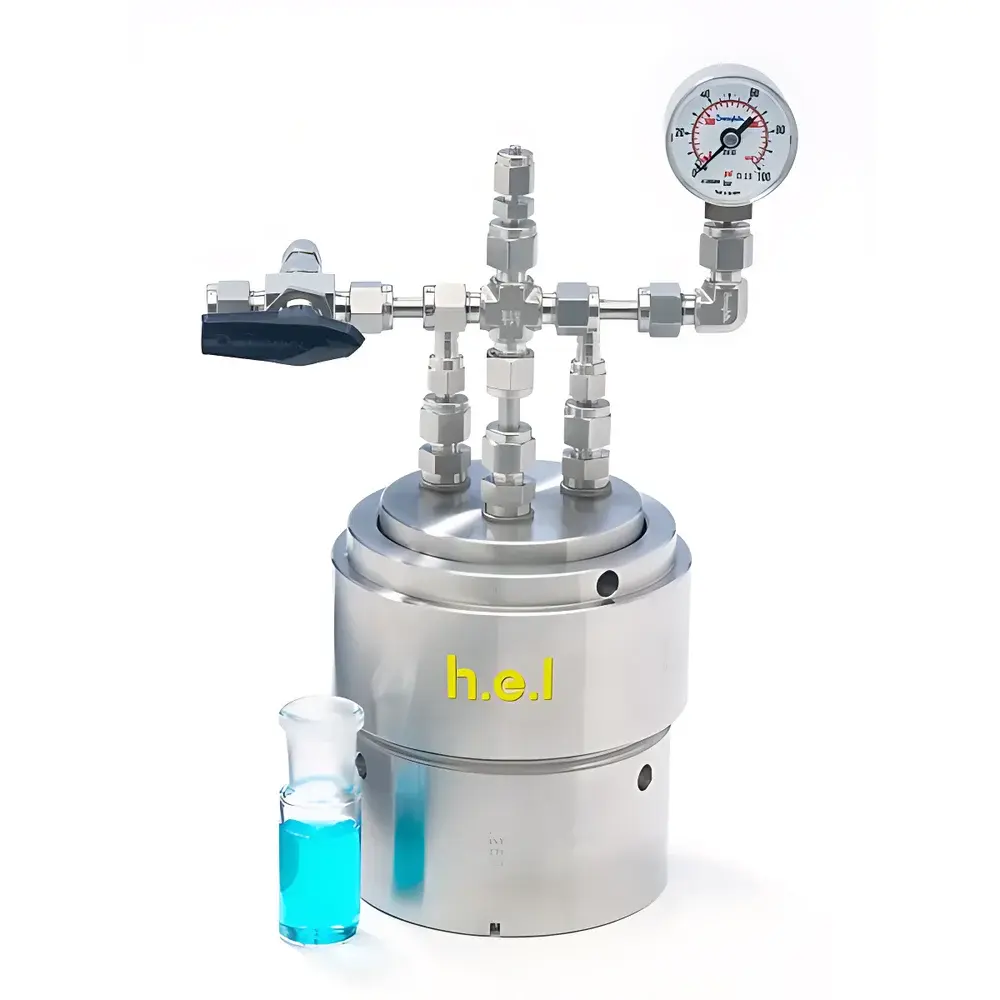
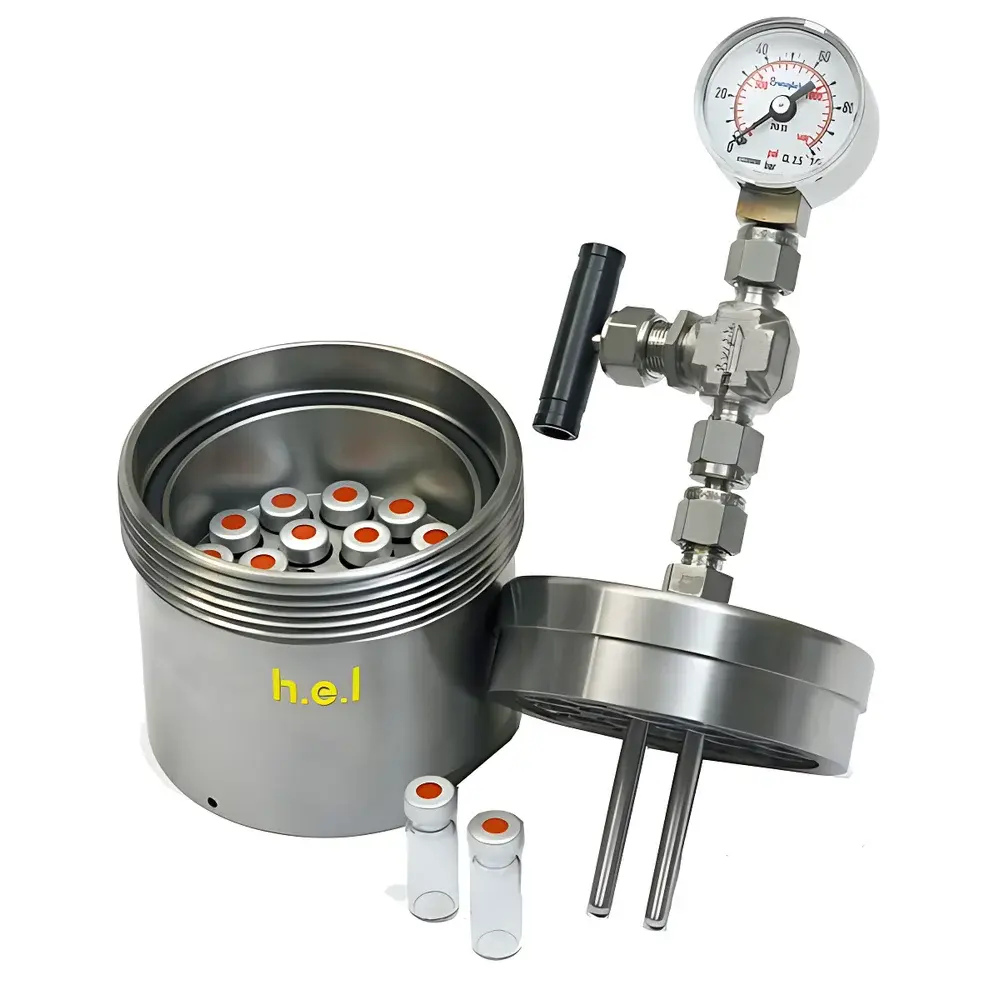
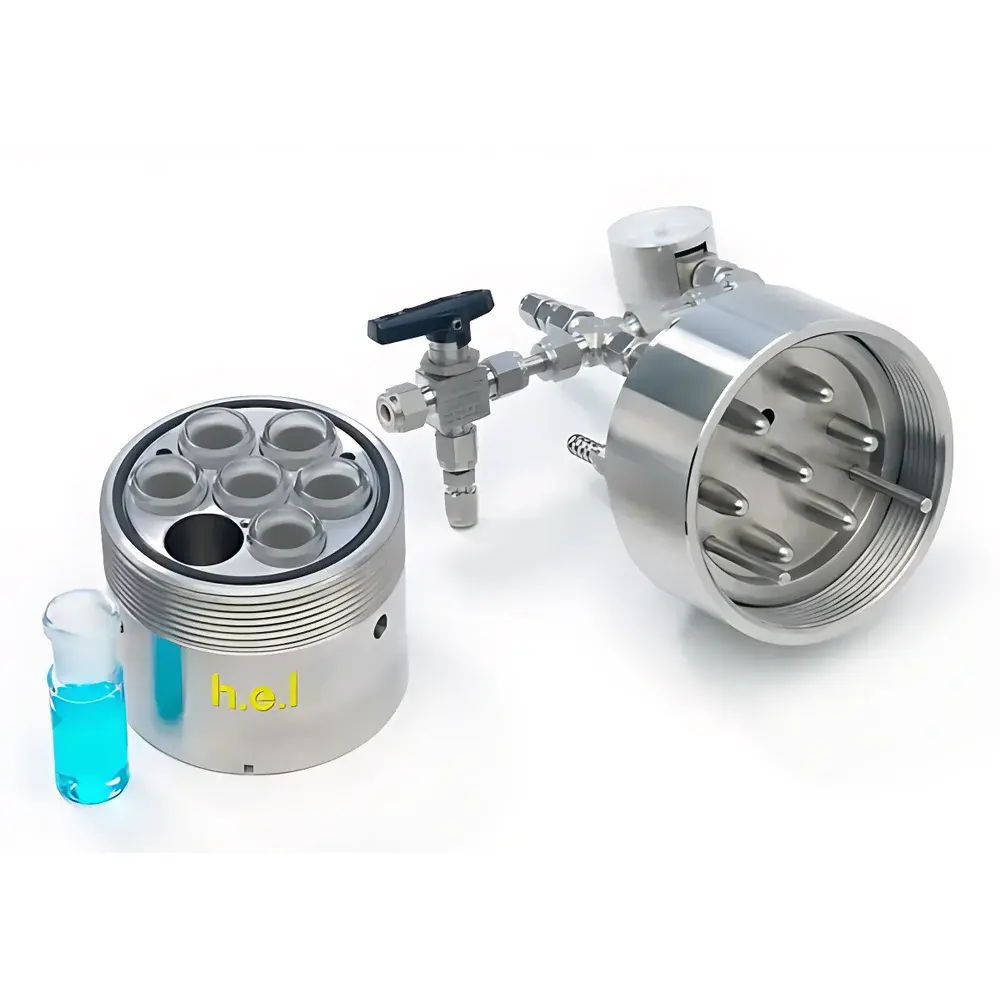
HEL CAT 7 / CAT 18 / CAT 24 High-Pressure Catalyst Evaluation Reactor
| Brand | HEL (UK) |
|---|---|
| Origin | United Kingdom |
| Model | CAT 7 / CAT 18 / CAT 24 |
| Max. Operating Pressure | 100 bar |
| Max. Operating Temperature | 300 °C |
| Catalyst Bed Volume | 10 mL |
| Vessel Material | 316 Stainless Steel or Hastelloy® Alloy |
| Sample Capacity Options | 2–10 mL per vessel |
| Heating Method | External (hotplate, oil bath, or PolyBlock™ heater block) |
| Stirring | Magnetic stirring integrated |
| Temperature Monitoring | Integrated micro thermocouple |
| Cooling Option | Finger-type condenser (CAT 7 & CAT 24 only) |
| HPLC Vial Compatibility | 2 mL vials (CAT 18 only) |
| Purge & Pressurization | Manual valve-controlled inert gas purge and reactant gas pressurization (e.g., H₂) |
Overview
The HEL CAT 7, CAT 18, and CAT 24 High-Pressure Catalyst Evaluation Reactors are engineered for precise, reproducible screening of heterogeneous and homogeneous catalysts under industrially relevant reaction conditions—specifically elevated pressure (up to 100 bar) and temperature (up to 300 °C). These modular, parallel-capable reactors operate on the principle of controlled batch-wise catalytic testing, where gas–liquid–solid phase interactions are rigorously monitored during hydrogenation, oxidation, hydrodeoxygenation, Fischer–Tropsch synthesis, and other high-pressure catalytic transformations. Each unit features a robust 316 stainless steel or Hastelloy® alloy pressure vessel designed to ASTM F2135 and PED 2014/68/EU standards, ensuring structural integrity and long-term corrosion resistance in aggressive chemical environments. Unlike continuous-flow microreactors, the CAT series maintains strict batch fidelity—critical for kinetic modeling, catalyst deactivation studies, and comparative activity assessment across multiple formulations in a single experimental run.
Key Features
- Modular configuration supporting 7, 18, or 24 parallel reaction vessels—enabling statistically significant high-throughput catalyst ranking without compromising individual reactor control.
- Full-pressure-rated vessels (100 bar at 250 °C; derated to 300 °C per ASME B31.3 guidelines) constructed from electropolished 316 SS or Hastelloy® C-276 for enhanced surface passivation and minimized metal leaching.
- Integrated magnetic stirring mechanism ensures uniform suspension of solid catalysts and efficient mass transfer—validated via Reynolds number analysis for laminar-to-transitional flow regimes typical in small-volume (<10 mL) catalytic slurry systems.
- Vessel head design includes dedicated ports for pressure transduction, thermocouple insertion, gas inlet/outlet, and optional condenser attachment—facilitating real-time process monitoring and vapor-phase management.
- CAT 7 and CAT 24 variants incorporate finger-type condensers to reflux volatile solvents and suppress cross-contamination between adjacent vessels—a critical feature for multi-component screening with low-boiling reagents (e.g., methanol, THF, ethyl acetate).
- CAT 18 is optimized for compatibility with standard 2 mL HPLC vials (with or without septa), enabling direct sampling and offline GC/HPLC analysis without transfer artifacts—fully compliant with USP and ICH Q5C analytical transfer protocols.
Sample Compatibility & Compliance
The CAT series accommodates diverse catalyst forms—including supported metal nanoparticles (e.g., Pd/C, Pt/Al₂O₃), zeolites, MOFs, and homogeneous complexes—within defined bed volumes (2–10 mL). Solvent compatibility spans polar protic (water, alcohols), polar aprotic (DMF, NMP), and nonpolar media (hexane, toluene), validated per ISO 15142-2 for elastomer seal compatibility. All units conform to CE marking requirements under the Pressure Equipment Directive (PED 2014/68/EU) and electromagnetic compatibility (EMC 2014/30/EU). Pressure relief is achieved via calibrated rupture discs (ASME Section VIII Div. 1 compliant), while vessel certification documentation supports GLP/GMP audit readiness—including traceable material test reports (MTRs) and hydrostatic test records.
Software & Data Management
While the CAT series operates as a manually controlled hardware platform, it is fully interoperable with third-party data acquisition systems (e.g., LabVIEW, MATLAB, or DeltaV DCS) via analog 4–20 mA or digital RS-485 outputs from optional external pressure and temperature transmitters. When deployed with HEL’s Reactor Manager™ software suite (sold separately), users gain automated pressure ramping profiles, event-logged purge cycles, and timestamped temperature/pressure correlation matrices—meeting FDA 21 CFR Part 11 requirements for electronic records and signatures when configured with audit-trail-enabled controllers. Raw sensor data exports in CSV or HDF5 format support kinetic modeling workflows in tools such as MATLAB’s Curve Fitting Toolbox or Python-based Cantera simulations.
Applications
- Accelerated catalyst discovery for pharmaceutical hydrogenations (e.g., nitro-to-amine reduction, enantioselective asymmetric hydrogenation).
- Structure–activity relationship (SAR) mapping in biomass upgrading—particularly hydrothermal liquefaction and catalytic fast pyrolysis model compound studies.
- Stability and lifetime evaluation of sulfided CoMo/Al₂O₃ catalysts under simulated hydrotreating conditions (H₂ + dibenzothiophene in decalin).
- Screening of earth-abundant transition metal catalysts (Fe, Ni, Co) for CO₂ hydrogenation to formic acid or methanol.
- Reaction calorimetry integration for exothermicity profiling during early-stage process safety assessment (per CCPS Guidelines).
FAQ
What materials are available for vessel construction, and how do they affect chemical compatibility?
Standard vessels use electropolished 316 stainless steel (suitable for most organic and aqueous systems up to pH 2–12). For highly corrosive media—especially halogenated acids, hot concentrated alkalis, or sulfur-rich feeds—Hastelloy® C-276 is recommended and supplied with full mill-certified MTRs.
Can these reactors be used under inert atmosphere prior to hydrogen introduction?
Yes. Each vessel is equipped with dual manual valves enabling sequential inert gas (N₂ or Ar) purge, vacuum evacuation (down to 1 mbar), and controlled reactant gas pressurization—all verified by integrated pressure gauges traceable to UKAS-accredited calibration standards.
Is magnetic stirring effective at high viscosities or with dense catalyst slurries?
Stirring torque has been empirically validated for slurries up to 1500 cP using glycerol–silica suspensions; for higher viscosities, optional overhead stirrer adapters (HEL TorqueDrive™) are available to maintain Reynolds numbers >100 for adequate mixing.
How is temperature uniformity ensured across all vessels in parallel operation?
When mounted on HEL PolyBlock™ heater blocks or calibrated oil baths, axial thermal gradients are maintained within ±1.5 °C across all positions—verified by NIST-traceable infrared thermography and embedded PT100 sensors at vessel mid-height.
Are replacement parts and seals available with documented shelf-life and lot traceability?
Yes. Viton®, Kalrez®, and EPDM O-rings are supplied with CoA (Certificate of Analysis), expiration dating, and full lot traceability per ISO 9001:2015—supporting regulated lab environments requiring component-level accountability.



