
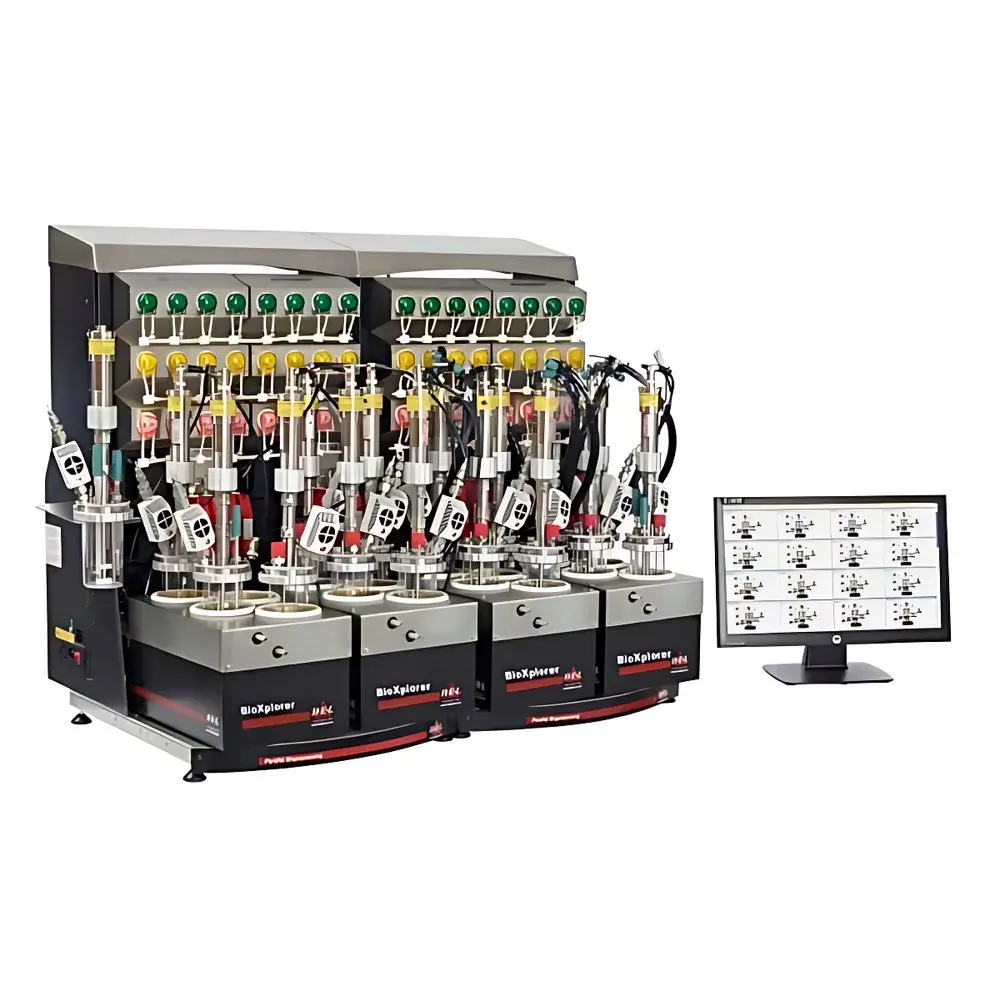
HEL BioXplorer Modular Automated Benchtop Bioreactor Platform
| Brand | HEL |
|---|---|
| Origin | United Kingdom |
| Model | BioXplorer Modular Automated Benchtop Bioreactor Platform |
| Vessel Material | Borosilicate Glass |
| Working Pressure | Low-Pressure (0–1 MPa vacuum range) |
| Nominal Volume | 5 L |
| Configuration | Modular, Supports 1–4 Parallel Vessels |
| Temperature Range | 25–60 °C |
| Agitation | Magnetic Stirring (200–1200 rpm) or Top-Drive Mechanical Stirring (50–1500 rpm) |
| pH & Redox Monitoring | Integrated |
| Optional Features | In-situ Turbidity Detection, Reaction Calorimetry, Spectral Product Tracking, Computer-Controlled Circulating Chiller |
Overview
The HEL BioXplorer Modular Automated Benchtop Bioreactor Platform is an engineered solution for scalable bioprocess development under controlled laboratory conditions. Based on Couette-type mixing principles and integrated sensor-driven feedback control, the system enables precise replication of physiological and biochemical environments across variable vessel geometries—from micro-scale (30 mL) to benchtop-scale (10 L). Designed explicitly for strain screening, media optimization, fed-batch parameter mapping, and early-stage process intensification, the BioXplorer supports seamless transition from discovery to pilot-scale validation. Its modular architecture eliminates hardware reconfiguration bottlenecks by decoupling vessel geometry from control infrastructure: identical software, data structure, and calibration protocols apply uniformly across all vessel sizes. This ensures data continuity during scale-up studies compliant with ICH Q5D and ISO 20387 biobanking guidelines.
Key Features
- Fully modular platform supporting 1–4 independent bioreactors in parallel—each with autonomous control of temperature, agitation, pH, redox, gas composition, and dissolved oxygen.
- Borosilicate glass vessels rated for low-pressure operation (0–1 MPa vacuum), autoclavable without disassembly, and compatible with SIP (Steam-in-Place) validation protocols.
- Dual agitation options: high-torque magnetic coupling (200–1200 rpm) for vessels ≤500 mL; top-drive mechanical stirring (50–1500 rpm) with dynamic seal integrity monitoring for ≥1 L configurations.
- Integrated real-time monitoring of pH and redox potential using sterilizable, reusable electrodes compliant with ASTM E2500-13 for sensor qualification.
- Gas delivery system with up to four independently regulated mass flow controllers (MFCs) for air, O₂, N₂, and CO₂—enabling precise pH modulation via CO₂ sparging and DO cascade control.
- Optional in-line turbidity detection (850 nm LED source, photodiode receiver) for non-invasive biomass tracking throughout fermentation cycles.
- Thermal management via jacketed circulation: heating via resistive modules; cooling via external chiller interface with PID-controlled setpoint tracking (±0.2 °C accuracy).
Sample Compatibility & Compliance
The BioXplorer accommodates microbial cultures (E. coli, yeast, bacilli), mammalian cell lines (CHO, HEK293), and filamentous fungi across aerobic, microaerobic, and anaerobic regimes. All wetted parts—including vessel bodies, probes, tubing, and gaskets—meet USP Class VI and FDA 21 CFR Part 11 requirements for material biocompatibility and electronic record integrity. System validation documentation supports GLP/GMP-aligned workflows, including IQ/OQ/PQ templates, audit trail logging, and electronic signature capability. Sensor calibration routines adhere to ISO/IEC 17025 traceability standards, with certificate-of-calibration included per probe batch.
Software & Data Management
Control is executed via HEL’s proprietary BioXplorer Control Suite—a Windows-based application structured into three interoperable modules: Entry-Level Simulation (single-step sequence), Programming Module (multi-step logic with inter-channel dependencies), and Full-Function Module (conditional branching, real-time parameter override, and event-triggered actions). All modules share a unified database schema supporting SQL Server or SQLite backends. Data acquisition occurs at 1 Hz resolution with timestamped metadata (operator ID, vessel ID, calibration status). Export formats include CSV, HDF5, and ISA-Tab-compliant JSON-LD for integration with ELN/LIMS systems. Remote access is secured via TLS 1.2 encrypted WebSocket connections, enabling 24/7 monitoring with role-based permissions and session timeout enforcement.
Applications
- Biopharmaceutical process development: optimization of induction timing, feed strategies, and harvest windows for monoclonal antibody expression in CHO cells.
- Industrial enzyme production: comparative evaluation of fungal protease yield under varying shear stress profiles and oxygen transfer rates.
- Synthetic biology chassis characterization: high-throughput assessment of genetic circuit performance across environmental gradients (pH, temperature, nutrient limitation).
- Microbial consortia dynamics: parallel cultivation of syntrophic co-cultures with synchronized redox balancing and interspecies metabolite exchange tracking.
- Regulatory filing support: generation of robust, auditable datasets meeting EMA CHMP/BWP/338/95 and FDA Guidance for Industry on Process Validation requirements.
FAQ
Can the BioXplorer be validated for GMP manufacturing environments?
Yes—the platform includes prequalified components, 21 CFR Part 11-compliant audit trails, and vendor-supported IQ/OQ documentation packages aligned with Annex 15 and EU GMP Annex 11.
Is it possible to retrofit existing Xplorer systems with BioXplorer software?
Legacy Xplorer units manufactured after 2018 are upgradeable via firmware update and license activation; units prior to 2016 require controller hardware replacement.
What sterilization methods are supported for the glass vessels and sensors?
All vessels and sterilizable probes undergo validated autoclaving at 121 °C for 20 minutes; SIP compatibility is confirmed for jacketed thermal cycling up to 135 °C.
Does the system support DOE (Design of Experiments) methodology integration?
Yes—BioXplorer Control Suite exports structured parameter sets compatible with JMP, MODDE, and Python-based PyDOE2 frameworks for automated experimental matrix execution.
How is temperature uniformity maintained across multi-vessel configurations?
Each vessel operates within its own thermally isolated chamber; independent PID loops with vessel-specific thermal inertia compensation ensure ±0.3 °C spatial uniformity during ramp-hold cycles.



