
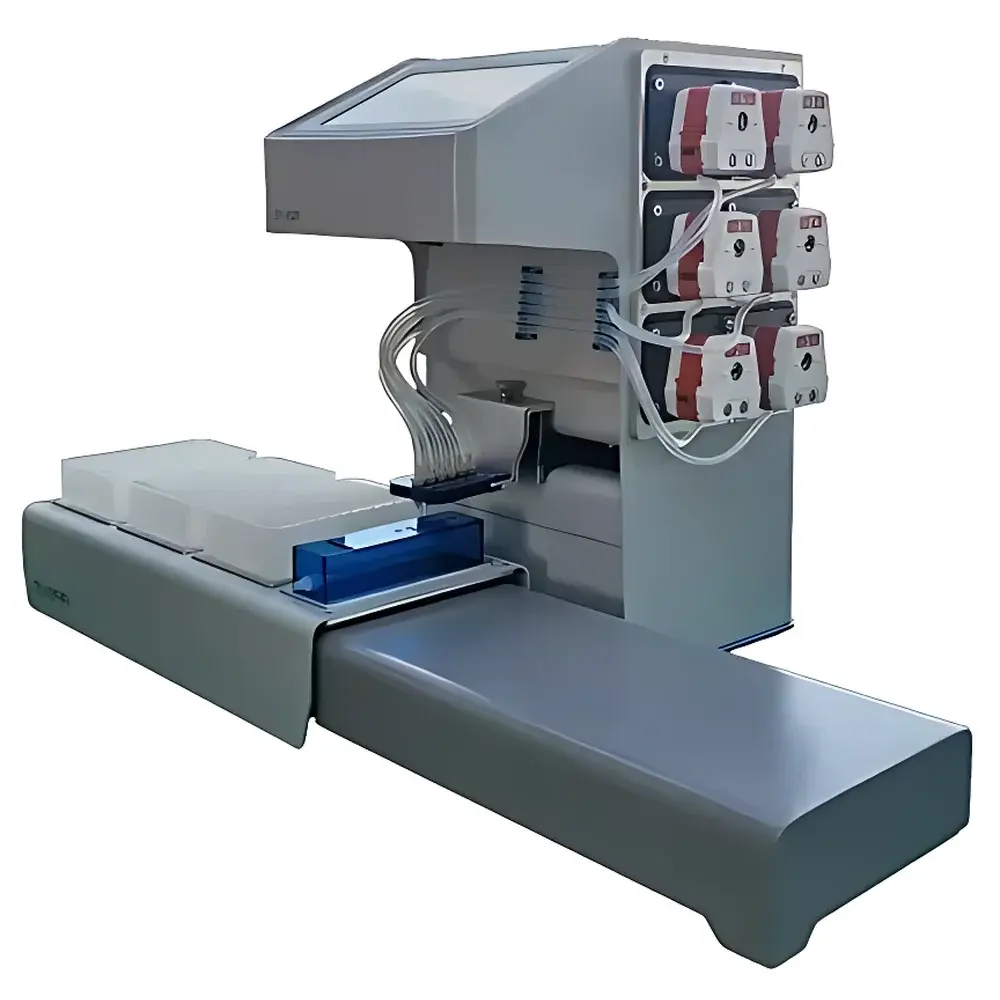
Zuofei ZF-920 Multi-Channel Liquid Dispenser
| Brand | Zuofei |
|---|---|
| Origin | Shanghai, China |
| Manufacturer Type | Original Equipment Manufacturer (OEM) |
| Product Category | Domestic |
| Model | ZF-920 |
| Instrument Type | Automated |
| Dispensing Range | 30 µL – 20 mL |
| Dispensing Accuracy | ±1% @ 100 µL |
| Dispensing Precision | ≤2% CV @ 100 µL |
| Throughput Capacity | Up to three 24-well or 96-well microplates simultaneously |
| Sample Vessel Compatibility | φ9 mm, φ10.8 mm, and φ13.3 mm cryovials/tubes |
| Dispensing Configuration | 6-channel parallel dispensing |
| Dispensing Principle | Peristaltic Pump Technology |
| Plate Height Adjustment | Motorized Auto-Height Detection |
Overview
The Zuofei ZF-920 Multi-Channel Liquid Dispenser is an engineered solution for high-reproducibility, medium-to-high-throughput liquid handling in life science laboratories. Designed around a robust peristaltic pump architecture, the ZF-920 delivers precise, contamination-minimized dispensing of aqueous buffers, cell suspensions, enzyme solutions, beads, and viscous reagents without requiring complex fluidic manifolds or disposable tips. Its core operational principle relies on positive displacement via calibrated elastomeric tubing compression—ensuring consistent volumetric delivery across varying fluid viscosities and surface tensions. Unlike air-displacement or syringe-based systems, the peristaltic mechanism eliminates carryover risk and enables rapid reconfiguration for multi-step workflows such as serial dilution, assay plate prepping, media aliquoting, and bead-based assay setup. The ZF-920 operates within ambient laboratory conditions (10–35 °C), complies with IEC 61000-6-3 EMC standards, and meets electrical safety requirements per IEC 61010-1 for Class I laboratory equipment.
Key Features
- Six independently controlled peristaltic channels with high-cycle-life silicone tubing—designed for >10,000 dispensing cycles before routine replacement
- Motorized auto-height adjustment system detects plate or tube rack height (up to 45 mm travel range) and dynamically calibrates nozzle clearance to prevent contact-induced damage or splashing
- Integrated 10.1-inch HD Android tablet interface with intuitive touch navigation, real-time status dashboard, and context-sensitive soft keys
- Wi-Fi-enabled architecture supports over-the-air (OTA) firmware updates, remote diagnostics, and secure network integration into lab-wide LIMS environments
- Tool-free, one-click pump head release mechanism allows rapid tubing swap under GLP-compliant documentation protocols
- Onboard data logging records timestamped dispense events, volume parameters, and error flags—exportable via USB or network share in CSV/JSON format
Sample Compatibility & Compliance
The ZF-920 accommodates standard ANSI/SLAS-compliant microplates (24-, 48-, and 96-well formats), including deep-well and skirted variants. It also supports common cryogenic storage formats: 0.5 mL, 1.5 mL, and 2.0 mL tubes with outer diameters of 9.0 mm, 10.8 mm, and 13.3 mm respectively. For sterility assurance, all wetted surfaces—including pump tubing, nozzles, and fluid paths—are compatible with validated chemical decontamination using 70% ethanol, isopropanol, or 0.5% sodium hypochlorite solutions. The instrument’s mechanical design conforms to ISO 13485 manufacturing practices, and its operational documentation supports audit readiness for GLP and GMP environments. While not FDA 510(k)-cleared, the ZF-920 satisfies functional equivalence benchmarks outlined in ASTM E2877-21 for automated liquid handlers used in analytical method development.
Software & Data Management
Running on a hardened Android 11 OS, the ZF-920’s embedded software provides protocol-driven operation through a modular workflow editor. Users define dispensing sequences by selecting plate maps, specifying volumes per well, assigning channel-to-source mapping, and configuring repeat cycles—all without scripting. All protocols are digitally signed and version-controlled. Audit trails capture operator ID, timestamp, parameter changes, and execution logs—meeting ALCOA+ principles (Attributable, Legible, Contemporaneous, Original, Accurate, Complete, Consistent, Enduring, Available). Data export supports direct upload to cloud-based ELN platforms via HTTPS or local transfer via encrypted USB storage. Optional API access (RESTful JSON endpoints) enables integration with third-party scheduling engines or robotic orchestration layers.
Applications
- High-volume preparation of cell culture media across multiple flasks or bioreactor seed trains
- Pre-aliquoting of master mixes for qPCR, digital PCR, and NGS library prep workflows
- Uniform distribution of magnetic beads in immunoassay development and CLIA validation studies
- Serial dilution series generation for IC50/EC50 determination in early-stage drug screening
- Automated filling of diagnostic test strips and lateral flow cartridges during R&D scale-up
- Reagent conditioning for microplate-based enzymatic assays (e.g., kinase, protease, or phosphatase activity)
FAQ
What types of liquids can the ZF-920 dispense reliably?
It handles aqueous solutions, glycerol-containing buffers (up to 30% v/v), cell suspensions (≤1×10⁶ cells/mL), and protein-conjugated beads—provided viscosity remains below 20 cP at 25 °C.
Is calibration traceable to national standards?
Yes—Zuofei provides optional factory calibration certificates traceable to NIM (National Institute of Metrology, China) via gravimetric verification at 10 µL, 100 µL, 1 mL, and 10 mL points.
Can the ZF-920 be integrated into a robotic workstation?
It features RS-232 and Ethernet ports with ASCII command protocol support, enabling synchronization with third-party robotic arms or conveyor systems via TTL-triggered start/stop signals.
How often must the peristaltic tubing be replaced?
Under typical usage (500 dispenses/day at 100 µL), tubing lasts ≥6 months; wear indicators appear in the UI when compression efficiency drops below 95% of nominal torque.
Does the system support multi-user authentication?
Yes—role-based access control (RBAC) supports administrator, technician, and operator profiles with configurable permissions for protocol editing, calibration, and data export functions.




