
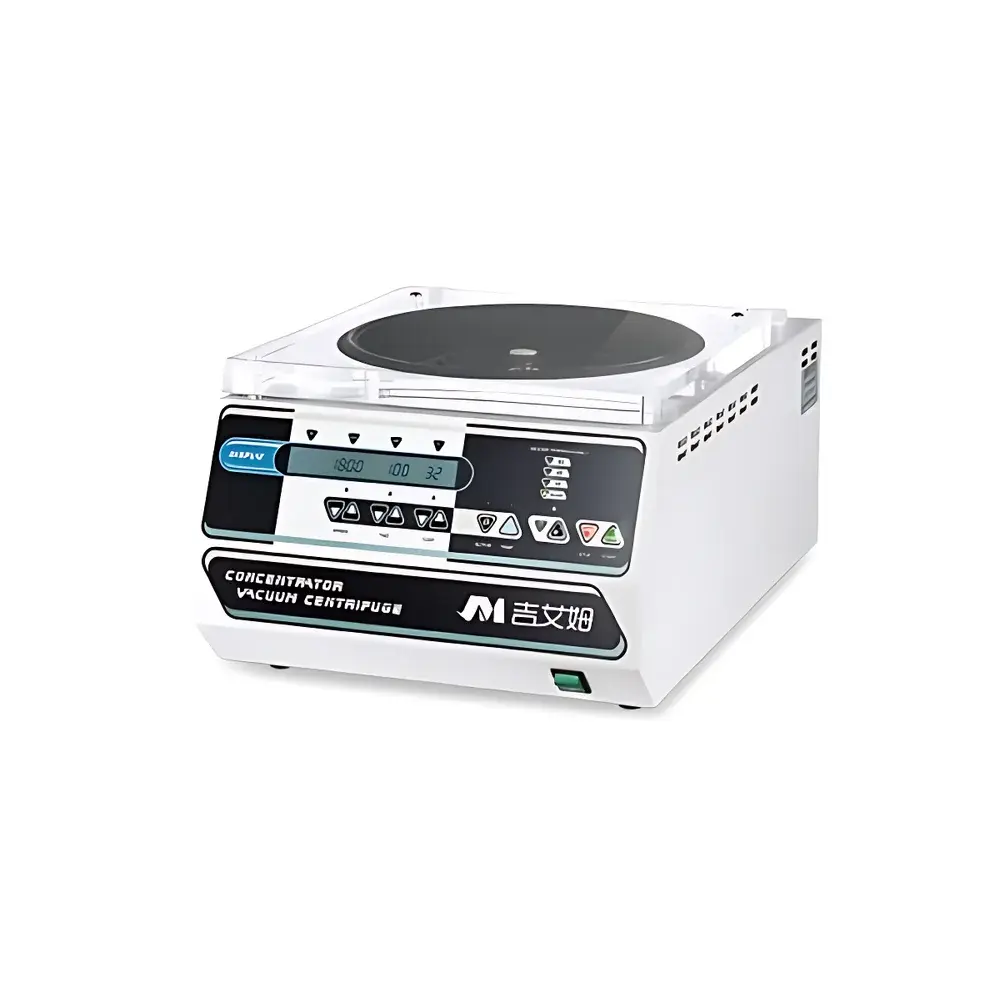
GiAim CV100-DNA Vacuum Centrifugal Concentrator
| Brand | GiAim |
|---|---|
| Origin | Beijing, China |
| Manufacturer Type | Authorized Distributor |
| Country of Manufacture | China |
| Model | CV100-DNA |
| Instrument Type | Vacuum Centrifugal Concentrator |
| Rotational Speed Range | 300–1800 rpm |
| Temperature Settings | Ambient, 30°C, 45°C, 60°C |
| Chamber Coating | PTFE (Teflon®) |
| Structural Materials | 304 Stainless Steel (rotor, internal tubing) |
| Control Interface | LCM segmented LCD panel with microprocessor control |
| Drive System | AC frequency-converter induction motor, electromagnetic drive |
| Condensation Method | Inline evaporator coil suspended in vapor path |
| Vacuum Interface | External vacuum pump required |
| Cold Trap | Modular, standalone unit |
| Exhaust Management | Integrated exhaust ducting with optional nitrogen purge and particulate/chemical filtration |
Overview
The GiAim CV100-DNA Vacuum Centrifugal Concentrator is an engineered solution for gentle, parallel sample concentration and desiccation of biomolecular specimens under reduced pressure. It operates on the principle of simultaneous centrifugal force, controlled thermal energy, and vacuum-induced solvent vaporization—enabling rapid yet non-destructive removal of volatile solvents (e.g., ethanol, isopropanol, water, acetonitrile) from sensitive biological samples. Unlike lyophilization or simple evaporation, this system maintains sample integrity by preventing foaming, splattering, or oxidation through precise rotational stabilization (300–1800 rpm), regulated heating (ambient to 60°C), and immediate condensation of vapors via an integrated inline cooling coil. Designed specifically for nucleic acid workflows, the CV100-DNA meets the physical handling and contamination-control requirements typical of pre-sequencing, microarray, and qPCR preparation environments.
Key Features
- Corrosion-resistant architecture: PTFE-coated centrifuge chamber and 304 stainless steel rotor, tubing, and structural components ensure long-term compatibility with acidic, basic, and organic solvents.
- Intelligent operational sequence: One-touch start initiates coordinated activation of rotation, heating, and vacuum interface—minimizing user input and procedural variability.
- Precision temperature presets: Four factory-calibrated setpoints (ambient, 30°C, 45°C, 60°C) allow method-specific thermal management without manual calibration or overshoot risk.
- Fail-safe vacuum management: Automatic venting upon power loss prevents sample rehydration or collapse; dual-stage inlet filtration supports inert gas (N₂) purging to exclude oxygen and moisture during concentration.
- Modular system topology: Independent concentrator head, vacuum pump, and cold trap units enable flexible lab integration, service isolation, and scalability across throughput tiers.
- Low-noise electromagnetic drive: Brushless AC induction motor with frequency-converter control delivers consistent torque, zero maintenance, and acoustic output <55 dB(A) at 1 m.
- Ergonomic form factor: 24 cm unit height optimizes benchtop accessibility for loading/unloading microtubes (0.2–50 mL), PCR strips, and deep-well plates without stooping or extended reach.
- High-efficiency vapor capture: Condenser coil positioned directly within the solvent vapor stream achieves >95% condensate recovery into a dedicated collection vessel—reducing solvent loss and minimizing downstream disposal burden.
Sample Compatibility & Compliance
The CV100-DNA accommodates standard nucleic acid preparation formats including 0.2 mL PCR tubes, 1.5/2.0 mL microcentrifuge tubes, 96-well plates (with compatible rotor adapters), and low-binding siliconized vials. It is routinely deployed in workflows compliant with ISO/IEC 17025-accredited laboratories for DNA/RNA quantification, fluorescent cDNA labeling, and post-PCR cleanup. While not certified to FDA 21 CFR Part 11 out-of-the-box, its microprocessor-based logging (start/stop time, temperature setpoint, runtime) supports GLP/GMP-aligned recordkeeping when paired with validated electronic notebooks. All wetted materials conform to USP Class VI biocompatibility standards; PTFE and 304 stainless steel surfaces meet ASTM F899 for corrosion resistance in aqueous and alcoholic media.
Software & Data Management
The CV100-DNA utilizes embedded firmware—not external PC software—for core operation. The LCM (Liquid Crystal Module) segmented display provides real-time feedback on speed, temperature, elapsed time, and system status (e.g., “Vacuum Active”, “Heating”, “Cooldown”). Event logs are retained in non-volatile memory for up to 100 cycles and can be reviewed locally via scroll navigation. No proprietary drivers or cloud connectivity are implemented, ensuring regulatory simplicity in controlled environments where network segregation is mandated. For audit readiness, users may manually transcribe cycle parameters into laboratory information management systems (LIMS) or electronic lab notebooks (ELN) per institutional SOPs.
Applications
- Concentration of dilute DNA/RNA extracts prior to electrophoresis, capillary electrophoresis, or next-generation sequencing library preparation.
- Drying of fluorescently labeled cDNA probes for microarray hybridization without dye degradation.
- Removal of residual ethanol from column-purified plasmid preps or oligonucleotide synthesis cleavage mixtures.
- Desalting and buffer exchange of small-molecule metabolites, peptides, and enzymatic digests in metabolomics and proteomics pipelines.
- Stabilization of labile compounds—including nucleosides, kinase inhibitors, and glycosylated intermediates—under inert atmosphere to prevent hydrolysis or oxidation.
FAQ
What vacuum pump specifications are recommended for optimal performance?
A two-stage oil-free diaphragm pump capable of ≤5 mbar ultimate vacuum and ≥20 L/min free-air displacement is advised. Pump selection must account for solvent compatibility—especially with chlorinated or highly polar solvents requiring chemically resistant membranes.
Can the CV100-DNA be used for protein samples without denaturation?
Yes—when operated at ambient temperature or 30°C under high vacuum (≤10 mbar) and moderate rotation (600–1000 rpm), it preserves tertiary structure in most globular proteins; however, validation via CD spectroscopy or activity assay is recommended for each new protein class.
Is cold trap condensation efficiency affected by ambient room temperature?
Yes—condenser performance declines above 30°C ambient; use in air-conditioned labs (18–25°C) ensures consistent dew point control and minimizes vapor breakthrough into the vacuum line.
Does the system support continuous unattended operation?
It supports timed runs up to 99 hours and automatic shutdown, but unattended overnight operation requires confirmation of solvent compatibility, cold trap capacity, and local safety protocols regarding flammable vapor containment.
Are rotor adapters available for non-standard tube formats?
GiAim offers OEM-certified adapters for 0.5 mL tubes, 8-strip PCR racks, and 24-position deep-well blocks; custom machining services are available under NDA for specialized plate geometries.



