
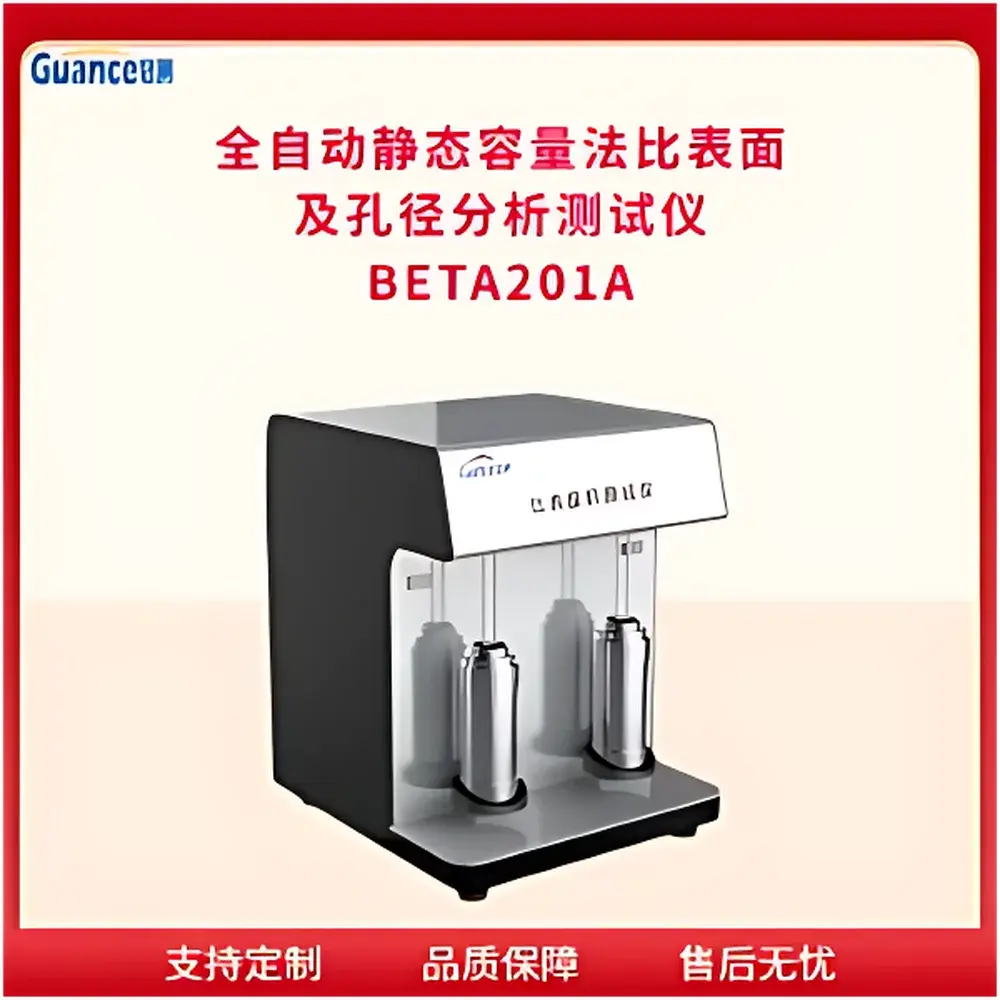
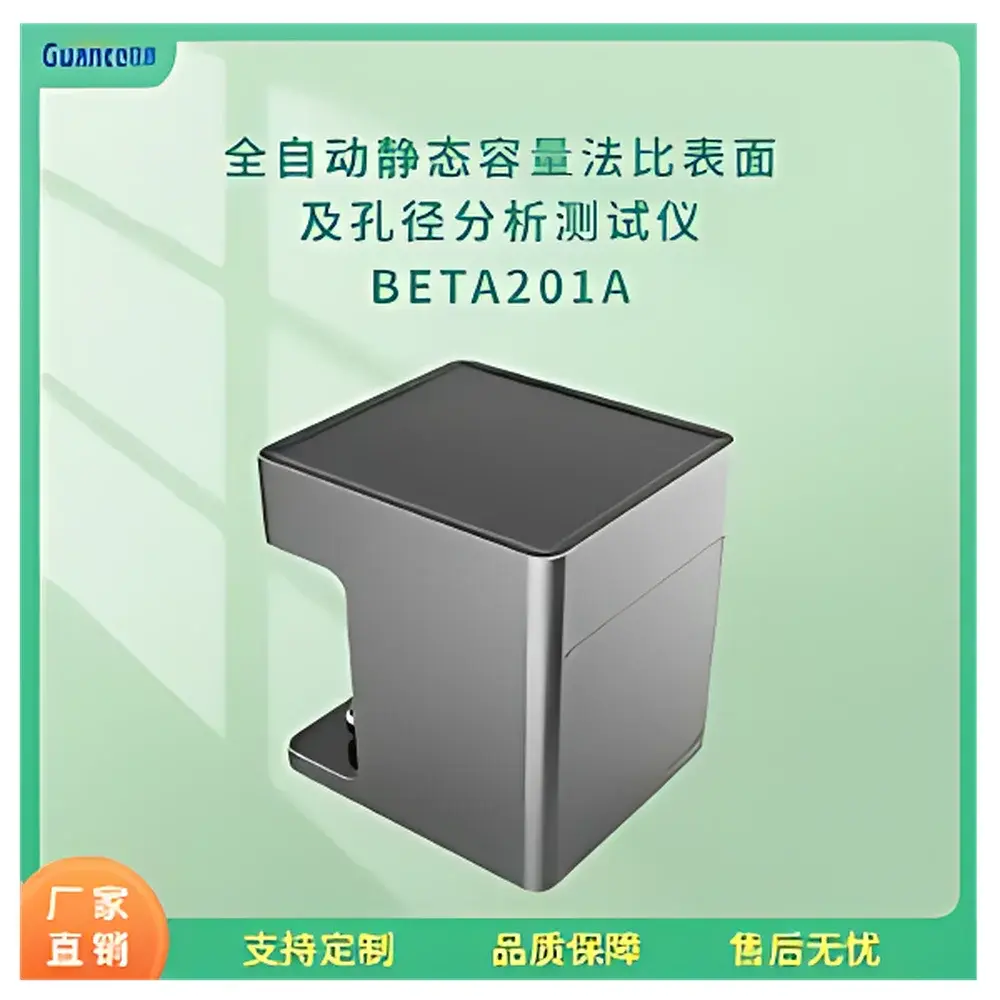
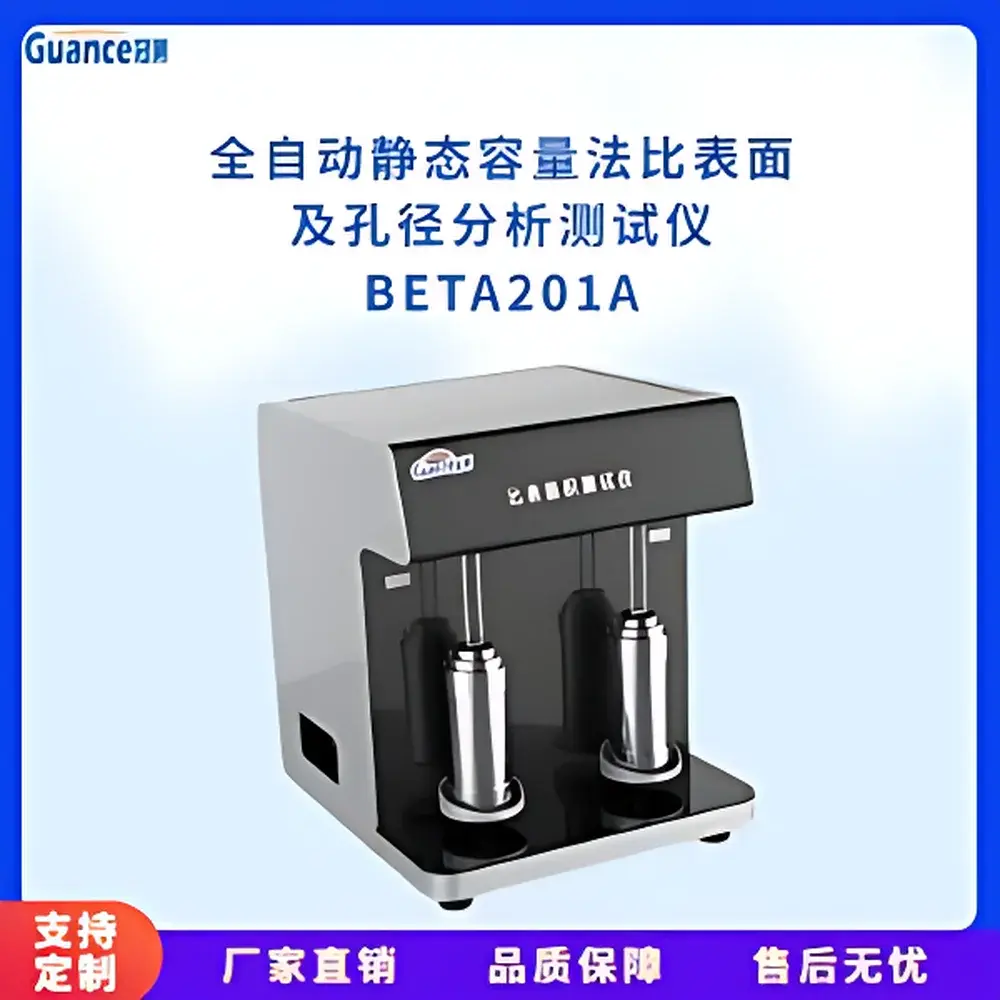
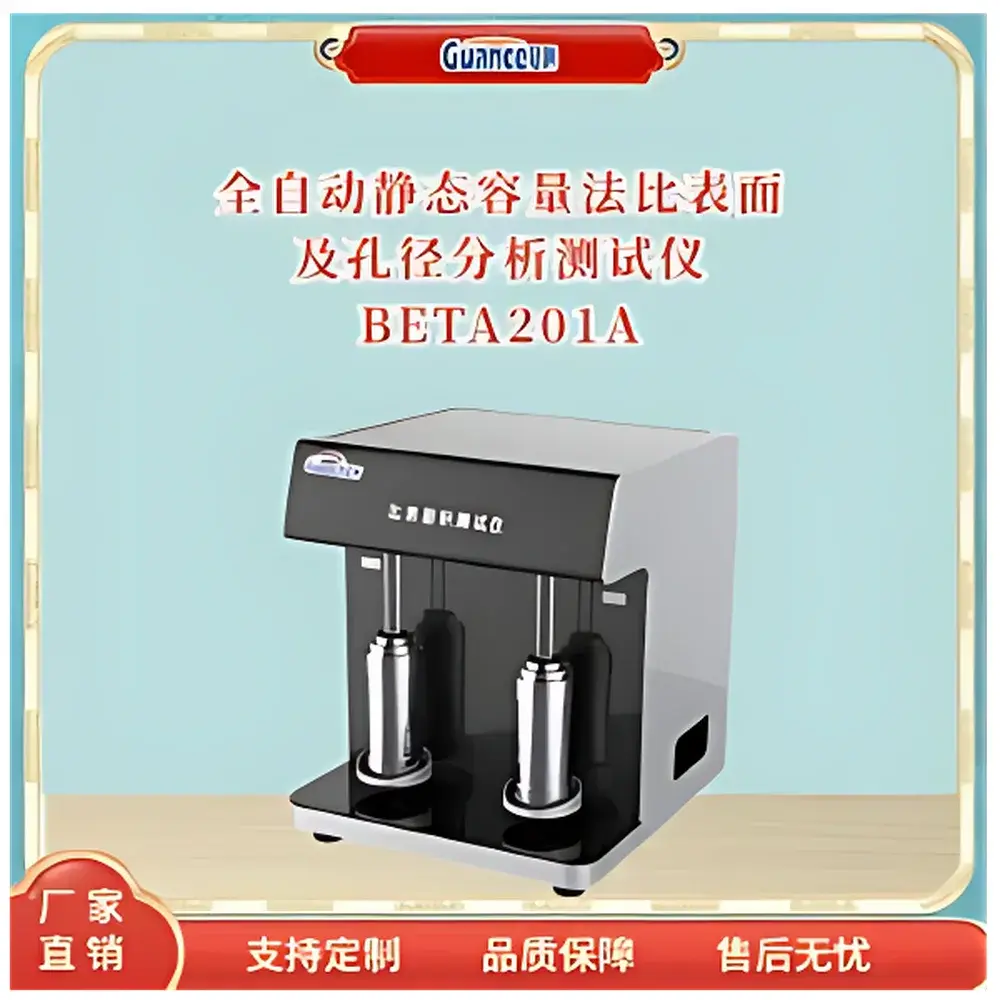
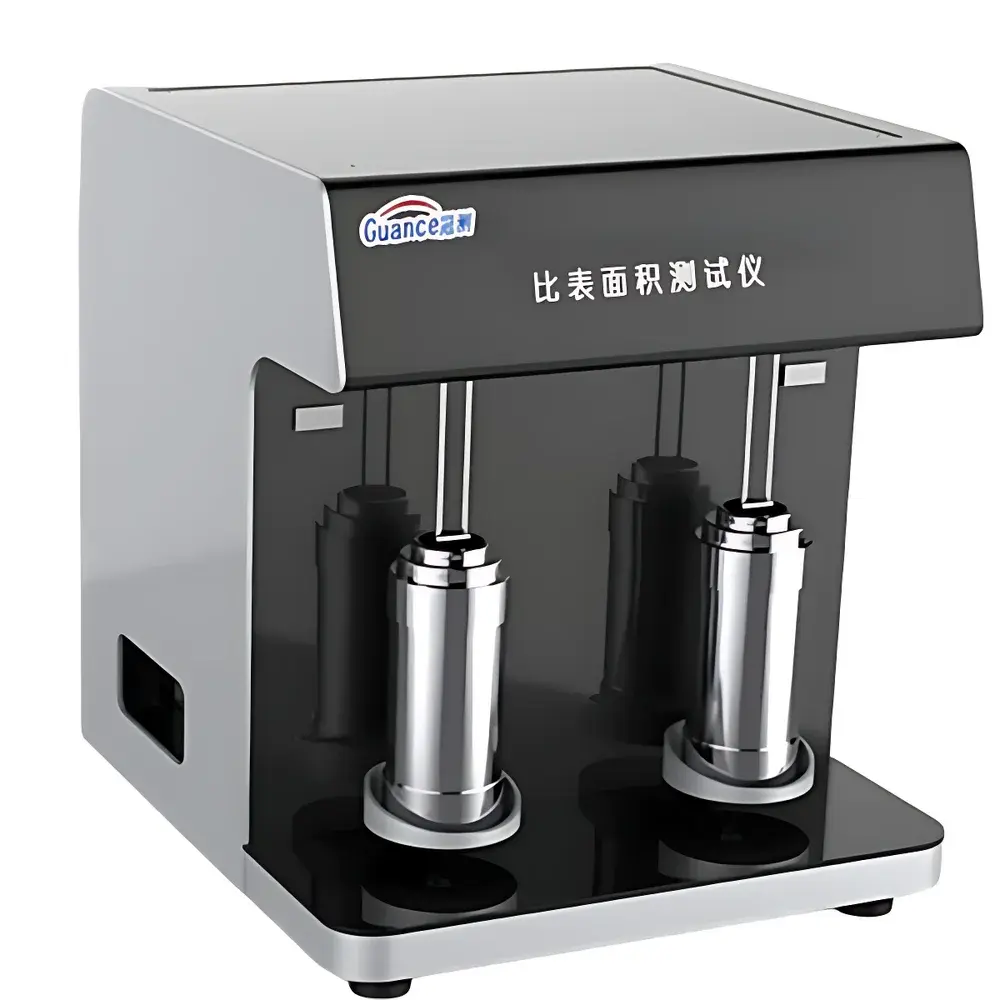
GuanCe Instruments BETA201A1 Specific Surface Area and Pore Size Analyzer
| Brand | GuanCe Instruments |
|---|---|
| Origin | Beijing, China |
| Manufacturer Type | Authorized Distributor |
| Country of Origin | China |
| Model | BETA201A1 |
| Instrument Type | Specific Surface Area and Pore Size Analyzer |
| Measurement Principle | Static Volumetric Method (with optional dynamic mode support) |
| Number of Analysis Stations | 4 |
| Specific Surface Area Range | 0.0001 m²/g (using Kr adsorption) to unlimited |
| Pressure Range | 0–133 kPa (0–1000 Torr) |
| Theoretical Basis | Static Volumetric Gas Adsorption |
| Repeatability | ±0.001 m²/g (absolute) or <±1% relative |
Overview
The GuanCe Instruments BETA201A1 Specific Surface Area and Pore Size Analyzer is an advanced benchtop instrument engineered for high-precision characterization of porous and powdered materials via static volumetric gas adsorption. It operates on the fundamental principles of physical adsorption—primarily nitrogen (N₂), krypton (Kr), argon (Ar), carbon dioxide (CO₂), and other non-corrosive gases—at cryogenic temperatures (typically 77 K for N₂, 87 K for Ar, or 119 K for CO₂). By measuring adsorbed gas volume as a function of relative pressure (P/P₀), the system constructs full adsorption–desorption isotherms, enabling quantitative determination of specific surface area (via BET, Langmuir, or single-point methods), pore size distribution (PSD) in the micropore (0.35–2 nm), mesopore (2–50 nm), and macropore (50–500 nm) ranges, total pore volume, micropore volume, external surface area, and cumulative pore area. Designed for research laboratories, QC/QA departments, and materials development centers, the BETA201A1 delivers metrologically traceable results compliant with ISO 9277 (BET surface area), ISO 15901 (pore size analysis), and ASTM D3663 and D4641 standards.
Key Features
- Four independent analysis stations with fully automated, parallel operation—enabling simultaneous measurement of up to four samples or sequential multi-point isotherm acquisition per station.
- Dual-sensor architecture: one dedicated absolute pressure transducer for real-time P₀ monitoring (accuracy ±0.1% FS, 24-bit ADC resolution), and one for sample manifold pressure measurement—ensuring thermodynamic consistency and eliminating P₀ drift errors.
- Ultra-high vacuum system: stainless-steel fluid path with metal-sealed valves, silver-plated internal surfaces, and dual-layer vacuum shielding; base pressure ≤1×10⁻⁸ Torr (≤1.3×10⁻⁶ Pa) with standard two-stage rotary vane pump (1×10⁻² Pa); optional turbomolecular pump upgrade available.
- Integrated thermal management: large-capacity liquid nitrogen Dewar (70-hour autonomy) with isothermal jacket; optional auto-refill system for unattended long-duration runs (e.g., low-pressure Kr isotherms or CO₂ micropore analysis).
- Intelligent vacuum control logic: adaptive pump cycling reduces acoustic noise by >40%, extends pump service life, and minimizes oil backstreaming risk during extended degassing.
- No-handling degas–analyze workflow: same-position heating and analysis eliminates air exposure; three-way valve isolates degas effluent from the analytical manifold—preventing cross-contamination and preserving vacuum integrity.
- Comprehensive safety architecture: hardware-level overpressure, overcurrent, short-circuit, and leakage protection; software-based operational interlocks prevent erroneous valve sequencing or pressure ramp violations.
Sample Compatibility & Compliance
The BETA201A1 accommodates diverse solid-state materials—including inorganic oxides (e.g., Al₂O₃, SiO₂), zeolites, activated carbons, battery cathode/anode powders (LiCoO₂, graphite), catalysts, soils, polymers, fibers, and thin-film-coated substrates—in powder, pellet, monolith, or fiber formats. Sample tubes are compatible with standard 6 mm and 9 mm OD quartz or stainless-steel configurations. All measurements adhere to GLP-compliant data handling protocols: full audit trail (user ID, timestamp, parameter set, raw isotherm points), electronic signatures, and 21 CFR Part 11–ready export options. Calibration verification includes certified reference materials (e.g., NIST SRM 1990a for surface area, NIST SRM 2973 for micropore volume) and built-in P₀ validation routines.
Software & Data Management
The proprietary GuanCe AnalyzeSuite™ software (v5.2+) provides bilingual (English/Chinese) GUI with role-based access control. It supports USB 2.0 and TCP/IP Ethernet connectivity—enabling remote instrument control, firmware diagnostics, and multi-device orchestration via standard network routers. Key capabilities include:
- Modular test method library: >30 preconfigured protocols (BET, t-plot, DFT/NLDFT kernel libraries, BJH, DH, HK, DA, QSDFT models) with customizable parameters (equilibration time, pressure step width, degas temperature ramp).
- Resumable testing: automatic state recovery after power loss—preserving degas progress, isotherm segments, and calibration metadata without data corruption.
- Export flexibility: PDF reports (ISO-formatted), Excel (.xlsx) raw data dumps, CSV isotherm exports, and overlayable comparative plots (e.g., time-series reproducibility, batch-to-batch PSD alignment).
- Database-driven workflow: encrypted local SQL database stores all raw isotherms, processed results, instrument logs, and user annotations—searchable by sample ID, date range, operator, or method tag.
Applications
The BETA201A1 serves critical characterization needs across academia and industry:
- Battery R&D: quantifying electrode-specific surface area (SSA) and mesopore volume to correlate with Li⁺ diffusion kinetics and cycle stability.
- Heterogeneous catalysis: evaluating active site dispersion via Kr-BET on low-surface-area catalysts (<0.1 m²/g) and micropore confinement effects using CO₂ at 273 K.
- Pharmaceutical solid-state science: assessing excipient porosity impact on tablet compressibility and dissolution rate per USP & ICH Q5A guidelines.
- Environmental materials: characterizing biochar pore hierarchy for contaminant adsorption capacity modeling.
- Advanced ceramics: verifying sintering density via helium pycnometry integration (optional module) and correlating closed porosity with mechanical strength.
FAQ
What gases can be used for analysis besides nitrogen?
N₂, Ar, Kr, CO₂, NH₃, H₂, CO, O₂, CH₄, and C₄H₁₀ are supported—subject to compatibility with the vacuum system and sensor range. Kr is recommended for ultra-low SSA measurements (<0.01 m²/g); CO₂ at 273 K enables sub-0.7 nm micropore resolution.
Is helium required for free space calibration?
No. The system uses an integrated, temperature-compensated absolute pressure transducer for direct P₀ measurement—eliminating the need for He pycnometry or separate dead-volume calibration.
How does the instrument ensure isothermal conditions during long isotherms?
The Dewar’s double-wall isothermal jacket maintains ΔT < ±0.1 K over 70 hours; optional LN₂ auto-refill sustains thermal stability indefinitely.
Can the BETA201A1 comply with FDA 21 CFR Part 11 requirements?
Yes—when deployed with network authentication, electronic signature enforcement, and immutable audit logging enabled in AnalyzeSuite™, it meets core Part 11 criteria for electronic records and signatures in regulated environments.
What is the minimum detectable pore volume?
0.0001 cm³/g (measured via N₂ at 77 K with high-vacuum option); detection limit improves to 0.00005 cm³/g when using Kr at 77 K or CO₂ at 273 K.



