


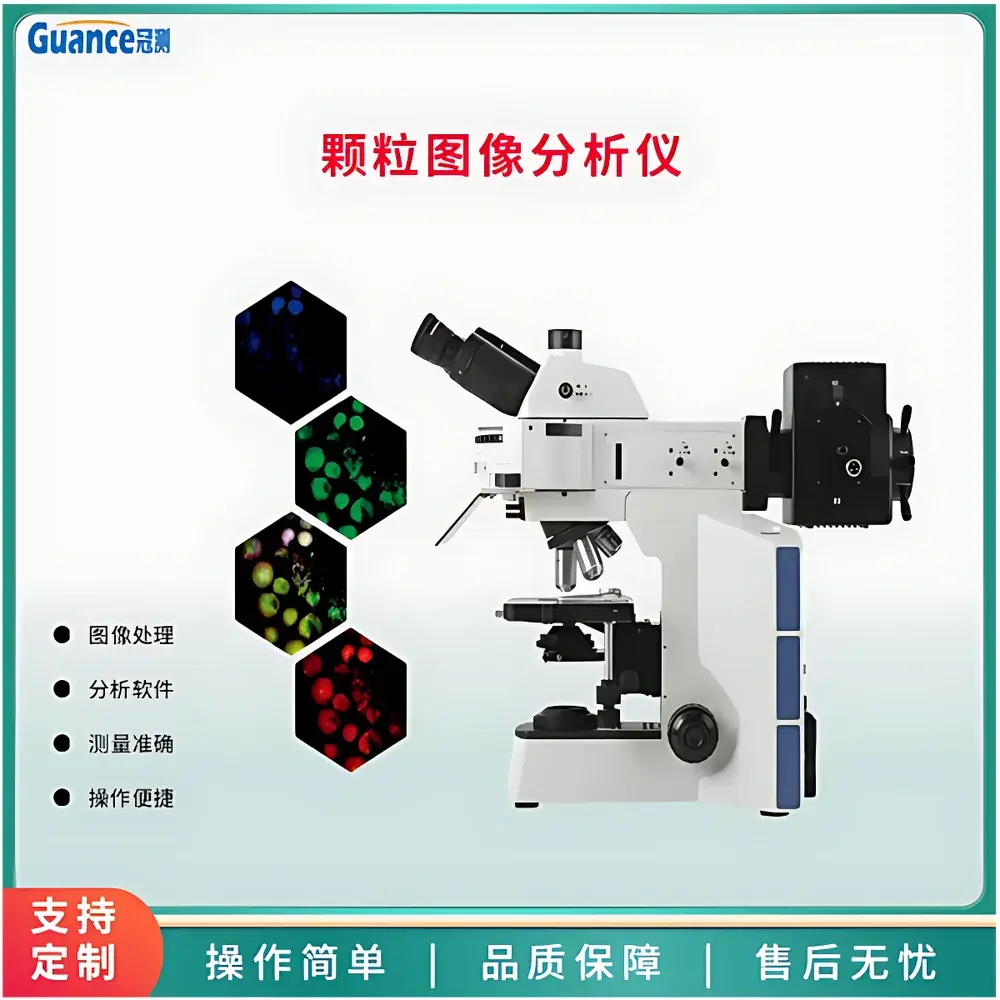
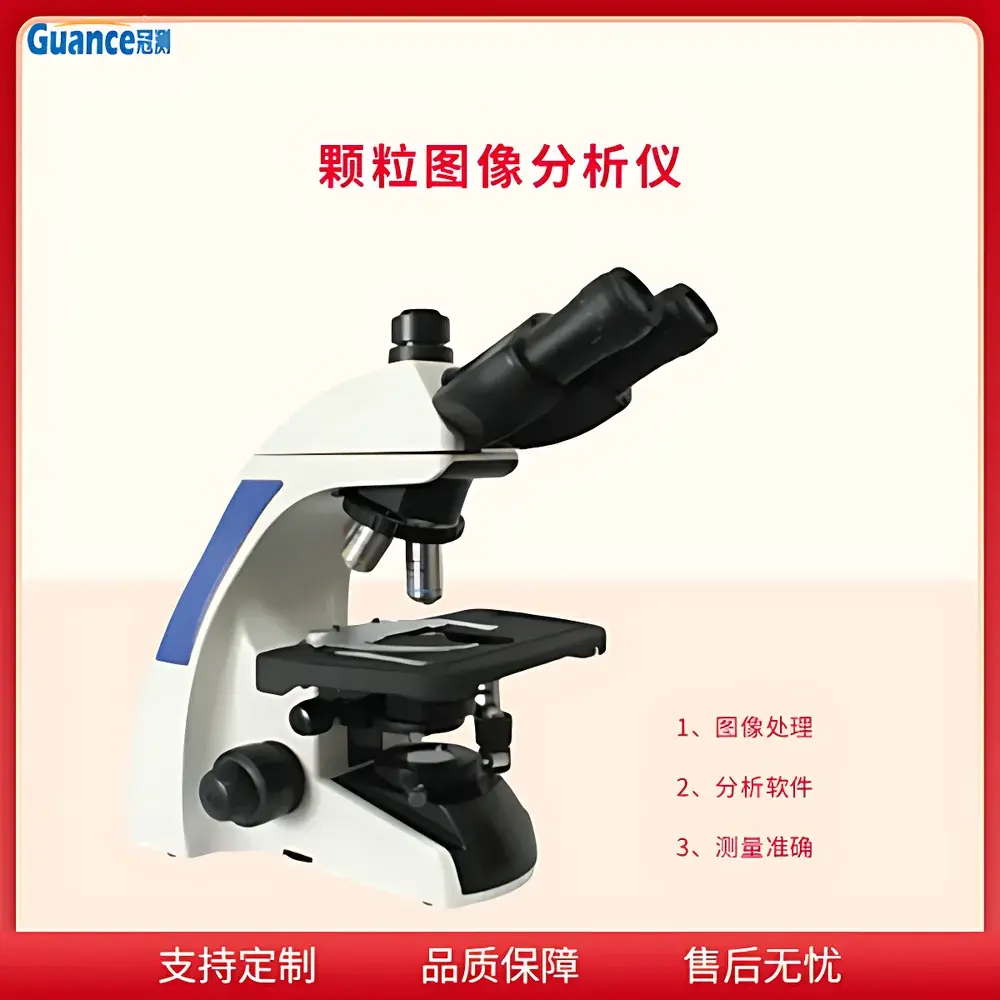
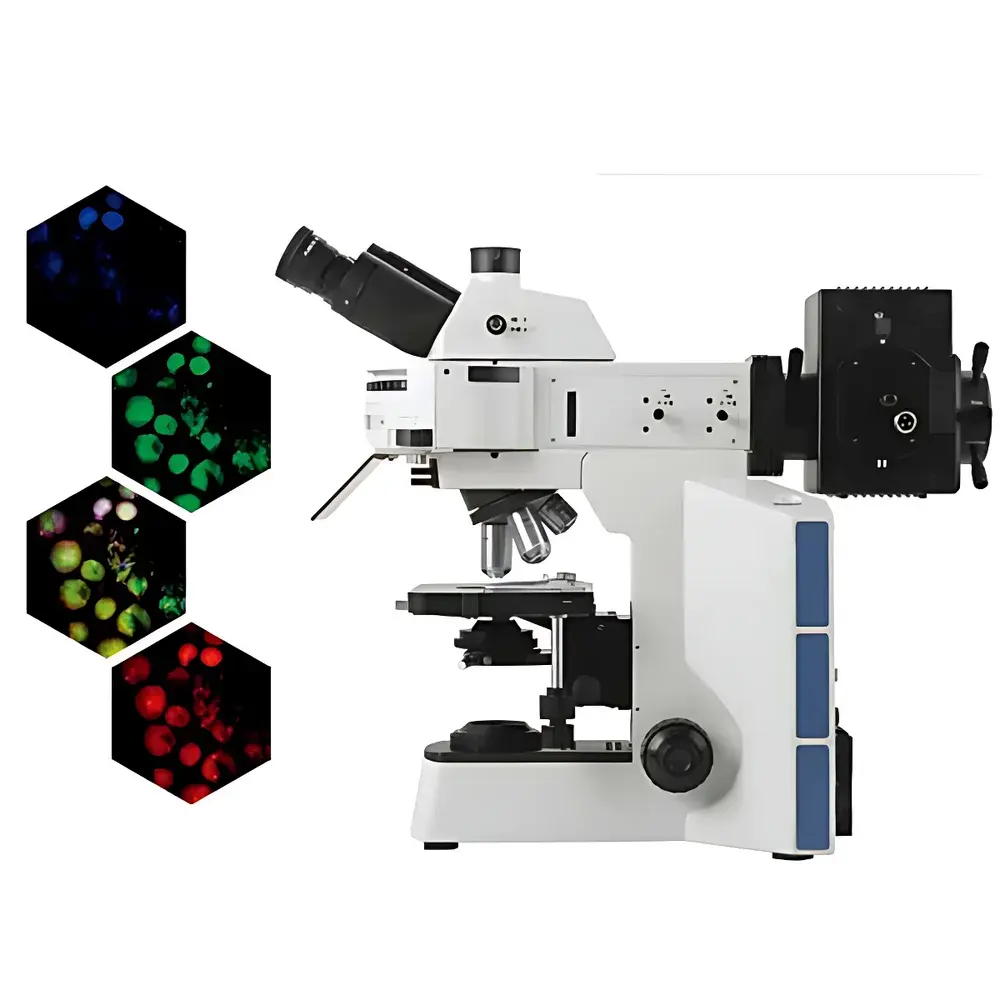
Guance Instruments ZKFT-1600C Image-Based Particle Size and Shape Analyzer
| Brand | Guance Instruments |
|---|---|
| Origin | Beijing, China |
| Manufacturer Type | Authorized Distributor |
| Country of Origin | China |
| Model | ZKFT-1600C |
| Application | Metal Powders |
| Instrument Type | Dynamic Imaging System |
| Field of View | 5.70 mm (H) × 4.28 mm (V) |
| Lens Count | 1 |
| Sample Dispersion Method | Gravity-fed free-fall imaging chamber (field-of-view defined) |
| Exposure Time Range | 0.21 ms – 2000 ms (ROI-adjustable) |
| Signal-to-Noise Ratio | 66.5 dB |
Overview
The Guance Instruments ZKFT-1600C is a dynamic, high-resolution image-based particle size and shape analyzer engineered for quantitative morphological characterization of dry, free-flowing particulates—particularly suited for metal powders used in additive manufacturing, powder metallurgy, and battery electrode material R&D. Unlike static microscopy or laser diffraction methods, the ZKFT-1600C employs real-time digital imaging under controlled illumination to capture individual particles in motion across a defined field of view (5.70 mm × 4.28 mm). Particles pass through the optical path via gravity-driven dispersion, minimizing agglomeration and enabling statistically robust sampling of thousands of particles per measurement cycle. The system integrates a precision optical microscope, a high-sensitivity monochrome CCD camera with ROI-triggered exposure control (0.21–2000 ms), and proprietary image segmentation algorithms compliant with ISO 13322-1:2020 (Particle size analysis — Image analysis methods — Part 1: Static image analysis methods) and aligned with ASTM E2454-22 guidelines for digital particle morphology assessment.
Key Features
- Dynamic imaging architecture optimized for rapid, non-contact analysis of dry, irregularly shaped particles—including spherical, dendritic, satellite, and fragmented metal powders.
- Single high-resolution objective lens configuration with fixed magnification and calibrated pixel-to-length mapping, ensuring traceable dimensional metrology.
- Adjustable exposure time (0.21–2000 ms) with region-of-interest (ROI) triggering to maintain optimal contrast and edge definition across varying particle reflectivity and velocity.
- Integrated signal-to-noise ratio of 66.5 dB, supporting reliable binary thresholding and sub-pixel contour detection even for low-contrast metallic surfaces.
- Automated particle segmentation using adaptive local thresholding and morphological filtering—minimizing operator bias and enabling reproducible shape parameter extraction.
- Modular hardware design compatible with standard laboratory benches; no external air supply, vacuum pump, or fluidic handling required.
Sample Compatibility & Compliance
The ZKFT-1600C is validated for use with dry, cohesion-free powders ranging from ~10 µm to >500 µm in equivalent spherical diameter—covering common AM feedstocks such as Ti-6Al-4V, Inconel 718, SS316L, and AlSi10Mg. It complies with ISO/IEC 17025:2017 requirements for test method validation when operated within documented SOPs. Data output formats (CSV, XLSX, PDF reports) support audit readiness for GLP and GMP environments. While not FDA 21 CFR Part 11–certified out-of-the-box, the software architecture supports optional electronic signature modules and audit-trail logging upon customer-configured deployment.
Software & Data Management
The proprietary Guance ParticleVision™ analysis suite runs on Windows OS and provides full workflow control—from live image acquisition and focus optimization to batch processing and statistical reporting. Core outputs include D10/D50/D90 by number and area-weighted distributions, aspect ratio (length/width), circularity (4π·area/perimeter²), convexity, solidity, and Feret diameters. All measurements are stored with metadata (timestamp, exposure, lens ID, operator ID), enabling traceability. Export options include raw image stacks (TIFF), annotated particle masks, and customizable report templates compliant with internal QA documentation standards.
Applications
- Quality control of metal powders prior to laser powder bed fusion (LPBF) or binder jetting processes.
- Process development studies evaluating atomization efficiency, sieving performance, or post-processing effects (e.g., thermal annealing, plasma spheroidization).
- Comparative morphological benchmarking between OEM and third-party powder suppliers.
- Root-cause analysis of print defects correlated with particle elongation or surface roughness metrics.
- Educational and research applications in materials science laboratories requiring visual, parameter-rich particle datasets.
FAQ
What particle size range is reliably measurable with the ZKFT-1600C?
The system is optimized for particles between approximately 10 µm and 500 µm. Below 10 µm, resolution limits and depth-of-field constraints reduce measurement confidence; above 500 µm, field-of-view coverage becomes statistically insufficient without sample subdivision.
Does the instrument require calibration standards?
Yes—NIST-traceable stage micrometers and certified reference powders (e.g., NIST SRM 1980) are recommended for initial setup and periodic verification of pixel calibration and shape algorithm accuracy.
Can the ZKFT-1600C analyze wet suspensions?
No—it is designed exclusively for dry, free-falling particle streams. Wet dispersion requires alternative systems with flow cells and refractive index matching.
Is remote operation or network data sharing supported?
The software supports local area network (LAN) file sharing and scheduled automated report generation. Remote desktop access is permitted via IT-approved protocols but is not natively embedded in the application layer.
How many particles are typically analyzed per run?
A typical 60-second acquisition captures 5,000–15,000 fully resolved particles, depending on feed rate and powder density—sufficient for <±2% relative standard deviation in D50 under ISO 13322-1 statistical guidance.



