
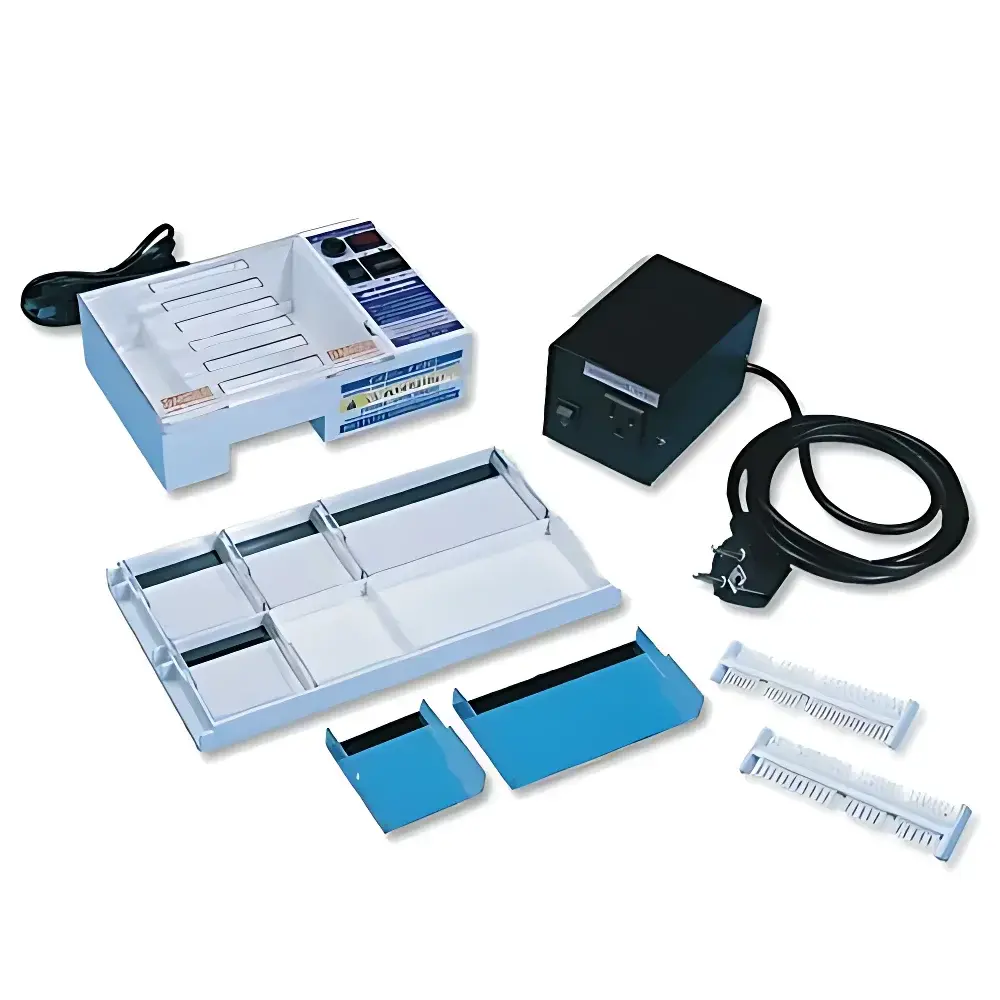
Bioer Mini Run Horizontal Electrophoresis System
| Brand | Bioer |
|---|---|
| Model | Mini Run |
| Type | Horizontal Electrophoresis Apparatus |
| Power Input | AC 100–110 V, 50–60 Hz or AC 220 V, 50 Hz (with included step-down transformer) |
| Output | DC 50 V / DC 100 V |
| Electrophoresis Chamber Volume | 250 mL (dual-chamber design) |
| Dimensions (L×W×H) | 192 × 130 × 60 mm |
| Net Weight | 320 g |
| Gel Tray Configurations | Four 60 × 55 mm slots or two 110 × 55 mm slots |
| Comb Specifications | 4 × 1 mm × 8 teeth |
| Electrode Material | Platinum-coated stainless steel |
| Housing & Lid Material | Corrosion-resistant engineering thermoplastic |
| Compatible Gels | Agarose and polyacrylamide gels |
| Compliance | CE-marked for laboratory use in EU |
Overview
The Bioer Mini Run Horizontal Electrophoresis System is a compact, self-contained electrophoresis apparatus engineered for high reproducibility and operational simplicity in nucleic acid and protein separation. Designed around the fundamental principle of horizontal electrophoresis—where charged biomolecules migrate through a porous gel matrix under the influence of a direct current electric field—the Mini Run enables reliable size-based resolution of DNA fragments, RNA, and small peptides. Its integrated DC power supply eliminates the need for external power supplies, supporting dual-input voltage compatibility (100–110 V or 220 V AC) via an included step-down transformer—making it suitable for global deployment across teaching labs, field-deployable diagnostics units, and resource-constrained research environments. The system’s ultra-lightweight architecture (320 g net weight), combined with its low-profile footprint (192 × 130 × 60 mm), ensures portability without compromising mechanical stability during run cycles.
Key Features
- Integrated dual-voltage DC power supply (50 V / 100 V output) with automatic voltage regulation—no external power module required
- Corrosion-resistant engineering thermoplastic housing and lid, rated for repeated exposure to ethidium bromide, SYBR® Safe, and other common nucleic acid stains
- Pt-coated stainless steel electrodes ensure long-term conductivity stability and resistance to oxidation during extended runs
- Modular gel tray system accommodating both standard mini-gel formats: four 60 × 55 mm chambers or two 110 × 55 mm chambers—optimized for parallel sample processing
- Interchangeable combs (4 × 1 mm × 8/17 teeth; 6 × 1 mm × 6/12 teeth) support variable well capacity and loading volume flexibility
- Sealed chamber design minimizes buffer evaporation and maintains consistent field uniformity over typical run durations (20–60 min)
Sample Compatibility & Compliance
The Mini Run supports routine electrophoretic separation in both agarose (0.7–3.0% w/v) and native or denaturing polyacrylamide (8–20% T) matrices. Its electrode geometry and chamber depth are calibrated to deliver uniform field strength across all gel formats, enabling consistent migration velocity and band sharpness. The system complies with IEC 61010-1:2010 for safety of laboratory electrical equipment and carries CE marking for conformity with EU health, safety, and environmental protection standards. While not certified for GLP/GMP production environments, its construction and performance align with ASTM D5232-20 (standard practice for electrophoretic analysis of nucleic acids) and ISO/IEC 17025:2017 requirements for method validation in accredited testing laboratories.
Software & Data Management
As a standalone benchtop electrophoresis platform, the Mini Run operates without proprietary software or connectivity interfaces. All operational parameters—including voltage selection and run duration—are manually controlled via front-panel switches. This analog architecture enhances reliability in settings where electromagnetic interference, network security constraints, or IT infrastructure limitations preclude digital control systems. For documentation and traceability, users may integrate the Mini Run into existing laboratory information management systems (LIMS) via manual entry of run logs, including gel composition, buffer type (TAE/TBE), voltage setting, and elapsed time. No firmware updates or driver installations are required—ensuring long-term operational continuity.
Applications
- Undergraduate and graduate molecular biology teaching labs: ideal for introducing core concepts of charge-to-mass ratio, gel pore size effects, and molecular weight estimation
- Point-of-care diagnostic screening: portable operation enables on-site DNA fingerprinting in veterinary clinics, agricultural extension services, and public health surveillance units
- Quality control of PCR products and restriction digests in academic core facilities and contract research organizations (CROs)
- Preparative electrophoresis for excision and extraction of DNA bands prior to cloning or sequencing workflows
- Field-deployable nucleic acid verification in environmental monitoring (e.g., waterborne pathogen detection) and food safety testing
FAQ
Does the Mini Run require an external power supply?
No—it includes a built-in DC power module and ships with a CE-certified step-down transformer for seamless operation on either 110 V or 220 V AC mains.
Can I run SDS-PAGE gels on this system?
The Mini Run is optimized for horizontal electrophoresis and supports native and denaturing polyacrylamide gels; however, vertical SDS-PAGE requires dedicated vertical tank systems and is not supported.
What buffer systems are compatible?
Standard electrophoresis buffers including TAE (Tris-acetate-EDTA), TBE (Tris-borate-EDTA), and sodium borate are fully compatible; avoid high-conductivity buffers such as lithium acetate that may cause thermal instability in mini-format chambers.
Is the unit suitable for UV transillumination?
Yes—the transparent polycarbonate lid and open-chamber design allow direct placement on standard UV or blue-light transilluminators for post-run visualization without gel transfer.
How is electrode polarity reversed for troubleshooting?
Polarity reversal is not supported by default; the system is wired for fixed anode/cathode orientation per IEC 61010-1 safety guidelines. Reversal requires manual lead swapping at the terminal block—a procedure only recommended under qualified technical supervision.



