
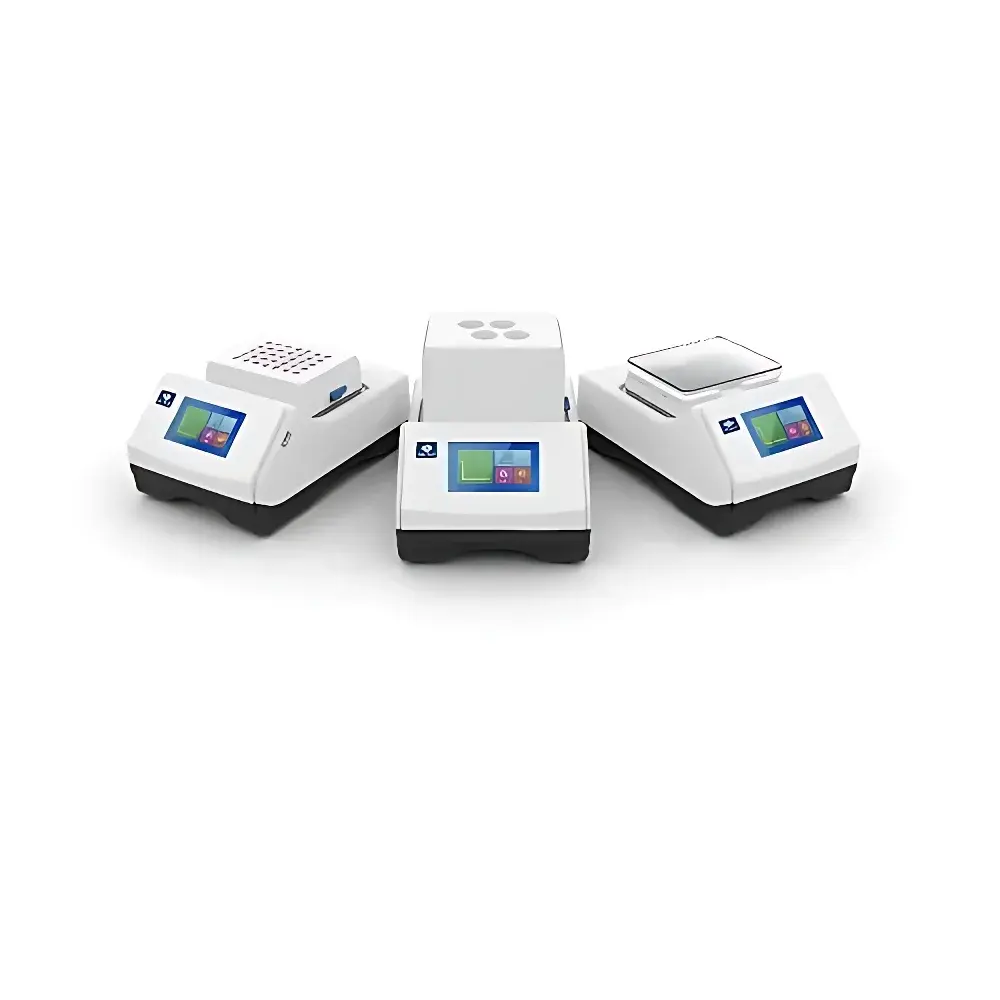
Bioer MB-202 Thermo Shaker Metal Block Heater
| Brand | Bioer |
|---|---|
| Origin | Zhejiang, China |
| Model | MB-202 |
| Temperature Range | 0°C to 100°C (0.1°C resolution) |
| Temperature Accuracy | ≤ ±0.5°C (15°C–100°C) |
| Temperature Uniformity | ≤ ±0.5°C (20°C–45°C) |
| Shaking Speed | 300–3000 rpm |
| Orbital Amplitude | 3 mm |
| Timer Range | 1 s to 99 h 59 min |
| Power Input | 100–240 V AC, 50/60 Hz, 180 W |
| Dimensions (L×H×W) | 310 × 210 × 145 mm |
| Net Weight | 5.9 kg (host only) |
| Standard Blocks | A (384-well), B (96×0.2 mL skirted/unskirted), C (54×0.5 mL), D (35×1.5 mL), E (35×2.0 mL), F (12×5.0 mL), G (12×15 mL), H (4×50 mL), J (32×0.2 mL + 20×1.5 mL) |
Overview
The Bioer MB-202 Thermo Shaker Metal Block Heater is an integrated thermal and mechanical agitation platform engineered for precision temperature control and reproducible orbital shaking in life science and clinical laboratories. Unlike conventional dry baths or standalone shakers, the MB-202 employs a solid aluminum heating block with embedded PTC thermistors and PID-controlled feedback loops to deliver rapid thermal equilibration and high spatial uniformity across the entire block surface. Its dual-function architecture enables simultaneous heating, cooling (via ambient dissipation), and programmable shaking—making it suitable for applications requiring strict thermal cycling (e.g., enzyme inactivation, PCR pre-denaturation, serum coagulation) alongside kinetic mixing (e.g., cell lysis, antigen-antibody binding, reagent solubilization). The instrument operates within a validated range of 0°C to 100°C with 0.1°C setpoint resolution and maintains ≤ ±0.5°C accuracy between 15°C and 100°C under steady-state conditions—meeting routine calibration requirements per ISO/IEC 17025 and CLIA-compliant lab workflows.
Key Features
- High-resolution digital temperature control (0.1°C increment) with real-time display and audible alert upon program completion
- Programmable orbital shaking at 300–3000 rpm with fixed 3 mm amplitude—optimized for consistent mixing without splashing or cross-contamination in low-volume tubes
- Multi-zone aluminum block design ensuring ≤ ±0.5°C uniformity across the working surface at physiologically relevant temperatures (20–45°C)
- Universal modular compatibility: Nine interchangeable blocks support formats from 0.2 mL PCR strips to 50 mL conical tubes, including hybrid configurations (e.g., J-block for parallel 0.2 mL and 1.5 mL tube processing)
- Wide-input universal power supply (100–240 V AC, 50/60 Hz) with over-temperature and motor stall protection circuits
- Compact footprint (310 × 210 × 145 mm) and lightweight construction (5.9 kg host) enabling benchtop deployment in biosafety cabinets, cold rooms, or multi-instrument workstations
Sample Compatibility & Compliance
The MB-202 accommodates standard microcentrifuge tubes (0.5–2.0 mL), PCR plates (96- and 384-well), deep-well plates, and larger vessels up to 50 mL via dedicated blocks. All blocks are precision-machined from anodized aluminum to ensure chemical resistance, thermal conductivity consistency, and long-term dimensional stability. The device complies with IEC 61010-1:2010 safety standards for laboratory electrical equipment and meets electromagnetic compatibility (EMC) requirements per EN 61326-1. While not certified for GMP manufacturing environments, its temperature logging capability (via optional external data logger) supports GLP documentation and audit readiness for QC/QA labs performing USP , ISO 15189, or ISO 17025–accredited testing.
Software & Data Management
The MB-202 operates via an intuitive front-panel interface with rotary encoder and LED display—designed for glove-compatible operation and minimal training overhead. It does not include onboard USB or Bluetooth connectivity; however, its timer and temperature parameters are fully repeatable and traceable through manual log entries. For labs requiring electronic records, integration with external temperature dataloggers (e.g., compliant with FDA 21 CFR Part 11 when paired with validated software) is supported via analog output (0–5 V) or relay-triggered event signaling. All operational parameters—including ramp rate, hold time, shake speed, and final cooldown—can be stored as user-defined protocols for procedural standardization across shifts or operators.
Applications
- DNA/RNA thermal denaturation prior to electrophoresis or hybridization assays
- Controlled serum coagulation and clot retraction studies in clinical hematology
- Enzymatic reaction incubation with concurrent mixing (e.g., restriction digests, ligations, phosphorylations)
- Cell suspension homogenization during lysate preparation for protein extraction
- Accelerated solubility testing of small-molecule compounds in pharmaceutical development
- Pre-analytical sample conditioning for immunoassays (ELISA, lateral flow) and molecular diagnostics
- Temperature-cycled bacterial transformation protocols requiring precise heat shock timing
FAQ
Does the MB-202 support active refrigeration below ambient temperature?
No. The unit relies on passive heat dissipation for cooling and cannot achieve sub-ambient temperatures. Its minimum operating setpoint is 0°C.
Can multiple blocks be heated simultaneously?
No. Only one block may be installed and operated at a time due to thermal load constraints and uniformity validation scope.
Is the 384-well block compatible with standard microplate readers?
Yes—the A-block conforms to ANSI/SBS footprint specifications and fits most plate-handling systems without adapter modification.
What maintenance is required for long-term calibration stability?
Annual verification using NIST-traceable thermometry (e.g., calibrated PT100 probe) is recommended. Clean block wells regularly with ethanol or isopropanol to prevent thermal insulating residue buildup.
Are spare blocks and fuses available through Bioer’s international distribution network?
Yes. All standard blocks (A–J), replacement fuses (T3.15A/250V), and service manuals are stocked by authorized Bioer distributors in North America, EMEA, and APAC regions.
Related Products



