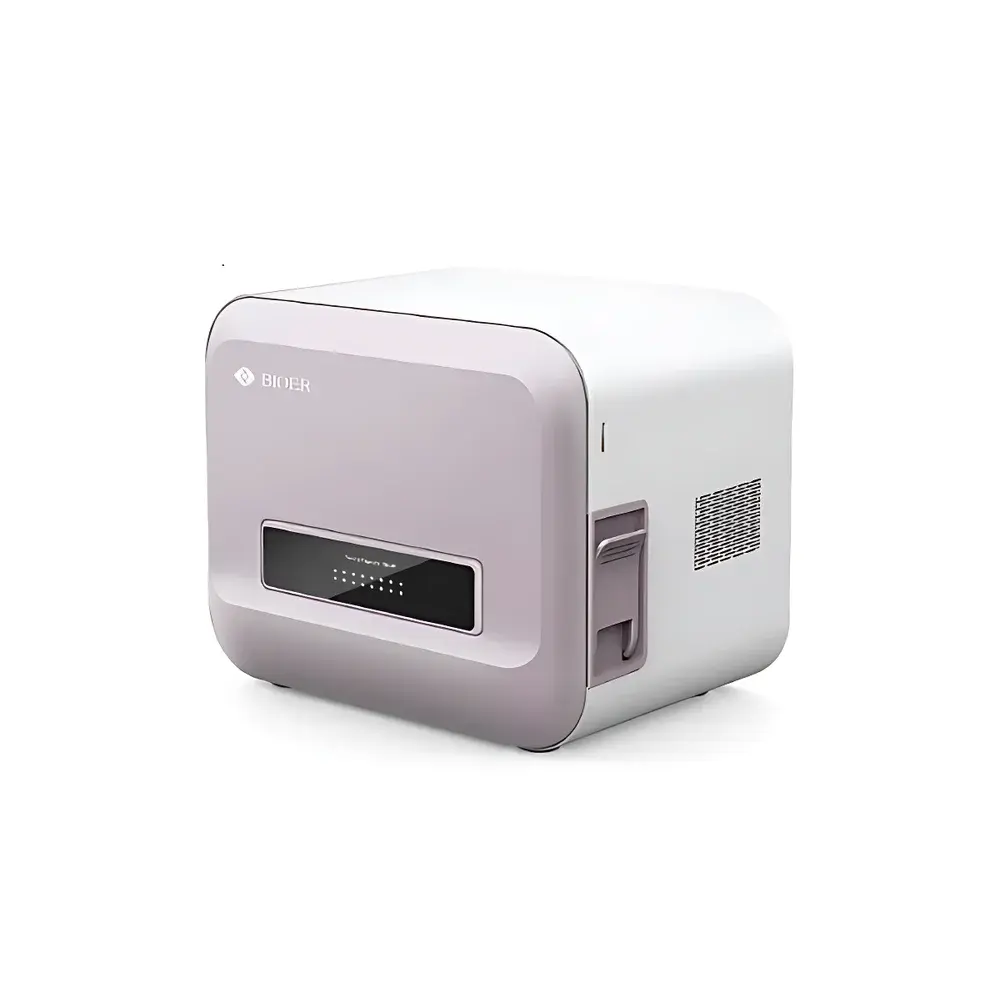
Bioer LineGene Mini Real-Time Fluorescence Quantitative PCR Analyzer
| Brand | Bioer |
|---|---|
| Origin | Zhejiang, China |
| Model | LineGene Mini |
| Instrument Type | Real-Time Fluorescence Quantitative PCR System |
| Sample Capacity | 16 × 0.2 mL tubes (flat, optically transparent caps) or 8 × 0.2 mL tubes (flat, optically transparent caps) |
| Reaction Volume | 10–100 μL |
| Dynamic Range | 1–10¹⁰ copies |
| Temperature Range | 0–100 °C (0.1 °C increment) |
| Temperature Control Accuracy | ≤ ±0.1 °C |
| Max Heating/Cooling Rate | 5 °C/s |
| Thermal Lid Temperature | 30–110 °C (adjustable, default 105 °C) |
| Fluorophore Channels | F1: FAM, SYBR Green I |
| F2 | VIC, HEX, TET, JOE, TAMRA, CY3 |
| F3 | ROX, Texas Red |
| F4 | CY5, Quasar-670 |
| Power Input | DC 24 V, 180 W |
| Dimensions (L×W×H) | 280 × 220 × 240 mm |
| Net Weight | 6.5 kg |
| Safety Features | Short-circuit/open-circuit detection for module/thermal lid/heat sink temperature sensors |
| Interface | USB |
| Preheat Time | None required |
Overview
The Bioer LineGene Mini Real-Time Fluorescence Quantitative PCR Analyzer is a compact, battery-compatible benchtop instrument engineered for high-fidelity nucleic acid quantification under resource-constrained or field-deployable conditions. It operates on the principle of real-time fluorescence detection during polymerase chain reaction amplification, utilizing sequence-specific DNA-binding dyes (e.g., SYBR Green I) or hydrolysis probes (e.g., FAM-, VIC-, CY5-labeled) to monitor amplicon accumulation cycle-by-cycle. Its core architecture integrates a custom Peltier-based thermal control system with top-illumination optical scanning—eliminating cross-well optical crosstalk and enabling precise, low-noise signal acquisition across four independent fluorescence channels. Designed for compliance with fundamental molecular diagnostics requirements, the LineGene Mini supports quantitative applications demanding trace-level sensitivity (detection limit: 1 copy), tight thermal uniformity (±0.1 °C), and rapid thermal ramping (up to 5 °C/s), making it suitable for both routine laboratory use and time-critical field deployment.
Key Features
- Portable form factor (6.5 kg, 280 × 220 × 240 mm) with optional DC24V battery operation for off-grid deployment in veterinary clinics, environmental monitoring sites, disaster response units, and mobile laboratories.
- 16-well sample capacity compatible with standard 0.2 mL flat-cap transparent tubes or 8-tube strips—optimized for low-volume reactions (10–100 μL) without requiring specialized consumables.
- Four-channel excitation/emission detection system supporting widely adopted fluorophores: FAM/SYBR Green I (F1), VIC/HEX/TET/JOE/TAMRA/CY3 (F2), ROX/Texas Red (F3), and CY5/Quasar-670 (F4), enabling multiplexed assays and reference dye normalization.
- Advanced thermal management architecture featuring a customized Peltier module and optimized heat-sink design—achieving ≤ ±0.1 °C temperature accuracy and up to 5 °C/s ramp rates across the full 0–100 °C range (0.1 °C resolution).
- Top-scanning optical path with minimized stray light interference, resulting in enhanced signal-to-noise ratio and reproducible Ct value determination—even at single-copy detection levels.
- No preheat requirement; immediate start-up and stable thermal equilibrium within seconds of initialization.
Sample Compatibility & Compliance
The LineGene Mini accepts standard 0.2 mL PCR tubes with flat, optically clear caps—ensuring compatibility with globally sourced consumables and eliminating proprietary tube lock-in. Its thermal lid (adjustable 30–110 °C, default 105 °C) maintains consistent evaporation control across all wells. The instrument meets essential safety and electromagnetic compatibility standards applicable to Class II medical and laboratory devices. While not certified for IVD use out-of-the-box, its operational parameters align with foundational requirements of ISO 13485 quality systems and support GLP-compliant data generation when integrated into validated workflows. Temperature sensor redundancy (module, lid, heatsink) and real-time fault detection (open/short circuit, overtemperature) satisfy basic risk-mitigation expectations per IEC 61010-1.
Software & Data Management
The analyzer runs Bioer’s native Windows-based analysis software with fully localized Chinese UI—designed for intuitive navigation by technicians without advanced bioinformatics training. Supported analysis modes include qualitative detection, absolute quantification, standard curve construction, melting curve analysis, SNP genotyping, relative quantification (ΔΔCt), and isothermal amplification monitoring. All raw fluorescence data, thermal profiles, and analysis logs are timestamped and exportable in CSV and PDF formats. Audit trail functionality records user actions, parameter changes, and run completion status—facilitating traceability in regulated environments. USB 2.0 interface enables secure offline data transfer; no cloud connectivity or remote access features are implemented, preserving data sovereignty.
Applications
- Rapid pathogen detection in livestock farms, aquaculture facilities, and forest surveillance stations using species-specific qPCR assays.
- Point-of-need clinical triage in field hospitals or humanitarian missions—supporting detection of viral RNA (e.g., influenza, SARS-CoV-2) or bacterial DNA (e.g., Salmonella, Brucella) directly from swab or blood samples.
- Environmental water quality assessment via quantification of fecal indicator organisms (E. coli, Enterococcus) or antibiotic resistance genes (ARGs).
- Academic and teaching labs requiring a cost-effective, robust platform for qPCR method development, assay validation, and student training—without sacrificing analytical performance.
- QC/QA testing in biomanufacturing settings where portable verification of nucleic acid reagent integrity or residual host-cell DNA is required.
FAQ
Does the LineGene Mini support FDA 21 CFR Part 11 compliance?
No—its software does not include electronic signature, role-based access control, or immutable audit logs required for Part 11 enforcement. It is intended for research-use-only (RUO) or non-regulated diagnostic applications.
Can it be used with commercial master mixes and probe-based assays?
Yes—fully compatible with all major third-party qPCR master mixes (e.g., TaqMan, Luna, PowerUp SYBR) and hydrolysis probes, provided fluorophore emission spectra match the configured channel filters.
Is thermal calibration traceable to NIST standards?
Factory calibration is performed using internal reference sensors; external NIST-traceable recalibration is not supported—but users may perform verification using certified thermal reference standards per ISO/IEC 17025 guidelines.
What maintenance is required?
No routine optical alignment or lamp replacement is needed—the solid-state LED excitation source and photodiode detection array have >50,000-hour lifetimes. Cleaning of the optical window and thermal block surface with 70% ethanol is recommended after high-biomass runs.
Is remote monitoring or network connectivity available?
No—data transfer occurs exclusively via USB interface; the device lacks Ethernet, Wi-Fi, or Bluetooth capabilities to ensure data isolation and reduce cybersecurity exposure.