
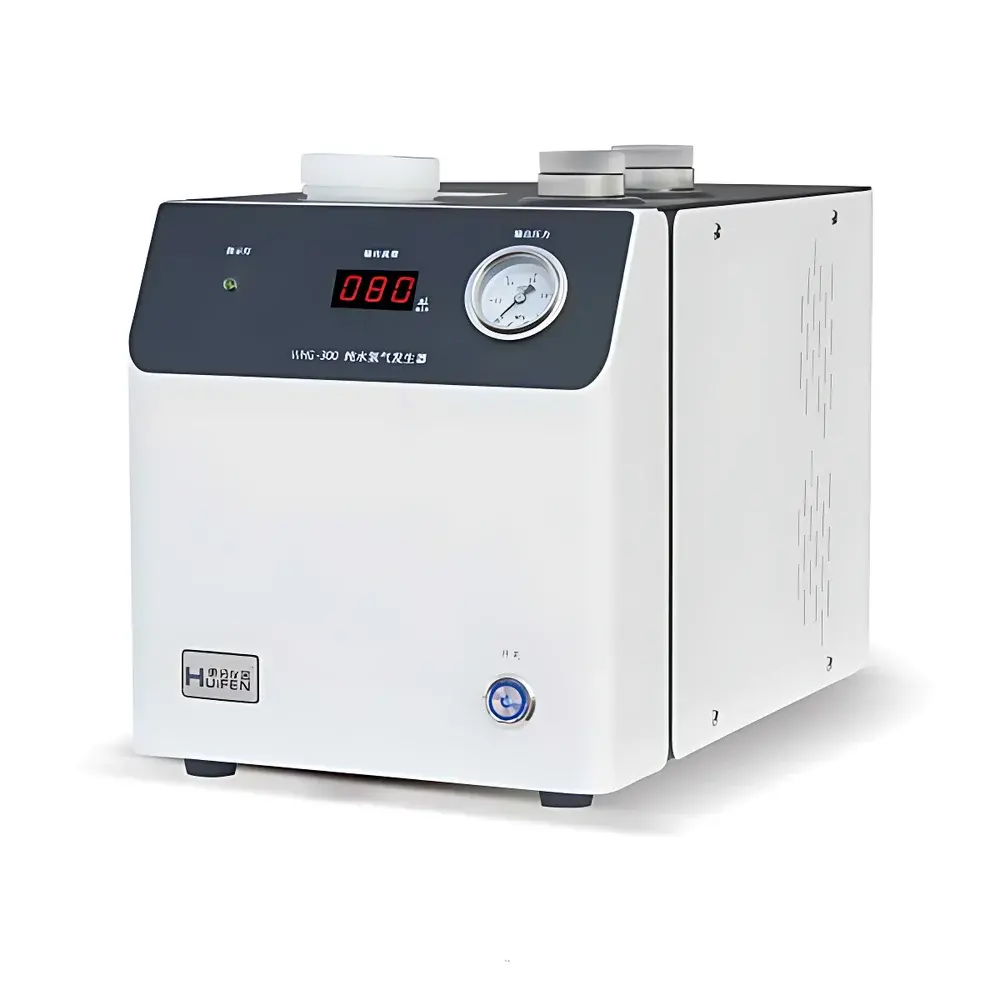
HUIFEN WHG-300 Pure Water Electrolytic Hydrogen Generator
| Brand | HUIFEN Instrument |
|---|---|
| Origin | Shandong, China |
| Model | WHG-300 |
| Hydrogen Generation Principle | Pure Water Electrolysis |
| Output Flow Rate | 0–300 mL/min |
| Output Pressure | ~0.4 MPa |
| Hydrogen Purity | ≥99.999% |
| Dimensions | 235 × 430 × 295 mm |
Overview
The HUIFEN WHG-300 is a compact, benchtop pure water electrolytic hydrogen generator engineered for continuous, on-demand hydrogen supply in analytical laboratories. Unlike traditional alkaline electrolysis systems requiring potassium hydroxide (KOH) electrolyte solutions, the WHG-300 employs deionized water as the sole reactant—eliminating chemical handling, corrosion risks, and residual alkali contamination. Its membrane-based proton exchange electrolysis cell operates at low thermal load, ensuring stable gas output with minimal maintenance. Designed for integration with gas chromatography (GC), hydrogen fuel cells, and catalytic reaction setups, the WHG-300 delivers high-purity hydrogen meeting stringent requirements for trace-level analysis and inert carrier gas applications.
Key Features
- Pure water electrolysis architecture—no KOH or other caustic electrolytes required, reducing operator exposure and system degradation.
- Integrated three-in-one design: water reservoir, electrolysis chamber, and oxygen venting pathway—minimizing footprint and enabling rapid startup (<60 seconds from power-on to stable flow).
- Low-temperature electrolysis cell with optimized thermal management extends membrane and electrode service life beyond 5,000 operational hours under typical lab conditions.
- Anti-backflow protection mechanism prevents liquid carryover into downstream instrumentation—critical for safeguarding GC injectors, detectors, and sensitive sensors.
- Stainless steel and PTFE-wetted components ensure long-term compatibility with ultra-high-purity gas delivery protocols.
- Front-panel digital display shows real-time flow rate, system pressure, and operational status; intuitive single-knob control simplifies user interaction.
Sample Compatibility & Compliance
The WHG-300 is compatible with standard laboratory-grade deionized water (resistivity ≥18.2 MΩ·cm, TOC <5 ppb) and requires no external gas purification modules for most GC carrier gas applications. Hydrogen purity of ≥99.999% meets ASTM D7165–22 specifications for high-resolution gas chromatography and satisfies ISO 8573-1 Class 1 compressed air/gas quality benchmarks when used with appropriate filtration (e.g., optional 0.01 µm particulate + moisture + oxygen scavenger filters). The unit complies with IEC 61010-1:2010 safety standards for electrical equipment in laboratory use and incorporates over-pressure relief and dry-run protection circuits. While not certified to UL or CE for medical or industrial process use, it is routinely deployed in GLP-compliant QC labs where instrument qualification (IQ/OQ/PQ) documentation is maintained per internal SOPs.
Software & Data Management
The WHG-300 operates as a standalone analog-controlled generator without embedded firmware or network connectivity. All operational parameters are monitored via front-panel indicators only—no data logging, remote monitoring, or USB/RS232 interfaces are provided. This architecture prioritizes reliability and electromagnetic compatibility in electrically noisy lab environments. For laboratories requiring audit-ready records, integration with external data acquisition systems (e.g., LabVIEW or custom SCADA) is feasible via optional 4–20 mA analog output (available upon request with factory configuration). No software validation packages or FDA 21 CFR Part 11 compliance features are included; users implementing the WHG-300 in regulated environments must perform their own risk assessment and define appropriate procedural controls for calibration, maintenance, and change management.
Applications
- Carrier gas source for flame ionization detectors (FID) and thermal conductivity detectors (TCD) in GC systems.
- Hydrogen supply for portable hydrogen fuel cells used in field-deployable analytical instruments.
- Reducing atmosphere generation in catalytic testing rigs and material synthesis reactors.
- Calibration gas blending systems requiring high-purity H₂ base gas.
- On-site hydrogen feed for palladium membrane purifiers or metal hydride storage units.
- Research-scale electrochemical studies where alkali-free hydrogen minimizes interference with catalyst surface chemistry.
FAQ
What type of water is required for optimal operation?
Deionized water with resistivity ≥18.2 MΩ·cm and total organic carbon (TOC) <5 ppb is mandatory. Tap water, distilled water, or reverse-osmosis-only water will cause rapid membrane fouling and reduced hydrogen purity.
Can the WHG-300 be connected directly to a gas chromatograph?
Yes—provided the GC manufacturer permits external hydrogen supply and the instrument’s inlet pressure regulation is compatible with the WHG-300’s nominal 0.4 MPa output. A pressure regulator and particulate/moisture filter are strongly recommended upstream of the GC inlet.
Is routine maintenance required?
Yes—water reservoir refills every 3–7 days depending on flow rate and ambient temperature; annual inspection of the electrolysis cell seal integrity and O-rings is advised. No electrolyte replacement or catalyst reconditioning is needed.
Does the unit include hydrogen purity verification capability?
No—purity is verified during factory acceptance testing using gas chromatography with thermal conductivity detection (GC-TCD). End users should conduct periodic purity checks using calibrated gas analyzers if regulatory or method validation requirements apply.
What safety certifications does the WHG-300 hold?
It conforms to IEC 61010-1:2010 for laboratory electrical safety but lacks UL, CSA, or ATEX certification. Installation must comply with local hydrogen ventilation codes and be located in well-ventilated, non-confined areas per NFPA 55 guidelines.



