
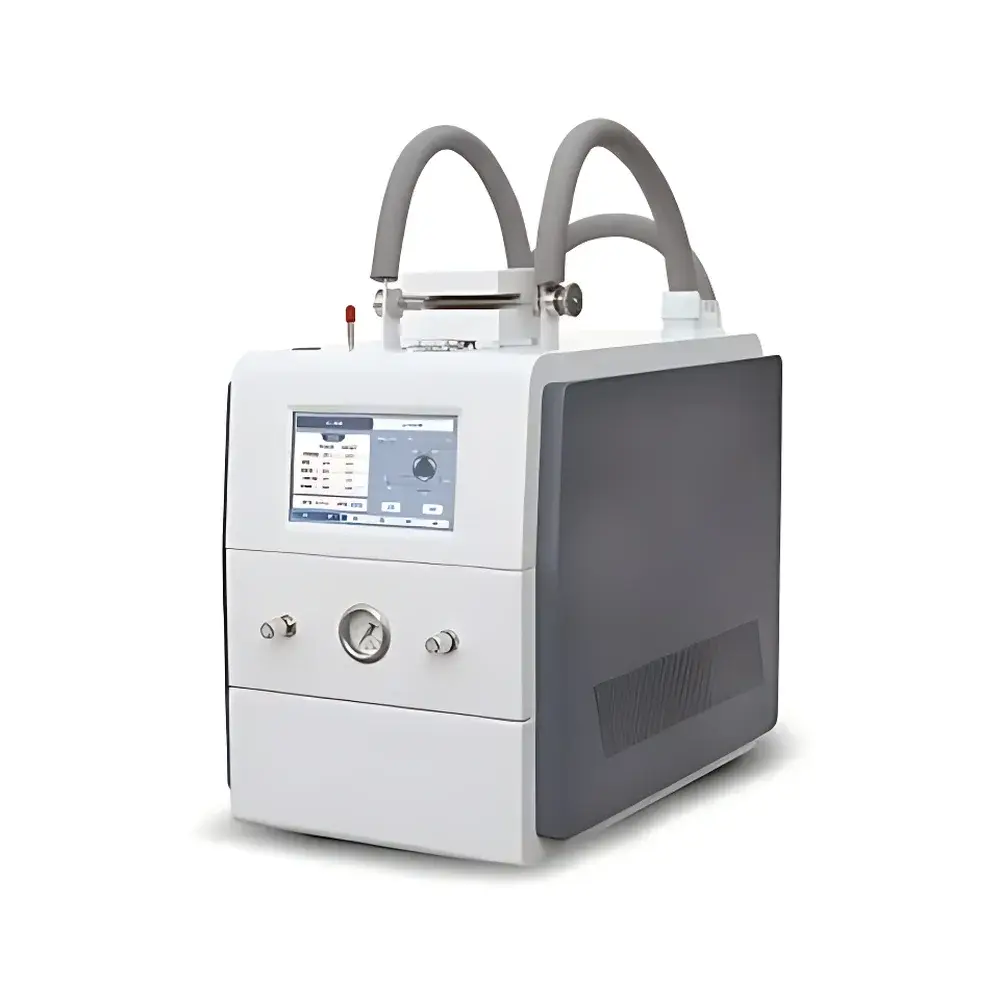
Huifen Instruments TD-09 Dual-Stage Automated Thermal Desorber
| Brand | Huifen Instruments |
|---|---|
| Origin | Shandong, China |
| Model | TD-09 |
| Instrument Type | Laboratory Thermal Desorption Unit for Gas Chromatography |
| Application Scope | General-Purpose Volatile Organic Compound (VOC) and Semi-Volatile Organic Compound (SVOC) Analysis |
| Heating Zones | Four Independently Controlled Zones (Primary Desorption Zone, Valve Oven, Transfer Line, Secondary Desorption Zone) |
| Cooling Method | Electronic Peltier Cooling |
| Automation Level | Full Sequence Automation with GC Synchronization |
| Sample Tube Activation | Integrated Tube Conditioning Protocol |
| Compliance Support | Designed to meet ASTM D6196, ISO 16017-1, and EPA TO-17 requirements for thermal desorption sampling and analysis |
| Software Interface | RS232/USB Communication |
| GC Interface | Universal Needle Port—Mechanically Compatible with All Standard Split/Splitless Inlets (Agilent, Thermo, Shimadzu, PerkinElmer, etc.) |
Overview
The Huifen Instruments TD-09 Dual-Stage Automated Thermal Desorber is a benchtop thermal desorption system engineered for precise, reproducible quantification of volatile and semi-volatile organic compounds (VOCs and SVOCs) from sorbent tubes in compliance with international ambient air, indoor air, and occupational hygiene monitoring standards. It operates on the principle of two-stage thermal desorption: first, analytes are thermally released from the sorbent matrix under controlled inert gas flow (primary desorption); second, the evolved vapors are refocused onto a cryogenically or electronically cooled trap (secondary desorption), followed by rapid flash-heating and transfer into the gas chromatograph (GC) inlet. This dual-stage architecture—combined with Peltier-based cooling—enables sharp, symmetrical peak formation, improved sensitivity (sub-pg detection limits for target VOCs), and enhanced resolution of co-eluting compounds. The system is not a standalone GC but an accessory module designed exclusively for coupling with laboratory gas chromatographs equipped with standard split/splitless inlets.
Key Features
- Four independently programmable heating zones: primary desorption oven (up to 400 °C), GC inlet valve oven (up to 350 °C), heated transfer line (up to 350 °C), and secondary desorption trap oven (up to 400 °C)—each with ±0.5 °C temperature stability.
- Integrated electronic (Peltier) cooling for secondary trap focusing, eliminating reliance on liquid nitrogen or compressed air chillers—reducing operational cost and improving lab safety and footprint efficiency.
- Full sequence automation: one-touch execution of tube conditioning, primary desorption, trap focusing, secondary desorption, GC injection, and post-run trap/inlet purging—all governed by time- and temperature-defined methods.
- Auto-backflush capability for both the transfer line and six-port switching valve, minimizing carryover between samples and extending sorbent tube service life.
- Modular secondary desorption configuration: supports optional ambient-temperature or low-temperature (down to –30 °C) trap modules, enabling method flexibility for high-boiling SVOCs (e.g., PAHs, phthalates) or ultra-trace VOC applications.
- Native synchronization protocols: triggers GC oven ramp start and data acquisition initiation via TTL or contact closure signals; also accepts external start commands from CDS software for audit-ready method integration.
Sample Compatibility & Compliance
The TD-09 accommodates standard 6 mm OD × 89 mm length stainless steel or glass sorbent tubes (e.g., Tenax TA, Carbopack B/C, Carboxen 1000, or multi-bed configurations). It supports both single- and multi-tube batch processing via optional carousel accessories. The system’s thermal profiles, flow control accuracy (<±1 mL/min), and inert flow path (electropolished stainless steel, silco-treated surfaces) ensure adherence to ASTM D6196 (selection of sorbents), ISO 16017-1 (indoor air VOC analysis), and U.S. EPA Method TO-17 (determination of VOCs in air). Its hardware architecture and method storage functionality support GLP-compliant operation when paired with 21 CFR Part 11–enabled CDS platforms.
Software & Data Management
The TD-09 is operated via embedded firmware with a high-resolution LCD touchscreen interface for local method creation, real-time status monitoring (temperature traces, valve actuation logs, elapsed run time), and event-driven diagnostics. All method parameters—including ramp rates, hold times, desorption flows, and cooling setpoints—are stored with timestamped versioning. RS232 and USB interfaces enable bidirectional communication with third-party chromatography data systems. Audit trails—including user login history, method modification records, and run start/stop events—are exportable as CSV for internal QA review or regulatory submission.
Applications
Typical use cases include environmental monitoring (ambient and stack emissions), indoor air quality assessment (formaldehyde, benzene, toluene, xylene), workplace exposure evaluation (OSHA/NIOSH-regulated compounds), polymer off-gassing studies, packaging migration testing, and forensic fire debris analysis. Its compatibility with multi-bed sorbent tubes and programmable secondary trapping makes it suitable for extended carbon number range coverage—from C2 hydrocarbons to C20+ polycyclic aromatic hydrocarbons—without hardware modification.
FAQ
Does the TD-09 require liquid nitrogen or mechanical cryocoolers for secondary trapping?
No. It employs solid-state Peltier cooling capable of achieving trap temperatures down to –30 °C, eliminating consumables and infrastructure dependencies.
Can the TD-09 be integrated into an existing Agilent 8890 GC workflow?
Yes. Its universal needle port and TTL trigger interface are fully compatible with Agilent 8890, 8860, 7890, and 7820 series GCs using standard split/splitless inlets.
Is tube activation performed automatically within the same instrument?
Yes. The built-in tube conditioning protocol executes high-flow purge, multi-step heating, and inert gas stabilization—fully automated without manual intervention.
What level of data integrity assurance does the TD-09 provide for regulated laboratories?
While the TD-09 itself does not embed 21 CFR Part 11 controls, its deterministic I/O signaling, method versioning, and event logging enable full traceability when used with compliant CDS software and documented SOPs.
How is carryover mitigated between sequential analyses?
Via automatic backflush of the transfer line and six-port valve using carrier gas at end-of-run—verified per ASTM D6196 Annex A3 validation guidelines.






