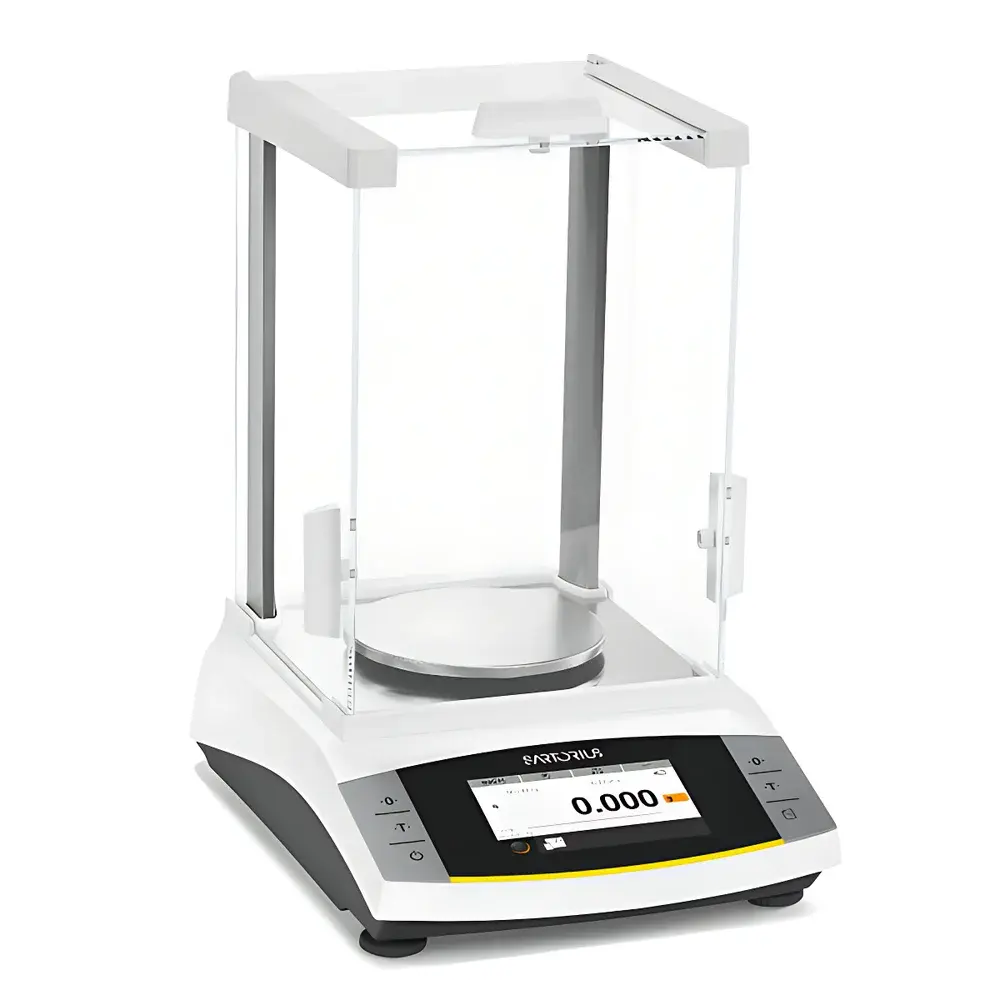
Sartorius BCA323i-1OCN Precision Analytical Balance
| Brand | Sartorius |
|---|---|
| Origin | Shanghai, China |
| Manufacturer Type | Authorized Distributor |
| Product Line | Entris® II BCA Series |
| Model | BCA323i-1OCN |
| Maximum Capacity | 320 g |
| Readability | 1 mg |
| Repeatability | ≤ ±1 mg |
| Calibration | Internal (isoCAL®) |
| Pan Size | Rectangular |
| Compliance | GLP/GMP-compliant data output, ISO/IEC 17025-supportive operation, USP <41> and <1251> compliant weighing performance |
| Connectivity | Dual USB-C, RS-232 (9-pin), optional Ethernet via adapter |
| Display | Graphical touchscreen with LED backlight |
| Languages | 13 built-in (including English, German, French, Spanish, Italian, Portuguese, Russian, Polish, Chinese, Japanese, Korean, Turkish, Hungarian) |
| Security | Multi-level user management (up to 10 users), password protection, CalAuditTrail™ audit trail |
Overview
The Sartorius BCA323i-1OCN is a high-performance precision analytical balance belonging to the Entris® II BCA series—engineered in Germany and manufactured under strict quality control in Shanghai. Designed for laboratories requiring consistent 1 mg readability across a 320 g maximum capacity, this balance employs Sartorius’ proprietary monolithic sensor technology to deliver exceptional stability, reproducibility, and long-term drift resistance. Its operating principle relies on electromagnetic force compensation (EMFC), where the restoring force required to maintain zero deflection of the load receptor is precisely measured and converted into mass value—ensuring traceable, SI-unit–referenced results. The BCA323i-1OCN meets critical regulatory expectations for routine analytical weighing tasks in QC, R&D, and production environments, particularly where adherence to USP , , ISO 9001, and ISO/IEC 17025 is mandated.
Key Features
- Real-time level monitoring with interactive on-screen guidance and audible/visual alerts—eliminates manual bubble-level dependency and ensures optimal measurement geometry at all times.
- Integrated Protection System (IPS) with three configurable validation tiers to enforce data integrity: only weight values meeting preset repeatability and environmental criteria are transmitted externally or logged.
- isoCAL®—fully automated internal calibration and adjustment triggered by time intervals or temperature shifts (±1.5 °C), fully compliant with SOP-driven workflows and reducing operator intervention.
- CalAuditTrail™: tamper-resistant, timestamped digital record of all calibration events—including operator ID, ambient conditions, deviation values, and pass/fail status—exportable as PDF or CSV for FDA 21 CFR Part 11–aligned review.
- Large rectangular weighing pan (180 × 180 mm) and fully removable draft shield with top/side sliding doors accommodate voluminous containers and facilitate ergonomic sample handling.
- Dual USB-C ports enable simultaneous connection to PC (for real-time data streaming via Sartorius LabX® Lite or third-party software) and USB storage devices (for direct export of weight logs, calibration reports, and application outputs).
- Graphical touchscreen interface with LED backlight supports 13 languages—including full East Asian language sets—and features intuitive icon-based navigation, customizable home screen layouts, and tactile feedback for gloved operation.
Sample Compatibility & Compliance
The BCA323i-1OCN is validated for use with standard laboratory samples ranging from fine powders and granules to viscous liquids and small solid components. Its electrostatic-dissipative glass draft shield—coated with a proprietary conductive layer—minimizes static-induced weighing errors common in low-humidity environments. The balance housing utilizes chemically resistant materials: stainless steel load receptor, PBT polymer housing, and tempered glass components—enabling safe exposure to common solvents, acids, and bases without degradation. All firmware and hardware configurations support GLP/GMP documentation requirements, including electronic signatures (via user authentication), audit-trail retention, and exportable metadata that satisfies ISO/IEC 17025 clause 7.7 and EU Annex 11 expectations for instrument qualification.
Software & Data Management
Data output conforms to ASTM E1782 and ISO/IEC 646 standards, with configurable ASCII or CSV formatting over RS-232 or USB-C. The balance natively supports Sartorius’ LabX® Lite software for basic data capture, report generation, and instrument configuration—while full LabX® integration enables centralized fleet management, electronic batch records (EBR), and automated compliance reporting. All 12 built-in applications—including parts counting, percentage weighing, density determination (with optional density kit), animal weighing, statistical analysis, peak hold, checkweighing, and unit conversion—generate GLP-compliant printouts with header metadata (date/time, operator ID, balance ID, calibration status). Data exports include embedded digital signatures and cryptographic hash verification to prevent post-acquisition modification.
Applications
- Pharmaceutical formulation: active pharmaceutical ingredient (API) dispensing, excipient blending, and tablet weight uniformity testing per USP .
- Chemical synthesis: stoichiometric reagent dosing, catalyst loading, and reaction yield quantification.
- Materials science: powder density profiling, coating mass verification, and nanomaterial dispersion quantification.
- Food & beverage QA: nutritional labeling compliance, moisture content determination (paired with halogen moisture analyzer), and portion control validation.
- Academic research: gravimetric titration preparation, standard solution calibration, and micro-scale reaction monitoring.
FAQ
Does the BCA323i-1OCN meet FDA 21 CFR Part 11 requirements for electronic records?
Yes—when used with LabX® software and configured with user authentication, audit trail logging, and electronic signature enforcement, it fulfills predicate rule requirements for closed systems.
Can the balance be integrated into an existing LIMS or MES platform?
Yes—via RS-232 or USB-C using standard ASCII protocols; Sartorius provides documented communication drivers and protocol specifications for seamless middleware integration.
What is the recommended recalibration frequency under ISO/IEC 17025?
Calibration interval must be risk-assessed per Clause 6.5.2; isoCAL® ensures continuous traceability between formal external calibrations, which are typically scheduled annually or after relocation/impact events.
Is the draft shield certified for Class II biological safety cabinet compatibility?
The removable design and low-profile footprint allow safe installation inside most Class II A2 cabinets; however, airflow interference testing is recommended per NSF/ANSI 49 prior to operational deployment.
How does the Integrated Protection System (IPS) validate weighing data before transmission?
IPS evaluates three parameters in real time: stability (±0.5 mg over 3 s), environmental fluctuation (temperature/humidity drift), and mechanical disturbance (vibration detection)—only values passing all thresholds are released to external systems.