
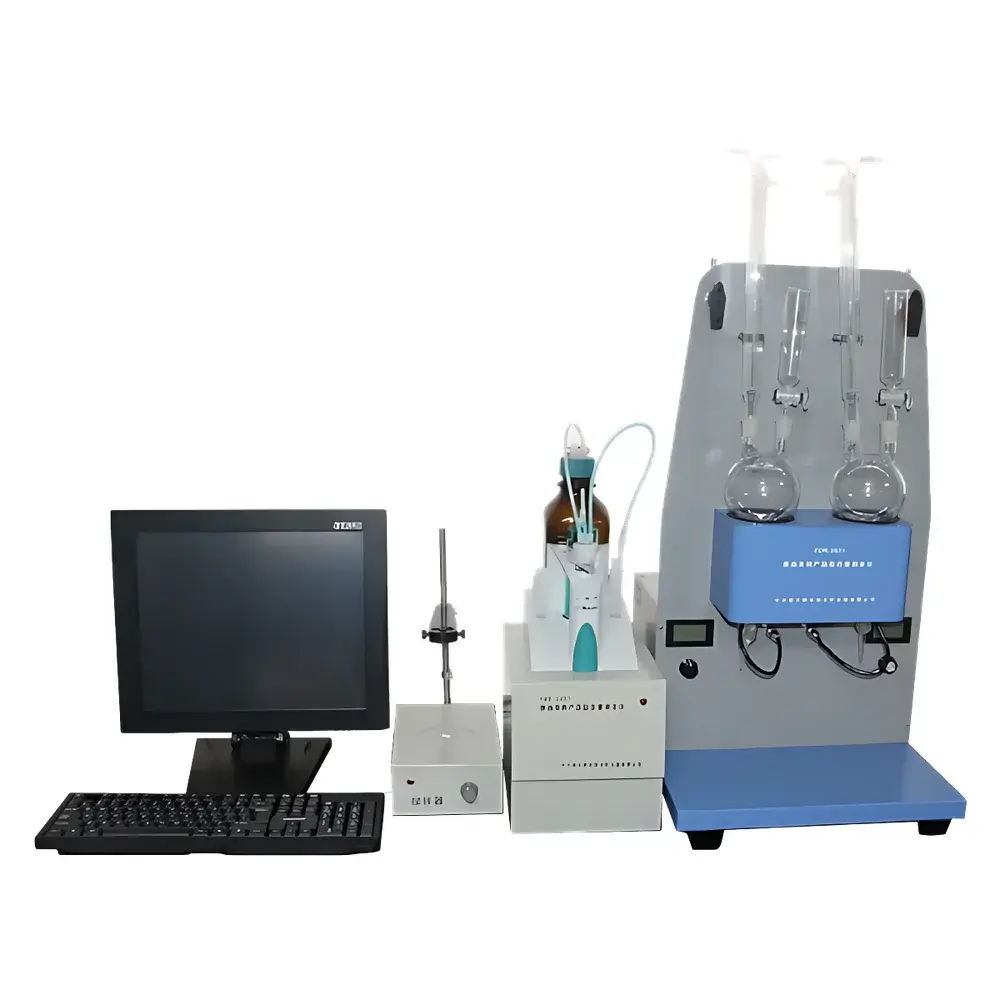
FDR-2601 Salt Content Analyzer for Crude Oil and Petroleum Products
| Brand | CSFriend |
|---|---|
| Origin | Hunan, China |
| Model | FDR-2601 |
| Temperature Control | 60 ± 1 °C |
| Measurement Principle | Potentiometric Titration |
| pH Range | 0.00–14.00 pH |
| mV Range | −1800.0 to +1800.0 mV |
| Temperature Range | −5.0 to 105.0 °C |
| pH Resolution | 0.01 pH |
| mV Resolution | 0.1 mV |
| Temperature Resolution | 0.1 °C |
| pH Accuracy | ±0.01 pH ± 1 digit |
| mV Accuracy | ±0.03 % FS |
| Temperature Accuracy | ±0.3 °C ± 1 digit |
| Burette Capacity Tolerance | ±0.025 mL (10 mL), ±0.035 mL (20 mL) |
| Burette Resolution | 1/10000 (10 mL), 2/10000 (20 mL) |
| Titration Repeatability | 0.2 % |
| Endpoint Detection Sensitivity | ±2 mV |
| Drift Stability | (±0.3 mV ± 1 digit) / 3 h |
| Power Supply | AC 220 ± 22 V, 50 ± 1 Hz |
| Dimensions (W×D×H) | 340 × 400 × 400 mm |
| Weight | 10 kg |
Overview
The FDR-2601 Salt Content Analyzer is a dedicated potentiometric titration system engineered for the precise quantification of inorganic chloride salts—primarily sodium chloride (NaCl)—in crude oil, fuel oils, distillates, and other petroleum-based feedstocks and finished products. It operates on the ASTM D6470 and GB/T 6532 standard methodologies, wherein soluble salts are extracted into an aqueous phase using a polar solvent mixture (e.g., isopropanol/water), followed by automated potentiometric titration with standardized silver nitrate (AgNO₃) solution. The endpoint is determined by a sharp inflection in the potential curve (E-V), detected via a dual-reference silver/silver sulfide indicator electrode and reference electrode pair. Designed for routine QC laboratories in refineries, third-party testing facilities, and upstream petrochemical R&D centers, the FDR-2601 delivers trace-level salt measurement capability (reported as mg NaCl/L or ppm w/w) with high reproducibility and minimal operator dependency.
Key Features
- Integrated extraction-titration architecture: Combines sample heating, solvent extraction, and electrochemical titration in a single instrument platform—eliminating manual transfer steps and reducing contamination risk.
- Precise temperature control: Digital PID controller maintains extraction bath temperature at 60 ± 1 °C, conforming to ASTM D6470 thermal conditioning requirements for optimal salt solubilization and phase separation.
- Adjustable heating voltage: Enables fine-tuned thermal management across diverse sample viscosities and volatility profiles without overheating sensitive fractions.
- Dedicated Windows-based software: Chinese-language GUI supports mouse/keyboard operation, real-time visualization of E-V curves, first-derivative (dE/dV) plots, electrode potential (E), delivered titrant volume (V), and final salt concentration results.
- Intelligent endpoint detection: Automatic recognition of titration endpoints using dynamic slope thresholding and second-derivative validation—ensuring robustness against noisy signals or slow-reacting matrices.
- Multi-mode titration protocols: Preloaded routines include pre-titration, preset-endpoint titration, blank correction, manual override, and user-defined method creation—supporting method validation, calibration verification, and matrix-specific optimization.
- Automated fluid handling: Integrated peristaltic pumps perform automatic electrode rinsing, titrant replenishment, and fixed-volume reagent dispensing—reducing carryover and improving inter-run consistency.
Sample Compatibility & Compliance
The FDR-2601 accommodates liquid petroleum samples ranging from light naphthas to heavy residual fuels, provided they are miscible with the extraction solvent system and yield a stable aqueous extract phase. It complies with core industry standards including ASTM D6470 (“Standard Test Method for Salt Content in Crude Oil by Potentiometric Titration”), GB/T 6532–2012 (“Petroleum Products — Determination of Salt Content in Crude Oil”), and ISO 6297 (referenced for marine fuel specifications). Instrument performance meets Class 0.05 accuracy per JJG 1046–2008 (Chinese metrological verification regulation for potentiometric titrators). All data acquisition, method storage, and result reporting support audit-ready documentation suitable for GLP-compliant environments; optional software upgrades can enable electronic signature and 21 CFR Part 11–compliant audit trails.
Software & Data Management
The embedded control software provides full method lifecycle management: method creation, parameter configuration (e.g., stirring speed, delay times, endpoint sensitivity), calibration curve registration (for multi-point standardization), and batch report generation. Raw sensor data—including timestamped potential readings, titrant volume increments, and derivative calculations—is stored in structured CSV format for external statistical analysis. Export functions support PDF reports with embedded chromatogram-style E-V plots, numeric summaries, and operator ID metadata. Data integrity safeguards include password-protected method editing, immutable result logs, and configurable auto-backup intervals to network drives or USB media.
Applications
- Crude oil custody transfer testing to verify salt content prior to desalting unit feed.
- Monitoring salt accumulation in atmospheric/vacuum distillation overhead systems.
- Quality control of marine distillate fuels (ISO 8217 DMA/DMB) and bunker fuels.
- Refinery process troubleshooting—correlating salt levels with corrosion incidents in overhead condensers or heat exchangers.
- Research into demulsifier efficacy and water-cut optimization in produced water treatment workflows.
- Regulatory compliance reporting for EPA, IMO, or national petroleum product specifications.
FAQ
What extraction solvent is recommended for use with the FDR-2601?
Isopropanol/water (80:20 v/v) is the standard solvent system specified in ASTM D6470. Alternative mixtures may be validated per laboratory SOP but require re-optimization of extraction time and temperature.
Can the FDR-2601 measure total halides or only chloride?
It is calibrated and validated for chloride ion (Cl⁻) quantification. While bromide and iodide also react with Ag⁺, their presence introduces positive bias; interference assessment is required if non-chloride halides are suspected.
Is the instrument compatible with LIMS integration?
Yes—via TCP/IP or RS-232 serial interface, the FDR-2601 supports ASCII-based data export for direct ingestion into most LIMS platforms using configurable delimiter and field-mapping templates.
How often does the silver/silver sulfide electrode require recalibration?
Electrode calibration is recommended before each analytical batch using standard NaCl solutions (e.g., 10, 50, and 100 mg/L); drift verification every 2 hours during extended operation is advised.
Does the system support ASTM D3229 for organic chloride determination?
No—the FDR-2601 is designed exclusively for inorganic salt (water-soluble chloride) analysis per D6470. Organic chloride requires oxidative combustion (e.g., ASTM D3229 or D4294) and is outside its operational scope.





