
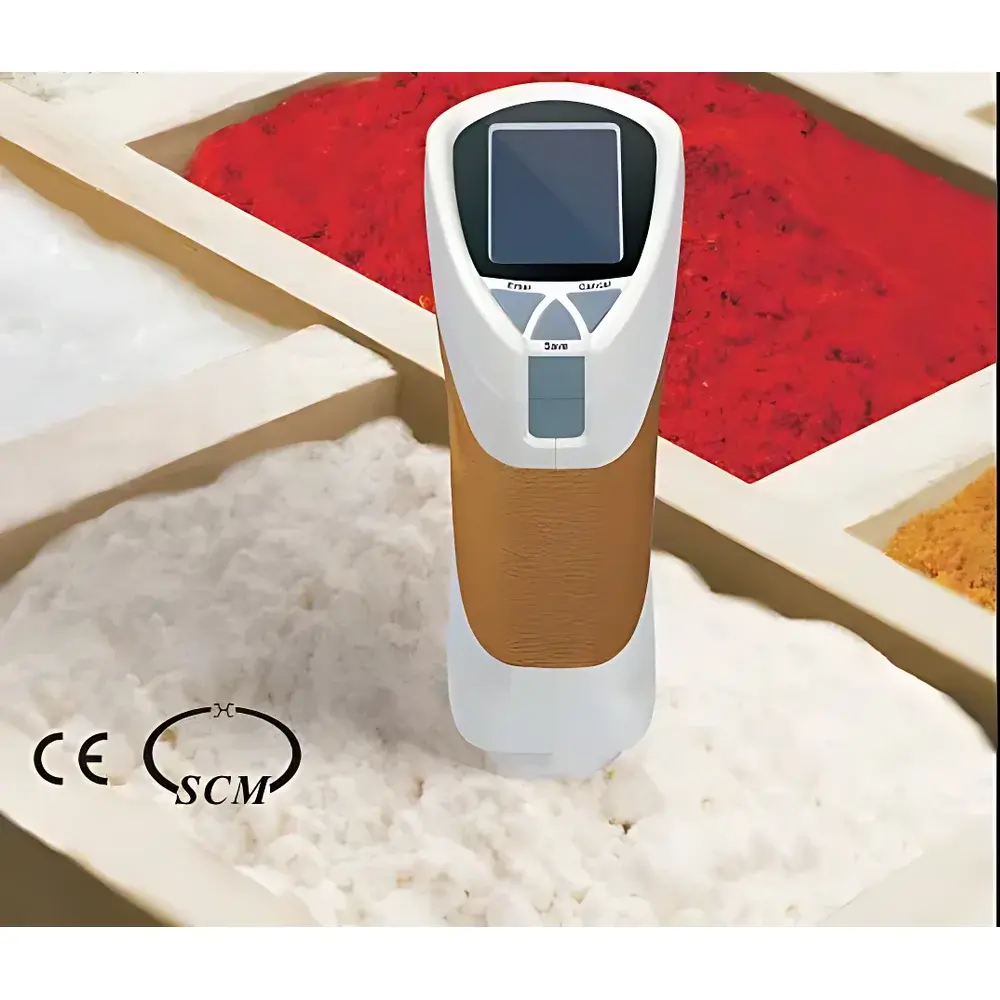
Fangyuan Instruments CS-220 Professional Color Difference Meter
| Brand | Fangyuan Instruments |
|---|---|
| Origin | Shenzhen, China |
| Manufacturer Type | Authorized Distributor |
| Product Type | Spectrophotometric Colorimeter |
| Instrument Form Factor | Portable |
| Optical Geometry | d/8° Integrating Sphere |
| Illumination/Viewing Condition | 8°/d (8° illumination / diffuse viewing), with Specular Component Included (SCI) |
| Spectral Range | L*: 1–100 |
| Repeatability | ΔE*ab standard deviation ≤ 0.08 (measured 30 times on white calibration tile) |
Overview
The Fangyuan Instruments CS-220 Professional Color Difference Meter is a portable, spectrophotometric color measurement instrument engineered for precision, traceability, and operational robustness in industrial quality control environments. It operates on the CIE 1976 L*a*b* color space and employs a d/8° integrating sphere optical geometry with SCI (Specular Component Included) mode—ensuring consistent measurement of both matte and glossy surfaces without geometric bias. The device conforms to ISO 7724-1, CIE No. 15, and ASTM D2244 standards for colorimetric evaluation, supporting compliance-critical workflows in paint, plastics, textiles, coatings, and food packaging industries. Its spectral response covers the visible range (typically 400–700 nm, interpolated at 10 nm intervals), enabling accurate calculation of chromaticity coordinates, whiteness (CIE Whiteness, Ganz Whiteness), yellowness (ASTM E313), and color difference metrics including ΔE*ab, ΔE*00, and ΔL*a*b*. Designed for routine use in production labs and field inspections, the CS-220 delivers metrological reliability backed by national calibration certification (CNAS-accredited verification available upon request).
Key Features
- Portable form factor with ergonomic handheld design for extended operator comfort during high-volume sampling
- d/8° integrating sphere optics with dual-mode capability (SCI/SCE switchable via firmware—SCE mode enabled through software configuration)
- Integrated CMOS imaging sensor for real-time sample framing and targeted measurement area selection
- High-stability LED-based illumination system with thermal drift compensation, ensuring consistent spectral output across ambient temperature fluctuations (15–30 °C operating range)
- On-device display with 0.01-unit resolution for L*, a*, b*, ΔE, and derived indices (Whiteness/Yellowness)
- Internal memory capacity supporting ≥2,000 measurement records with timestamp, operator ID, and batch metadata tagging
- Dual connectivity: USB 2.0 for direct PC synchronization and Bluetooth 4.2 LE for wireless data transfer to local networks or mobile applications
- Calibration traceability supported via factory-provided white/black ceramic tiles; user-performed recalibration validated against NIST-traceable reference standards
Sample Compatibility & Compliance
The CS-220 accommodates diverse physical sample types—including flat solids, curved surfaces, powders, pastes, gels, and translucent films—via adjustable aperture masking and pressure-controlled contact measurement head. Its 8 mm measuring port and uniform illumination profile minimize edge effects and spatial non-uniformity errors. All measurements adhere to GLP-aligned data integrity principles: each record includes audit trail metadata (date/time, calibration status, operator code, instrument serial number). The device supports IQ/OQ documentation packages for regulated environments and aligns with FDA 21 CFR Part 11 requirements when used with validated PC software (Fangyuan ColorLink v3.2+), which enforces electronic signature, role-based access control, and immutable data archiving.
Software & Data Management
Fangyuan ColorLink software (Windows/macOS compatible) provides full spectral data export (CSV, XML, CxF/XRGA), statistical process control (SPC) charting, tolerance zone mapping (ellipsoidal or rectangular ΔE limits), and multi-instrument fleet management. Raw reflectance spectra (31-point or interpolated 10 nm steps) are accessible for third-party analysis. The software maintains version-controlled method templates (e.g., “Paint Batch QC”, “Textile Shade Matching”) and supports automated report generation compliant with ISO/IEC 17025 reporting clauses. Audit logs record all user actions—including parameter edits, calibration events, and data exports—with SHA-256 hashing for tamper detection.
Applications
- Color formulation validation and batch-to-batch consistency verification in automotive OEM supply chains
- Whiteness/yellowness trending for paper, detergent, and pharmaceutical excipient manufacturing
- QC release testing of plastic injection-molded parts under varying lighting conditions (D65, A, F2)
- Supplier color approval workflows with digital master standard sharing and delta-Lab comparison
- In-line color monitoring integration via RS-232/Modbus TCP gateway (optional hardware module)
- Educational laboratories for teaching CIE color theory, metamerism, and instrumental colorimetry fundamentals
FAQ
Does the CS-220 support CIEDE2000 (ΔE₀₀) calculations?
Yes—firmware v2.4 and later include CIEDE2000, CMC(l:c), and BFD(2:1) color difference algorithms alongside standard ΔE*ab.
Can it measure textured or irregular surfaces reliably?
With proper contact pressure and aperture alignment, the CS-220 achieves repeatable results on moderately textured surfaces; for highly structured topographies, averaging ≥5 readings per location is recommended.
Is spectral data export available for advanced analysis?
Yes—ColorLink software exports full 31-channel reflectance spectra and allows interpolation to 10 nm resolution for compatibility with MATLAB, Python (scikit-optimize), or industry-specific spectral modeling tools.
What calibration standards are required for ISO 9001-compliant use?
NIST-traceable white and black ceramic tiles (certified reflectance values ±0.2% absolute) are required for initial qualification; annual verification against accredited reference materials is advised.
How is data security managed during Bluetooth transmission?
All BLE communication uses AES-128 encryption; pairing requires manual confirmation on both device and host, and no credentials are stored on the meter’s embedded memory.





