
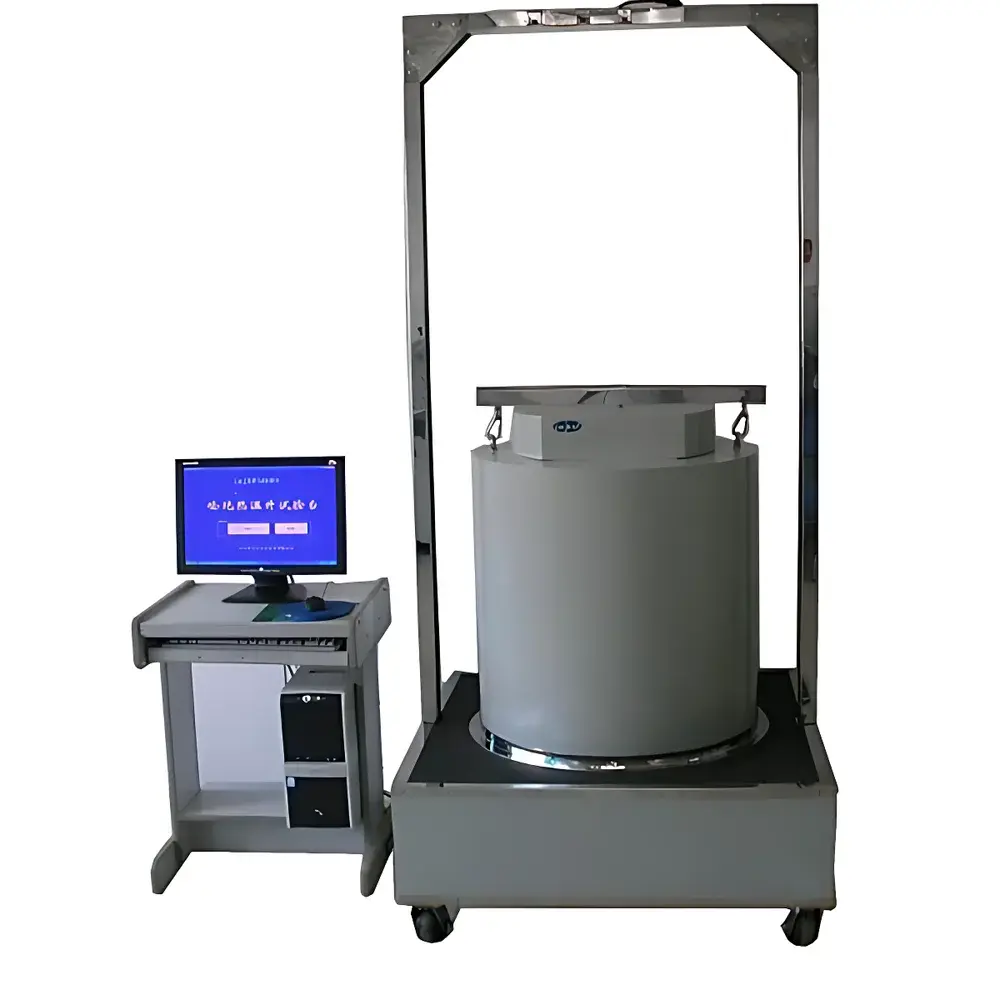
ZHENHUAFENXI JRWS-06A-50L Automated Adiabatic Temperature Rise Tester for Concrete
| Brand | ZHENHUAFENXI |
|---|---|
| Origin | Hunan, China |
| Model | JRWS-06A-50L |
| Temperature Control Range | 5–95 °C |
| Temperature Resolution | 0.01 °C |
| Temperature Tracking Accuracy | ≤ ±0.05 °C |
| Adiabatic Vessel Capacity | 50 L |
| Vessel Material | Stainless Steel |
| Internal Water Bath Stability | ≤ ±1 °C |
| Cooling Method | Compressed Air (Cooling Power < 1.5 kW) |
| Electrical Supply | 220 V / 50 Hz / Adjustable Power up to 4 kW |
| Compliance | GB/T 50080–2016, DL/T 5150–2001, SL 3562–2006, DL/T 536–2006 |
Overview
The ZHENHUAFENXI JRWS-06A-50L Automated Adiabatic Temperature Rise Tester is a precision-engineered system designed to quantify the adiabatic temperature rise of fresh and early-age concrete under near-zero heat exchange conditions. This measurement is critical for predicting thermal cracking risk in mass concrete structures—such as dams, bridge piers, nuclear containment walls, and foundation slabs—where exothermic hydration reactions generate significant internal heat. The instrument operates on the principle of active adiabatic control: a high-stability water bath surrounding a stainless-steel test vessel continuously adjusts its temperature to match the real-time thermal output of the concrete specimen, thereby minimizing heat loss or gain across the boundary. This closed-loop thermal tracking enables highly reproducible determination of the complete adiabatic temperature rise curve (ΔTad vs. time), from initial setting through peak hydration (typically 1–7 days), with resolution down to 0.01 °C and tracking accuracy within ±0.05 °C.
Key Features
- Active adiabatic control architecture using PID-regulated water bath with compressed-air cooling and electric heating, ensuring dynamic thermal compensation across the full 5–95 °C operating range.
- 50 L stainless-steel adiabatic vessel engineered for mechanical robustness, corrosion resistance, and minimal thermal inertia—optimized for standard cylindrical specimens (e.g., Ø150 mm × 300 mm) and large-volume mixes.
- Integrated environmental compensation algorithm: the control system autonomously calculates and applies correction factors based on ambient temperature drift and sensor thermal lag, reducing systematic bias in long-duration tests.
- Stable water bath performance with ≤ ±1 °C fluctuation over 72-hour continuous operation, validated per ISO 1920-7 and ASTM C1074 Annex A protocols for adiabatic calorimetry.
- Modular hardware design comprising main test unit, dedicated control cabinet, specimen support frame, and calibrated thermocouple array (Type T, Class 1) pre-installed in the vessel lid.
- Low-power cooling subsystem (<1.5 kW) minimizes facility load while maintaining rapid thermal response during exothermic peaks.
Sample Compatibility & Compliance
The JRWS-06A-50L accommodates standard concrete specimens prepared according to GB/T 50080–2016 (slump, air content, and casting procedures), as well as specialized low-permeability or fiber-reinforced mixes requiring extended monitoring windows. It supports both sealed and vented curing configurations, enabling comparative studies of hydration kinetics under different moisture retention conditions. The system complies with national and industry standards governing thermal property testing of hydraulic cementitious materials—including DL/T 5150–2001 (Hydropower Concrete Test Code), SL 3562–2006 (Water Conservancy Concrete Standard), and DL/T 536–2006 (Asphalt Concrete for Hydraulic Structures). All calibration routines, data logging intervals (configurable from 10 s to 60 min), and report generation adhere to GLP-aligned documentation practices, with audit-ready timestamps and operator ID logging enabled via the host software.
Software & Data Management
The included Windows-based control and analysis software provides full remote operation, real-time curve visualization, and automated compliance reporting. Users define test profiles—including target start temperature, duration, sampling frequency, and pass/fail thresholds for maximum ΔTad or time-to-peak. Raw thermocouple voltages are converted to temperature using NIST-traceable polynomial coefficients; all data are stored in encrypted .csv and PDF formats with embedded metadata (test ID, operator, ambient conditions, calibration certificate IDs). The software supports FDA 21 CFR Part 11-compliant user access levels (administrator, technician, reviewer), electronic signatures, and immutable audit trails. Export modules enable direct integration with LIMS platforms and statistical process control (SPC) dashboards for quality assurance departments managing multi-site concrete supply chains.
Applications
- Prediction of thermal stress development in mass concrete placements for dam construction and offshore foundations.
- Optimization of supplementary cementitious material (SCM) blends—e.g., fly ash, slag, silica fume—to suppress peak adiabatic temperature without compromising early strength.
- Validation of hydration models used in finite element thermal-stress simulations (e.g., ABAQUS, ANSYS).
- Quality control of ready-mix concrete batches prior to delivery, especially for nuclear or infrastructure projects with strict thermal specifications.
- Research into low-heat cements, phase-change admixtures, and internal curing agents under controlled adiabatic conditions.
- Support for durability assessments linked to thermal cracking susceptibility, per ACI 207.2R and fib Model Code 2010 guidelines.
FAQ
What standards does the JRWS-06A-50L explicitly support for calibration and reporting?
The system implements measurement protocols aligned with GB/T 50080–2016, DL/T 5150–2001, SL 3562–2006, and DL/T 536–2006. Calibration certificates reference ISO/IEC 17025-accredited traceability for temperature sensors and data acquisition modules.
Can the instrument operate unattended for multi-day tests?
Yes—fully autonomous operation is supported for up to 168 hours. The system includes power-failure recovery, automatic data backup every 5 minutes, and email/SNMP alerts for out-of-tolerance events.
Is external refrigeration water required?
No. The integrated compressed-air cooling module eliminates dependency on chilled water loops or glycol systems, simplifying installation in field laboratories or temporary site offices.
How is thermal uniformity verified inside the 50 L vessel?
A 9-point thermocouple validation grid (per ASTM E740) is provided with each unit. Users perform quarterly spatial uniformity checks using the supplied mapping routine, with results logged in the software’s calibration history module.
Does the software support batch processing of multiple test records?
Yes—the analysis suite includes batch export, differential curve overlay, and statistical comparison (mean, SD, CV%) across up to 50 concurrent datasets, facilitating mix optimization studies.






