
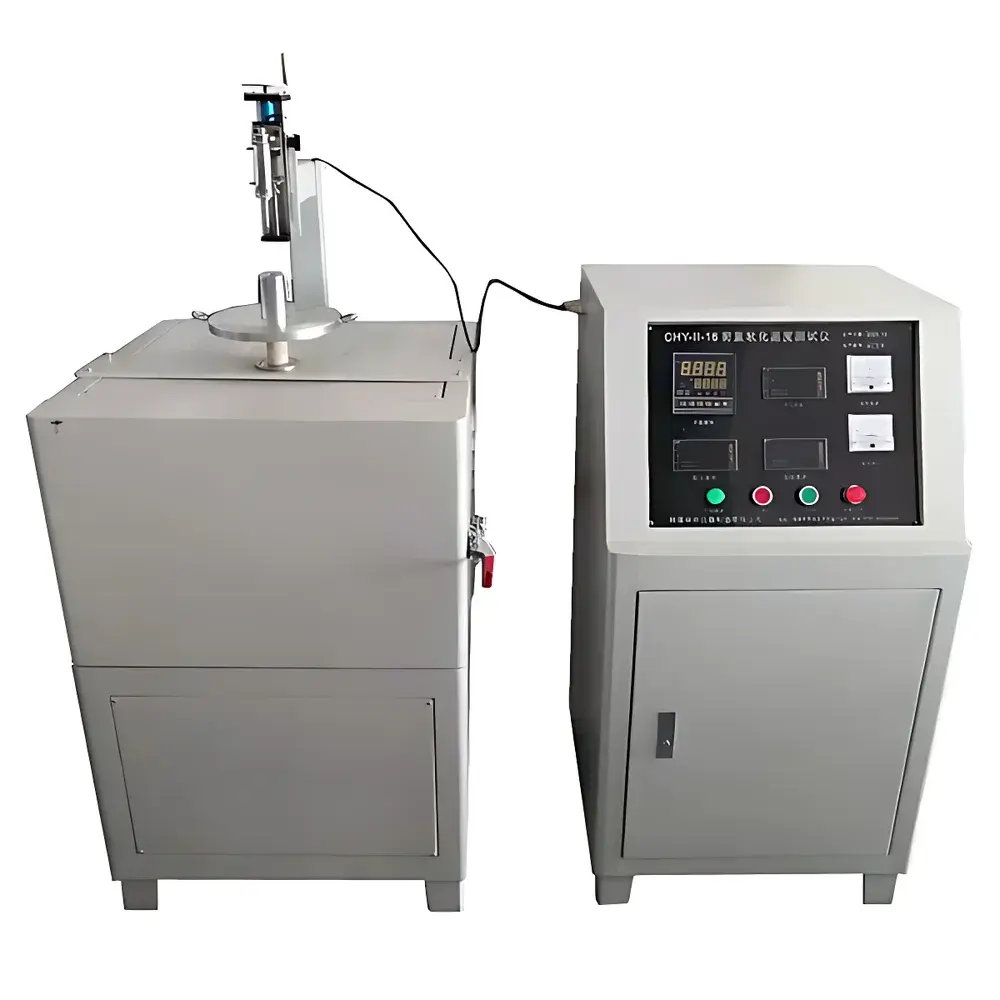
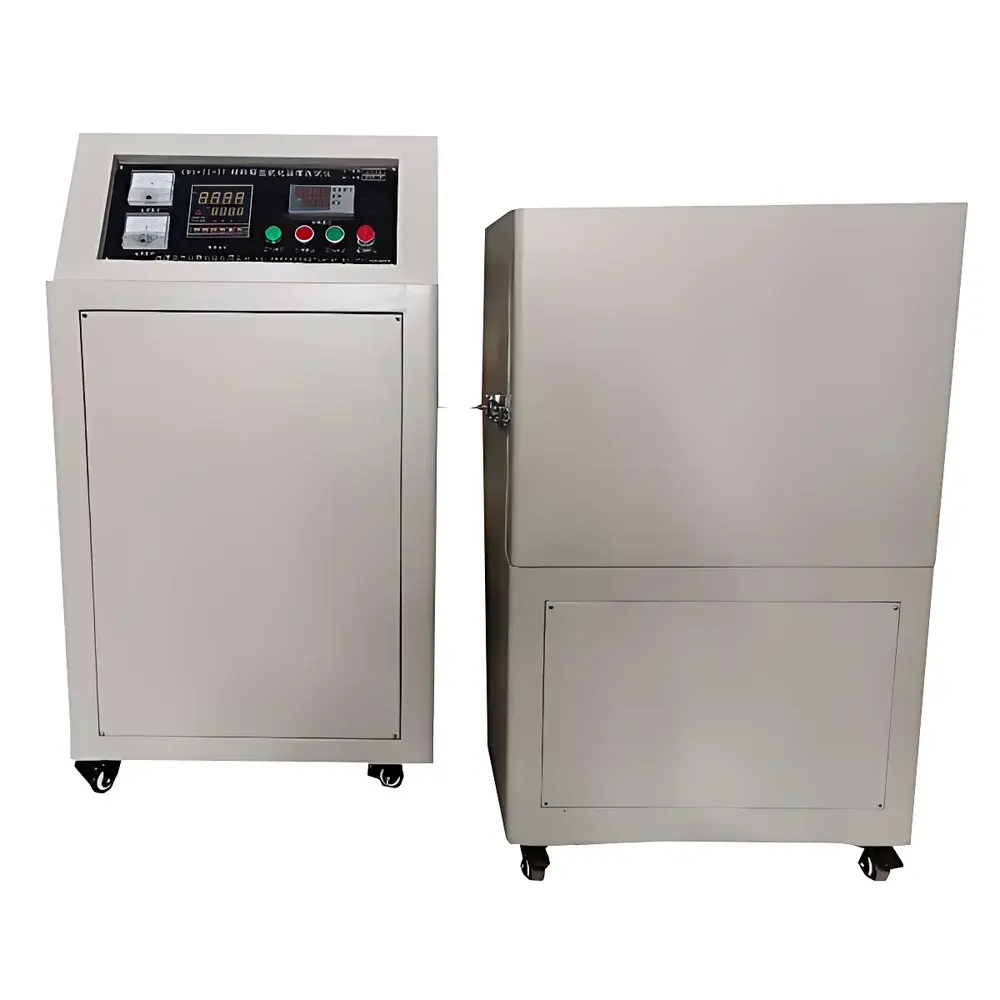
Changsha Hengyu CHY-II-17/16 Load-Softening Temperature Tester for Refractory and Ceramic Materials
| [Origin | Hunan, China |
|---|---|
| Manufacturer Type | Authorized Distributor |
| Origin Category | Domestic (PRC) |
| Model | CHY-II-17/16 |
| Heating Capacity | 1650 °C / 1750 °C (selectable) |
| Max. Operating Temperature | 1600 °C / 1700 °C |
| Temperature Control Accuracy | ±2 °C during ramp |
| Heating Rate | 0–20 °C/min (programmable) |
| Programmable Ramp Segments | ≥30 |
| Deformation Measurement Range | 0–10 mm |
| Deformation Resolution | ≤0.03 mm |
| Specimen Dimensions | 50 ±0.5 mm height × 36 ±0.15 mm or 50 ±0.35 mm diameter |
| Uniform Temperature Zone Height | ≥75 mm (ΔT ≤20 °C) |
| Applied Load Options | 0.1 MPa, 0.2 MPa |
| Load Application Range | 100–1000 N (digital force display, 1 N resolution) |
| Power Rating | 3.5–6 kW |
| Compliance Standards | YB/T 370, GB/T 5989, ISO 1893:1989] |
Overview
The Changsha Hengyu CHY-II-17/16 Load-Softening Temperature Tester is an engineered high-temperature testing system designed to determine the load-softening behavior of refractory ceramics, graphite-based composites, and other inorganic structural materials under simultaneous thermal and mechanical stress. It operates on the principle of controlled uniaxial compression during programmed heating, measuring the onset and progression of plastic deformation—typically defined as the temperature at which a specimen exhibits 0.6% linear deformation under constant compressive load. This parameter is critical for evaluating service limits in furnace linings, kiln furniture, metallurgical crucibles, and high-temperature insulation components. The instrument conforms to standardized non-differential (non-dilatometric) heating methodologies specified in YB/T 370, GB/T 5989, and ISO 1893:1989, ensuring traceability and interlaboratory comparability in quality control and R&D environments.
Key Features
- Two-tier high-temperature capability: Selectable maximum furnace ratings of 1650 °C or 1750 °C, with corresponding stable operating limits of 1600 °C or 1700 °C—validated for long-term thermal stability and repeatability.
- Precision temperature control: Digital PID regulation delivers ±2 °C accuracy across the full heating ramp, supported by calibrated thermocouples (Type S or B) and multi-zone furnace insulation.
- Programmable thermal profiles: ≥30-segment ramp/soak sequences enable complex protocols—including hold steps, rate modulation, and cooling ramps—to simulate real-world thermal cycling conditions.
- High-resolution deformation monitoring: Linear variable differential transformer (LVDT)-based displacement transducer with 0–10 mm range and ≤0.03 mm measurement uncertainty, mounted externally to avoid thermal drift.
- Modular load application system: Independent digital force actuator applies constant compressive loads (0.1 MPa or 0.2 MPa standard; custom options available), with real-time N-scale readout (1 N resolution) and mechanical decoupling from furnace expansion.
- Optimized specimen geometry support: Accommodates two standard cylindrical specimen configurations (50 ±0.5 mm × 36 ±0.15 mm or 50 ±0.5 mm × 50 ±0.35 mm) aligned within a ≥75 mm uniform temperature zone (axial ΔT ≤20 °C).
- Open-frame furnace architecture: Top-hinged, split-shell design allows rapid insertion/removal of upper/lower pressure rods and quick specimen exchange without thermal soak delay.
Sample Compatibility & Compliance
The CHY-II-17/16 is validated for use with dense sintered ceramics (e.g., alumina, silicon carbide, zirconia), carbon-bonded refractories, isotropic graphite, and fused-cast AZS materials. Specimens must be machined to tight dimensional tolerances (height ±0.5 mm, diameter ±0.15–0.35 mm) to ensure uniform stress distribution and minimize eccentric loading artifacts. All test procedures adhere strictly to YB/T 370 (Chinese metallurgical standard), GB/T 5989 (national standard for refractories), and ISO 1893:1989 (international standard for non-differential load-softening tests). Data acquisition and reporting comply with GLP documentation requirements, including timestamped raw deformation vs. temperature curves, annotated load application events, and final softening point determination (T0.6%).
Software & Data Management
Integrated Windows-based control software enables full automation of heating schedules, real-time LVDT and thermocouple data logging (≥10 Hz sampling), and synchronized force monitoring. The interface supports dual-mode operation—manual stepwise control for method development and fully autonomous execution for routine QC batches. Export formats include CSV, Excel-compatible .xlsx, and PDF report generation with embedded calibration certificates, operator ID, environmental conditions, and pass/fail flags against specification limits. Audit trails record all parameter changes, user logins, and report generation events—fully compatible with FDA 21 CFR Part 11 requirements when deployed with electronic signature modules and role-based access controls.
Applications
- Quality assurance of monolithic refractories and shaped firebricks in steelmaking and non-ferrous metallurgy supply chains.
- R&D evaluation of novel ceramic matrix composites (CMCs) for aerospace thermal protection systems.
- Comparative assessment of binder burnout effects on green-body softening behavior in advanced ceramic processing.
- Validation of graphite electrode performance under simulated electric arc furnace (EAF) thermal-mechanical loading.
- Supporting ISO/IEC 17025-accredited testing laboratories requiring documented metrological traceability and uncertainty budgets for T0.6% measurements.
FAQ
What standards does the CHY-II-17/16 formally comply with?
It is manufactured and verified per YB/T 370, GB/T 5989, and ISO 1893:1989 for non-differential load-softening temperature testing.
Can the system perform both differential and non-differential methods?
No—the CHY-II-17/16 implements only the non-differential (constant-heating-rate) method as defined in the referenced standards; dilatometric or differential thermal analysis requires separate instrumentation.
Is calibration traceability provided with the system?
Yes—each unit ships with NIST-traceable calibration certificates for temperature (thermocouple), displacement (LVDT), and force (load cell), valid for 12 months from commissioning.
What maintenance intervals are recommended for sustained accuracy?
Annual recalibration of sensors and verification of furnace uniformity (per ISO/IEC 17025 Annex A.3) are advised; consumables include thermocouple assemblies and alumina pressure rods (typical service life: 50–100 cycles at ≤1600 °C).
Does the software support networked data archiving and LIMS integration?
Yes—via OPC UA or TCP/IP protocol, enabling direct push to enterprise LIMS platforms and centralized SQL database storage with configurable metadata tagging (batch ID, material grade, operator, date/time).



