
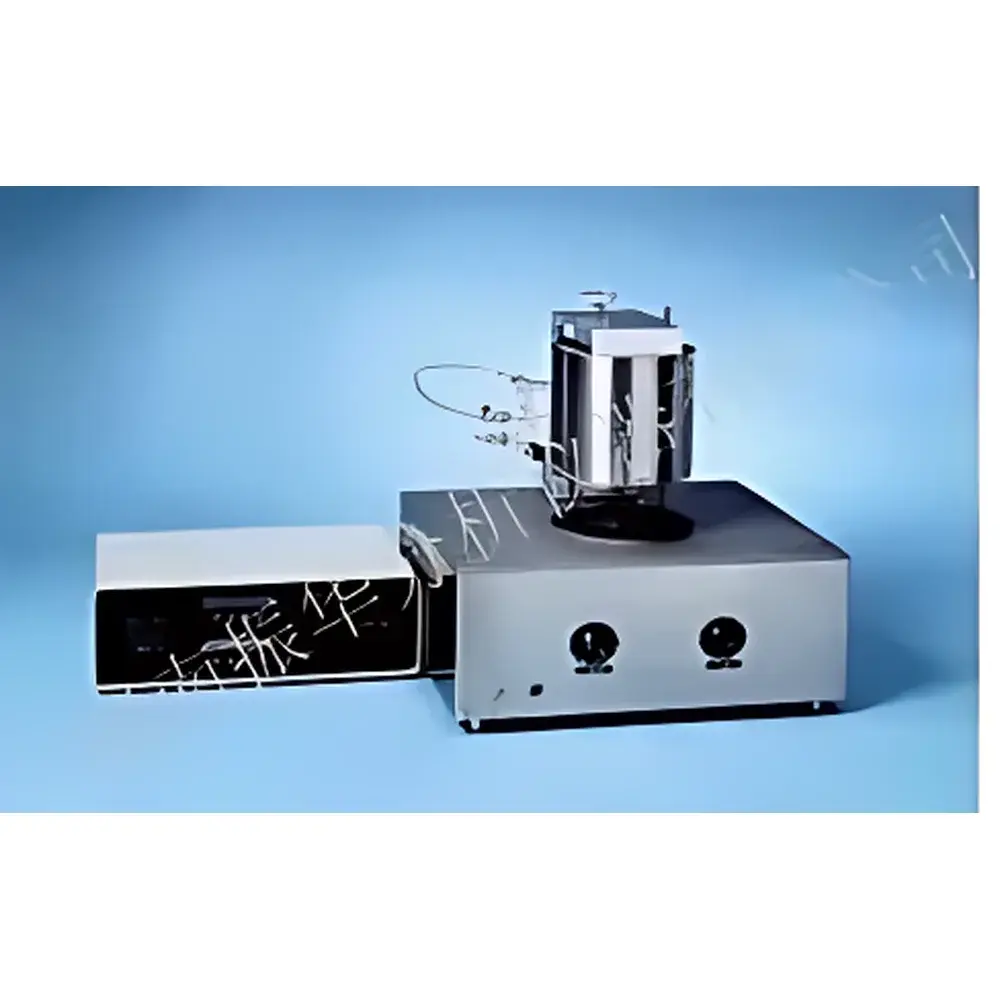
HCX09A Thin-Film Thermal Property Analyzer
| Origin | Hunan, China |
|---|---|
| Manufacturer Type | Authorized Distributor |
| Origin Category | Domestic (PRC) |
| Model | HCX09A |
| Pricing | Available Upon Request |
| Thermal Conductivity Range | 0.05–20 W/(m·K) |
| Temperature Measurement Accuracy | Better Than Class 0.2 |
| Measurement Uncertainty | ±3% |
| Heating Power Control Resolution | ±1% |
| Sample Geometry | Cylindrical, Ø15–30 mm × 5–30 mm |
| Temperature & Atmosphere | Customizable per User Specification |
| Data Acquisition | Fully Automated via PC Interface |
Overview
The HCX09A Thin-Film Thermal Property Analyzer is a precision instrument engineered for the non-destructive, transient characterization of thermal transport properties in freestanding or substrate-supported thin-film materials. It operates on the principle of the temperature wave method—a frequency-domain variant of transient plane source (TPS) and periodic heating techniques—where a sinusoidal or cosinusoidal thermal excitation is applied to one surface of a finite-thickness, one-dimensional sample. Under controlled oscillatory boundary conditions, the phase lag between temperature responses measured at the top and bottom surfaces is directly related to the thermal diffusivity (α) of the film. When combined with independently determined density (ρ) and specific heat capacity (cp), thermal conductivity (λ = α·ρ·cp) is derived rigorously. This approach avoids assumptions inherent in steady-state methods and eliminates contact resistance artifacts common in guarded-hot-plate or laser-flash configurations—critical for nanoscale and microscale films where interfacial thermal resistance dominates bulk conduction.
Key Features
- Frequency-resolved thermal wave analysis optimized for films ranging from sub-10 µm to several hundred micrometers in thickness
- Digital temperature sensing with Class 0.2 accuracy across the operational range (ambient to 300 °C, configurable)
- High-stability programmable heater with ±1% power regulation for precise thermal excitation amplitude control
- Modular furnace chamber enabling customizable temperature profiles and protective atmospheres (N2, Ar, vacuum, or reactive gas options)
- Integrated dual-surface thermocouple or RTD array for synchronous, high-temporal-resolution phase-difference measurement
- Rugged mechanical design accommodating cylindrical samples (Ø15–30 mm × 5–30 mm), including freestanding membranes and supported thin films on low-conductivity substrates
Sample Compatibility & Compliance
The HCX09A supports a broad spectrum of thin-film material systems, including but not limited to: polymer dielectrics (e.g., polyimide, PET), metal films (Cu, Al, NiCr), transition metal dichalcogenides (MoS2, WS2), oxide layers (SiO2, Al2O3, HfO2), and emerging 2D heterostructures. Sample mounting requires minimal preparation—no metallization or coating is needed. The system complies with fundamental metrological principles outlined in ISO 22007-2 (Plastics — Determination of thermal conductivity and thermal diffusivity — Part 2: Transient plane source [hot disc] method) and aligns with ASTM E1461 (Standard Test Method for Thermal Diffusivity of Solids by the Flash Method) in its underlying physics, though it implements a distinct, phase-sensitive methodology appropriate for constrained geometries. For regulated environments, data acquisition logs include time-stamped metadata, user ID, instrument calibration status, and environmental parameters—supporting GLP/GMP traceability when integrated with validated LIMS platforms.
Software & Data Management
The HCX09A is operated via dedicated Windows-based software featuring real-time waveform visualization, automated frequency sweep protocols, and built-in inverse modeling algorithms for simultaneous extraction of thermal diffusivity and effusivity. Raw thermal response data (voltage vs. time) are stored in HDF5 format, ensuring long-term readability and compatibility with MATLAB, Python (NumPy/H5Py), and OriginLab. All measurement sessions generate audit-trail reports compliant with FDA 21 CFR Part 11 requirements—including electronic signatures, change history, and tamper-proof timestamps—when deployed on networked, domain-authenticated workstations. Calibration certificates (traceable to NIM or NIST standards) are embedded within the software and auto-linked to each test record.
Applications
- Thermal interface material (TIM) development for advanced packaging and heterogeneous integration
- Process optimization of ALD/CVD-grown functional oxides in semiconductor manufacturing
- Structure–property correlation studies in flexible electronics and wearable sensors
- Validation of molecular dynamics (MD) simulations predicting cross-plane thermal conductivity in layered van der Waals materials
- Quality assurance of barrier coatings in OLED and thin-film PV encapsulation
- High-throughput screening of thermally stable polymer electrolytes for solid-state batteries
FAQ
What sample thickness range is optimal for accurate phase-difference measurement?
For reliable thermal wave analysis, film thickness should satisfy the condition: d ≈ 0.3–3 × √(α/ω), where d is thickness, α is expected thermal diffusivity, and ω is angular frequency. Typical effective range spans 5 µm to 200 µm; thinner films require higher excitation frequencies (>1 Hz), thicker ones lower frequencies (<0.01 Hz).
Can the HCX09A measure anisotropic thermal conductivity?
No—the current configuration assumes isotropic, homogeneous, one-dimensional conduction perpendicular to the film plane. In-plane anisotropy requires orthogonal sensor alignment and multi-axis excitation, which is outside the scope of this model.
Is vacuum or inert atmosphere operation standard or optional?
Atmosphere control is fully customizable per customer specification; base configuration includes ambient air operation, with vacuum (<10−2 mbar) and gas-purged options available as factory-installed modules.
How is calibration verified during routine use?
Calibration is performed using certified reference materials (e.g., sapphire disks, NIST SRM 736) at three temperatures (25 °C, 100 °C, 200 °C); verification checks are executed before each measurement batch via automated reference-sample routines.
Does the system support unattended overnight testing?
Yes—scheduled multi-frequency sweeps, temperature ramps, and conditional stop criteria (e.g., convergence threshold, max runtime) are fully scriptable and monitored via background service with email/SNMP alerting.



