
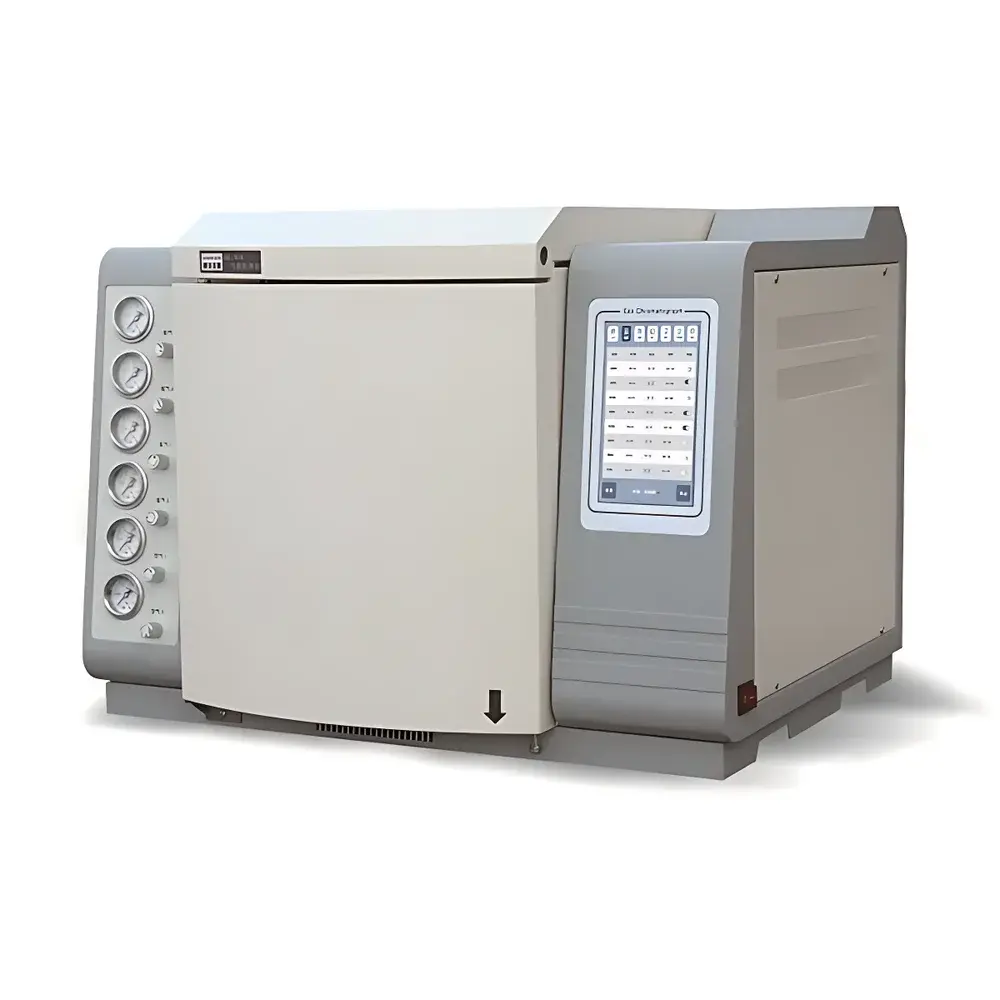
Huifen Instruments GC-7820 Helium Ionization Gas Chromatograph
| Brand | Huifen Instruments |
|---|---|
| Origin | Shandong, China |
| Model | GC-7820 Helium Ionization Gas Chromatograph |
| Instrument Type | Laboratory Gas Chromatograph |
| Application Scope | General-purpose High-Purity Gas Analysis |
| Oven Temperature Range | Ambient + 3°C to 450°C |
| Oven Ramp Rate | 0.1–40°C/min |
| Oven Cool-down | 450°C → 50°C in ~8 min |
| Carrier Gas Flow Range & Control | 0–1200 mL/min |
| Carrier Gas Pressure Range & Control | 0–970 kPa |
| Injector Maximum Operating Temperature | 450°C |
| Injector Pressure Setting Range | 0–970 kPa |
| Injector Total Flow Setting Range | 0–1200 mL/min |
| Detector | Pulsed Discharge Helium Ionization Detector (PDHID) |
| Detection Limit | ≤10 ppb (for CH₄) |
| Baseline Noise | ≤0.05 mV |
| Baseline Drift | ≤0.2 mV/30 min |
| Repeatability | RSD ≤3% |
| Gas Purifier Compatibility | He, Ar, Ne, Kr, Xe (residual impurities ≤10 ppb) |
| Regulatory Compliance | GB/T 16942–2009 through GB/T 28125.1–2011 |
Overview
The Huifen Instruments GC-7820 Helium Ionization Gas Chromatograph is a dedicated high-purity gas analysis platform engineered for trace-level impurity quantification in ultra-high-purity (UHP) industrial gases—including helium, hydrogen, nitrogen, argon, oxygen, and specialty electronic-grade gases. It employs pulsed discharge helium ionization detection (PDHID), a non-destructive, universal detection principle based on electron capture and ionization in a metastable helium plasma. Unlike flame-based or thermal conductivity detectors, PDHID delivers exceptional sensitivity (≤10 ppb for methane), wide linear dynamic range (>10⁵), and uniform response across permanent gases and light hydrocarbons without calibration dependency on compound-specific response factors. The system integrates zero-dead-volume, passivated stainless-steel flow paths; multi-valve, multi-column configurations with heart-cutting and back-flush capabilities; and temperature-programmed separation using both micro-packed and fused-silica capillary columns—enabling baseline resolution of co-eluting species such as O₂/N₂, CO/CH₄, and C₂H₂/C₂H₄ in a single run.
Key Features
- Passivated flow path architecture with electropolished, silanized stainless-steel tubing—minimizing surface adsorption and catalytic decomposition of reactive analytes (e.g., NH₃, PH₃, SiH₄).
- Eight independently programmable temperature zones (oven, up to 4 injectors, detector, purifiers, valves)—each controlled to ±0.01°C stability for reproducible retention time alignment.
- High-speed, pneumatically actuated solenoid valves (10 ms switching, >1 million cycles rated) with purge-gas isolation—preventing ambient air ingress during valve sequencing and ensuring long-term seal integrity.
- Intelligent rear-door airflow modulation enabling rapid oven cooldown (450°C → 50°C in <8 min), reducing cycle time between consecutive UHP gas analyses.
- Full Ethernet (10/100M auto-negotiating) connectivity supporting remote instrument control, real-time data streaming, and audit-trail-enabled method deployment via compliant chromatography data systems (CDS).
- Integrated gas purification modules compatible with He, Ar, Ne, Kr, and Xe—reducing H₂, O₂, N₂, CO, CO₂, CH₄, H₂O, NO, and NH₃ to ≤10 ppb residual levels prior to detection.
Sample Compatibility & Compliance
The GC-7820 is validated for analysis of gaseous matrices defined in Chinese national standards for electronic industrial gases—including GB/T 16942–2009 (hydrogen), GB/T 16943–2009 (helium), GB/T 14604–2009 (oxygen), GB/T 14601–2009 (ammonia), and GB/T 28125.1–2011 (cryogenic process hazard analysis). Its hardware design and operational protocols align with GLP and GMP documentation requirements: all temperature/pressure/flow setpoints are digitally logged with timestamps; method parameters are version-controlled; and raw signal acquisition supports 21 CFR Part 11-compliant electronic signatures when paired with validated CDS software. The system meets ISO/IEC 17025 technical competence criteria for gas purity testing laboratories performing accredited measurements of ppb-level contaminants.
Software & Data Management
Control and data acquisition are executed via a browser-accessible, web-native workstation supporting Windows and Linux clients. The interface provides intuitive sequence setup for multi-sample, multi-method batch runs; real-time monitoring of detector baselines, pressure profiles, and valve status; and automated peak integration using adaptive thresholding and retention time locking. All raw chromatograms, method files, and audit logs are stored in vendor-neutral .CDF format (compatible with OpenLab CDS, Chromeleon, and AIA-standard viewers). Built-in reporting tools generate compliance-ready certificates of analysis (CoA) with embedded metadata—retention times, integration parameters, calibration curves, and uncertainty estimates per ISO/IEC 17025 Annex A.3.
Applications
- Ultra-high-purity helium supply chain verification for semiconductor lithography and cryogenic cooling applications.
- Residual impurity profiling in bulk hydrogen used in fuel cell manufacturing and ammonia synthesis.
- Trace oxygen and moisture monitoring in argon blanketing gas for aluminum welding and titanium sintering.
- Speciation and quantification of hydrocarbon impurities (C₁–C₃) in electronic-grade nitrogen for CVD chamber purging.
- Validation of gas purifier performance in on-site gas generation systems serving flat-panel display fabs.
- Compliance testing of specialty gases (e.g., SiH₄, PH₃, BF₃) against GB/T 15909–2009 and GB/T 14851–1993 specifications.
FAQ
What detection principle does the GC-7820 employ?
It utilizes pulsed discharge helium ionization detection (PDHID), generating a metastable helium plasma that ionizes all compounds except helium carrier gas—providing universal, quantitative response without flame or radioactive sources.
Is the system compatible with regulatory audit requirements?
Yes—when operated with validated CDS software, it supports full 21 CFR Part 11 compliance, including electronic signatures, audit trails, and secure user access controls aligned with FDA and NMPA expectations.
Can the GC-7820 analyze corrosive gases like NH₃ or Cl₂?
Yes—its passivated flow path and optional inert column coatings (e.g., deactivated fused silica) minimize surface reactivity, enabling reliable analysis of NH₃, PH₃, SiH₄, and anhydrous HCl at sub-ppb levels.
What column configurations are supported for complex gas mixtures?
The platform accommodates dual- or triple-column setups with active valve routing—including packed/micro-packed columns for permanent gas separation and capillary columns for hydrocarbon speciation—using center-cut and back-flush techniques.
How is carrier gas purity ensured during analysis?
Integrated, high-capacity gas purifiers remove H₂, O₂, N₂, CO, CO₂, CH₄, H₂O, NO, and NH₃ from helium or argon carrier streams to ≤10 ppb, eliminating baseline interference and detector contamination.






